
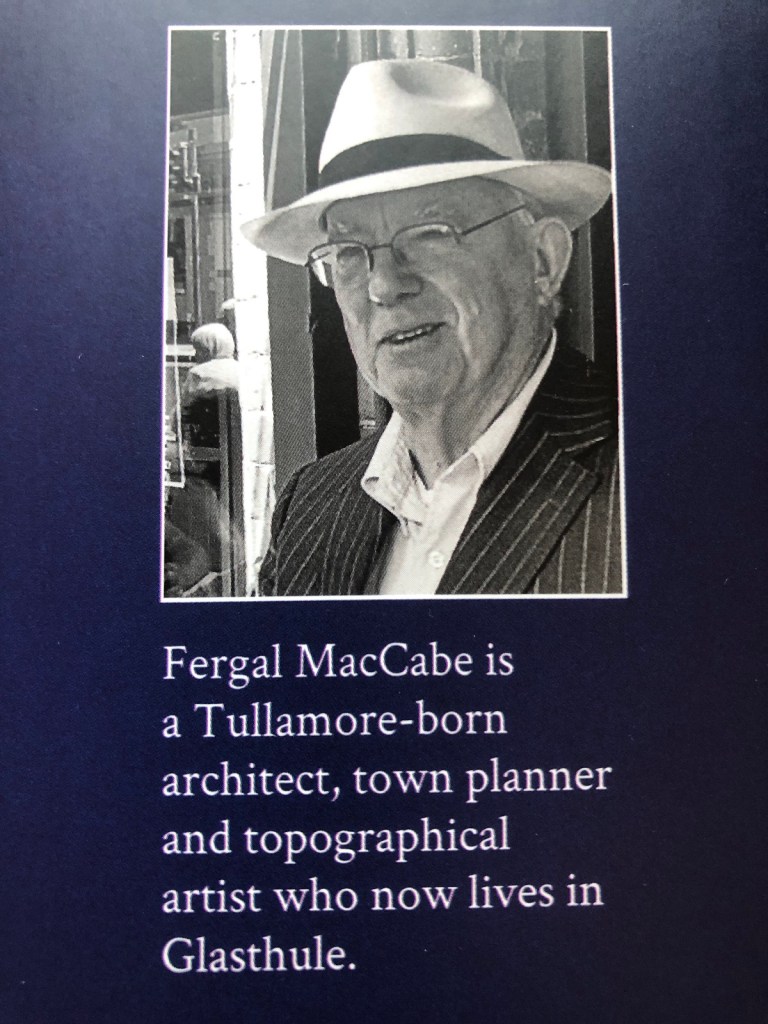
Fergal MacCabe is an architect, town planner and a topographical artist. He has managed to combine all three disciplines in his career. His fondness in recent years for the capriccio style of painting in many ways pulls together all his skills in how he views buildings and sees them in context. In his capriccio style Fergal MacCabe draws on real architectural elements and it is their juxtaposition that is whimsical. Yet he has regard to his own aesthetics, architectural and town planning skills in the buildings he selects and how he brings these buildings together.
For his jovial attitude to life we can probably thank his mother Winifred, who was by all accounts a character up to early passing in 1960.
Fergal was born in Tullamore in 1939 and went to school locally. By his own admission in his essays in Tullamore in the Sixties (2024) the 1950s were good to him and he enjoyed his time with local drama group the Runners and early on got experience of painting sets for their plays. His early promise was recognised in 1956 when the sixth earl of Rosse in opening an An Tostál art exhibition in the market house in Tullamore commended the young exhibitor.
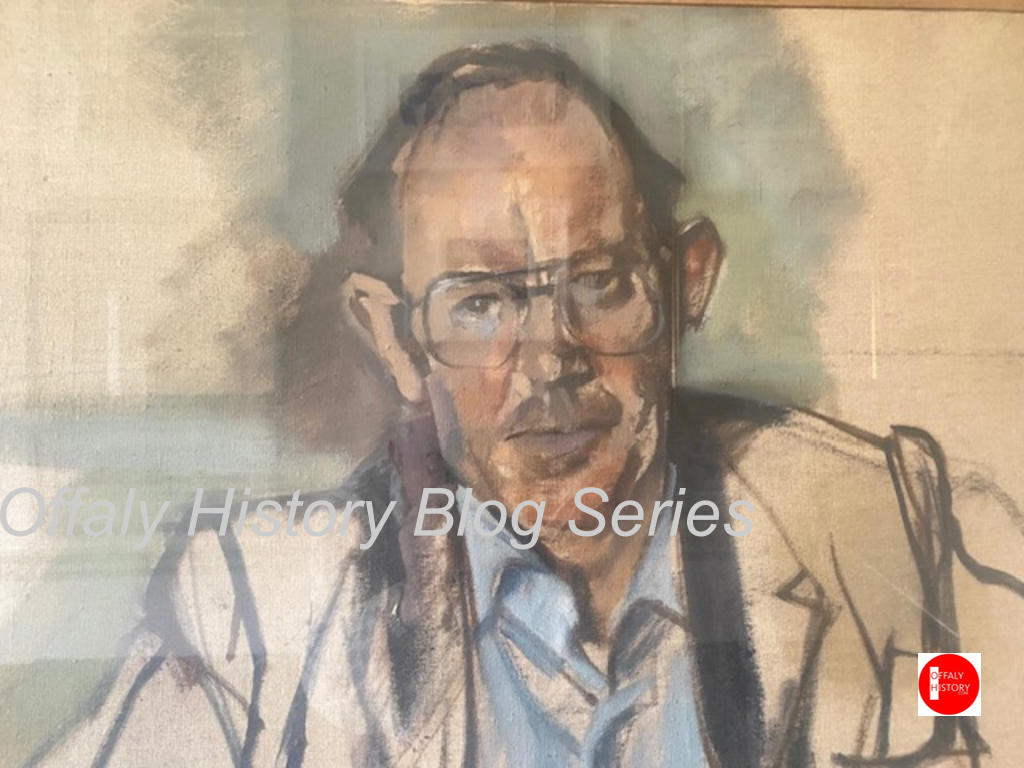
Soon after he went to the College of Art and in 1957 to UCD to study architecture and here he made colleagues for life while studying under Professor Desmond FitzGerald (brother of Garret). After that it was the boat train to work in England like so many of his countrymen.
His artistic career (as a hobby) began to develop in the early 1970s and he spent more time visiting Offaly and taking in subjects in Tullamore, Clonony and Banagher. Surprisingly, there appears to be little from Ferbane town even though he spent a lot of time with family relations and their neighbours, including the Connollys. Sean Connolly is a life-long friend who with Power Design, Fitzwilliam Street, Dublin has designed some of the important publications exhibiting Fergal MacCabe’s work. Sean and Fergal are currently working on a new book on the urban heritage of Tullamore.
Having set up the consultancy practice known today as MacCabe Durney Barnes in 1974 his career as an architect and town planner was also flourishing particularly in the layout of large housing schemes, mainly in the Dublin area. In Tullamore he designed housing schemes for the late James Spollen and the delightful small scheme of Glenfircal for the late John Flanagan. Having studied town planning in UCD, he was a founder member of the Irish Planning Institute and elected as its President in 1990.
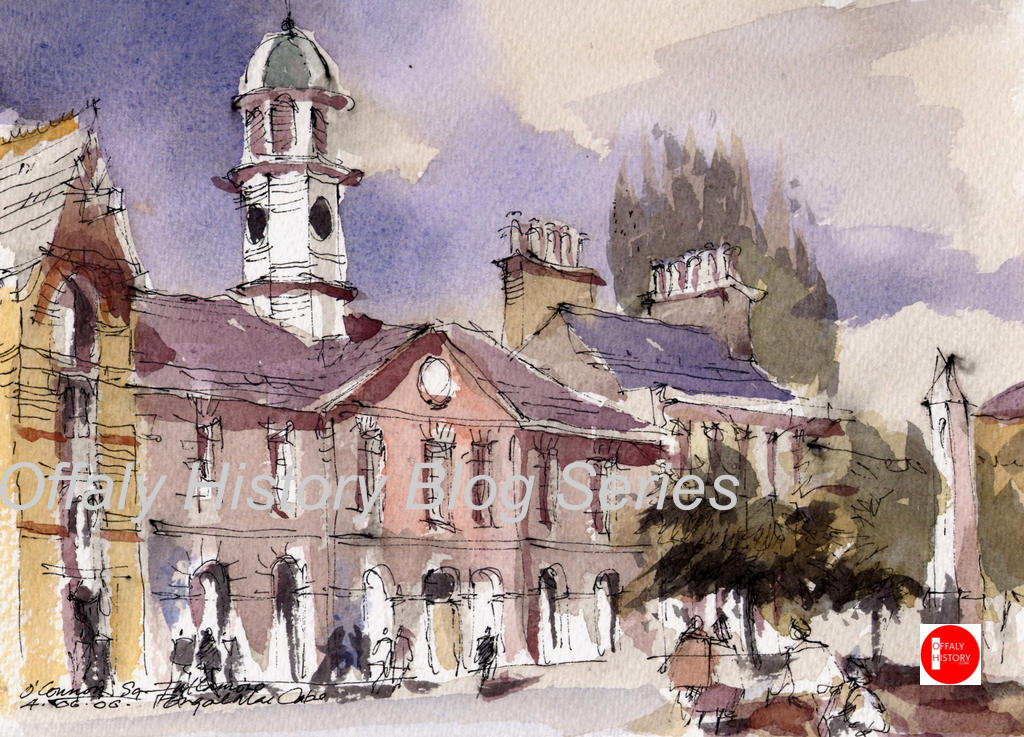
With more time to visit Tullamore he became aware of losses to Tullamore’s heritage with the demolition of the parochial house (the former Grand Canal hotel) in 1973 and the loss of the ‘porter’s lodge’ at the former workhouse at Ardan Road, Tullamore in 1977. It was in the 1970s that he began to make submissions to the local authorities in regard to Development Plans and has continued to press for consultation and conservation of the historic core of Tullamore.
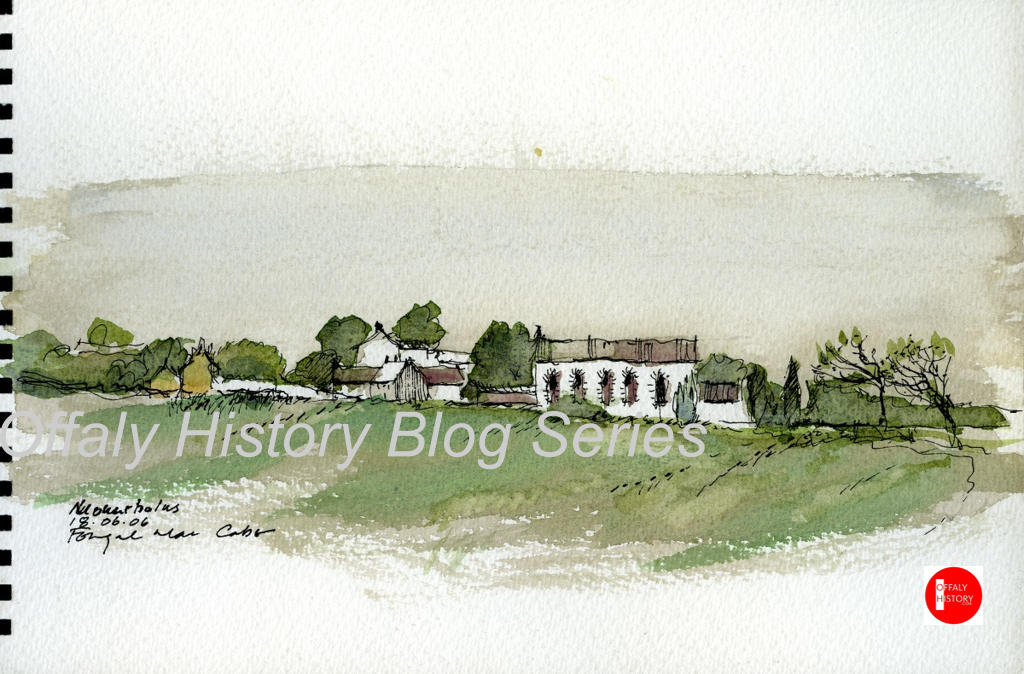
In 2002 he submitted a commissioned report on prospects for the old canal harbour, Tullamore. His proposals were in line with what was happening at Grand Canal Dock, Dublin. Nothing came of this and the area was not designated for tax relief to facilitate construction. Waterways Ireland, before it came under the North-South body, was exceedingly slow in doing anything and the recession saw proposals parked for over twenty years.
More recently he has given him more time to indulge his passion for the midlands and to involve himself in important exhibitions such as ‘Casting Shadows, opened in Aras an Chontae, Tullamore in 2014. It was in the same year that he began to advocate the full pedestrianisation of O’Connor Square in place of its role as a car park. In this he was heavily influenced by his architectural experience of the town and the city in other European states. Tullamore had to make an architectural statement if it wanted to stand out from the herd and save itself from demise as a town centre without people. Fergal MacCabe took a strong stand on the war memorial in the same square and has battled with the county council over removing the plinth from a listed structure and erecting rolling advertising in an area that should be a special conservation area.
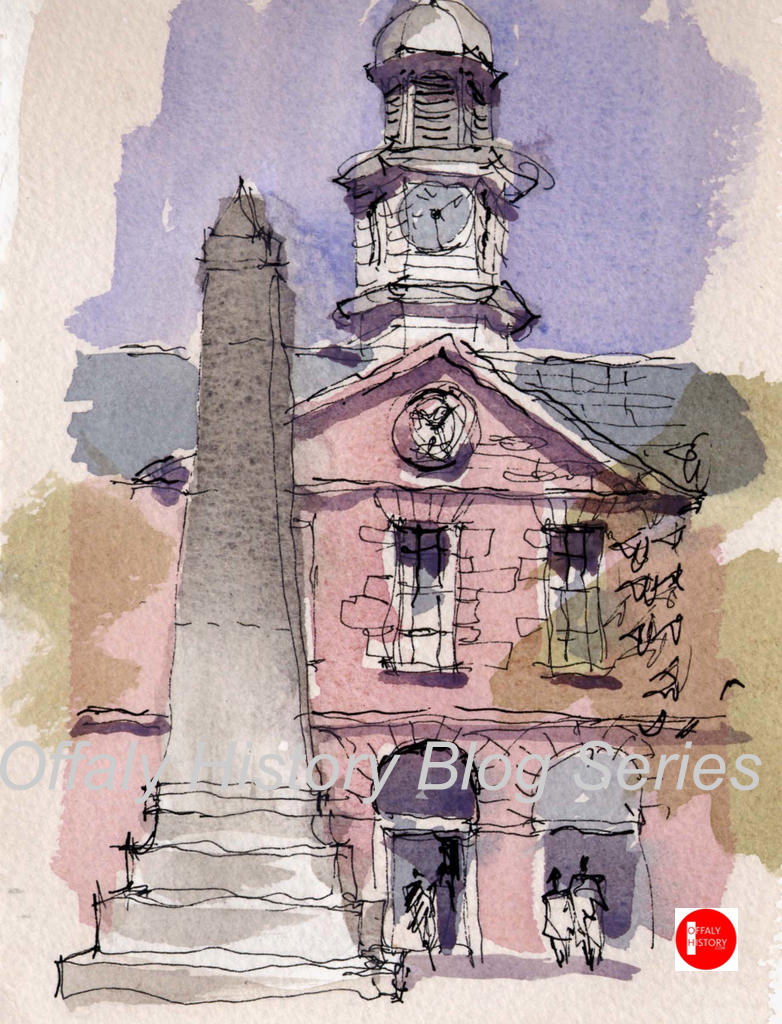
He has presented the town in his water colours as looking really good and proud of its architectural heritage, but of course the reality is shockingly different. He cannot be faulted for increasing dereliction in the last seventeen years.
His water colours for the Portrait of Tullamore (2010) were a triumph as was his study and illustrations for his Frank Gibney book (2018). He has huge admiration for the wholistic approach of Gibney and it is no surprise that he has the greatest respect for Grafton Architects (and not just because Yvonne Farrell of this partnership has a shared upbringing in the town of Tullamore). Grafton’s study (2024) of the canal harbour leads the field but as Fergal is only too well aware (having acted for many developers) there must be an economic engine and implementation team to drive the project forward.
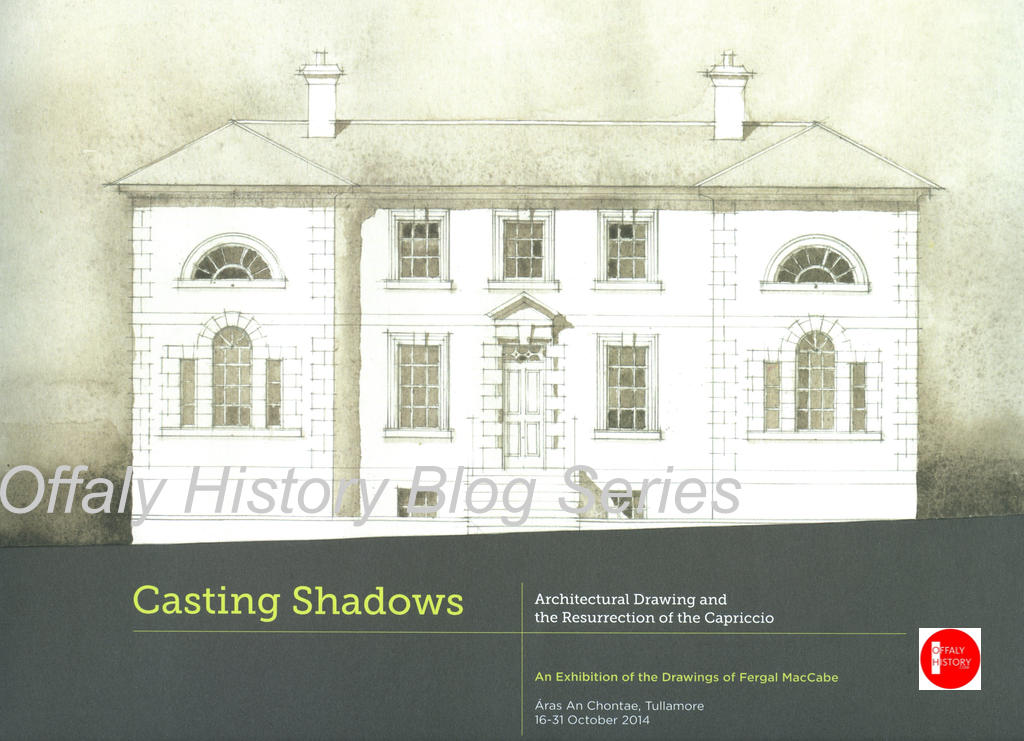
Fergal MacCabe has been relentless in seeking to have the ‘Crawford building’ in High Street assessed for restoration and funded his 2014 exhibition catalogue in endeavouring to secure support for a building he considers one of the most important in Tullamore (camouflaged since 1960 for TV showrooms and now to the front of Mr Price shop).
Fergal MacCabe’s water colours and drawings are hugely popular and he has worked almost single-handedly to bring a change of heart to the general public and to local representatives in regard to the county’s conservation needs. He has used his planning and artistic skills in the service of his convictions and in the winning of hearts and minds he has the people with him.
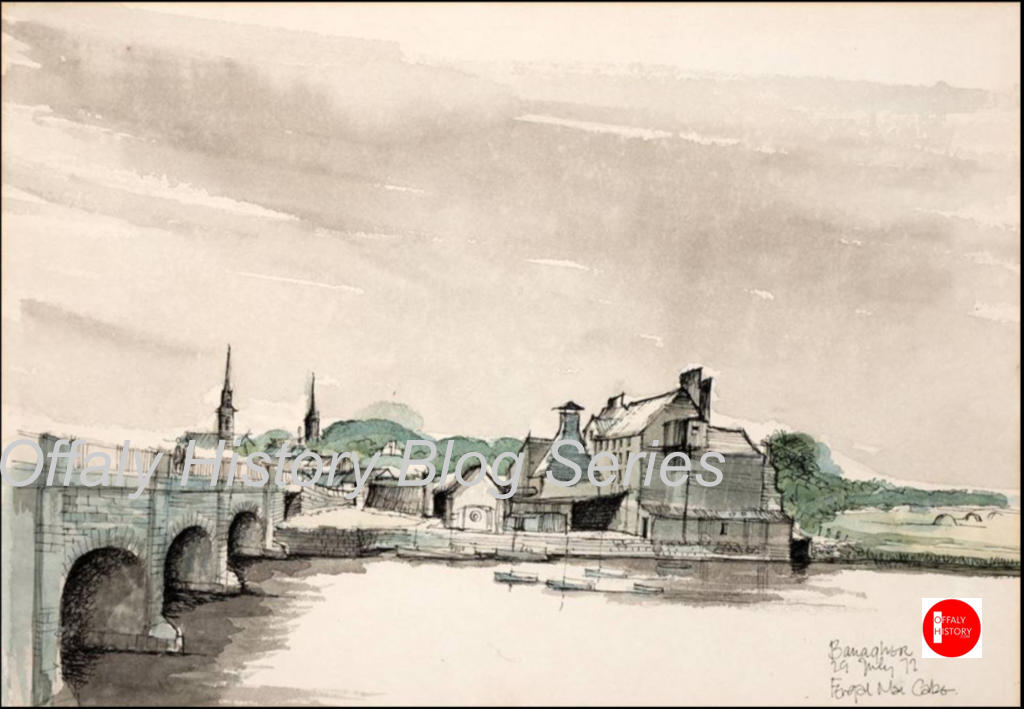
Offaly History Centre has used his art to decorate its meeting room and welcomes visitors to view Fergal MacCabe’s work and also that of Sean O’Sullivan and other portraits (check for opening hours via info@offalyhistory.com).
Fergal MacCabe in summary
Topographical artist (b. 1939)
Career
Studied Art in St Columba’s College Tullamore under Bill Sheedy
Encouraged to draw by Bean Ui Chinneide and Noel MacMahon
Studied life drawing at the National College of Art under Sean Keating
Studied architecture and town planning at University College Dublin 1957-63 and 1973-75
Elected to membership of the Watercolor Society of Ireland 1990
Elected to Honorary Life Membership of Offaly Historical and Archaeological Society, 2017
Influences
Carl Laubin, Paul Hogarth, John Piper, Raymond Piper, Arthur Gibney, Hugh Casson, Rex Whistler
Solo Exhibitions
1974 ‘ Offaly Series’ Birr
1976 ‘Clare Series’ Ennis
1977 ‘ Dun Laoghaire Series’ John Ryan Gallery, Monkstown
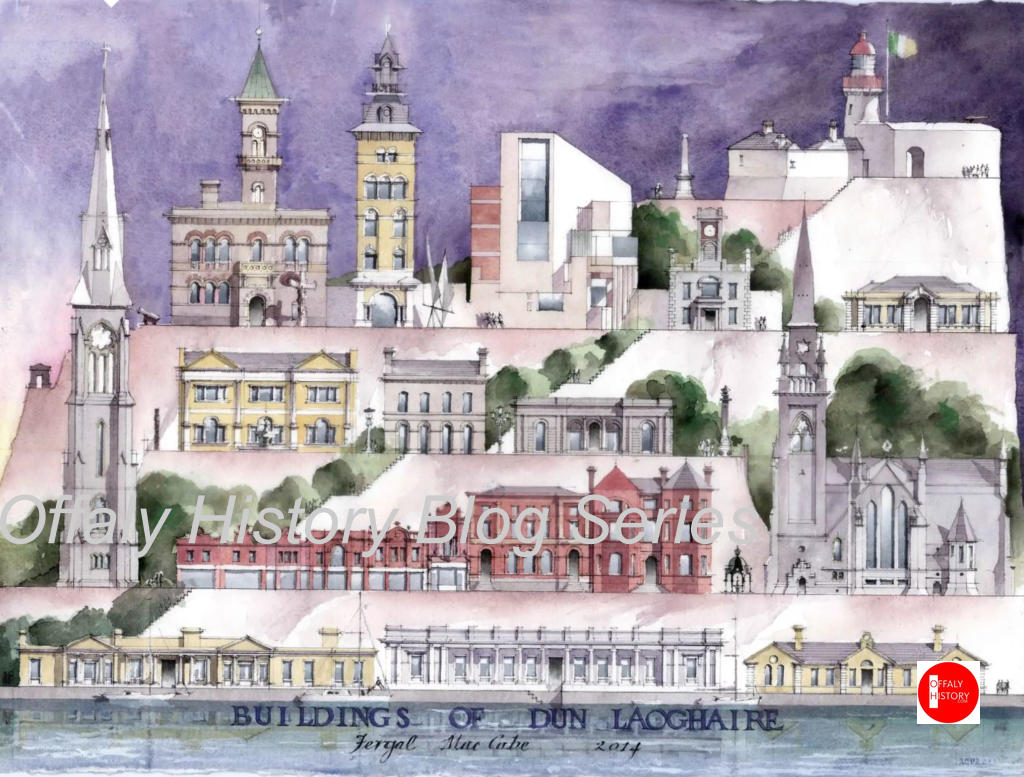
Dun Laoghaire 2014
‘For many years now I have been exploring the architecture of Ireland and particularly its great practitioners Gandon and Johnston, through the medium of the capriccio and examples of my efforts have been displayed in the annual exhibitions of the Royal Hibernian Academy and the Irish Watercolour Society.
Walking the East Pier of Dun Laoghaire Harbour over the years, I came to realise that the panorama of the seafront is as astonishing a vista as that provided by the magnificent urban harbours of Valletta, Helsinki or Marseilles and that it was an obvious subject for a scenic composition.
Its towers and terraces, steeples and fortresses, its mix of fine classical and modern architecture, its history as the last sight of Ireland for so many emigrants and often the first glimpse for visitors; all set against a background of mountains and fronted by an ever busy harbour, contribute to this work of the imagination.’
1980 ‘Dublin Series 1’ Brock Gallery, Blackrock
1982 ‘ Dublin Series 2’ Peacock Theatre, Dublin
1984 ‘Slieve Bloom Series’ Kinnitty
2014 ‘Casting Shadows’ Aras an Chontae, Tullamore
Group Shows
Exhibited in Royal Hibernian Academy, Senior Artist Award 2019
Annual WCSI Exhibitions
Part of the WCSI representation at the Confederation of European Watercolor Society Exhibitions in Haapsalu 2019 and Dublin 2023
With Noel MacMahon and John Healy (‘Backbencher’) Central Hotel Dublin 1970
‘Architects as Artists’ United Arts Club 2016
Illustrations and Publications
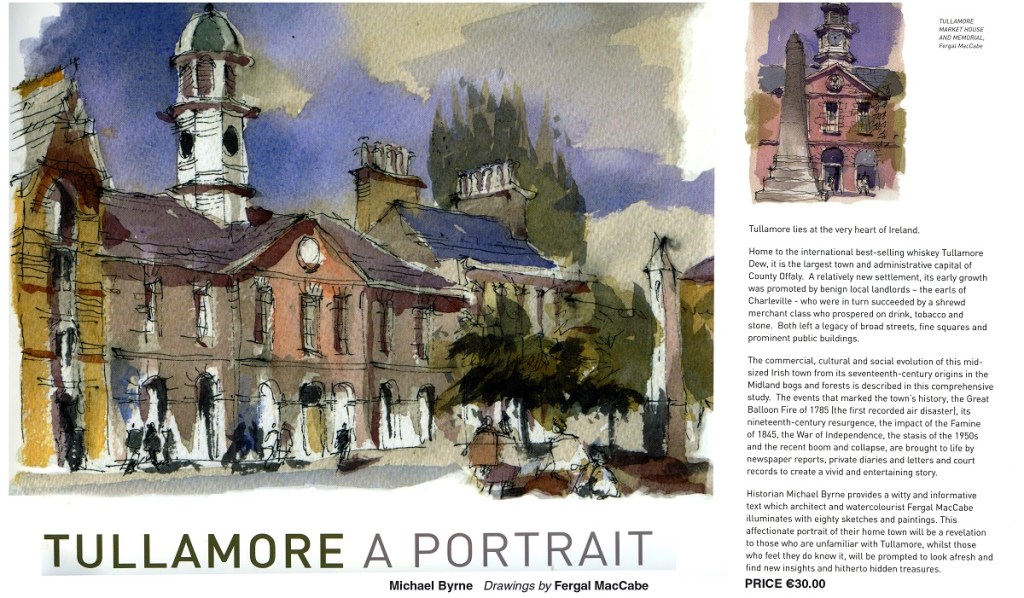
‘Tullamore a Portrait’ by Michael Byrne 2010
‘Near and There’ by John Boland 2020
‘No Lies Told’ by Brian Whiteside 2021
‘Friends Houses’ 2013
‘Ambition and Achievement- The Civic Visions of Frank Gibney’ 2018
‘Faithful Images- Public Art in Co Offaly’ with Paul Moore 2023
Works are in private, local authority and State collections including the visitor foyer to Dublin Castle and the National Self Portrait Collection.
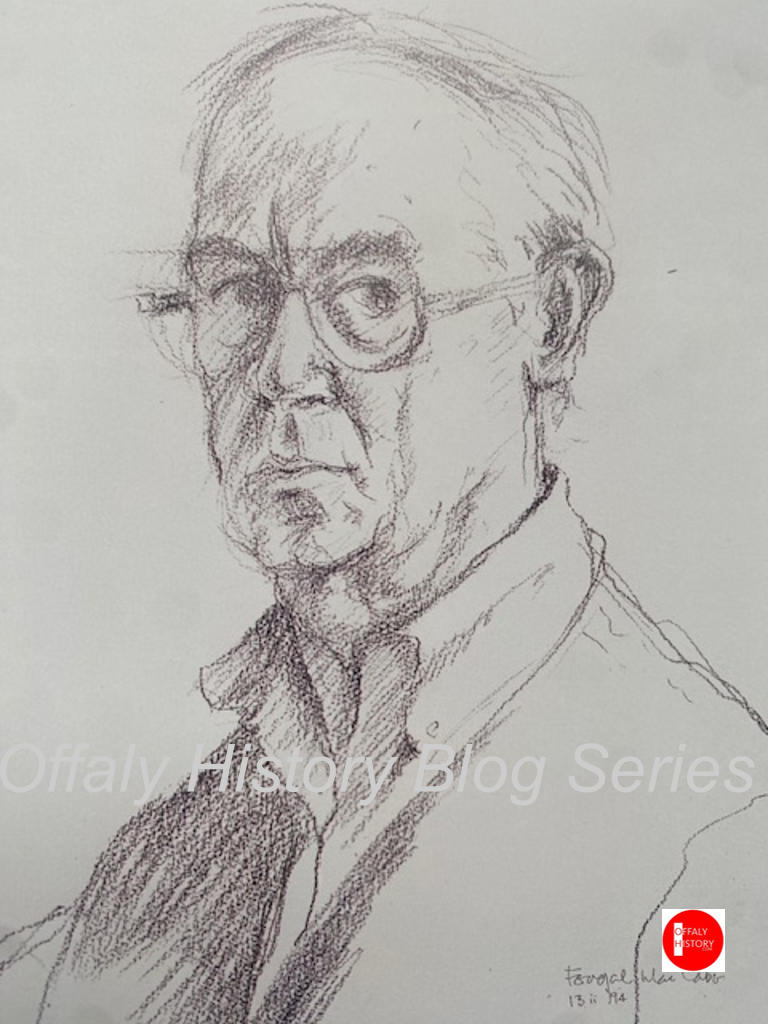
‘Self Portrait’ 1994 University College Limerick
Articles and blogs by Fergal MacCabe published by Offaly History in its journal Offaly Heritage and on its website – www.offalyhistory.com and offalyhistoryblog.com
Fergal McCabe, ‘The Efficacy of Statutory Planning in the Development of Tullamore 1987–2004’ Offaly Heritage 4 (2006) pp 241-257.
Fergal Mac Cabe, ‘The fall and hopeful rise of Tullamore town centre’Offaly Heritage 7 (2013) pp 24.
Fergal MacCabe, ‘A Mere Boy’ [Thomas Holohan and his death at Gallipoli] Offaly Heritage 9, pp 322–26.
Fergal MacCabe, ‘From Clara Road to Portland Place: The exciting journey of a Tullamore architect’, Offaly Heritage 11 (2020), 255–57.
Fergal MacCabe with Geoff Oakley, ‘From An Tostal to The Runners: the spirit of Tullamore in the 1950s’. in Michael Byrne (ed.), Tullamore in the sixties (Esker Press, Offaly History, Tullamore, 2025), pp 79-85.
Fergal MacCabe, ‘Tullamore in the 1960s: A town in transition’. Michael Byrne (ed.), Tullamore in the sixties (Esker Press, Offaly History, Tullamore, 2025), pp 86–96.
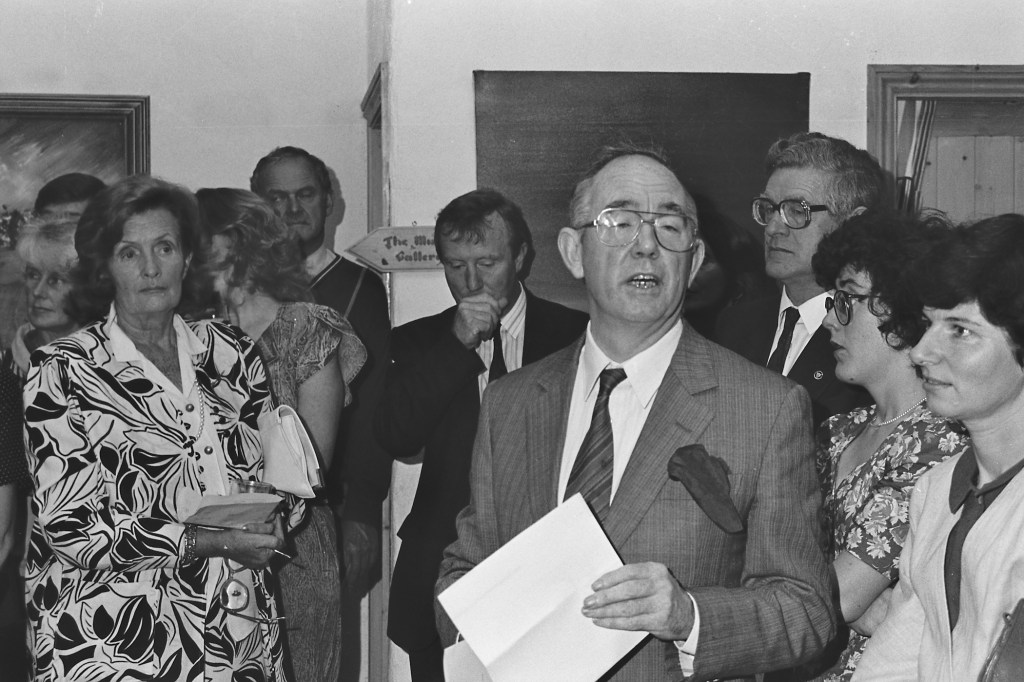
Blog articles on OffalyHistoryblog
- ‘A great town to get a letter from’ Early recollections of Tom Murphy (1935- 2018) ‘HOME TOWNS’ by Fergal MacCabe, 2018
- OFFALY AT THE ARSENALE- Yvonne Farrell, Grafton Architects and the Venice Biennale. By Fergal MacCabe, 2018
- 24 March 2021, ‘The golden era of housing in Tullamore from the 1930s to the 1950s: Clontarf Road, Pearse Park and Marian Place, but Dr Moran, P.P. has reservations’. By Fergal MacCabe
- April 24th 2021, Inspired by Water: Four Conjectural Views of a Past and Future Tullamore. By Fergal MacCabe
- August 21st 2021 Founding families: the Legacy of the Moores and the Burys. By Fergal MacCabe.
- September 29th 2021 Profitless Bog- The impact of energy generation on the landscape of the Midlands. By Fergal MacCabe
- November 6th 2021 ‘Opening the Hidden Bridge and A New Theory of The Early Origins of Tullamore’. By Fergal MacCabe
- December 18th 2021 Tullamore: ‘A good business town’. By Fergal MacCabe
- 16 February 2022, ‘Tullamore: recently nominated by the Irish Times as amongst the twenty best places to live in Ireland. A Tullamore Capriccio’. By Fergal MacCabe
- 5 March 2022, ‘Demolish or Preserve? The dilemma for the future of the architectural heritage of Tullamore and of many other Irish towns’. By Fergal MacCabe
- 25 May 2022, ‘Shops and pubs designed by Michael Scott in the 1940s for D.E. Williams’. By Fergal MacCabe
- 22 June 2022, ‘The Magnificent Mansions of Tullamore’. By Fergal MacCabe. A contribution to the Tullamore 400th series, no. 6
- 7 September 2022, ‘The growth of middle class-owner occupied housing in Tullamore, 1900-1960’. By Fergal MacCabe. A contribution to the Decade of Centenaries
- 24 September 2022, ‘Tullamore – Places to visit to mark Tullamore 400th anniversary’. Contributed by Offaly History with water colours courtesy of Fergal MacCabe
- 26 November 2022, ‘It will last for centuries’: St. Joseph’s Convent, Tullamore. By Fergal MacCabe.
- 4 Feb 2023, ‘2023 will be remembered as the year in which Tullamore tried to reinvent itself: the Dream Team. By Fergal MacCabe
- 13. 18 Feb 2023, ‘Planning for a new central Tullamore. By Fergal MacCabe. Knowledge-based support for creativity and innovation.
- 74. 27 Sept 2023, ‘Visualizing Tullamore and its unique architectural character – A new Capriccio.’ By Fergal MacCabe
- 77. 8 October 2023, ‘Paul Burke-Kennedy, architect.’ An Appreciation by Fergal MacCabe
- 98. 9 December 2023, ‘Faithful Images: public art in County Offaly: a new book from Fergal MacCabe and Paul Moore
- 3 January 2024, ‘4 A Canalside Idyll: the Tullamore canal quarter of the future. From the Grand Canal Offaly series by Offaly History.’ This essay by Fergal MacCabe
- 8 January 2024, ‘Six’ fine works of public sculpture in Birr. By Fergal MacCabe and Paul Moore.
- 13 April 2024, ‘AN AWKWARD SITE- The Building and Rebuilding of the Church of the Assumption of Our Blessed Lady, Tullamore.’ By Fergal MacCabe
- 12 July 2024, ‘The Role of Urban Design in the Evolution of Tullamore. By Fergal MacCabe. Published to mark the Regeneration Plan for Tullamore and the Harbour Master Plan. Submissions by 25 July (see online for details)
- 24 August 2024, ‘Modern Times: mid-twentieth century architectural styles in Tullamore, Ireland.’ By Fergal MacCabe. Published to mark Heritage Week 2004 and no. 9 in Offaly History Anniversaries Series.
- 22nd January 2025, Can town planning make Tullamore a better place? An opening debate on the upcoming ten-year Local Area Plan. By Fergal MacCabe
- 2nd April 2025, Michael Scott: his Midland Connections and Networks. By Fergal MacCabe. No 2
- 5th April 2025, ‘No Entry’ The Inaccessibility of Two Important Amenity Sites in Offaly (Durrow Abbey and Tullamore Harbour). By Fergal MacCabe. Blog no. 705 in the Offaly History Series.
- 30th April 2025, Frances Kelly’s painting in the County Hospital Tullamore. By Fergal MacCabe. No 4 in a series on the paintings and drawings heritage of County Offaly, 1750-2000, explored through the works of artists from or associated with County Offaly. Blog no. 709.
- 4 June 2025 The Offaly County Hospital Tullamore: The Fruits of Independence. By Fergal MacCabe. No 5 in a series on the paintings and drawings heritage of County Offaly, 1750-2000, explored through the works of artists from or associated with County Offaly. Offaly History Blog no. 716.
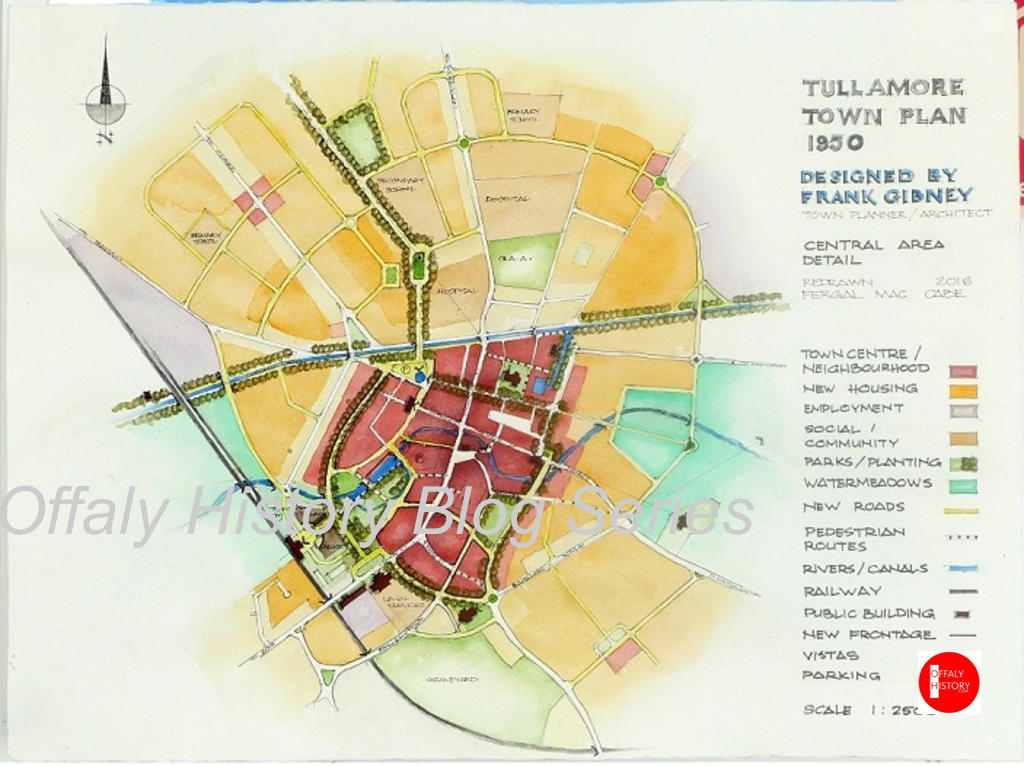
AMBITION AND ACHIEVEMENT-The Civic Visions of Frank Gibney”
The town planner and architect Frank Gibney (1905-1978) was one of the most prolific urban designers in Ireland in the years between 1930 and 1960.In that period he was responsible for the laying out of almost 6000 houses in every part of the country, though he is most celebrated today for the six villages built in the Midlands in the 1950s for Bord na Mona workers.
A noted polemicist who constantly advocated the need for forward planning, he produced the very first spatial plan for the island of Ireland in 1943 and followed this in 1945 with a plan for Dublin. He constantly promoted the use of indigenous architecture, building materials and energy sources.
Between 1939 and 1950 he produced plans for many Irish villages, towns and cities including Tullamore and Birr and in both towns designed housing of outstanding quality. His Bord na Mona schemes in Kilcormac and Bracknagh have been declared to be “models for rural living”. Many of his buildings now enjoy protected status.
Fergal MacCabe has made a lifetime study of Gibney’s work and in particular his 1950 plan for Tullamore and contrasts its proposals with the form of the town today.
Faithful Images: Public Art in County Offaly Fergal MacCabe and Paul Moore, large format, pp 124, full colour, €20.00. (Offaly History, Tullamore, 2023), ISBN 978-1-909822-37-5. Increasing affluence and local self-confidence, government support and E.U. funding have encouraged the extensive commissioning and delivery of public art in every part of Ireland in the past forty years. In this book architect Fergal MacCabe and Photographer Paul Moore explore the experience detailed examination of nineteen sculptures –their stories, settings qualities and symbolism-suggest new directions for future creations.
This series is supported by Offaly County Council’s Creative Ireland community grant programme 2025-2027.


 offalyhistoryblog