
The foundation stone for the Tullamore jail was laid on 13 September 1826 just 200 years ago. Two hundred years of history as we pass those gates of what is now Kilcruttin Business Park. We may wonder at what went on there over 200 years. In many ways the former jail encapsulates the history of Tullamore since the 1820s. When the jail was built Tullamore was not yet the county town. There was no railway until 1859 at this location. No road up from Kilcruttin until 1938, Lloyd Town Park was agricultural land with an old out-of-town cemetery nearby. Only the ‘Charleville Parade’ houses north of the courthouse were built. The courthouse was not completed until 1835. The jail was designed to accommodate 120 prisoners and had double that number during the Famine years of the late 1840s. It was well run on reform lines but Victorian prisons were tough places.
(more…)Category: Charleville
-
The Groome Family of Knockdrin and Garr in the Heart of Uíbh Fhailí. ByPadráig Groome. Blog no. 807, 24 July 2026.
The Groome Family of Knockdrin and Garr in the Heart of Uíbh Fhailí
Introduction
Nestled on the frontier of the ancient kingdom of Uíbh Fhailí, beneath the shadow of Croghan Hill, lies the historic townland of Knockdrin—a place long known as the “Hill of Conflict.” For centuries, this landscape formed part of the heartland of Gaelic Offaly, where kings ruled, battles were fought, and generations of ordinary families worked the land and built their lives.
Like many Irish families, the history of the Groomes was preserved through seanchas, the ancient Irish tradition of storytelling. Long before history was written in books, it was carried in memory. Stories of ancestors, local events, victories, hardships and family life were passed from one generation to the next around the warmth of the turf fire by the seanchaí (traditional storyteller), ensuring that the history of a family and its community would never be forgotten.
(more…)
-
A new study of Offaly’s two Great Houses at Birr and Charleville, Tullamore Blog no. 802 in the Offaly History Series, 18 June 2026.
A new study of Offaly’s two Great Houses at Birr and Charleville, Tullamore just published
Two of the great houses of Ireland, are here in County Offaly at Birr and Tullamore. Both regularly feature in articles and magazine stories. Birr Castle much more so as it has been the family home of the Parsons family, earls of Rosse, since the 1620s. The present earl and his wife from the death of the sixth earl in 1979, have worked for almost fifty years to promote the castle and gardens for the benefit for tourism and build on the enthusiasm of the sixth earl to create a science museum commemorating the work of the third and fourth earls and that of Charles Parsons, the engineer who helped win the First World War. Both earls worked tirelessly for the gardens at Birr Castle.
(more…)
-
Farming in the Philipstown/Daingean in the 1830s: the evidence from the the 1835 Poor Law Inquiry part four (final): ‘The farmers who occupy the district are of two classes; some few large farmers very respectable, but the small farmers poor and distressed’. By J.J. Reilly. Offaly History Blog no. 789, 2.4.2026.
[This is part four and the final part of a blog article on the 1835 Poor Law Inquiry into the baronies of Philipstown Upper and Lower and is based on the transcripts from the original reports into social conditions in Ireland before the Famine. It provides a fascinating picture of farming in the area before the Famine, Ed.
Enjoy the weekend and sitback. We have the Book Fair on Saturday 4 April from 10 to 4 at Offaly History Centre, Bury Quay, beside the new Aldi.]
Tillage
The general produce of this barony is about equal proportions of tillage and grazing and the average size of the tillage farms is from 10 to 20 Irish acres; the Irish acre [1.62 statute acres] is used throughout the district. The largest farmer in this part of the country is Mr. Rait, who holds 700 Irish acres. In this barony there are no mountain dairy farms. The nature of the soil partakes of all kinds, from rich loam to the poorest clay, and was considered to be deteriorating in quality from the want of means among the farmers, caused by the low price of agricultural produce. It was, however, stated that the entire produce was greater now than formerly, owing to the far greater exertions now made. The farmers who occupy the district are of two classes; some few large farmers very respectable, but the small farmers poor and distressed. Some of the wheat is of the first quality, but in general it is not good in the district.
(more…)
-
An opportunity to see the old Tullamore jail and hear of its turbulent history in the 1880s, 28 March, Saturday from 10.00 a.m. A welcome to all and meet local history enthusiasts for coffee at 10 and the book launch at 11 a.m. An Offaly History blog, no. 788, 27 March 2026.
28 March Saturday at 11.00 a.m. at the former Tullamore Prison/Kilcruttin Business Park, Cormac Street, Tullamore, for the Launch of a new edition of Prison Poems or Lays of Tullamore by T.D. Sullivan, edited by Terry Moylan and Padráig Turley. Sullivan like William O’Brien and John Mandeville were political prisoners who refused to wear the prison clothes.
See Cormac Street from a new perspective
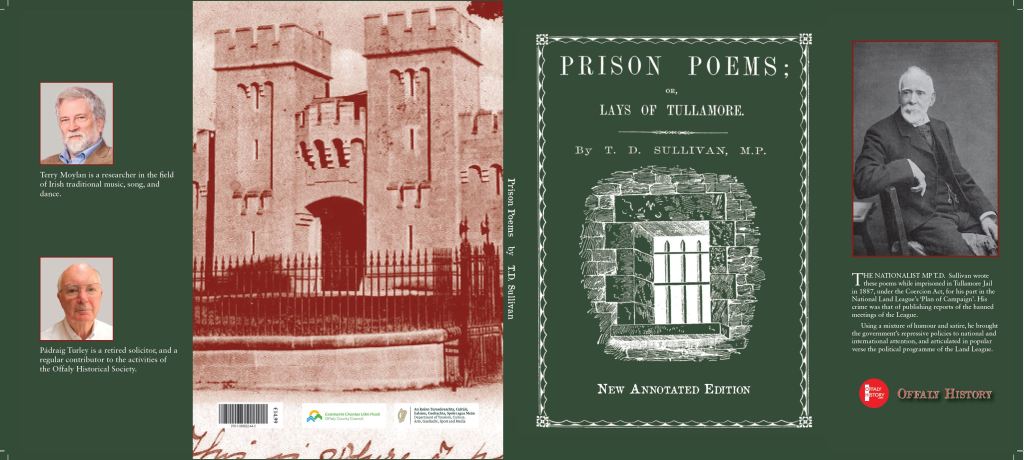
Jacket of the new edition of Prison Poems Today we are reminded of the jail every time we stop at the lights at the junction with Cormac Street, Kilcruttin and Charleville Road and look to the magnificent limestone façade, memorial tablet, jail warders’ cottages and the very fine gates with their Roman fasces to remind us of the symbols of authority back to early times. Then who has not heard of the underground passage (now mostly closed off) that allowed the prisoners to be brought into one of the two semi-circular courts in the old pre-1922 courthouse.
(more…)
-
The ‘Elite’ of Tullamore skating at Charleville Lake on St Stephen’s Day 1864. By Cosney Molloy. Blog no 770, 26 12. 2025
Skating on Charleville Lake, Tullamore was a popular pastime when I was a young lad. I remember the cold icy winters of 1962, 1982 and 2010. I can recall as a young man the Tullamore people skating on Charleville Lake in 1962. I am a long time now in D 4 but I got down a few weeks before Christmas of 2020 to the nice butchers in Tullamore – old Tormey’s was still going strong and then you had, Hanlon’s, Crossan’s of Main Street, Ray Dunne and Fergus Dunne, and a few more I would not know. I was sorry to see Grennan’s main shop closed for now in 2020. I miss Paddy Mac’s, Cleary’s and Joe ‘the Butch’ Kearney and not forgetting Dunne’s butchers off the Square. It was Treacy’s later. Liver we got a lot of and sheep’s hearts in that fine shop. Many old friends gone to the heavenly pastures. I always like to get my turkey in Tullamore and a nice ham even though I am out of the town now for over forty years. What with the bacon factory open until 1989, and now Tullamore Meats, the town has a long tradition in fine food. Come to think of it the bacon factory did a huge business in turkeys back in the 1940s and 1950s when my father was rearing same.
(more…)
-
The making of O’Connor Square, Tullamore: People, Houses and Business will be launched on Wednesday 10 December 5 p.m. at the Brewery Tap, Tullamore and Ferbane 1950-2000 on 12 Dec. in Ferbane Blog No 766, 9th Dec 2025
The making of O’Connor Square, Tullamore: People, Houses and Business will be launched on Wednesday 10 December 5 p.m. at the Brewery Tap, Tullamore. The Brewery Tap is the longest established business in the square dating back to the 1830s as a pub and brewery. The lease of the site was dated to 1713 with the property in possession of the Brennan and Thornburgh families, later Deverell, Egan, Adams, Carragher and now Paul and Cathy Anne Bell.
We look forward to meeting you at the launch where savouries and tea/coffee will be served. Parking will be available at this time and should not cost more than 1 euro for an hour. Walkers and cyclists go free.
The making of O’Connor Square, Tullamore: People, Houses and Business (Offaly History, Tullamore, 2025), pp 440, p/b €23, h/b €29. ISBN978-1-909822-45-0 (hardcover) ISBN978-1-909822-46-7 (softcover). The book contains fifteen essays by Michael Byrne, Fergal MacCabe, Rachel McKenna and Timothy O’Neill. Publication is supported by the Heritage Council.
At the same event we launch Offaly Heritage 13. This the 13th issue of the Offaly History Journal It’s another bumper issue with over 330 pages and well-illustrated, €19 soft and €25 hardback. The issue is dedicated to the late Christy Maye – a great friend to Offaly History.
The two books are now available from Offaly History Centre, Midland Books and at www.offalyhistory.com for online.
(more…)
-
Charleville School, Church Street, Tullamore. By Michael Byrne and Offaly History. No 7 in the new Offaly History series on Church Street, Tullamore: houses, businesses and families, over 300 years. Part of the 2025 Living in towns series prepared with the support of the Heritage Council. Blog No 745, 10th Sept 2025
There are few buildings of interest on the northern side other than the Charleville School. McNamara’s Foresters Hall of 1923-4 had a fine façade spoilt in the 1950s to make way for the Morris hardware store at ground level.
The former Charleville school is an attractive building in rough-cut limestone ashlar with Georgian glazing bars was built in 1811 and vacated as a school in 2006 when the new building was completed at Church Avenue. Erected by the earl of Charleville (1764–1835) for the education of the poor children of the parish of all religions, it was operated originally on the plan on Joseph Lancaster. Lancaster’s system was to have small classes with the elder pupils (monitors) doing much of the teaching of the younger. Louisa Tisdall, a daughter of the countess of Charleville by her first marriage, wrote a few interesting details about the school in 1824:
The school was built by Papa and is a handsome building. It was originally arranged by dear Mama on the Lancasterian plan, but in our absence it was remodelled and is now a mixture of the Bell system and Lancaster’s with other additions. Introducing the bible among the school books has given great offence to the Catholics, and the whole thing was nearly overturned: there are still however a tolerably good attendance of children in the boys’ school; the girls’ we hope to revive soon again – but subscriptions were withdrawn in our absence and as usual it will all fall again on Mama’s purse. The schoolmaster [Taylor] is clever but appears methodistical [that may have been true]… The Irish peasantry has great natural quickness and talent, and warmth of feeling very congenial to my own. Were they but educated, civilised, done justice to, would they not be a charming people.
(more…)
-
Fergal MacCabe architect, town planner, artist and heritage brand ambassador for Tullamore. No 11 in a series on the paintings and drawings heritage of County Offaly, 1750-2000, explored through the works of artists from or associated with County Offaly. By Michael Byrne. Blog No 732, 19th July 2025
Fergal MacCabe is an architect, town planner and a topographical artist. He has managed to combine all three disciplines in his career. His fondness in recent years for the capriccio style of painting in many ways pulls together all his skills in how he views buildings and sees them in context. In his capriccio style Fergal MacCabe draws on real architectural elements and it is their juxtaposition that is whimsical. Yet he has regard to his own aesthetics, architectural and town planning skills in the buildings he selects and how he brings these buildings together.
For his jovial attitude to life we can probably thank his mother Winifred, who was by all accounts a character up to early passing in 1960.
(more…)
-
The memorial to the earl of Charleville (1712–64) in St Catherine’s Church, Tullamore. No 10 in a series on the paintings and drawings heritage of County Offaly, 1750-2000, explored through the works of artists from or associated with County Offaly. By Michael Byrne. Offaly History Blog No 731, 16th July 2025
John Wesley, the founder of Methodism with his brother Charles, was the first person to record seeing the Van Nost memorial to the lately deceased earl of Charleville, the owner of Tullamore town and ‘the manor of Tullamore and Croghan’ – about 20,000 acres. Wesley recorded in his Journal:
Thursday 25 June 1767
I was desired to look at the monument lately erected for the Earl of Charleville. It observes ‘That he was the last of his family, the Great Moores of Croghan [sic].’ But how little did riches profit either him, who died in the strength of his years, or his heir, who was literally overwhelmed by them: being so full of care, that sleep departed from him, and he was restless day and night; till after a few months, life itself was a burden, and an untimely death closed the scene.
(more…)
 offalyhistoryblog