
The foundation stone for the Tullamore jail was laid on 13 September 1826 just 200 years ago. Two hundred years of history as we pass those gates of what is now Kilcruttin Business Park. We may wonder at what went on there over 200 years. In many ways the former jail encapsulates the history of Tullamore since the 1820s. When the jail was built Tullamore was not yet the county town. There was no railway until 1859 at this location. No road up from Kilcruttin until 1938, Lloyd Town Park was agricultural land with an old out-of-town cemetery nearby. Only the ‘Charleville Parade’ houses north of the courthouse were built. The courthouse was not completed until 1835. The jail was designed to accommodate 120 prisoners and had double that number during the Famine years of the late 1840s. It was well run on reform lines but Victorian prisons were tough places.
The story of the jail buildings can be looked at in three acts:
- The first 95 years, Act 1, from 1826 to 1921 when it served as a county jail under British administration. Followed by an intermission of sixteen years when it was a ruin.
- Act 2 was its reconstruction as a woollen mill/textile factory for Salts and Tullamore Yarns, from 1938 to 1982, when it finally closed. Another interval followed but only of three years.
- Salts factory was purchased in 1985 by the builder John Flanagan for use for local enterprises in need of space. This is the story of the former jail for the past 41 years as an enterprise centre and business park. Today it is well-known to new people who visit the Farmers’ Market on Saturday. But they may never have seen the front buildings on indeed know much of the history of the place. Behind the Gothic facade are modern warehouse buildings and the buzz of activity.
The site of the jail and the 1835 courthouse was part of the elaborate strategy of Lord Charleville and his son Lord Tullamoore to get Tullamore established as the county town in place of Daingean with a new jail and courthouse paid for out of public and county funds while enhancing their town. The Gothic style, the same as that of Charleville Castle, was preferred, but when it came to the courthouse in 1833–5 the grand jury (the major landowners of the time) insisted on a classical Greek style.
The houses on all sides of the jail and those on the approach near the courthouse were all part of a plan to ensure that these new public buildings were located in an attractive planned setting.
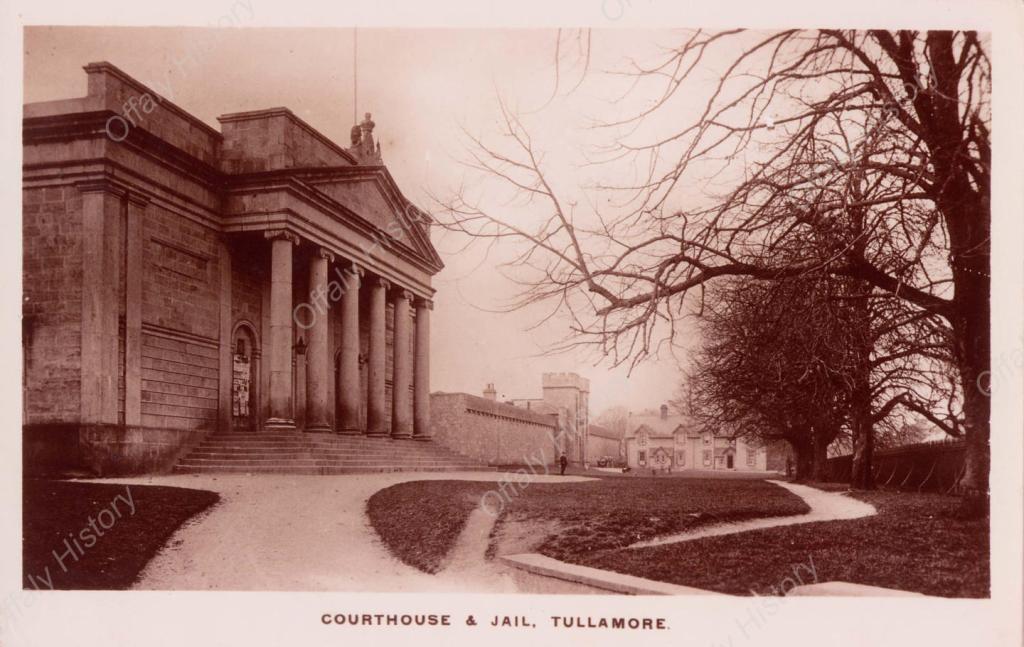
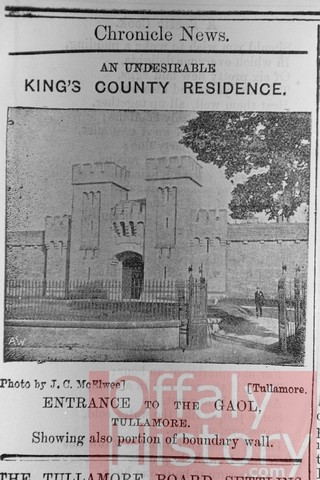
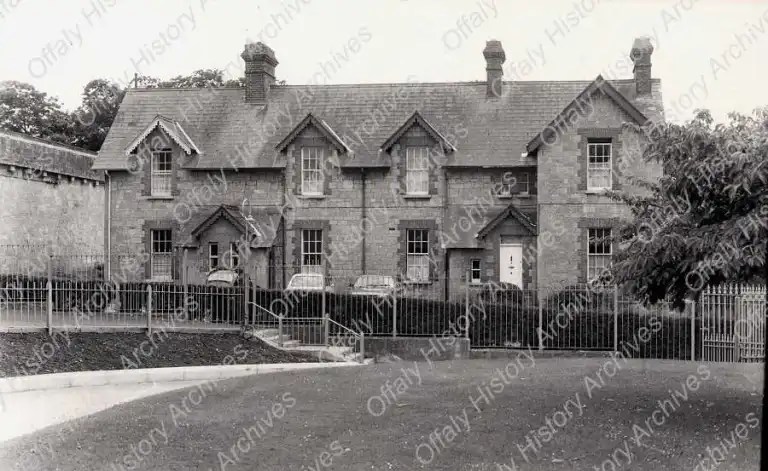
Today we are reminded of the jail every time we stop at the lights at the junction with Kilcruttin and Charleville Road and look to the magnificent limestone façade, memorial tablet over the entrance gate, jail warders’ houses on the right and the very fine gates with their Roman fasces to remind us of the symbols of authority back to Roman times. Who has not heard of the underground passage (now mostly closed off) that allowed the prisoners to be brought into one of the two semi-circular courts in the old pre-1922 courthouse.

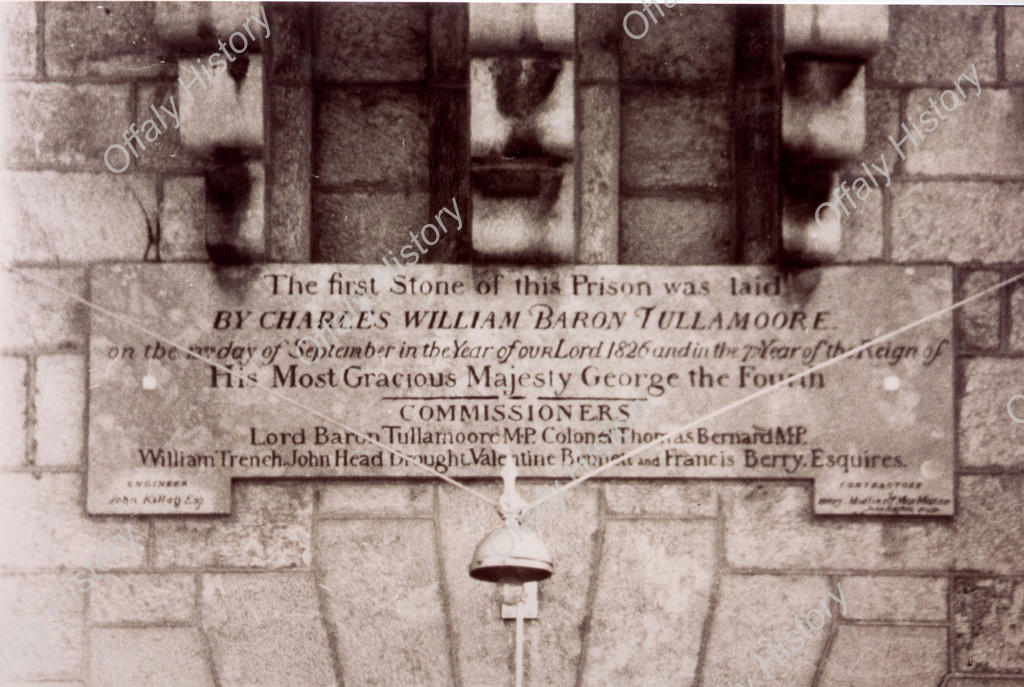
Although only the façade of the jail now survives (thanks to the county engineer of the time) it is one of the most impressive architectural features in Tullamore and makes for a striking and impressive structure as one takes a first view of it coming from the railway station. The building of the jail is recorded on a memorial tablet over the entrance (see photograph):
The first stone of this prison was laid by Charles William Baron Tullamoore on the 13th day of September in the year of our Lord 1826 and in the 7th year of the reign of his Most Gracious Majesty George the Fourth. Commissioners Lord Baron Tullamore M P, Colonel Thomas Bernard M P, William Trench, John Head Drought, Valentine Bennett and Francis Berry Esquires. Engineer John Killay Esq., Contractors Henry, Mullins and MacMahon. John Rafter sculp.
The Killay was a misspelling for the well-known canal engineer John Killaly. The Rafter/Wrafter are a well-known Tullamore family of stone masons. One of the family sculpted the memorial in front of the courthouse 112 years later
The first major public event in Tullamore
Lord Tullamore was delighted with the ceremony around the laying of the foundation stone. He reckoned that 30,000 attending the event. ‘The town, every single house, was illuminated, many most tastefully… A beautiful fire-balloon with my arms etc. was sent up, so constructed as to discharge fireworks and have the appearance of a fiery meteor.’ The jail was opened in April 1830; the prisoners having been transferred by canal barge from Daingean and the courthouse in 1835. The warders’ houses, now looking so well, as are the railings and façade of the old jail, were built in 1889. The courthouse was totally revamped in 2007. All these works, including the town park of 2009, making Cormac Street one of the finest in Tullamore
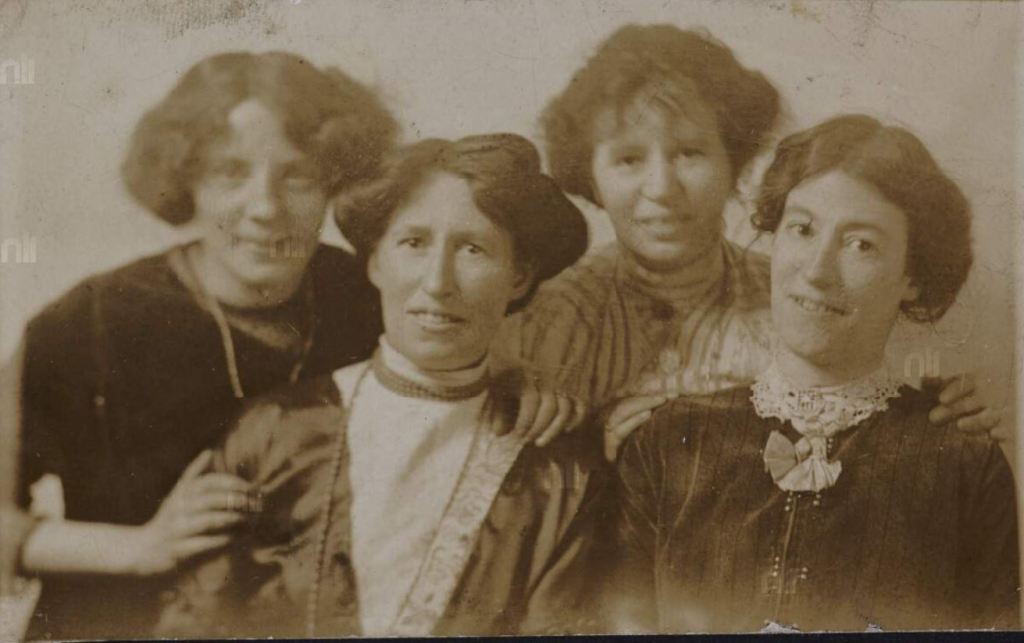
Undoubtedly, the history of Tullamore jail would make a book in itself for besides the mundane occurrences there were a few extraordinary events such as the imprisonment of some of those involved in the Plan of Campaign including William O’Brien and John Mandeville in 1887–88, the women’s suffrage prisoners in 1913, the Tullamore Incident prisoners of 1916 and, of course, the executions, the last being in 1903, and of a woman, Mary Daly. Prisoners who were held there in the 1916–22 period.
Salts to Tullamore Yarns, 1937–82
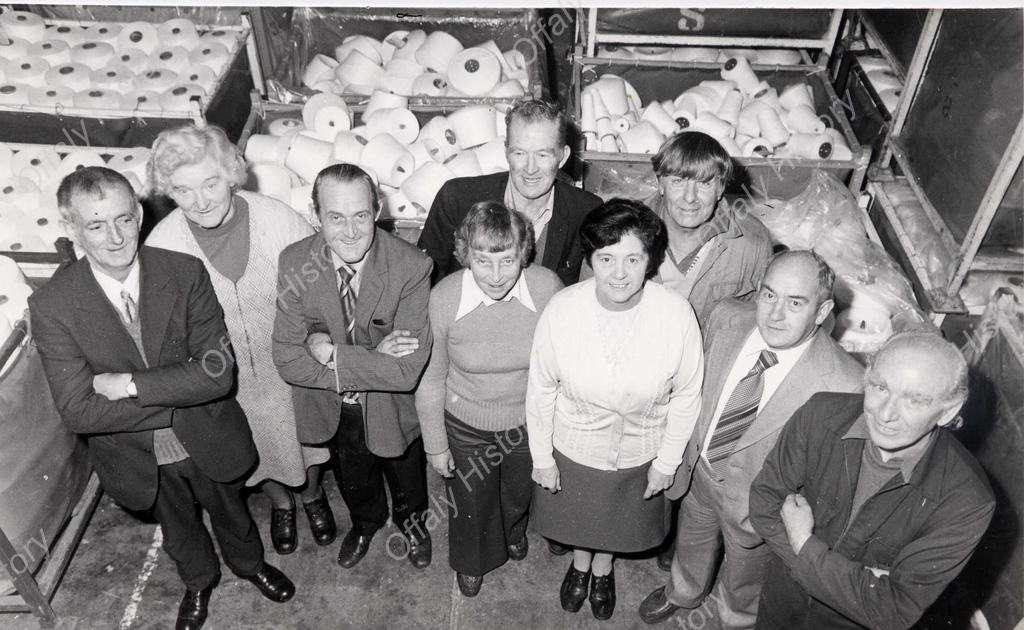
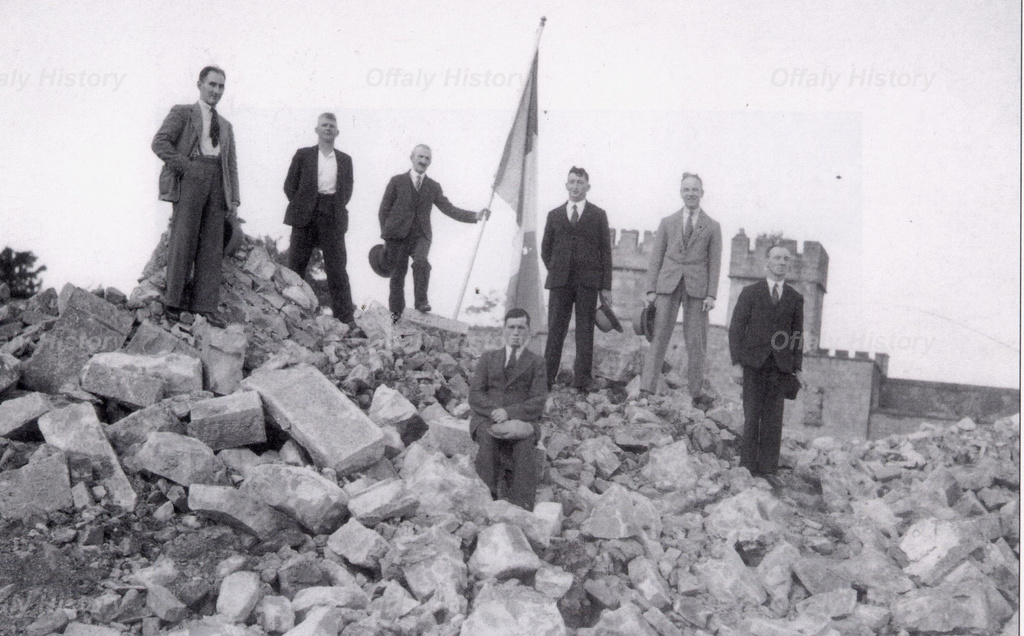
After the burning of the jail in July1922 by retreating Republican forces it lay robbed and in ruins until selected as a location for the new Salts Woollen Mills in 1937 and opened in 1938. It was a huge success and contributed up to 1,000 jobs to Tullamore and the midlands up to the 1960s. With the expansion of free trade textiles suffered and Salts/Tullamore Yarns finally closed in 1982 with the loss of the last 120 jobs. You can read more about Salts in Tullamore in the Sixties (2024).
John Flanagan and Kilcruttin Business Park
The 1980s was a bad time for business, jobs, families with emigration increasing and population declining. John Flanagan had first started with a small enterprise centre in Tanyard Lane in the 1970s. Now, as the contract for the building of the new church in Tullamore was nearing completion, he was ready for another push to attract and promote local development. John Flanagan acquired this very large premises and built it up it up to a significant number of enterprises. Today Kilcruttin Business Park has 30 businesses and services operating on the Kilcruttin site. Between those working there and the pupils and trainees attending the educational and training services there are over 300 people working or studying at Kilcruttin. As to its management it is led by Tony Flanagan assisted by family members and a loyal support staff.

In this short review we can see the need for not one but three books to record the memories and stories of all concerned with the transition to a county town in 1832 with fine public buildings by way of a county jail (90 years) and county courthouse, the new railway station of 1865, Salts factory for 45 years and now the web of businesses in Kilcruttin for over forty years.
Perhaps there is a master class here in the decisions we take and the life we make. We need to celebrate all concerned in the development of this industrious setting over the last 200 years.
 offalyhistoryblog