
The foundation stone for the Tullamore jail was laid on 13 September 1826 just 200 years ago. Two hundred years of history as we pass those gates of what is now Kilcruttin Business Park. We may wonder at what went on there over 200 years. In many ways the former jail encapsulates the history of Tullamore since the 1820s. When the jail was built Tullamore was not yet the county town. There was no railway until 1859 at this location. No road up from Kilcruttin until 1938, Lloyd Town Park was agricultural land with an old out-of-town cemetery nearby. Only the ‘Charleville Parade’ houses north of the courthouse were built. The courthouse was not completed until 1835. The jail was designed to accommodate 120 prisoners and had double that number during the Famine years of the late 1840s. It was well run on reform lines but Victorian prisons were tough places.
(more…)Category: Criminal law
-
An opportunity to see the old Tullamore jail and hear of its turbulent history in the 1880s, 28 March, Saturday from 10.00 a.m. A welcome to all and meet local history enthusiasts for coffee at 10 and the book launch at 11 a.m. An Offaly History blog, no. 788, 27 March 2026.
28 March Saturday at 11.00 a.m. at the former Tullamore Prison/Kilcruttin Business Park, Cormac Street, Tullamore, for the Launch of a new edition of Prison Poems or Lays of Tullamore by T.D. Sullivan, edited by Terry Moylan and Padráig Turley. Sullivan like William O’Brien and John Mandeville were political prisoners who refused to wear the prison clothes.
See Cormac Street from a new perspective
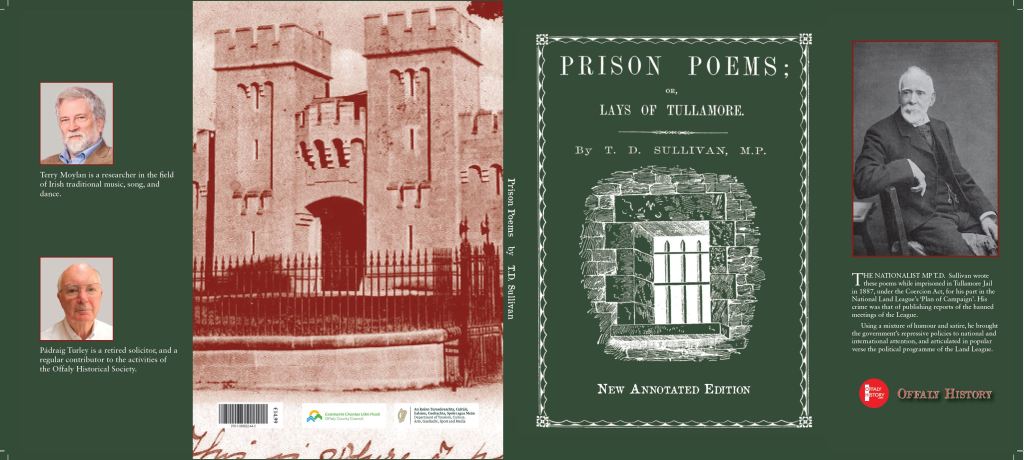
Jacket of the new edition of Prison Poems Today we are reminded of the jail every time we stop at the lights at the junction with Cormac Street, Kilcruttin and Charleville Road and look to the magnificent limestone façade, memorial tablet, jail warders’ cottages and the very fine gates with their Roman fasces to remind us of the symbols of authority back to early times. Then who has not heard of the underground passage (now mostly closed off) that allowed the prisoners to be brought into one of the two semi-circular courts in the old pre-1922 courthouse.
(more…)
-
Tullamore Jail moves the muse in T.D. Sullivan, Lord Mayor of Dublin. The new annotated edition of Prison Poems; or Lays of Tullamore (1888, new edition 2025). By Terry Moylan and Pádraig Turley. To be launched at Tullamore Prison gates, Cormac Street on Saturday 28 March at 11 a.m. Blog 787 21.3.2026
The new edition of Prison Poems or Lays of Tullamore by T.D. Sullivan, now edited by Terry Moylan and Padráig Turley, will be launched on Saturday 28 March at 11 a.m. at Cormac Street entrance to the old prison. Coffee will be available from 10 a.m. at Tullamore market Spollanstown to the rear of the old prison, now Kilcruttin Centre.. Parking is available at the farmers’ market, Spollanstown and at the Cormac Street frontage to the old jail (best approached from Cormac St to take a left turn into the jail/Kilcruttin Centre). Pedestrian access only will be available from the market to the front of the jail from 10 to 12 noon The book can be ordered online from Offaly History or purchased on the day or later at Offaly History Centre and Midland Books.
28 March Saturday at 11.00 a.m. at the former Tullamore Prison/Kilcruttin Business Park, Cormac Street, Tullamore,
The plan is to meet in the farmers’ market, Spollanstown for coffee from 10 a.m. and process at 10 45 to the front hall of the jail for the launch. Tony Flanagan has kindly sponsored the coffee in the market and OH will distribute a voucher ticket to those attending the book launch.
The book will be launched by Michael Hanna who gave the lecture in December 2025.
The launch should take about thirty minutes.
The speakers are:
Chair of Offaly History Shaun Wrafter welcomes the speakers
Padraig Turley, a co-editor, on the author T.D. Sullivan
Terry Moylan, co-editor, on the Poems
Delcan Harvey Cathaoirleach of Tullamore Municipal
Michael Hanna to launch – on the jail, medical men and the new book. Michael Hanna is the author of Irish General Practice: the long story. He spoke on medical doctors at Tullamore prison in the 1880s in the course of his lecture to Offaly History in December 2025.
Michael Byrne, General Secretary Offaly History, to close and thanks to all.
[Before moving to the article Offaly History wish to congratulate the authors/editors on the issue of the new annotated edition of Prison Poems; or Lays of Tullamore from Terry Moylan and Pádraig Turley and published by Offaly History with the support of the Decade of Commemorations funding. The book is now on sale and is available from Offaly History Bury Quay and online at www.offalyhistory.com. Ed.]
Timothy Daniel Sullivan MP and Lord Mayor of Dublin published Prison Poems; or Lays of Tullamore in 1888, printed by The Nation at 90 Middle Abbey Street, Dublin. What are these about? What made Sullivan write them?
(more…)
-
The incarceration of T.D. Sullivan – Lord Mayor of Dublin – in Tullamore jail, December 1887. Published (13.3.2026) to mark the launch of the new edition of Sullivan’s Prison Poems: Lays of Tullamore at Tullamore jail/Kilcruttin Centre, Cormac Street, on Saturday 28 March 2026 at 11 a.m. Blog no. 785 in the Offaly History Series. By Martin Hoctor.
T.D. Sullivan was one of the most high-profile political figures to be targeted by the London administration under the Crimes Act for publishing what they considered dangerous material that could incite opposition and violence against the police from carrying out their duties of evicting tenants who were unable to pay their rents. The Irish National League was established with the aims of bringing about the end of rack-rents (extortionate rents) and ownership of the soil by the occupier and a nationwide fund was in place for several years to prevent as many evictions as possible. However, publicising this opposition and encouraging the people to come together in the newspapers now placed a target on the backs of editors who began to be arrested and imprisoned for encouraging the ‘Plan of Campaign’ and Sullivan was the latest editor to be arrested and conveyed to the notorious Tullamore Jail. He arrived in Tullamore on December 7 1887 and upon his arrival met the Governor of the Prison, Captain Fetherstonhaugh, who was extremely frosty in his reception to such an illustrious new inmate and Sullivan was astonished to learn that despite his being regarded as a first class misdemeanant, he would be sharing a cell with other inmates. The Tullamore Town Commissioners were immediately on the ball to try and make contact with the political prisoners now incarcerated and to assess their wellbeing in this institution that gained notoriety for its deplorable unsanitary conditions and the treatment of the prisoners subjected to hard labour.
(more…)
-
Tullamore Jail moves the muse in T.D. Sullivan. The new annotated edition of Prison Poems; or Lays of Tullamore (1888, new edition 2025). By Terry Moylan and Pádraig Turley. Blog No 762, 26th Nov. 2025
Timothy Daniel Sullivan MP published Prison Poems; or Lays of Tullamore in 1888, printed by The Nation at 90 Middle Abbey Street, Dublin. What are these about? What made Sullivan write them?
[Before moving to that we wish to congratulate the authors on the issue of the new annotated edition of Prison Poems; or Lays of Tullamore from Terry Moylan and Pádraig Turley and published by Offaly History with the support of the Decade of Commemorations funding. The book is now on sale and is available from Offaly History Bury Quay and online at www.offalyhistory.com. Ed.]
These were written during a most tempestuous, unsettled, tumultuous decade in Irish history, the 1880s. The Land War was at its height under the leadership of Charles S. Parnell. The campaign for Home Rule had turned to dust. William Ewart Gladstone the British Prime Minister had brought forward a Home Rule Bill in 1886, which by today`s criteria might appear modest, but for its time was seen as revolutionary. This set off alarm bells which would do irreparable damage to the ruling Liberal Party.
(more…)
-
The Law of the Innocents, Birr 697 AD. By Jim Houlihan. Blog No 525, 20th Sept 2023
In a time of war in eastern Europe and the coming to an end of the Decade of Centenaries period in Ireland, 1912–23 with the cessation of the civil war, here we today publish the second of two blogs on the protection of innocent people in times of strife. The article is by Jim Houlihan and on Monday 25 Sept. Dr Houlihan will give a lecture on Adomnán’s Law of the Innocents-Birr 697 AD. at Offaly History Centre, Bury Quay, Tullamore (and online) at 8 p.m. More details of his talk and online booking for Zoom see our FB post @offalyhistory. Our thanks to John Dolan for the first article and to Jim Houlihan for this article and his forthcoming talk.
Early in the summer of the year 697, probably in May, a great assembly of kings, bishops and abbots, along with their followers and servants, took place in Birr. It was a joint meeting of kings (rígdál) and of church leaders (synod). They came together to proclaim a law for the protection of women, children, clerics and other people who did not bear arms, in times of conflict. The law was called Cáin Adomnáin or the ‘Law of the Innocents’ (Lex Innocentium) and later referred to in a poem as the ‘Great Law of Bir
(more…)
-
The shooting of Jack Finlay of D.E. Williams, Tullamore, in a robbery at Lemanaghan, Ballycumber, County Offaly on 12 February 1923. By Jackie Finlay. A contribution to the Decade of Centenaries. Blog No 463, 11th Feb 2023
My story starts as a small boy growing up in Dillon Street, Tullamore in the 1940s. I remember seeing a cutting from a newspaper which I presumed was from a Tipperary weekly paper. The article covered a report of a feis and sports held in a field at the Golden Vale Hotel in Dundrum Co. Tipperary. It mentioned about the Misses Crummy from Ballydine taking part in the Irish dancing. A small report on the opposite side of the cutting was headed
Shooting near Birr. Charged at Birr with conspiring in 1923 to kill and killing John Finlay, Tullamore. Chas and Peter Molloy and Michael Coyne were sent for trial.
What is so unusual about this paper cutting from 1923?
My mother, one of the Misses Crummy mentioned in the article, was now working in Tullamore for T. English & Co. She met and married my father Thomas, brother of John Finlay some ten years later.
(more…)
-
The District Court in Offaly is 100 years old, January 2023. A contribution from Offaly History to the Decade of Centenaries. Blog No 454, 11th Jan 2023
The commencement of the new District Court in Offaly in January 1923 was an inauspicious time to start. The county was caught up in the civil war that it seemed neither side could win. The Free State (National Army) had taken all the cities by August 1922, but the fight was still going on in the hills, especially in the south. Neither Tullamore nor Birr was free of anxiety with shots fired on New Year’s Eve to remind people that the Republicans had not gone away. How could they forget? In January 1923 two men from Kilkenny were executed for possession of arms and robbery. Soon after five National soldiers captured with a body of anti-Government forces were executed – a courtmartial having found them guilty of treachery. Five from County Offaly were executed in January and early February. In the same month there had been an attack at Raheen in north Offaly – an ambush while soldiers were going to mass with at least one dead. Some of the neutral IRA were talking about ending the conflict and the press reported that Peadar Bracken ex Brigade officer, Thomas Ua Quinn ex Vice Commdt, and Martin Fleming, ex Brigade staff officer, had called a meeting of pre-truce ex officers of nos 1 and 2 Offaly Brigades IRA at the old Sinn Féin hall regarding the peace movement. Peadar Bracken would know the place well as he was involved in the ‘affray’ in 1916 where ‘the first shot was fired’ in that very hall in William/Columcille street, Tullamore.
(more…)
-
Building Offaly’s courthouses and prisons in the eighteenth and nineteenth centuries. Blog No 398, 9th July 2022
Dr Richard Butler will showcase the building of Offaly’s courthouses and prisons in the years between roughly 1750 and 1850 in a lecture at Offaly History Centre, Bury Quay, Tullamore and via Zoom on Tuesday 12 July 2022. The presentation will place individual buildings in Tullamore, Birr, Daingean and elsewhere in the context of changing political and social events throughout Ireland in these years, highlighting local agendas alongside those of the British administration in Ireland. Illustrated with historic architectural drawings, old and new photographs, the lecture will also highlight schemes that were never built as it traces the ways in which the appearance of Offaly’s towns was transformed in these years by new public architecture. The lecture will incorporate new research on Offaly’s history undertaken in recent years by historians based in the county such as Michael Byrne alongside volumes such as Andrew Tierney’s new Buildings of Ireland guide for Central Leinster and the speaker’s recently published book, Building the Irish Courthouse and Prison: A Political History (Cork University Press, 2020).
(more…)
 offalyhistoryblog