
The foundation stone for the Tullamore jail was laid on 13 September 1826 just 200 years ago. Two hundred years of history as we pass those gates of what is now Kilcruttin Business Park. We may wonder at what went on there over 200 years. In many ways the former jail encapsulates the history of Tullamore since the 1820s. When the jail was built Tullamore was not yet the county town. There was no railway until 1859 at this location. No road up from Kilcruttin until 1938, Lloyd Town Park was agricultural land with an old out-of-town cemetery nearby. Only the ‘Charleville Parade’ houses north of the courthouse were built. The courthouse was not completed until 1835. The jail was designed to accommodate 120 prisoners and had double that number during the Famine years of the late 1840s. It was well run on reform lines but Victorian prisons were tough places.
(more…)Category: Quarrying/ stone
-
Birr Town Commissioners and The Grand Jury: Decades of Confrontation. By Martin Hoctor. Blog no. 815 in the Offaly History Series, 4.9.2026
In 1852 Birr in King’s County decided to have a town commission/council in an attempt to improve facilities in the town that had aspirations to be the county town in the 1640s and perhaps up to the 1780s. The earl of Charleville ensured that Tullamore was named as the capital of King’s County after legislation was passed in the House of Commons in 1832 before becoming the capital town in 1835. This was by way of becoming the chief assize town with the full apparatus of county courthouse and jail.
How people travelled in the country towns in the midlands during these years is a mystery as the state of the roads were an absolute disgrace from mud and horse droppings that made travel impossible and unhealthy as the threat of cholera and typhoid fever was prevalent in the country and killed more people than the years of the Great Famine. Indeed, King’s County despite a low death rate from 1847 experienced emigration to an unprecedented level and Birr was no exception as the town suffered a serious decline in the population in the post-famine period.
(more…)
-
Part 6 – The Jageurs Stonecutters: The limestone quarries of Ballyduff, Tullamore. By John Wrafter. No 796 in the Offaly History Blog Series. 15.5.2026
This article is the sixth in a series on the stonecutters of Tullamore, particularly those associated with the limestone quarries of Ballyduff on the outskirts of the town.
When I began researching the quarries and the men who worked there, I thought I might find enough material for one or two articles. Instead, a much wider story has come to light—one shaped not only by local industry, but also by migration and opportunity.
One of the most striking features of that story is the number of stonecutters who, having learned their trade in Tullamore, chose to emigrate. This was not unusual in nineteenth-century Ireland, but what is interesting in this case is that many of these men were not driven by poverty. They had skills and could make a living at home. Even so, many chose to leave, drawn by the hope of a better future for themselves and their families.
Unlike most Irish emigrants of the time, most of the Tullamore stonecutters went to Australia, where they helped to build a growing society. Among them were members of the Jageurs family, whose story gives a good insight into this wider pattern.
(more…)
-
An opportunity to see the old Tullamore jail and hear of its turbulent history in the 1880s, 28 March, Saturday from 10.00 a.m. A welcome to all and meet local history enthusiasts for coffee at 10 and the book launch at 11 a.m. An Offaly History blog, no. 788, 27 March 2026.
28 March Saturday at 11.00 a.m. at the former Tullamore Prison/Kilcruttin Business Park, Cormac Street, Tullamore, for the Launch of a new edition of Prison Poems or Lays of Tullamore by T.D. Sullivan, edited by Terry Moylan and Padráig Turley. Sullivan like William O’Brien and John Mandeville were political prisoners who refused to wear the prison clothes.
See Cormac Street from a new perspective
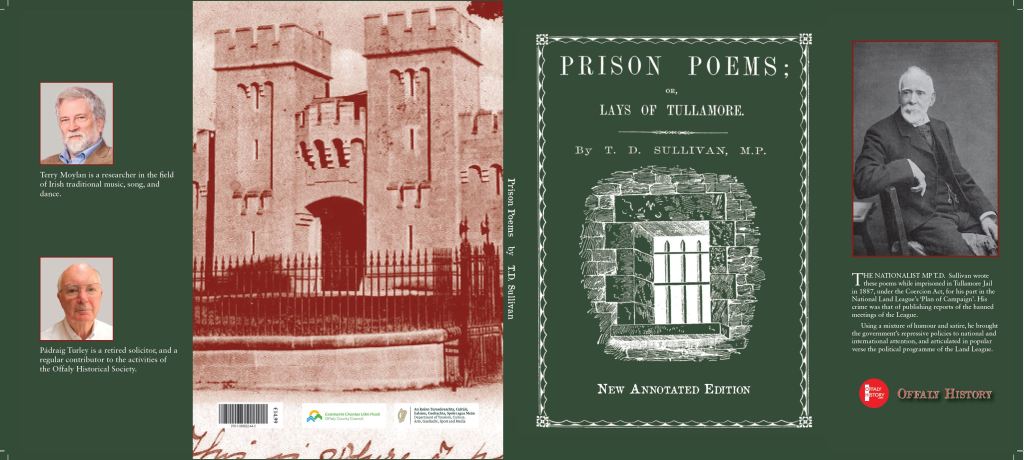
Jacket of the new edition of Prison Poems Today we are reminded of the jail every time we stop at the lights at the junction with Cormac Street, Kilcruttin and Charleville Road and look to the magnificent limestone façade, memorial tablet, jail warders’ cottages and the very fine gates with their Roman fasces to remind us of the symbols of authority back to early times. Then who has not heard of the underground passage (now mostly closed off) that allowed the prisoners to be brought into one of the two semi-circular courts in the old pre-1922 courthouse.
(more…)
-
The leasing of plots or sites for building in Church Street, Tullamore from Lord Charleville to his tenants, 1786–c. 1835.By Michael Byrne and Offaly History. Offaly History series, Church Street, Tullamore: houses, businesses and families, over 300 years. No. 8 in the 2025 Living in towns series prepared with the support of the Heritage Council. Blog No 750, 24th Sept 2025
Church Street is unusual in Tullamore in that it does not have a common width throughout and its lower half, closest to the town centre, is clearly earlier than the upper half from the Methodist church to the Pound Bridge over Tullamore River. While the building pattern is now post 1786 in date it did have at least two earlier buildings in the Protestant church built by Mrs Ellen Moore in 1726. She was the mother of the first Lord Tullamore who died in 1725. Charles the second Lord Tullamore succeeded while still a minor, having been born in 1712.[1] In an earlier article we reproduced maps from the 1770s depicting the church and noted that the building was shown on the on the 1730 Mountrath (Coote) estate map. The church stood in what was post 1820 the yard shown as The Shambles and was not aligned to the later street.[2]
(more…)
-
Local Heritage and Family History Course: Sources and Methods, 24 September to 26 November 2025 (ten sessions of two hours each) at Offaly History Centre, Bury Quay, Tullamore. Blog No 747, 13th Sept 2025
What? The course will give an overview of the sources and methods for the study of the archaeology, community and family history of County Offaly, and how to do research on areas that may interest you in local and family history. Thematic sessions will be delivered by experienced local scholars, who will introduce participants both to physical sources and to online resources. Offaly is taken as the example, but most of the records will have application for the entire country.
When? All talks will be held on Wednesday nights, from 7.30 to 9.30 pm.
Where? Offaly History Centre, Bury Quay, Tullamore, Co. Offaly, R35 Y5V0

Fees? The course fee for all ten sessions is €50, payable to the Offaly Heritage Centre at the time of booking. Please provide your credit or debit card details when booking, or visit the shop Monday–Friday, 9:30 am–4:30 pm.
Alternatively, payment can be made by bank transfer: Best contact us first as only a few places are left.
This course is supported by the Heritage Council and Offaly County Council.
Places are limited to 25 participants, so early booking is strongly advised.Please call or email us to check availability and make your booking
(more…)
-
George Petrie (1790–1866) a key landscape painter for Offaly’s heritage of ruins on the landscape: Clonmacnoise. No 8 in a series on the paintings and drawings heritage of County Offaly, 1750-2000, explored through the works of artists from or associated with County Offaly. By Michael Byrne. Blog No 726, 28th June 2025
Let Erin remember the days of old
Alongside John O’Donovan and Eugene O’Curry the name of George Petrie (1790–1866) will forever be remembered as one of Ireland’s greatest scholars of the first half of the nineteenth century. It was a time when tremendous work was done for Irish archaeology and history. Petrie was a major figure in the historical research section of the Ordnance Survey. Jeanne Sheehy in her The Rediscovery of Ireland’s Past 1830–1930 states that he was the founder of systematic and scientific archaeology in Ireland.
Petrie was involved in the work of the Ordnance Survey from 1833 for ten years. He was very much a polymath and in his late years published a volume of Irish music arising from his efforts to collect and preserve old Irish music.
(more…)
-
The Offaly County Hospital Tullamore: The Fruits of Independence. By Fergal MacCabe. No 5 in a series on the paintings and drawings heritage of County Offaly, 1750-2000, explored through the works of artists from or associated with County Offaly. Offaly History Blog No 718, 4th June 2025
In the early days of the Irish Free State two ambitious projects stood out as justifying the struggle for national independence.
In 1925, out of a total national budget of £25 million, the fledgling government bravely invested £5.2 in the Shannon Hydro Electric Scheme. Finished within four years, it ensured a degree of energy autonomy and dramatically improved living conditions, particularly in towns and later in rural areas.
In a second progressive advance the State embarked on a programme to build a modern hospital in every county.
(more…)
-
Kilcruttin’s Forgotten People. Recapturing memories of Tullamore in the Sixties by Terry Adams. Blog No 676, 3rd Dec 2024
One of the essays in the new book on Tullamore in the Sixties to be launched on Friday 6 December 2024 at 7.30 p.m. at Offaly History Centre (beside the new Aldi store in Tullamore, all welcome) is that by Terry Adams on his beloved Cormac Street, Tullamore where his family have been located for 150 years or thereabouts. Terry’s is an evocative piece and one of 29 essays in this new book on Tullamore with over 300 pictures.
I stood with my back to Lloyd’s field, surrounded by memories of childhood and family. On my left, back towards the town, my Grandmother Egan’s family home, The Hall, now the municipal council offices, nestles behind its railings and garden. Opposite, on the junction of Cormac Street and O’Moore Street, stands the building I was born in, now home to my brother Brian. My Adams grandparents’ house faces me across the street. Further along the imposing old courthouse and jail buildings sit in their solemn majesty.
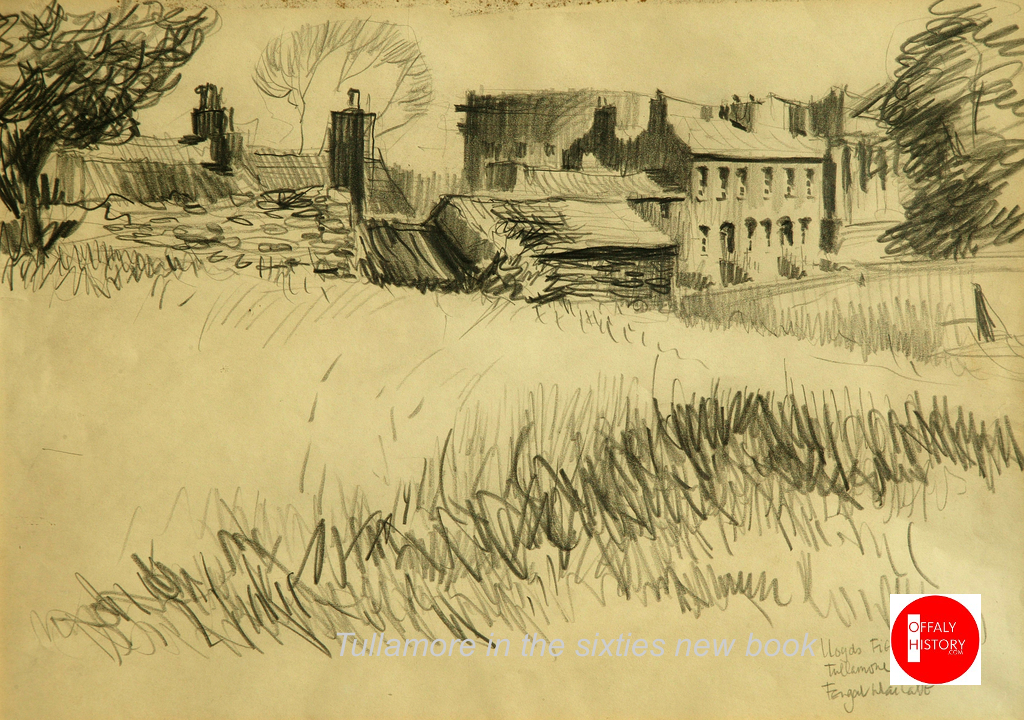
The view from Kilcruttin Hill courtesy of Fergal MacCabe Cormac Street, my street, even if I have not lived here since 1981. When I think of home it is to this street, to these buildings, my mind roams. It is a major part of me, of my identity, of who I am, of who I always will be. I look back towards the town centre, the street has changed little since my childhood. The house exteriors, excluding The Hall, have not been radically altered but most of their old occupants have left us: my father, also Terry, Frank and Carmel Egan, Ray and Sylvia Courtney, Ray and Emer McCann, Mr and Mrs McNeill, Mr and Mrs Brennan, Bridie Byrne, Jimmy and Marcella Byrne, Mrs Behan, Paddy and Mrs. Lloyd……
(more…)
-
Remembering Josephine Warren of ‘Tay’ Lane and Marian Place, Tullamore. By Cecilia Warren with a transcript of a 2006 recording of Josephine Warren talking about life at Tay Lane/officially called O’Connell Street, Tullamore. Blog No 673, 27th Nov 2024
The recording of my mother Josephine was made in 2006 as part of my research on local history and my mother’s interpretation of it. At the time, little did I know the significance that it would have, not just from a local history record perspective but also in a deeply personal context.
Our family connection here in Tullamore began in 1923, when a young Dublin native, Josephine Moore came to work at McCann’s as a housekeeper. This building later became the Tullamore Enterprise board ( now occupied by Jigsaw) Cormac Street. She married William Gorman, a local man. My mother, also called Josephine, was born in 1928. Mum left school aged 14 and she would have been the first to admit that she lacked a proper education. In those unkinder days, walking to school barefoot and being put to clean up in the home economics room by the nuns after the wealthier girls had cooked was all too often a regularity. She would have liked to have had a career as a nurse she often said.
(more…)