
This article is the sixth in a series on the stonecutters of Tullamore, particularly those associated with the limestone quarries of Ballyduff on the outskirts of the town.
When I began researching the quarries and the men who worked there, I thought I might find enough material for one or two articles. Instead, a much wider story has come to light—one shaped not only by local industry, but also by migration and opportunity.
One of the most striking features of that story is the number of stonecutters who, having learned their trade in Tullamore, chose to emigrate. This was not unusual in nineteenth-century Ireland, but what is interesting in this case is that many of these men were not driven by poverty. They had skills and could make a living at home. Even so, many chose to leave, drawn by the hope of a better future for themselves and their families.
Unlike most Irish emigrants of the time, most of the Tullamore stonecutters went to Australia, where they helped to build a growing society. Among them were members of the Jageurs family, whose story gives a good insight into this wider pattern.
Peter Jageurs: From Tullamore to Melbourne
Peter Jageurs (or Jaggers, as it was spelt in Ireland) was born in Tullamore in 1835 into a family of stonecutters. His father, Morgan, moved from Stradbally to Tullamore where, in 1823, he married Elizabeth Horan from an established stonecutting family.
The family’s roots were not originally Irish. His grandfather had come to Ireland from England in the late eighteenth century, and earlier still the family is thought to have had German origins. By the early nineteenth century, however, they were well established in the Midlands, working as stonecutters in both Stradbally and Tullamore.
As a young man, Peter became foreman to the sculptors Molloy and Fitzpatrick in Tullamore and Dublin. In 1861, he married Mary Casey of Philipstown (now Daingean), and the couple soon had two children, Morgan and Mary.
At the time, the family lived on Clara Road, close to the Ballyduff quarries where Peter worked. He was clearly a skilled craftsman; according to his obituary, one of his Celtic crosses won first prize at the Dublin Exhibition of 1865.
Like many people of the time, Peter decided to leave Ireland in search of a better future. In 1865, he emigrated to Australia with his wife and young children, travelling on the Landsborough. The family settled first in Brisbane, and later moved through Sydney before eventually settling in Melbourne.
There, in 1870, Peter set up a successful business in monumental masonry. He worked on both headstones and larger architectural pieces, including the entrance gates of Melbourne University in 1876. He was also one of the first sculptors to introduce the Celtic cross to Australian cemeteries.
Peter remained active in Irish community life in Australia and died in Melbourne in 1923 at the age of 89.
Morgan Jageurs: Craft and Identity
If Peter established the family’s name in Australia, it was his son Morgan who built on it.
Morgan was born in Tullamore in 1862, shortly before the family emigrated. Like his father, he became a stonecutter, and together they ran the business Jageurs and Son, Monumental Sculptors. Over time, they became a well-known firm in Melbourne.
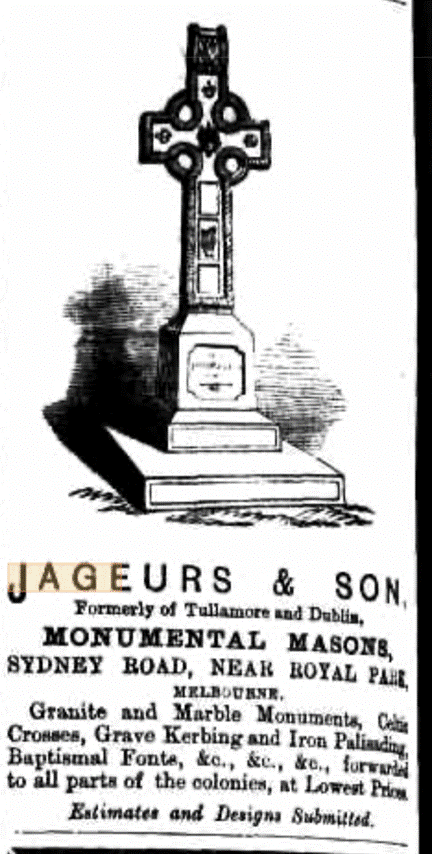
Fig. 1. Newspaper advertisement for the services of Jageurs and Son (Melbourne, 1880)
Their work often drew on Irish designs, including round towers and Celtic crosses. Morgan returned to Ireland in 1890 and again in 1901, and these visits may have influenced his work. The historian Pamela O’Neill has described him as a highly skilled monumental mason and has suggested that his designs also reflected a sense of Irish identity among emigrants.
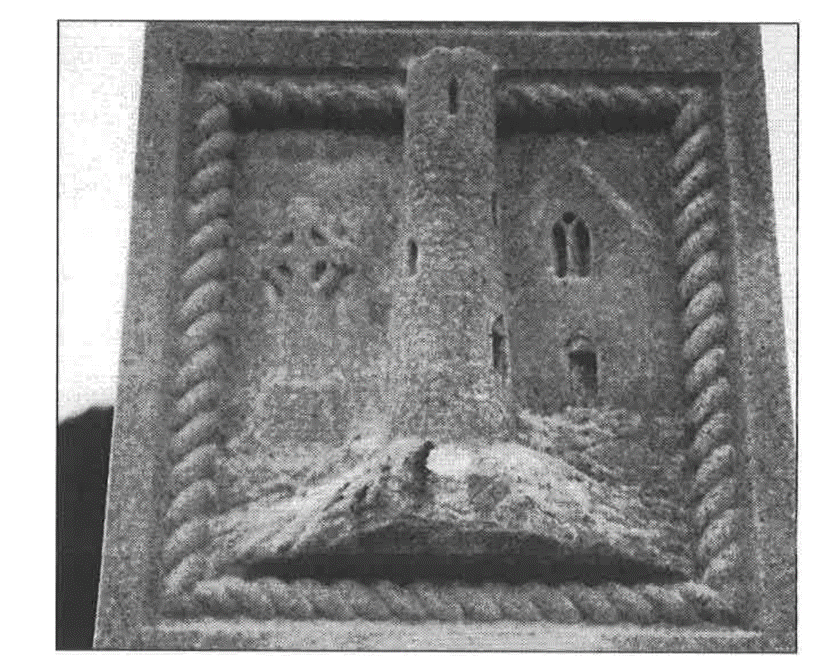
Fig.2. Part of memorial monument to Patrick Moloney (died 1888) made by Jageurs and Son.
The firm also carried out work for churches, producing altars and other stone pieces across Australia. In the 1890s, they erected an altar in St Patrick’s Cathedral in Melbourne, and in 1893 completed another in St Mary’s Church in Maffra using stone brought from Ireland.
Morgan was also very active in Irish political life in Australia. He supported the Home Rule movement and took part in Irish organisations in Melbourne. His involvement brought him into contact with leading figures of the time. During Michael Davitt’s visit to Australia in 1895, he attended the christening of Morgan’s eldest son and is said to have advised against using the name “Michael,” saying it had “never brought him any luck.” The child was instead named John Davitt Jageurs.
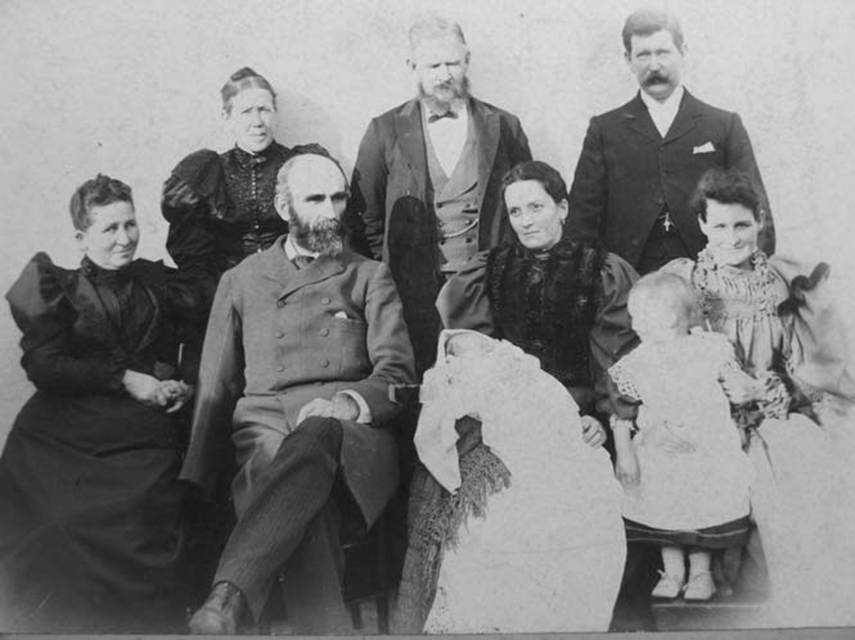
Fig. 3. Photograph taken in connection with the baptism of John Davitt Jageurs in 1895. (back) Mary Jageurs (grandmother), Peter Jageurs (grandfather), Morgan Jageurs (father), (front) Elizabeth Bartley (grandmother), Michael Davitt (godfather), John Davitt Jageurs, Mary O’Donnell (godmother), Mary Jageurs (sister), Dena Jageurs (mother). Photo is from the private collection of Kerry Blanc and reproduced in an article by Pamela O’Neill in the Australasian Journal of Irish Studies in 2007.[1]
Morgan followed Irish affairs closely and often wrote letters to newspapers. As politics in Ireland became more radical, he remained a supporter of Home Rule, which brought him into disagreement with some others in the Irish-Australian community. In 1916, he was charged under wartime regulations for speaking out on Irish political issues.
Alongside this, he had a strong interest in Irish music and culture and served as president of the Irish Pipers Association.
Morgan died in 1932.
John Davitt Jageurs: A Life Cut Short
The next generation of the family took a very different path.
Morgan’s eldest son, John Davitt Jageurs, was born in Australia but grew up with a strong sense of Irish identity. He was involved in Irish cultural groups and had a deep interest in Irish music and art.
When the First World War broke out, he was keen to join the Australian army. His father was at first against the idea, but John wrote to him making his case. In his letter, he rejected the idea that his German-sounding surname should count against him:
“I am, as you well know, of true Irish blood descent, German only in name and Irish Australian to the backbone.”
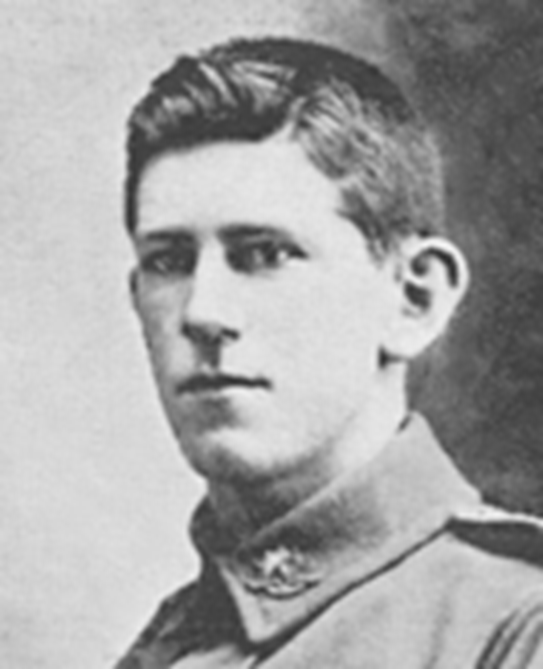
Fig. 4. Corporal John Davitt Jageurs.
He later enlisted and served at Gallipoli, where he was badly wounded. After recovering in Malta and England, he paid a short visit to Tullamore, where he met relatives and spent time with local nationalist groups.
He then rejoined his unit and was sent to France. He was killed at Pozières on 29 July 1916, just weeks after his twenty-first birthday.
His death had a deep impact on his family. In 1925, a memorial was erected in Parkville, Melbourne, to local soldiers who died in the war. Morgan Jageurs was commissioned to design it. Among the names on the monument was that of his own son—Corporal John D. Jageurs.
A Family Tradition
The story of John Davitt Jageurs is a sad one, but it is only one part of the wider family history.
Other members of the Jageurs family continued to work as stonecutters, both in Ireland and in Australia. For example, Bernard Jaguers, born about 1843 in Tullamore, with his wife and their four or five children emigrated to Melbourne, Australia in 1882, almost 20 years later than his brother Peter. Three of the sons, Thomas, Peter and Bernard, followed their father into the stonecutting trade.
In Tullamore and Stradbally, as well as in Melbourne, the trade was passed down from one generation to the next. The last stonecutter bearing the name of Jagger in Tullamore, and probably in Ireland, was Thomas Jagger who lived on Clontarf Road up to the 1950’s. He died in 1963, aged 88.
In total, at least fifteen members of the family, over five generations from around 1800 into the twentieth century, worked as stonecutters.
From the quarries of Ballyduff to the cemeteries of Melbourne, the Jageurs family left their mark in stone. Their story reflects a wider pattern—of skilled workers who carried their trade, and part of their identity, across the world.
[1] Pamela O’Neill, ‘Michael Davitt and John Davitt Jageurs (1895-1916),’ Australasian Journal of Irish Studies 6 (2006/7) 43-56.

