
A new study of Offaly’s two Great Houses at Birr and Charleville, Tullamore just published
Two of the great houses of Ireland, are here in County Offaly at Birr and Tullamore. Both regularly feature in articles and magazine stories. Birr Castle much more so as it has been the family home of the Parsons family, earls of Rosse, since the 1620s. The present earl and his wife from the death of the sixth earl in 1979, have worked for almost fifty years to promote the castle and gardens for the benefit for tourism and build on the enthusiasm of the sixth earl to create a science museum commemorating the work of the third and fourth earls and that of Charles Parsons, the engineer who helped win the First World War. Both earls worked tirelessly for the gardens at Birr Castle.
The Gothic at Charleville
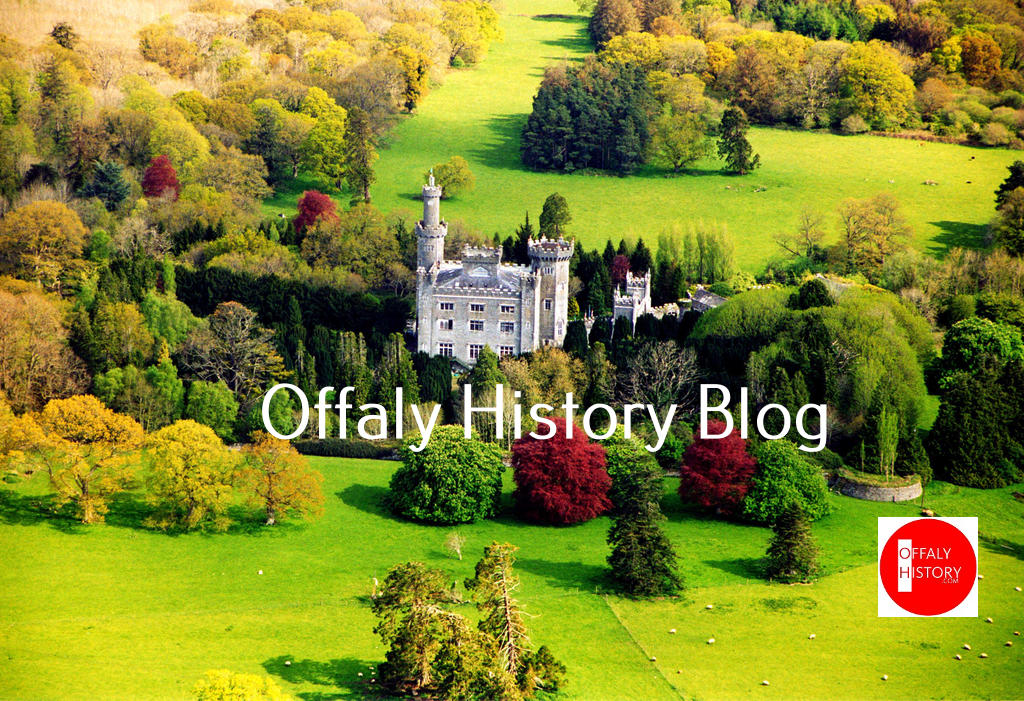
Charleville Castle is equally exciting, but the Bury family experienced many vicissitudes from the want of sufficient cash to truly enjoy a Gothic castle as grand as Charleville and to live to the standard required of such a great house. The first Bury earl sought honours and was created Lord Tullamore in 1797 and earl of Charleville in 1806. He owned Tullamore but of course it was the merchants who built almost all of the town on favourable leases from the earl and his great uncle Charles Moore. Moore and Bury created the demesne that is Charlville today and known and enjoyed by so many people. The first Bury earl spent a lot of time abroad, and he and his son spent too much money on the great house and on parliamentary elections, despite a substantial income. The young Lord Tullamore, unlike Lord Oxmantown (1800–67) in Birr, was not successful in the marriage market. His wife was charming, grace there was plenty of but cash was in short supply. She died in Naples in 1848 and Lord Tullamore in 1851. His three successors died within 24 years from 1851. The second earl was a tory in politics, but had he been a little more political he would have gained the second parliamentary seat in the county and been acclaimed as he so much needed. He was an only child with a clever step brother and step sister who did make his feel inadequate.
The young Lord Tullamore (1801–51, the second earl from 1835) had his parents’ fondness for the Gothic style and wanted the Tullamore courthouse to be in the Gothic style, like the jail beside it which was built in 1826–30. The courthouse was finished in two years and ready for the assizes in 1835 – the year of the first earl’s death. His wife, Catherine Maria Bury died in 1851 – in the same year as her son.
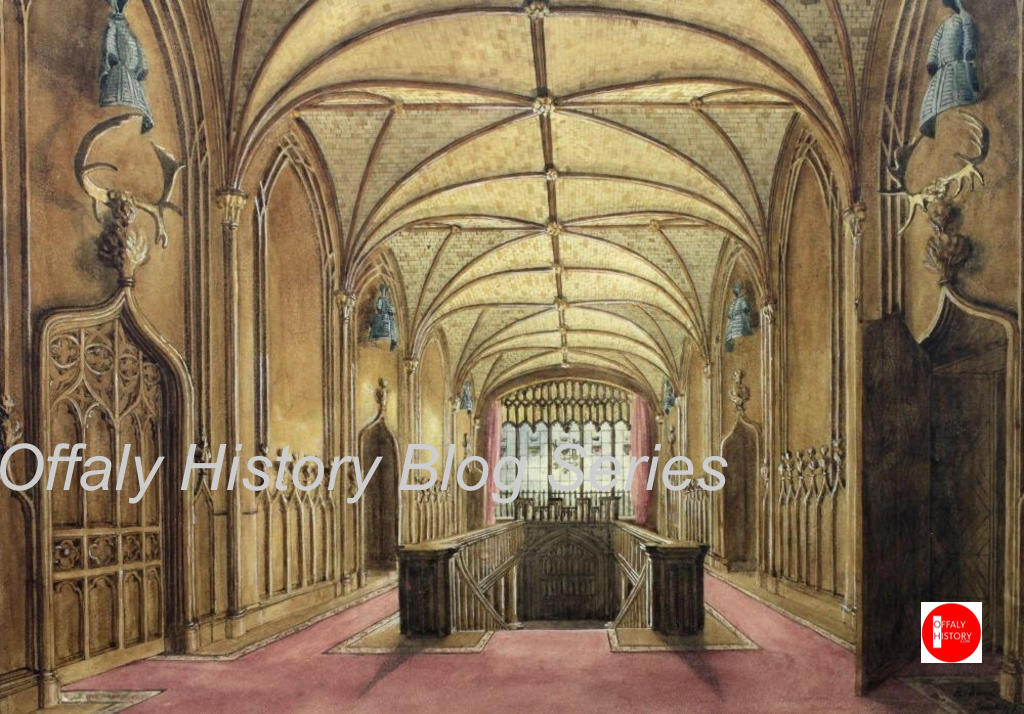
The two great houses, built in the Gothic style, are the subject of this new book by architectural historian Judith Hill and it is the first detailed study of the planning and research that went into creating these architectural works that were and are important. The comparative aspect in looking at the thought process and creative genius of the two earls (Rosse and Charleville) makes this study particularly valuable.
We assume that both castles will continue to be there without intervention, but of course they both need significant ongoing support. Both are open to the public and fascinating to view. The great sales at Charleville in 1948 and at Belvedere in 1980 (the home of Colonel Bury from 1912 who was the only surviving child of Lady Emily Bury and a great grandson of the third earl) denuded Charleville of some of its great treasures. And yet the architectural detail is there in all its glory and now we can learn more about it.
Judith Hill was invited to write for the Offaly History Blog Series and kindly provided the note below on her new book. You will have an opportunity to meet her at the launch of her book in Tullamore on Thursday 25 June at Offaly History Centre at 5 p.m. All are welcome.
Gothic: building castles in post-Union Ireland – Judith Hill
On Thursday 12 October 1809 the viceroy and his entourage visited the recently completed Charleville Castle as part of an extended tour of Ireland. It was the first viceregal tour undertaken since the passing of the act of union between Great Britain and Ireland in 1800, and the viceroy was keen to assert his role in Ireland. The inhabitants of the towns and cities and the owners of the great houses that he visited were equally keen to make their mark with the viceroy and the government he represented.
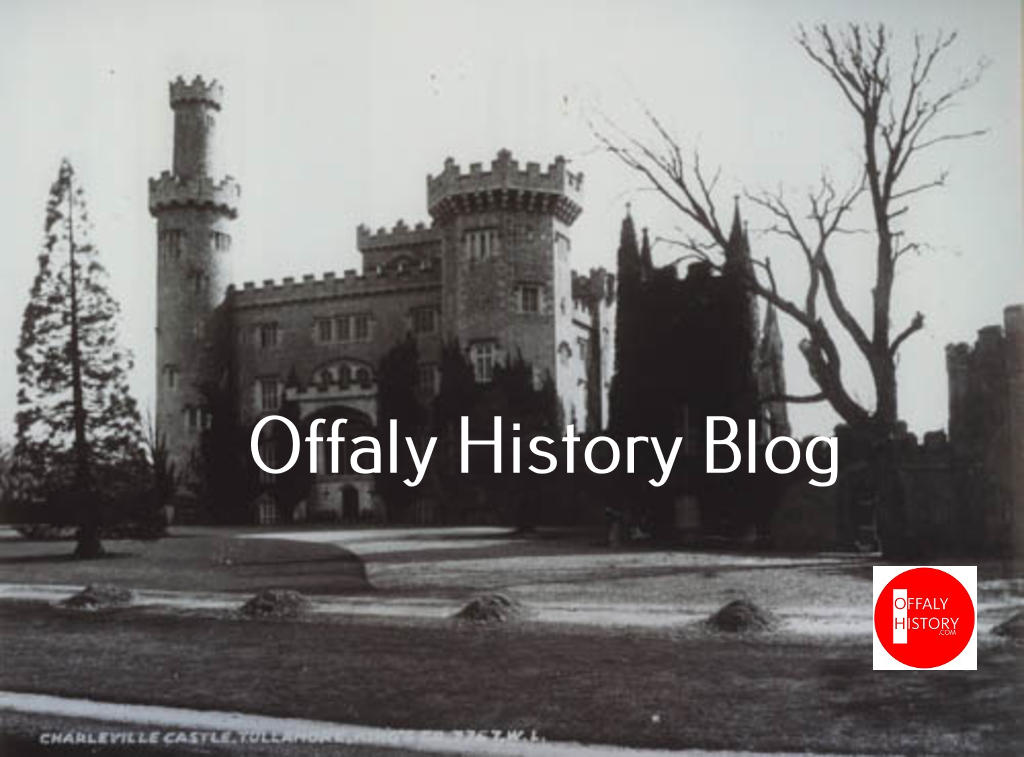
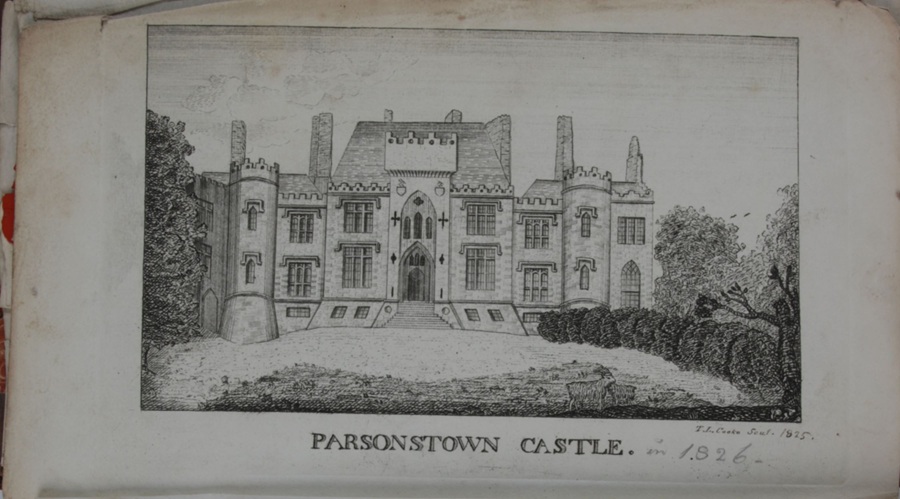
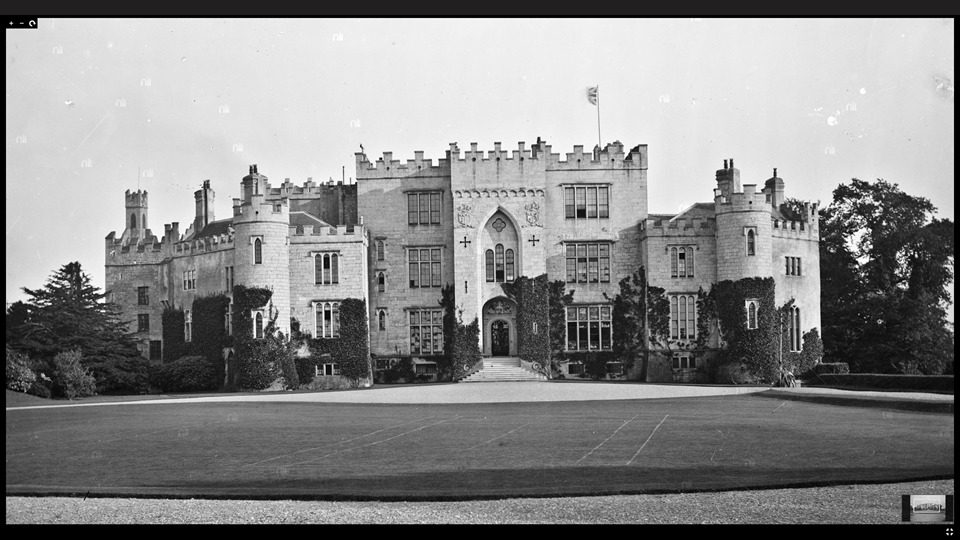
Charleville was not only one of the most magnificent houses and demesnes that the Duke of Richmond encountered on this tour, but it was also full of surprises, for whereas most great houses in Ireland in the early nineteenth century were Classical, Charleville was Gothic. Classical houses tended to stand four-square at the end of a formal avenue, the message of power and prosperity hitting the visitor in a single direct encounter. Gothic versions of the same message were unveiled more slowly. The Duke of Richmond’s carriage crossed the river Clodagh at the western gate of the Charleville demesne and, having passed a round tower, entered a park beyond which lay a wood, its trees slowly turning to their autumnal colours. Emerging from the wood and partly obscured by parkland trees could be seen a massive conglomeration of towers, turrets and battlemented walls. The carriage turned into the woodland, and when it re-emerged it was at the base of the forbiddingly craggy entrance front of Charleville Castle, facing a great machicolated octagonal tower.
When he stepped inside, the duke of Richmond climbed the processional stair that had been inspired by James Wyatt’s recent work at Windsor Castle for George III. At the top he might have been prompted by Lord or Lady Charleville to look back and admire the vast perpendicular window in which was set their coat of arms. Then he would have been ushered through the elaborately carved doors straight ahead into the gallery, reminiscent of Horace Walpole’s Strawberry Hill in Twickenham with its impressive fan-vaulted ceiling whose succession of carved pendants keep time with the great sash windows which then overlooked the extensive park.
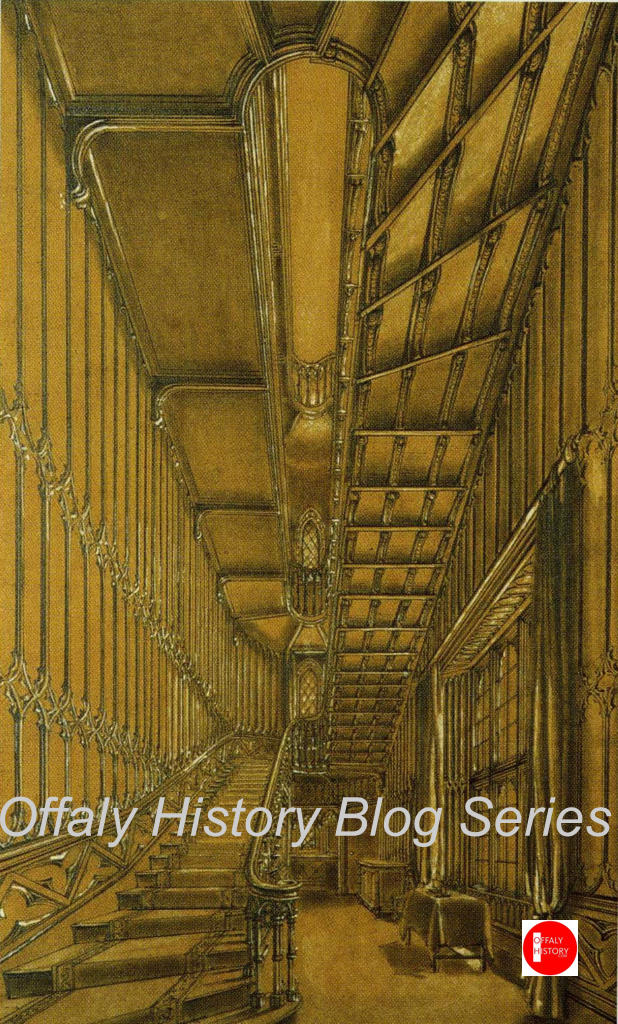
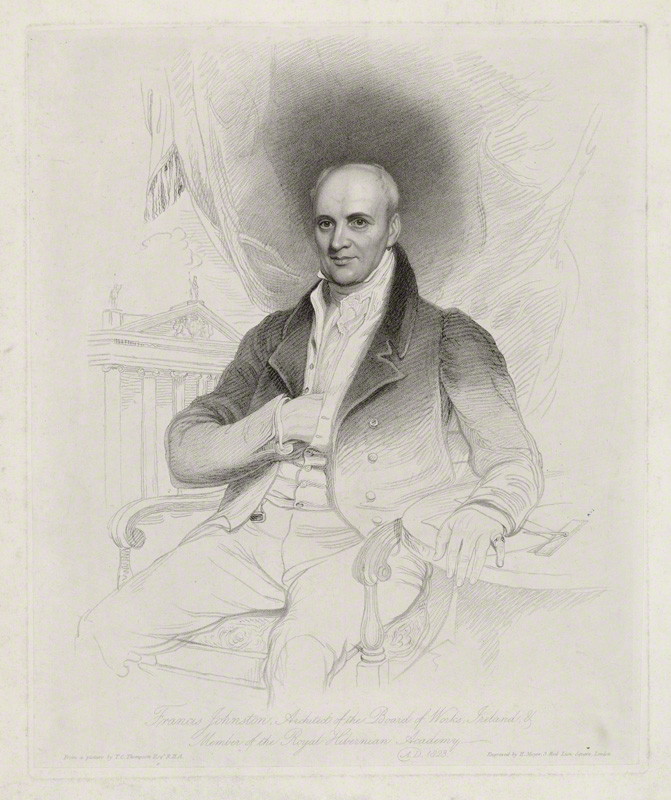
In Gothic: building castles in post-Union Ireland I look at the building of two castles in that first decade of the union: Charleville Castle built by Charles William Bury, Catherine Maria Bury and their architect Francis Johnston; and Birr Castle built by Sir Lawrence Parsons (2nd earl of Rosse) and his architect John Johnston. I am interested in the use made of Gothic for magnificent statements which, I argue, the owners were making to position themselves within the new dispensation of the union. These castles were the forerunners of many nineteenth-century Irish castles which can be associated with unionism.
Gothic is a style freighted with meaning, alluding to the past which may be an imagined one, or one which is remembered and celebrated. In both cases it is being used by the builders for contemporary purposes. I am interested in finding out what the players – patrons and architects – understood of medieval architecture. In what contexts did they encounter it? How did they perceive it? I am interested in finding out what they were trying to do when they built these castles, or in the case of Birr, when Parsons remodelled an existing seventeenth-century house. I want to know how the patrons realized their ambitions. And how these ambitions related to their position as part of the ruling elite whose role in Ireland had shifted as a consequence of union with Great Britain.
These kinds of questions were answerable and arguments could be constructed because of the survival of a great variety of documents – letters, drawings, sketches, poems, and journals – in private and public archives. These documents revealed the close connections, both social and cultural, between the Irish patrons and their architects, and their peers in Britain. I was also able to demonstrate that although there is no doubt that Francis Johnston, the foremost architect of his period in Ireland, and his patrons, as well of Sir Lawrence Parsons took much from their experiences and contacts in Britain, many of their decisions and the resulting architecture arose from their situation in Ireland and that it is Irish Gothic that we are dealing with. On his visit to Charleville the Duke of Richmond was encountering a great house that proclaimed associations with British culture while asserting status in Ireland.
Irish Gothic has received some scholarly attention, but Gothic: building castles in post-Union Ireland is the first book to examine the early ‘Georgian’ Gothic revival in Ireland at the level of micro-history, and to situate it in its cultural, social and political context. It explores Georgian Gothic in its own terms and establishes the nature and character of Francis Johnston’s Gothic, seen most fully in Charleville Castle and the Viceregal Chapel in Dublin Castle. The book reveals that despite the prevalence of Classicism, Gothic was a significant cultural force in Ireland in the late eighteenth and early nineteenth centuries.
Judith Hill, Gothic: building castles in post-Union Ireland (Four Courts Press, Dublin, 2026) will be launched at Offaly History Centre, Bury Quay, Tullamore on Thursday 25 June at 5 p.m. The guest speaker is Rachel McKenna, Senior Executive Architect with Offaly County Council.
27 May 2026
Copyright © Judith Hill.
Pictures and captions provided by Offaly History save the jacket from Four Courts Press
 offalyhistoryblog