T.D. Sullivan was one of the most high-profile political figures to be targeted by the London administration under the Crimes Act for publishing what they considered dangerous material that could incite opposition and violence against the police from carrying out their duties of evicting tenants who were unable to pay their rents. The Irish National League was established with the aims of bringing about the end of rack-rents (extortionate rents) and ownership of the soil by the occupier and a nationwide fund was in place for several years to prevent as many evictions as possible. However, publicising this opposition and encouraging the people to come together in the newspapers now placed a target on the backs of editors who began to be arrested and imprisoned for encouraging the ‘Plan of Campaign’ and Sullivan was the latest editor to be arrested and conveyed to the notorious Tullamore Jail. He arrived in Tullamore on December 7 1887 and upon his arrival met the Governor of the Prison, Captain Fetherstonhaugh, who was extremely frosty in his reception to such an illustrious new inmate and Sullivan was astonished to learn that despite his being regarded as a first class misdemeanant, he would be sharing a cell with other inmates. The Tullamore Town Commissioners were immediately on the ball to try and make contact with the political prisoners now incarcerated and to assess their wellbeing in this institution that gained notoriety for its deplorable unsanitary conditions and the treatment of the prisoners subjected to hard labour.
This is part three of a four-part blog on the 1835 Poor Law Inquiry into the baronies of Philipstown Upper and Lower. The respondents to the questionaries for Philipstown/Daingean were Rev P. Rigney and Roger North. Roger North was a landowner in King’s County. He inherited the Kilduff estate upon the death of his father, Roger North, in 1830. He was involved in estate management, including raising rents, which made him unpopular with local farmers and other landlords.[1] North was shot dead in 1850.
Transcripts of the Poor Law Reports – ContinuedThe questions raised by the Poor Law Commissioners for the local respondents are in the column on the left
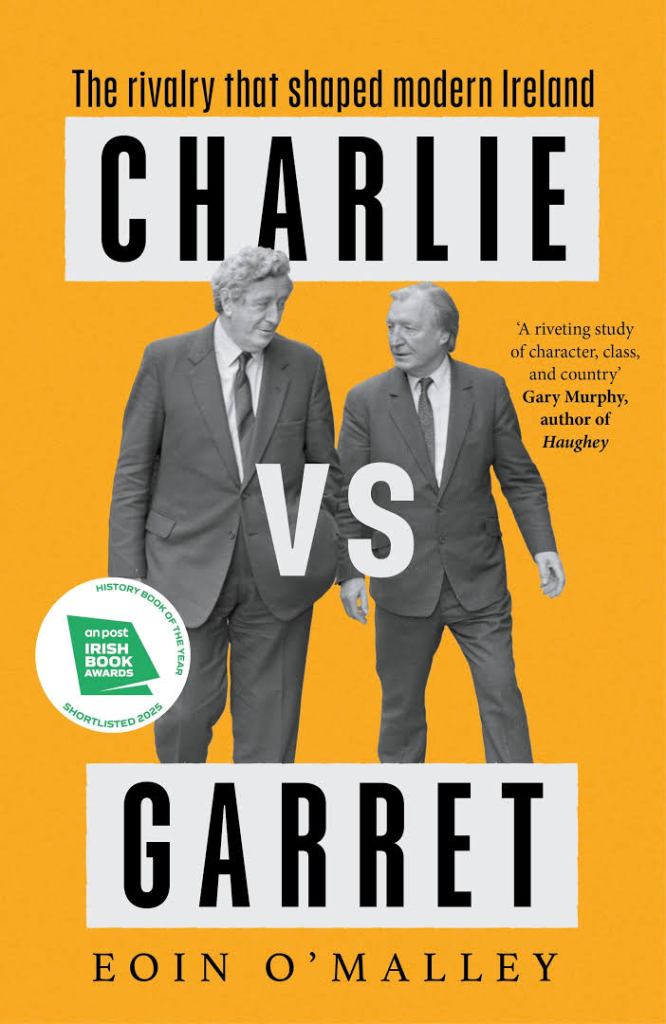
Today we mark the 100th anniversary of the birth of that hugely popular politician Garret FitzGerald. An intellectual in politics he was greatly respected in Ireland, Britain and Europe. Recent estimates such as that of Eoin O’Malley’s Charlie vs Garrett (2025) have not been so flattering to his handling of the economy in the 1980s. And yet his achievements and those of John Bruton have underestimated their roles in bringing peace to Northern Ireland.
FitzGerald, according to the DIB life by Patrick Maume (summarised here) was one of the most influential Irish political figures of the late twentieth century, known for his intellectualism, his commitment to European integration, and his efforts to modernise Irish society. Born in Dublin to the prominent revolutionary and cabinet minister Desmond FitzGerald and his wife Mabel McConnell, Garret grew up in a household steeped in politics, culture, and international connections. His parents’ mixed religious backgrounds—his father Catholic, his mother Protestant—shaped his lifelong interest in reconciling Irish identities and overcoming sectarian divides.
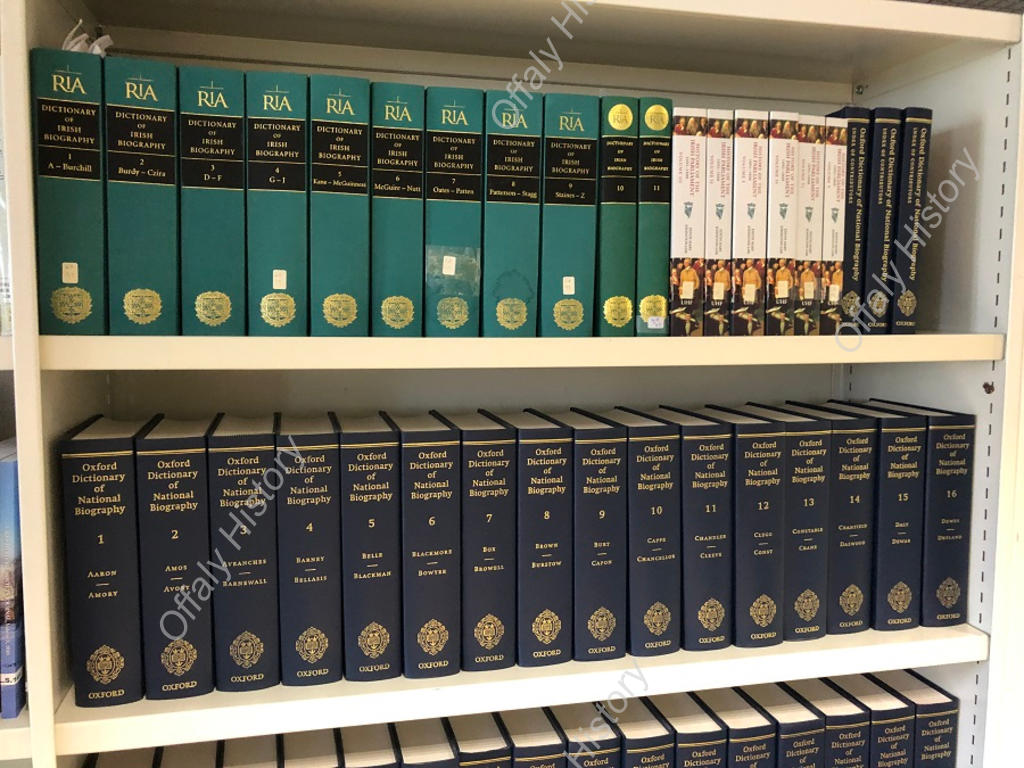
The DIB (above in green binding) runs to eleven printed volumes and is now online and free to use – a wonderful resource.Pic from Offaly History Centre.(more…)
As mentioned earlier there are many histories of hurling in recent times, particularly county and local club histories. A major and broad history of hurling, Scéal na hIomána was produced by Brother Liam Ó Caithnia in Irish and was published in 1980, but was left largely unappreciated for decades. Ó Caithnia’s history was an exhaustive work, the definitive historical account, written initially as an academic thesis, 826 pages long, written in dense Irish with a small print font and included references and appendixes. Over a dozen mentions of Co. Offaly are to be found in the Scéal.
This is part two of a three-part blog on the 1835 Poor Law Inquiry into the baronies of Philipstown Upper and Lower. The respondents to the questionnaires for Philipstown were Rev P. Rigney and Roger North. Roger North was a landowner in King’s County. He inherited the Kilduff estate upon the death of his father, Roger North, in 1830. He was involved in estate management, including raising rents, which made him unpopular with local farmers and other landlords.[i] Roger North was shot dead in September 1850.
Offaly History Lecture at Offaly History Centre, Bury Quay, Tullamore, R35 Y5V0 On Monday 26th January 2026 at 7. 30 p.m. following the AGM at 7 p.m. Offaly History presents a lecture about the recently launched “Voices of Offaly” resource available from http://www.offalyistory.com. The collection now comprises over 300 recordings of Offaly People captured over the past 30-40 years. Presented by Aidan Barry and Shaun Wrafter.
The illustrated lecture with voices will include: 1. An overview of the resources available on the new “Voices of Offaly” website. 2. A chance to listen to short audio clips which will give a flavour of the recordings available on the website.
1. Overview of the Website The website is organized into several key sections:
The story of people hitting a ball with a stick is a story which is told everywhere, from Iceland to Ethiopia to the Far East and across to the Aztecs. Look at lacrosse played by the American Indians, the stick and ball games played by the Mongols, the Berber stick and ball game played on the sands of the desert. The Irish game of hurling is a modern variant of a theme which is written through history, across millennia.
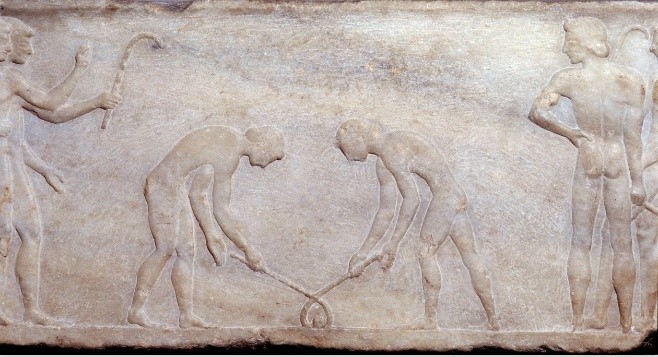
Players with two sticks and ball. Greek National Museum, Athens.
There are plenty of books that cover the history of hurling in Ireland. The public library system has most of them. Along with a general history of hurling that are also many histories that are specific to individual counties, particularly parishes and clubs.
Town Commissions in Ireland were possible from 1847 after the introduction of the Towns Improvement (Ireland) Act that would allow the larger towns to introduce a series of measures starting with the appointment of commissioners to carry out works in a town like drainage, paving, and other improvements to the infrastructure. Unfortunately, this legislation was neglected in Ireland during the years of the Great Famine and it was not until the early 1850s when events slowly improved in terms of lesser number of deaths that several towns began to explore embracing this legislation for their districts. Parsonstown (Birr) Town Commissioners held their first meeting on August 4 1852 with Laurence Parsons elected as the first chairman and slowly began to implement the 1847 Act and its subsequent consolidation statute in 1854. Over the next 46 years Parsonstown/Birr Town Commissioners attempted to run the town from the rates received from the ratepayers and loans from the Local Government Board as they engaged in constant disputes with the King’s County Grand Jury and the County Surveyor for decades over which authority was responsible for the scavenging and cleaning of the streets and the expenses incurred.
We are glad to welcome the second of our Young Historians blogs this week and this year. If you have an article or an idea for an article do contact us at info@offalyhistory.com. Offaly History blogs now number 774 and reach 80,000 to 100,000 views each year. So do join the panel of authors of this treasure trove of easily accessed articles since 2016. Doing (or have done) a Leaving Cert History Project on local history -keep Offaly History in mind for your piece of research. We can help with editing and illustrations.
Skating on Charleville Lake, Tullamore was a popular pastime when I was a young lad. I remember the cold icy winters of 1962, 1982 and 2010. I can recall as a young man the Tullamore people skating on Charleville Lake in 1962. I am a long time now in D 4 but I got down a few weeks before Christmas of 2020 to the nice butchers in Tullamore – old Tormey’s was still going strong and then you had, Hanlon’s, Crossan’s of Main Street, Ray Dunne and Fergus Dunne, and a few more I would not know. I was sorry to see Grennan’s main shop closed for now in 2020. I miss Paddy Mac’s, Cleary’s and Joe ‘the Butch’ Kearney and not forgetting Dunne’s butchers off the Square. It was Treacy’s later. Liver we got a lot of and sheep’s hearts in that fine shop. Many old friends gone to the heavenly pastures. I always like to get my turkey in Tullamore and a nice ham even though I am out of the town now for over forty years. What with the bacon factory open until 1989, and now Tullamore Meats, the town has a long tradition in fine food. Come to think of it the bacon factory did a huge business in turkeys back in the 1940s and 1950s when my father was rearing same.
ROSE-TINTED: Memories of the Tullamore Swimming Pool inevitably come through rose-tinted glasses. Some can be explained: The glorious weather – you didn’t go to the pool unless the weather was good. But there were heatwaves!! I vividly remember tar bubbling up on red hot road surfaces beyond Hop Hill Church, destroying the soles of our bare feet or God forbid THE NEW SANDALS!! from Owen Marron’s sweet smelling leathery shoe shop [in Patrick Street]