
A blog contribution had been planned closer to the envisaged eventual publication of the biography; however, following a request from Offaly History for an article prior to the lecture on 28 September, I have composed the following internet pages. I will return to the story of the biography from initial acceptance by my agent in 2022 in a separate blog.
[Monday 28 September 2026 at 7 30 p.m. Timothy Moloney on William Bulfin: his Life and Works at Offaly History Centre, Bury Quay, Tullamore (beside new Aldi). All are welcome.]
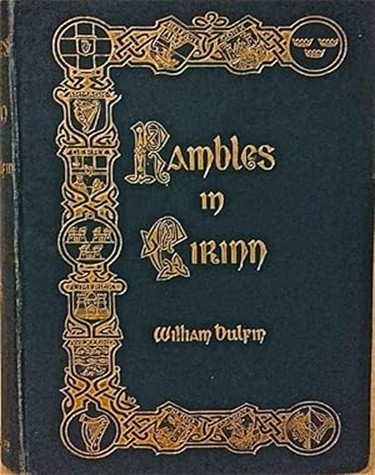
Timothy Moloney describes the life of William Bulfin using his works as a frame in which to set the biographical details. Drawing on his as yet unpublished biography, Timothy surveys his main works, Tales of the Pampas and Rambles in Eirinn, but he also pays attention to his lesser-known creations ̶ ‘Sketches of Buenos Aires’ and a novel A Man of the Pampas, as well as a series of articles he wrote on a trip to the Andes in 1905. He accompanies the lecture with interesting slides showing samples from Bulfin’s oeuvre and pictures from his time and of his family members.
Editor adds: Bulfin was an important figure in Irish Ireland of the early 1900s. His premature death in 1910 robbed Offaly and Ireland of a leader in cultural nationalism who might well have been a senator and perhaps a candidate for the presidency. The family have lived in County Offaly since at least the 1800s if not much earlier. Bulfin was buried in the Eglish churchyard. ]
The topic was to be a choice of my own, and after consideration, I chose ‘William Bulfin: his Life and Works’. It should have been easy to prepare, but since I had been working on other projects since completion of the biography ̶ a novel completed in 2023, and another historical work in 2023 and 2024, it proved more difficult than I expected. I had to review his life again, and had to distil it into manageable chunks for a sixty minute lecture. The life itself was one aspect, but then there were also the works: I planned to examine the genesis of his well-known works such as Tales of the Pampas and Rambles in Eirinn, but also wanted to draw attention to his lesser known literary or journalistic creations, such as his ‘Sketches of Buenos Aires’ under the nom-de-plume Che Buono, an unpublished novel he wrote called A Man of the Pampas, and also a lengthy series of articles he composed about a trip to the Lower Andes in 1905.
I started with the ‘Sketches’, which he wrote over a period of about ten years, 1892 to 1902. I had read many and included excerpts from some in the biography, but these ‘Sketches’ have never been published in any other form and thus this ambition to draw attention to them meant trawling through many editions of the newspaper (fortunately photographed from microfilm as recorded in Blog No 1) to find suitable examples and to try to provide an overview. Tales of the Pampas was less challenging in this respect because the text is available in print (though now very expensively) and also online. I had written about the novel A Man of the Pampas in the biography, but still had to re-read a summary I had made of it and further condense the plot. Rambles is his best known work in Ireland; I had dealt with it in some depth in the biography, but had to go over what I had written. The remaining challenge was his ‘Trip to the Andes’, a series of connected newspaper articles dating from 26 May to 1 September 1905, which I had transcribed to a total of one hundred and eleven typed pages in 2025, about forty-two thousand words, the size of a small book. I had added an excerpt from it as an appendix to the biography, and had chosen another for my introduction to Rambles, but I went through it again to be able to present it in an acceptable form in the lecture. Having done so I discovered that I could not do it justice and had to postpone it to a future blog article.
The life aspect had also to be considered. Choices had to be made about what was significant and relevant, and what was already well known. Certain elements of his life have been repeated over and over in print and online, and I tried to avoid these and chose to highlight some lesser known facts. I initially divided his life into seven main sections, detailed below, preceded by an introduction about his early life, and ending with a conclusion on his final nine months in Ireland and early death:
Introduction: 1863-1888: background and education; Pampas years.
1. 1889-91: Transition to Buenos Aires: ‘Che Buono’: ‘Sketches of Buenos Aires.’
2. 1892-96:Joins Southern Cross: becomes editor in 1896. ‘Sketches’ continued.
3. 1896-1901: Southern Cross: consolidates the editorship. ‘Sketches’ continued.
4 . 1900-01: Literary endeavours: Tales of the Pampas published; Novel ̶ A Man of the Pampas completed.
5. 1902-03: First trip to Ireland: Rambles begun.
6. 1903-05: Second trip home:side trip to US. Rambles continued. Trip to the Andes.
7. 1906-08: Illness 1906. Third trip home1906-07. Rambles published 1907.
Conclusion: Return home and early death 1909-10.
I then consolidated the sections into five, with an introduction and conclusion. The main creative periods and work completed thus listed were used as starting points for the talk, and the life events were built into the following structure:
Introduction: 1863-1888: Background and Education; Pampas years.
1. 1889-1901: Editor and Journalist: ‘Sketches of Buenos Aires’ (separate newspaper articles).
2. 1900-1901: Literary Work: Tales of the Pampas (short story collection).
3. 1901: Literary Work continued: A Man of the Pampas (novel).
4. 1902 ̶ early 1905: Irish Travels: Rambles in Eirinn (published. 1907).
5. 1905: Trip to the Andes (Series of connected newspaper articles), Rambles published 1907. Final Years in Buenos Aires 1906-1908.
Conclusion: 1909-10: return home and early death.
One of the joys of doing research is the discovery of something new: it could be a previously unknown fact, an unseen document or an undiscovered pictorial record. In my biography of Bulfin I mention that he had taken up cycling in Buenos Aires in the closing years of the nineteenth century, and a number of articles in the Cross reflected this. This was correct, However, while researching for the talk, I encountered an article in the Southern Cross of 1 October 1897 on the subject ‘Bicycling’. Here is how he introduces the topic in a mock heroic and quasi-religious grand manner:
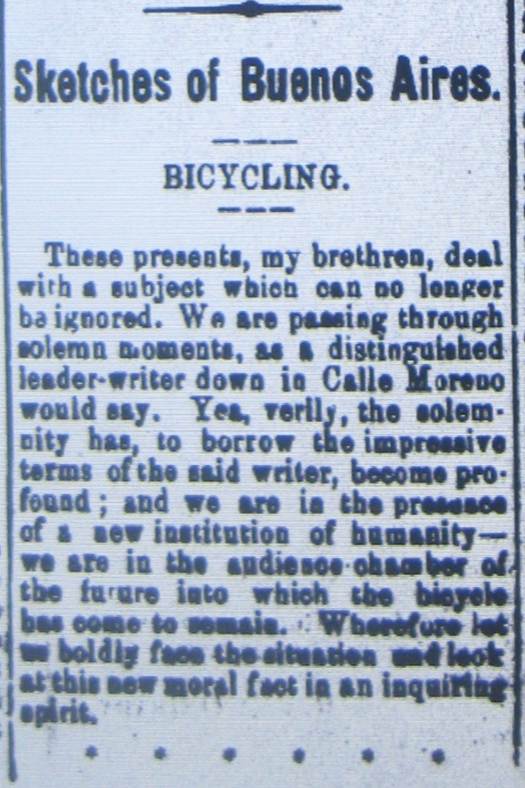
Southern Cross 1 October 1897
He recounts how he ‘first made the acquaintance of the bicycle’ in Galway in 1881, (where he spent two years studying for state examinations). He describes how a fellow student brought a machine back with him after a summer vacation and was the centre of attention when he rode about the suburbs of Salthill and Rockbarton, and how his fellows envied him. Bulfin describes the rider as follows: ‘He had a costume consisting of a round serge cap, dark blue jersey, knickerbockers, long stockings stuffed with a little curled hair to make his calves look more manly, and neat shoes.’ He was also a great attraction for the ladies, and this spurred Bulfin and twelve of his friends to club together to buy a second hand model which ‘came down’ from Dublin, ‘warranted almost as good as new’. The young men experimented and eventually were able to ride downhill with the assistamce of ‘only three companions’ ̶ two to hold the rider up and a third to keep the bicycle from running away (early versions had no brakes because the the pedals were fixed to the front wheel as in a child’s tricycle). Bulfin gives a description of the model: ‘When you stood beside it it looked simple enough. There was one big wheel as high as your chin, and another small one something bigger than a two-cent piece. There were bright metal fittings here and there, and the handles were silver mounted.’ It was the Panny Farthing, then the the most advanced technical model. Bulfin’s pen picture of machine and rider was highly accurate:
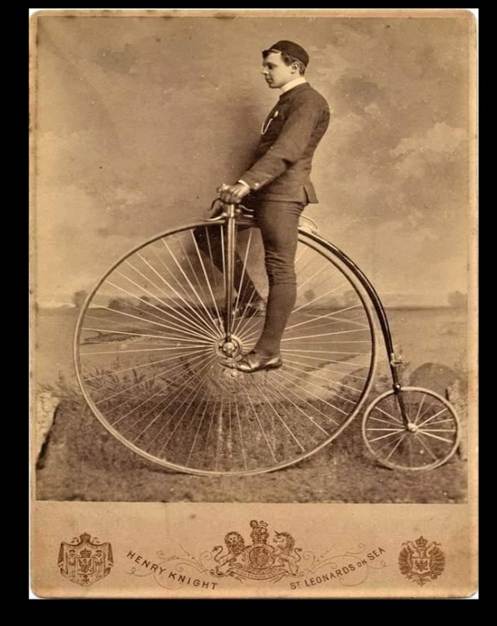
A contemporary picture
He continued that it looked ‘qute unemotional and commonplace’ until one got into the saddle and ‘gravity became a thing of chance’. He declared that the most disturbing thing was the height above the road that the cyclist experienced, and inevitably there were accidents where the high riding cyclist or his – literal – supporters suffered injury, not to mention occasional damage to the machine. Bulfin himself took the driving seat and was doing very well until he shouted to the others to ‘let it go’, which they did. He instantly regretted it when the machine ran away with him and his feet lost the pedals (now turning faster with the faster spinning big wheel), and he collided with a hay cart and was thrown ignominiously into a brake of briars thirty feet away. sustaining material damage to the bike and thorn injury to himself.
But what, he asked had this to do with Buenos Aires? ‘Nothing in particular,’ he answers, in his conversational way, ‘now that I come to think of it. Still it occurred to me to give you my experince as a sort of guarantee that I know something about bicycling.’ He continues and concludes the article with his experiences on the same activity in Buenos Aires, with the bicycle now ‘completely transformed’ technically. It was on just such a machine that he made his circuit of Ireland in the early twentieth century, as pictured below in this rare photograph:
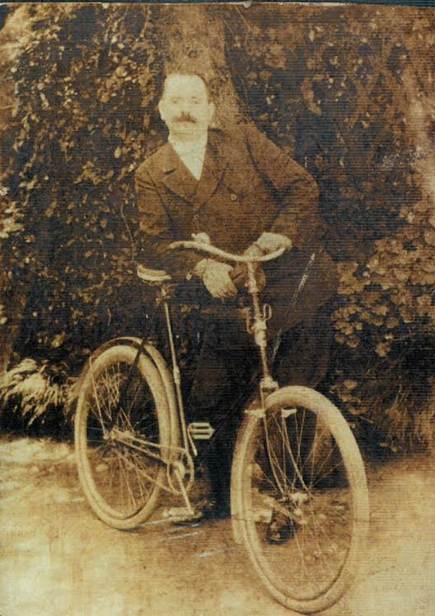
Photo courtesy of Michael Bulfin
I was very pleased to have discovered the very first assay at (bi)cycling in Ireland made by the man who might be termed its putative patron saint, a valiant warrior of the wheel and a trenchant spokesman for the spokes-men of Ireland.
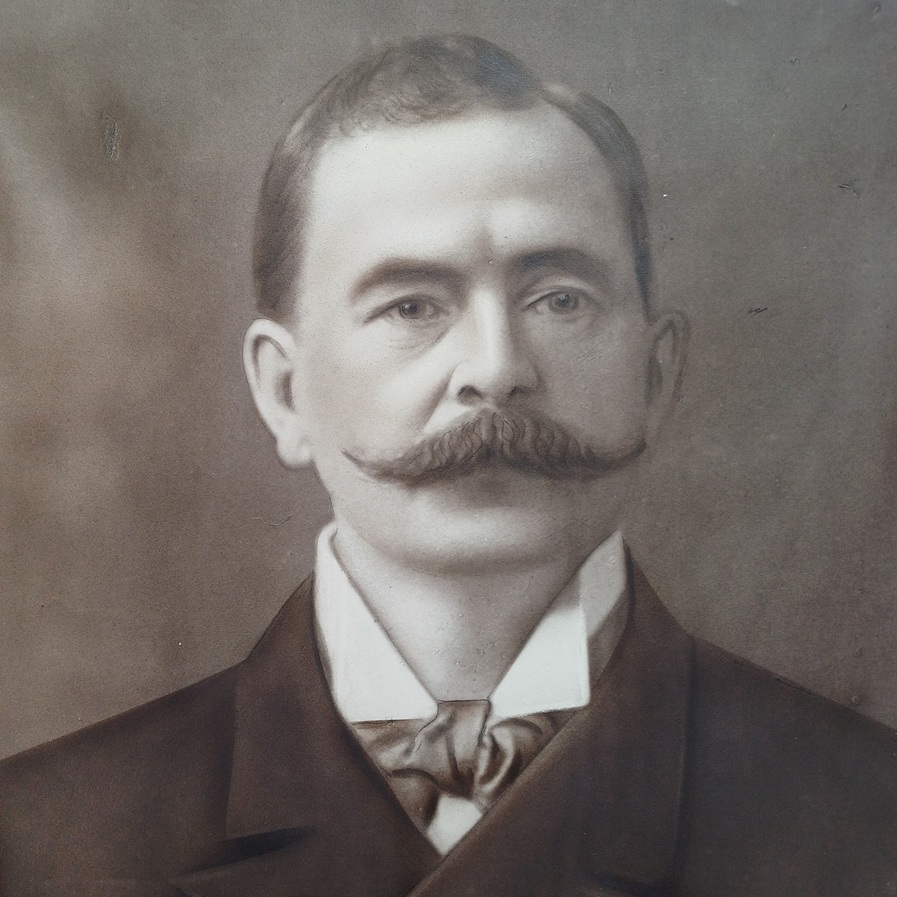
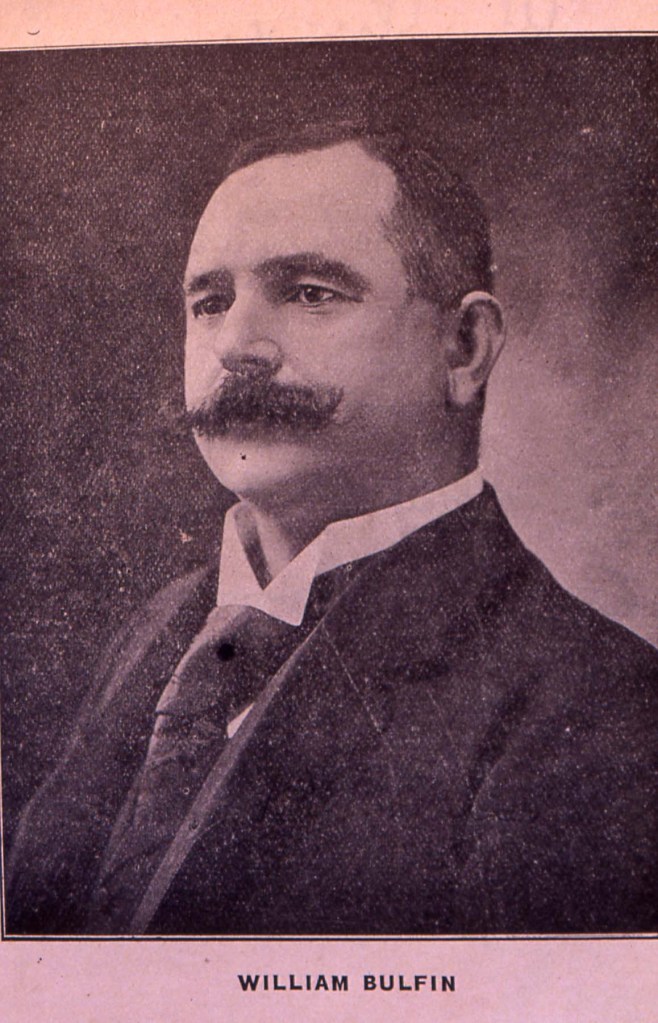
William Bulfin, photographic portrait.
All are welcome to this talk on Monday 28 Sept. at 7. 30 p.m. at Offaly History Centre, Bury Quay, Tullamore (beside new Aldi store).

