
No, it was not a blue raincoat but rather a Crombie of an unusual hue. Yet the wearing of it while dining in, not one but two Dublin hotels, was rejected by the headwaiters of such places. The set for this culinary tragedy was not the famous Restaurant Jammet, or the Royal Hibernian, but rather the Central Hotel and the Wicklow Hotel, both near enough to affluent Grafton Street but not haute cuisine for all that.
(more…)Category: Killeigh
-
Bernard Delaney (1854-1923): Offaly piper conquers America. ‘He put the music right under their feet’ – Francis O’Neill (1913). By Frank Kelly. 2025 Anniversaries Series. Blog No 707, 9th April 2025
Do come to the lecture and musical event on 12 April, 3 p.m. Saturday at Offaly History Centre, Bury Quay, Tullamore (beside New Aldi and Old Warehouse)
Bernard Delaney (1854-1923) – Offaly piper conquers America
Bernard Delaney was an extraordinary man, a superb musician and above all a survivor. Birr Historical Society presented the story of piper Bernard (Barney) Delaney in January and we are glad to confirm a further lecture and musical afternoon to recall his life and contribution to Irish traditional music. This time in his home town of Tullamore. Delaney suffered the loss of three of his four children and his wife in the late 1870s and was forced to leave his country in search of hope and a better life in the New World. Delaney was a master of the Uileann Pipes. The Talk will focus on his life, the story behind his enrolment into the elite Irish Music Club of the Chicago Police Department and his legacy.
Short presentations will be given by both Frank Kelly and Seamus Kelly.
Delaney’s musical heritage will be played at the event by Frank Kelly and musical friends.
Frank Kelly is from Lusmagh and has written articles about Delaney for the Fleadh Cheoil Clár and the Comhaltas magazine Treoir.
Seamus Kelly is from Kildare with Birr connections. He has researched Barney’s life and written the book Bernard ‘Barney’ Delaney (1854-1923) Offaly and Chicago Piper. Copies available from Offaly History Centre.
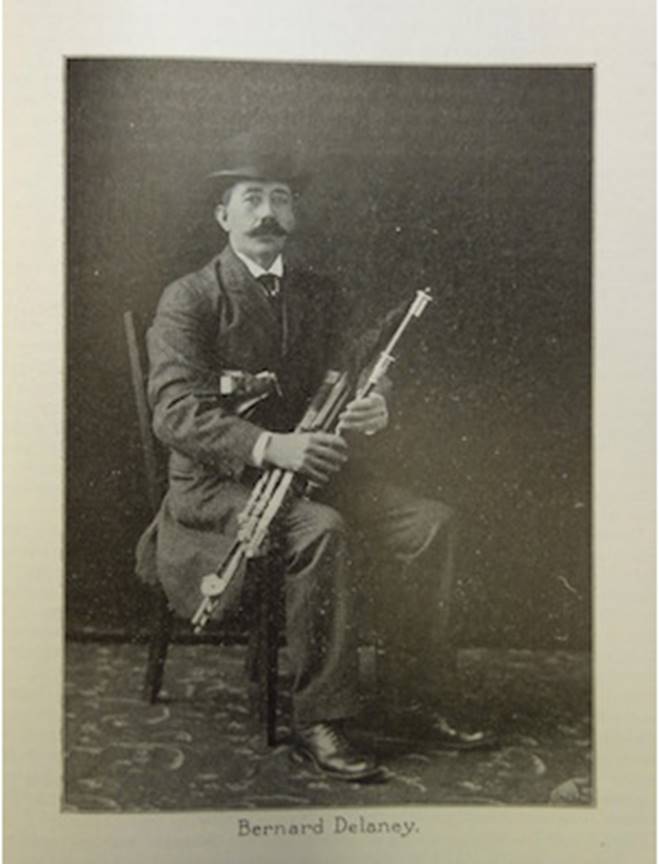
Bernard Delaney, Source: Francis O’Neill, Irish Minstrels and Musicians (1913)
‘We are more or less indebted to Bernard Delaney for the introduction of many fine tunes to our community. His well-deserved reputation as an Irish piper did much to spread the local knowledge of his music among local musicians, as well as to promote the popularity of Irish music in general.’ Source: Francis O’ Neill, Irish Folk Music (1910)
Ahead of Fleadh Cheoil ns h-Éireann 2009, I researched the life of Bernard (Barney) Delaney of Killeigh so as to publish a piece on him in the Fleadh brochure. Offaly has a rich Traditional-Music Heritage and a multitude of All-Ireland champions since modern competitions began in Fleadhanna in the 1950s. However, our folklore is filled with records in the oral and written traditions of musicians dating back to the courts of our Gaelic Chieftains, our famed monastic settlements and music even has filtered through to us from the Celtic mists of ancient Ireland.
Due to the devastating famines of the 1840s and the following poverty in the 1860s and 70s when the people’s main motivation was pure survival, our musical heritage fell away among the general population. It fell to the immigrant classes to carry their music and song with them to the far-flung places where they could find work and sustenance.
Bernard Delaney of Killeigh was typical of these survivors. Unlike many of his fellow immigrants, he had a “magic wand” in his pocket in the form of a penny whistle and all the melodies that instrument could conjure up. Melodies that would provide his sorry Irish comrades with hope, joy, and the happier memories they may have associated with these tunes.
Following my meagre scraping of the surface in 2009, a hero emerged in the form of Seamus Kelly of County Kildare who dug deeper Delaney’s life. Then, with the backing of Attracta Brady; the soon-to-be Uachtarán of Comhaltas Ceoltóirí Éireann, local researcher, Brendan Berry and Seamus’ own team of sleuths, the life of Bernard or Barney Delaney was uncovered. Before the launch of this delightful publication, few in Offaly or Killeigh would have known much of the life of the once-celebrated uilleann piper of Chicago and American fame. Now, it’s about time Barney was given the recognition he truly deserves. The following are a few snippets of background from Seamus Kelly.
Frank Kelly
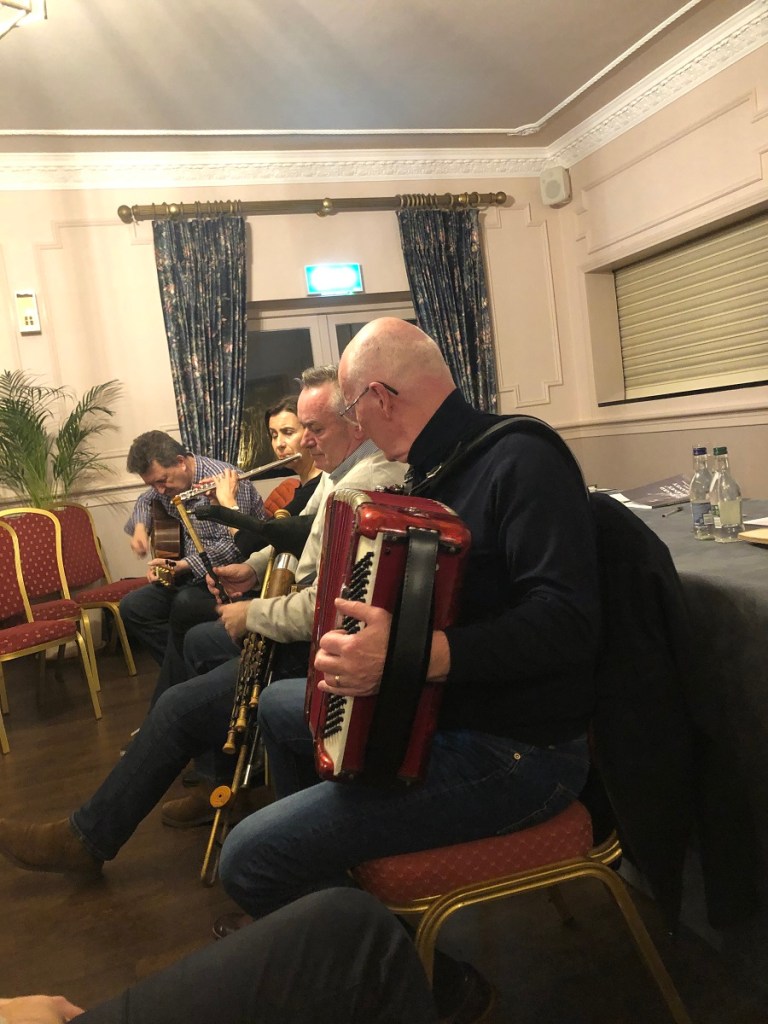
The musicians at the Birr Historical Society event in January 2025. 
Courtesy Bantry Historical Society Seamus:
Frank Kelly’s article in Treoir outlined some of Barney’s background and early life in Ireland. Without Frank Kelly, and his many Offaly contacts, my publication would not have seen the light of day. The support of Attracta Brady, now President of Comhaltas Ceoltóirí Eireann (CCE), was also crucial.
The Offaly Independent (18 September 1992 stated that Offaly has a tradition of excellence in music and added that ‘Offaly can also boast one of the great Irish pipers in Barney Delaney who was born in the Tullamore area about 1860…’. He was, in fact, born there in 1854.
The book was brought to fruition by three Kellys – Seamus, Frank and Michael. Michael Kelly and Brendan Berry’s pioneering work in following up on Delaney’s family in Ireland has made a real difference to our knowledge of the ‘Offaly piper’. An article by John Ennis in The Gael magazine (February 1902) also provided us with a wonderful photo of Delaney.
Francis O’Neill wrote in 1910 that he was delighted that Bernard Delaney brought himself and his tunes from Offaly ‘Here, indeed was a prize and what a repertory of unfamiliar tunes he had from Tullamore, his native place! Chief O’Neill, mentioned that Barney was from around Tullamore. Well, could we be more specific? Yes, we can.
Finding out that his father’s name was Patrick (from Bernard’s passport application in 1919) was a start. Frank Kelly’s article entitled ‘The Offaly-Chicago connection from Scrubb, Killeigh, to Ocean Springs, Mississippi’ (Treoir, 2009, 2020) tried to identify Barney Delaney’s birthplace. Brendan Berry was able to pinpoint Patrick Delaney’s plot to Meelaghans instead of Scrubb.
The Killeigh Co. Offaly Delaney connection was further confirmed by the excellent research of Michael Kelly. Aileen Saunders accessed the transcript of Bernard Delaney’s baptismal record. It informs us that Bernard was from the Parish of Killeigh, just south of Tullamore. The name was misspelt ‘Delay’ on this electronic record which was unhelpful. It gives us Bernard’s mother’s name as Eliza Dinn (possibly Elizabeth Dunne). It also gives the date of his baptism, in Killeigh, as the 25 May 1854.That date is reliable although it conflicts with other records. For example, in the 1900 US Census Barney gave his birth date as August 1852. His police record says he was born on 24 March 1854.
Bernard had a family of his own, in Offaly, before he emigrated to America in the early 1880s. Aileen Saunders noted from US Census records that Bernard Delaney had a daughter Elizabeth. Barney was around 20 years old when he married Mary Farrell on the 23rd October 1874. Bernard’s age was given as 20 while Mary was 24. They were married in Tullamore. Mary Farrell, from Tullamore, worked as a servant and was the daughter of Charles Farrell who was a carpenter. Bernard’s father Patrick had died before the wedding. Throughout this period (1876–1882) Bernard Delaney is described as a labourer. The children of Mary and Barney Delaney:
Thanks to Michael Kelly’s research we know when the Delaney children were born and when they died. Bernard and Mary lived in Charleville Road, Tullamore but mostly after that they were in Distillery Lane until at least May 1882. Their first child Patrick was born on 25 March 1875 at Charleville Road in Tullamore. Soon after they moved to Distillery Lane in Tullamore where most of the children were born. Second son John was born there on 6 September 1876. Their first daughter Mary arrived in April 1879 followed by Elizabeth on 2 July 1880. Their last child, Ellen was born in February 1880. Five children in five years!
Note: ‘The Tullamore Piper’ title is still accurate in the sense that he lived as a young married man in Tullamore though he was a native of and was baptised in Killeigh; RC parish. A tune in O’Neill’s Music of Ireland (1903) (Number 1773) is called The Tullamore piper. The title can only refer to one man!
Tragically, all of the Delaney children, except Elizabeth, died young between 1879 and 1882. Patrick died from typhoid fever on 1 March 1877, aged 2. Mary died (aged 1 year), John died (aged 6) and Ellen (aged 3 months). Barney’s wife Mary Farrell died from measles, pneumonia and heart disease in Tullamore Union Workhouse or the infirmary attached to it, on 21 May 1882, aged 30.
Their youngest child Ellen had died the day before. Mary died 8 days after her son John died from measles.
The family struggles must have been traumatic. Mary Delaney must have suffered terribly. The losses of his wife and four of his children must have taken its toll on Bernard. These very harsh family circumstances probably influenced his very rapid decision to emigrate, and may have impacted on him later in life.
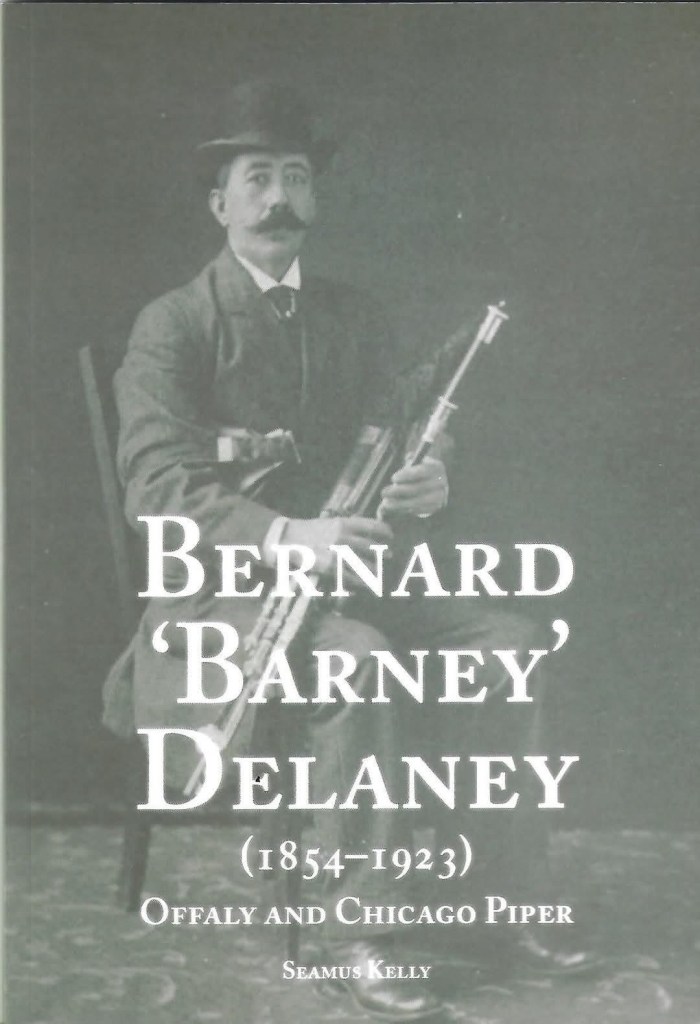
The full publication is available in the Offaly Historical Society book shop on Bury Quay.
Frank Kelly

Venue for the Saturday lecture and music session, Bury Quay (beside New Aldi and Old Warehouse restaurant).
Published as part of the County Offaly 2025 Commemorative Programme with the support of Department of Tourism, Culture, Arts, Gaeltacht, Sport and Media

-
Dancing in Ireland’s Biggest marquee at Killeigh Carnival and the revival of the ancient Killeigh Festival in 1950s Killeigh, County Offaly. By Offaly History storytellers. No 3 in our Offaly Anniversaries Series 2025. Blog No 690, 1st Feb 2025,
On Thursday July 24th 1958 the following article appeared in the Irish Press.
Dancing in Ireland’s Biggest marquee at Killeigh Carnival
The Irish Press Thursday, 24th July 1958

Killeigh Macra na Feirme Branch
Back L-R: Tommy Clavin, Peter Phelan, Jim Plunkett, Jim O’Rourke, Senchell Gallagher or ? O’Brien, Phil Deering, Dick White, Jack Bracken, Mick Dunne, Dinny Plunkett, Joe Plunkett, ? O’Brien, [], John Deering, Ben Purcell, Mick Dunne, Paddy Conroy, Christy Murray, Tony/Sony Foy, Jimmy Meackle, Ned Berry, Mick Murray, Brian Deering, Aage Delaney, Harry Cox, Willie O’Rourke, Ned McElduff.
Centre Kneeling: Brian O’Rourke, Joe Kane, Paudie (Pat) Condron, Seated: Martin O’Grady, Billy Mitchell, James Matthews, Fr. Donohoe, John Kearney, Mick Horan, Paddy Mitchel
Front: Paddy Berry, P.J. Meehan, Pauline O’Brien, Marie O’Rourke (?Molloy), ?O’Brien, [?], [?] , Dolores Plunkett, ? O’Brien, John Cox, Jim Gallagher
If any names are incorrect or missing please let us know in Offaly Historical Society at info@offalyhistory.com or 057 9321421.
(more…)
-
The changing face of Offaly towns in the early 1900s, beautifully illustrated with historic pictures, to be launched on Friday 15 November, 7.30 p.m. at Offaly History Centre Tullamore by Cllr Tony McCormack, cathaoirleach Offaly County Council. Blog No 668, 9th Nov 2024
The changing face of Offaly towns in the early 1900s: An illustrated history edited by Michael Byrne with contributions from Paul Barber, Stephen Callaghan, Grace Clendennen, Kevin Corrigan, Michael Goodbody, Ger Murphy, John Powell, Laura Price, Ciarán Reilly and Brendan Ryan (Offaly History, Tullamore, 2024, 368 pp). Available from Offaly History Centre and Midland Books Tullamore and online at www.offalyhistory.com. ISBN 978-1-909822-38-2 (hard back), €27.99. The book will be launched at Offaly History Centre, Bury Quay, Tullamore – beside the new Aldi and Old Warehouse. It is already available at the Centre, online at http://www.offalyhistory.com and at Midland Books, Tullamore. If you cannot attend in Tullamore we have a launch at Giltrap’s of Kinnitty on Thursday 21 Nov. at 7. 30 p.m. We will have copies in Bridge Centre for the Christmas Sale 14 to 24 December.
(more…)
-
2 The background to the development of the towns on the Grand Canal in County Offaly. ‘The man-made features of the Irish landscape, urban and rural, were created within little more than a century before the 1840s and remained largely unchanged till the 1950s.’[1] Prepared by Offaly History. Blog No 558, 27th Dec 2023

This week we look at the background to the Vallancey report on the Offaly towns carried out in 1771 to facilitate the construction of the new Grand Canal line from Dublin to the Shannon. Vallancey was then a young engineer, employed to report to the Commissioners of Inland Navigation and his findings were published in a little known and very scarce pamphlet, A Report on the Grand Canal or Southern Line (Dublin 1771).[2] This report is useful as a window on some of the north King’s County (hereafter generally referred to as Offaly) towns and villages and all the more so because of the scarcity of published accounts of the midland towns prior to 1800.[3] The report was published in the same year as that of John Trail who was at the time employed by Dublin Corporation.[4] Vallancey was writing with a mission. He was being paid to spin the story of the benefits that would come from inland navigation and to highlight the difficulties with road transport and its adverse impact on competition and pricing of commodities so as to bolster the arguments in favour of canal construction and satisfy those who were paying his consultancy fees.
Why not contribute to our series of blog articles on the Grand Canal in Offaly – info@offalyhistory.com.
(more…)
-
Mick The Miller – A Sporting Legend – a greyhound born and bred in Killeigh, County Offaly, Ireland. By Brendan Berry. Blog No 494, 31st May 2023
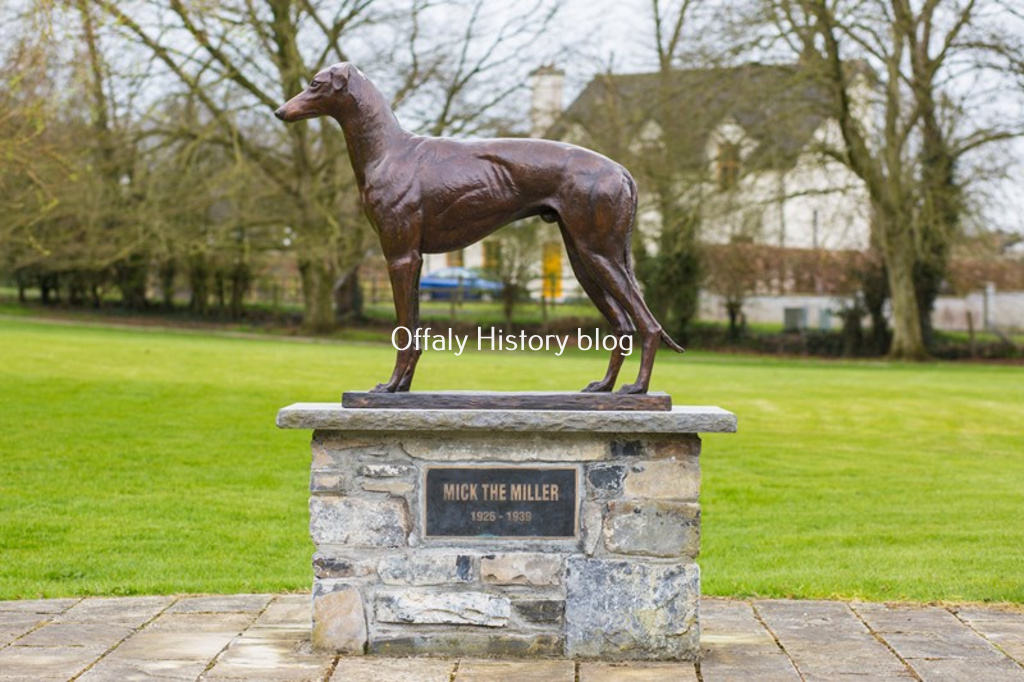
1. Sculpture of Mick the Miller by artist Elizabeth O`Kane on Killeigh village green.
Mick the Miller was the first great star of greyhound stadium racing in Britain. Born in Killeigh, Co Offaly in 1926, he had a successful Irish career before he began racing in England in 1929. By the time he retired in 1931 he had won 5 classics including the English Derby twice, the Cesarewich, the St Leger and also the Welsh Derby. He was the first greyhound to win the English Derby twice in succession and the first greyhound in the world to win 19 races in a row (both records remained unequallled for over 40 years). He won 51 of his 68 races, finished out of the top 2 positions only 6 times and also won 10 of his 13 one-on-one matches. His total prizemoney was £9,017 (€485,000 in today`s money) and he won 18 silver and 6 gold trophies. Mick equalled 2 track records and set 7 new ones (6 of which were also new world records).
He was a very exciting dog to watch and people flocked in their thousands to see him run.
(more…)
-
Exploring our heritage and history in Offaly during Heritage Week, 13–21 August 2022. Something for the Polish community too, so take a look, subscribe and share. Blog No 408, 13th August 2022
This weekend sees the start of Heritage Week 2022 and a very welcome return to exploring the county in person with some great material coming on-line too from Offaly History. We are launching six new videos via Offaly History YouTube and Heritage Week 2022. Our thanks to Amanda Pedlow, county heritage officer for all who work in coordinating the programme. She writes:
‘Hopefully everyone signed up for this email has by now received the pdf / hard copy Offaly Heritage Week brochure however you can still check in on www.heritageweek.ie for updates in Offaly, download the Offaly pdf here https://www.offaly.ie/eng/Services/Heritage/News-Events/Heritage-Week-Brochure-2022.pdf or pick up a copy in the library. Do please note that a number of events do require booking!
With over 30 events here is a reminder for Saturday’s events as a starter’…@offalyheritage @HeritageHubIRE Our thanks to Fergal MacCabe for the use of three of his wonderful watercolours of Srah Castle (1588), Ballycowan (1626) and Bury Bridge (1801).

Ballycowan Castle, Tullamore. Courtesy Fergal MacCabe
(more…)
-
The limestone quarries of Ballyduff, Tullamore. Part 3: From Tullamore to Tasmania. By John Wrafter, Blog No 388, 4th June 2022
In the second article on the quarries and stonecutters of Tullamore, I wrote about members of the Bracken family that left Ireland with their stonecutting skills and brought them to Australia. That was around 1910. However, stonecutters from the Ballyduff quarries had been emigrating and practicing their trade abroad for many years before that. Australia, in particular, was the destination for many. In this article, I will focus on two families, the Molloys and the Cronlys, and their involvement in stonecutting both at home and abroad.
(more…)
-
Geashill GAA footballers: ‘The King’s County Cracks’. By John Malone, Blog No 353, 2 Feb 2022
Followers of Gaelic games in Offaly will no doubt be familiar with Raheen’s G.A.A. grounds, just outside the village of Geashill. The grounds were once known as ‘The Lawn’ where stood the gate house to Alderborough house. In the early 1900s Alderborough house was the headquarters of the famous Reamsbottom garden nurseries, one of the largest in Europe and renowned worldwide for its anemones, the most famous of which was the St Bridget’s which won numerous prizes in shows such as the Chelsea Flower Show. At that time also a Gaelic football team trained and played their matches on the lawn and other fields in Geashill including P. Finlay’s field in Bawnmore, which became both feared and respected, not alone in Offaly but throughout Leinster.
(more…)
-
‘Opening the Hidden Bridge and A New Theory of The Early Origins of Tullamore’. By Fergal MacCabe. Blog No 328, 6th Nov 2021
Introduction
Amongst the recently announced projects for the rejuvenation of the centre of Tullamore is the long promised opening of the ‘Hidden Bridge’ behind the County Library and the linking across it of O’Connor Square and Church Street by a new public park. Though the age and function of the bridge are obscure, clues may be found which shed light on not just its genesis but also those of Tullamore itself.
Settlement Types
As humans began to leave the forests and gather together for trade and security, three distinct models of settlement began to emerge. One was the elongated village street which developed along a well travelled trail. Another was the crossroads ie. a meeting of four trails creating a junction around which housing and businesses clustered.The third was the village green form, where several trails came together around an open marketplace.
In Offaly the best examples of the first are Banagher, Shannonbridge, Daingean or Edenderry with their long main streets. Ferbane is a good example of the second type. Killeigh, Cloneygowan, Geashill and Clara which share the same feature of a triangular fair green, are good examples of the last.
Into which category therefore does Tullamore fall?
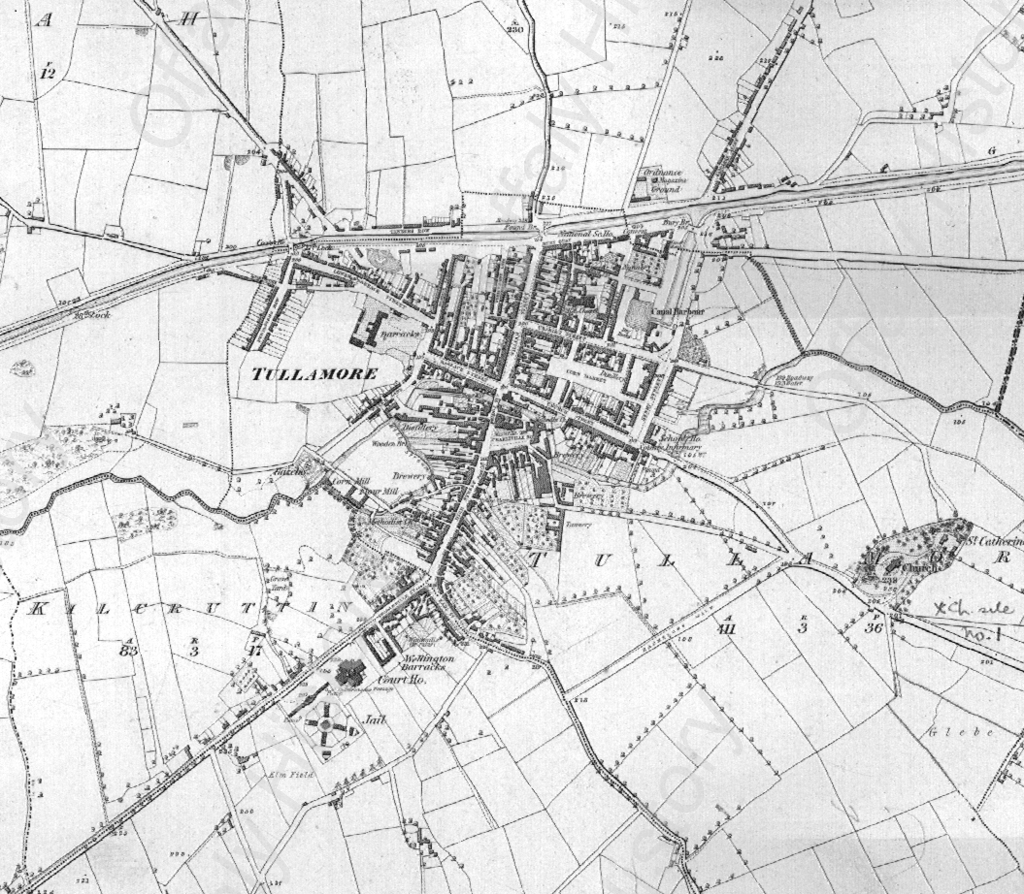
Tullamore 1838 Early Maps
The Cotton map of the mid to late 16 th century shows the central Midlands as mainly woods, trackless plains and bogs. Apart from ‘Dinian’ (Daingean), Killeigh is the only settlement noted
Tullamore first appears as a distinct settlement on the Moll Atlas of 1728 which shows the Tyrellspass to Birr road as the main route from Westmeath to Tipperary and crossing the Ballycowen River river just south of a hamlet noted as ‘Tullymore’. No other roads into this village are shown.
The first map which shows the layout of the town of Tullamore itself is Taylor and Skinner’s 1777 volume which describes the routes of all the main roads traversing Ireland at that time, but does not purport to be a reliable guide to the streets or form of the towns through which they pass. The guide shows the north -south Kilbeggan to Birr road crossing the river and intersected by the east-west Philipstown (Daingean) to Clara road at a point just south of the present canal bridge. A small chapel is shown on Church Street and a nobleman’s seat close by. The Tyrellspass to Birr road is shown entering the town from the north east and meeting the Philipstown/Clara road at a T-junction, but does not continue further southwards. Were it to continue in a straight line however, it would arrive at the river at precisely the location of the ‘Hidden Bridge’ at the rear of the Library which suggests that this was once its destination.
William Larkin’s Survey of 1809 is a little more detailed and shows seven roads radiating out into the countryside from a central point- again presumably the river crossing. The arrival of the Grand Canal in 1798 had interrupted this road pattern north of the river.

Larkin 1809 Some indication of the age of these radial roads may be drawn from an examination of the first really reliable map of Tullamore-the Ordnance Survey of 1838. Field boundaries which are not continuous across road lines suggest land ownerships of some antiquity and therefore longer established routes. The clearest example of newer roads interrupting established field boundaries is visible in Bachelors Walk, laid out in 1815 while the relatively recent vintage of Tanyard Lane and the road to Geashill are evident also. However, the Killeigh, Kilbeggan, Rahan and Charleville radial roads which have differing boundaries on either side, are clearly much older.
The North Eastern Radial
Of particular interest however is the north eastern entry to the town from the Tyrrellspass direction and the former direct route to Birr according to Moll. Having cut through the esker at Derrygolan, the road takes a direct and straight line to enter Tullamore at Puttaghan along a route formerly known locally as Rapparee Alley; at which point (according to Taylor and Skinner) it suddenly meets the east-west Philipstown-Clara road and proceeds no further. The discontinuous boundaries on either side northwards of this junction suggests a route of some antiquity. We can only speculate as to why it does not continue further to its projected and natural destination point -the river crossing suggested by Moll’s map.
Roads evolve along desire lines of movement and historically the focus of all the other radial roads entering Tullamore was the river crossing. As there were no physical obstacles to interrupt the original line of the Puttaghan Road, we can only surmise as to the reasons for its discontinuance or abandonment.
Combining the Moll Atlas and Taylor and Skinner’s Map it would appear that the road originally ran past the ruined castle recorded in 1620 as being in the ownership of Sir John Moore and which was located somewhere in the Church Street/O’Carroll Street area. Indeed the castle may have originally been built to ensure the security of that ancient road.
In 1710 Sir John moved the family seat of the O’Moores from Croghan to Tullamore and built a new house somewhere near the old castle. It is possible but conjectural that some years later the Puttaghan road was decommissioned by Sir John to increase and protect the pleasure grounds around his new residence. Traffic from the north east would now meet a T-junction at the northern edge of his estate and travel westwards along the Philipstown- Clara road to meet with what was by then, the main Kilbeggan-Birr road and then proceed southwards along it to ford the river.
Though this diversion might have inconvenienced travellers, it should be noted that in 1786 Sir John’s successors rerouted the Tullamore- Birr road around their new demesne at Charleville for this very reason.
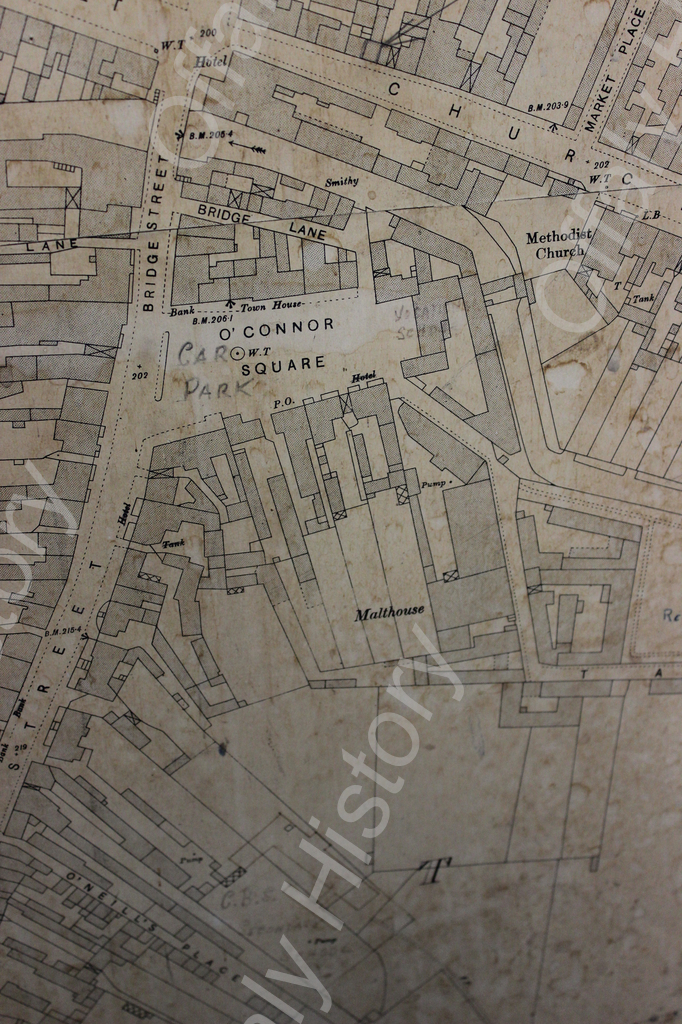
Tullamore c. 1912 The Old Bridge
What then was the function of the bridge between O’Connor Square and Church Street and which has been hidden out of sight for many years? The sharp cutting of the stonework of its central abutment suggests that it is not an ancient structure, but we have no precise information as to when it was erected; in particular we don’t know if it predates or succeeds the bridge to the west which was provided on the site of the former ford sometime around 1775.
The eminent chronicler of the history of the town, Dr. William Moran conjectures that ‘It was probably about the time (early 18c.) the fair green and the cornmarket were opened, that the first bridge over the river was built to enable farmers from the south side of the river to bring their produce to market’. He then goes on to surmise that ‘Two short stretches of road, one each side of the river, connected this bridge with the already existing Philipstown-Birr road.The inconvenience of having to make this little detour, in order to cross the river by the bridge was soon felt; and the present bridge was built to replace the old one’
The provision of the western bridge to replace the ford at present day Bridge Street does not explain why the eastern bridge should have been enclosed and abandoned. It would still have been the more direct route between the two market places of the town and of greater convenience to cattle drovers and wheeled traffic.
The other eminent chronicler of the history of Tullamore Michael Byrne, suggests that property records indicate that the eastern bridge is of a later date than 1775 and was a private facility and an internal link within a single business premises-as was common in the other brewing, tanning and distilling businesses of the town that utilised the river as a source of water or for the discharge of effluent.
I think it is possible to argue that neither Dr. Moran nor Michael Byrne have fully explained the genesis of the bridge and that we have to go back to an earlier date to understand the reason for its location; whatever about the date of its construction.
I believe that, as in the case of its companion to the west, the natural extension of the radial line of the approach roads into Tullamore suggests that it may have been built on the site of an earlier ford-indeed that the entire river between both bridges may have originally been shallow enough to have been fordable. The drainage scheme of the early 1950s deepened this section of the river between Church Street and Bridge Street by removing the rocky outcrop which facilitated the fording of the river at this point.
If this earlier crossing point existed, it is probable that prior to the construction by Sir John Moore of his new house in 1710, all of the radial roads met together at a point to the south of the river. If I am correct in this, a triangular fair green with the fordable river running through and surrounded by houses on the three sides (Church Street being its northern side) would have been the most likely original urban form.
The neighbouring villages, Killeigh, Clonygowan, Geashill and Clara, display such triangular layouts. As may be seen from comparative plans, the form and dimensions of their central village greens are almost identical to each other. (illus.). The village green which I submit may have been the form of Tullamore up to the end of the 17th c. would have been similar to them in scale and shape.
It is possible also that Frankford (Kilcormac) originally formed around a Fair Green of similar scale though the triangular block is now much compromised by infill housing.

A New Theory
As ‘Tullymore’, Geashill, Killeigh, Clonygowan and Clara appear on Moll’s map of 1728 it is possible therefore that all five or even six villages all formed in the mid to late 16th c, as the plantation of Leix-Offaly began to transform the economy and settlement pattern of this particular area of the Midlands.
It is also possible that some time in the early 18th c. the direct route into Tullamore from the north east and which crossed the river to culminate in the fair green of Tullamore-today O’Connor Square- was enclosed into the estate of Sir John Moore and the connection discontinued.
Over the years, the triangular form of the original village green evolved into ‘The Market Place’ and later into Charleville Square. From 1740 onwards it was reduced in scale and became more rectangular and formal. Eventually the land on its northern side, between it and the river was enclosed to build the Market Hall in 1789.
Meanwhile, the lands on either side of the river at the location of the former crossing had come into the ownership of the Quaker Thomas Wilson, who together with his partner Thomas Pim conducted a wool combing and tannery business at the rear, backing on to the river. The lands then passed through the hands of Gideon Tabuteau and on to Joseph Manly who operated a brewery and maltings. They were later acquired by the Tarletons who operated a milling business. It is possible that any of these commercial families may have erected the private stone cut bridge.
I suggest therefore that the bridge behind the County Library is relatively new but that it is located on an earlier crossing point of the river which existed up to the end of the 17 th. century and which gave direct access from the farming hinterland on the north east to the central marketplace of Tullamore.

If I am right, the long promised and eagerly awaited opening to the public of the ‘Hidden Bridge’ will reestablish part of an ancient route which was once an integral part of the original village of ‘Tullymore’.

