
The Grand Canal, like all great waterways, has its own traditions. One of the most enduring of these customs is the tradition of loyal service given by those men and women who work on, or at the canal. In many cases, this tradition of service remains within a family, and is passed down from generation to generation. The Cummins family of Ballycowan Lock are such a family.
In the early years of the twentieth century when trade and commerce flourished, and the Grand Canal was still a thriving transport waterway with barges steaming up and down from Dublin to Shannon, Michael Cummins worked as a greaser in the Canal Basin T Shannon. In 1915 he was the victim of a tragic drowning accident in the place where he had spent his whole working life. He left behind a widow, Catherine, and a teenage boy, Joseph and to keep the wolf from the door, they had to find a new means of living. Thus began the long association between the Cummins family and Ballycowan Lock.

A Teenage Keeper
For a short while, Catherine acted as Lock Keeper, until her son reached the age of 15, and took over. The year was 1915. Joseph Cummins was to remain Lock Keeper at Ballycowan until the day he died, in 1972. In the hallway of the Lock House at Ballycowan, hangs a framed certificate from C.I.E., who latterly took over the Canal, thanking Joseph Cummins for 51 years of service, from 1915 to 1967.
That Lock house is still occupied by a Cummins, Patsy, who took over the Lock, in March 1981. When Joseph Cummins died, the position of Lock Keeper was offered to his sons, Michael and Martin, but neither was interested as they had forged their own careers. For eight years, the Lock was looked after by a relief Willie Smyth, until finally daughter, Patsy Cummins stepped into her late father’s shoes. Not that the life of a lock keeper is anything new to Patsy. Having watched her father since she was a little girl, Patsy could probably do her work blindfolded by now.
While a Lock Keeper’s life might seem idyllic to some, having the responsibility of being in charge of a lock ties one down somewhat. “Even if there aren’t many boats on the canal, you have to be there, just in case” explains Patsy.
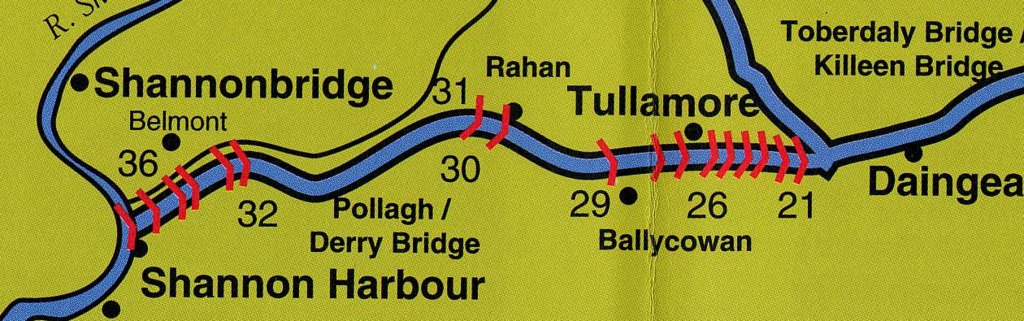
She remembers a time when the canal was packed with boats and barges, and the lock was constantly being opened and closed. That was before the canal was closed to commercial travel in 1960. A great tradition died, because of the exigencies of modern commerce. Time, in transporting goods, had become of the essence.


One A Day Now
Those famous blue and gold Guinness Barges continued to make their way from St. James Gate to the Shannon Estuary, and back for a time after the Canal officially closed to commercial traffic, but even they are now gone. These days, Patsy Cummins only has to open the Ballycowan lock for the odd pleasure boat, “an average of about one a day”. Occasionally, life at the lock is like it was in the old days; a boat rally creates a swarm of pleasure craft and they each have to be let through the lock.

Patsy doesn’t have to worry about maintenance of the lock, that is looked after by C.I.E., but the lock gates have to be painted and tarred at regular intervals. And despite the natural beauty of Ballycowan, some senseless people spoil and pollute its most attractive feature, the Canal, with rubbish. But the Canal, like ‘old man river’, just keeps rolling along, oblivious to over 200 years of change since it was first carved out of the countryside. The Cummins of Ballycowan Lock go on as well, inextricably linked to the lore of the Canal. Barges no longer steam by, night and day, but there is still a lock keeper’s life to believed, and perhaps it hasn’t changed all that much since the first Cummins came to Ballycowan Lock, almost three quarters of a century ago.


With thanks to the Tullamore Tribune, 13 August 1983
 offalyhistoryblog