
This appreciation piece is based on an interview by Aidan Barry and Shaun Wrafter (Offaly History members) with Phil O’Reilly Snr. at his home in Harbour St. Tullamore on 10th June 2024.
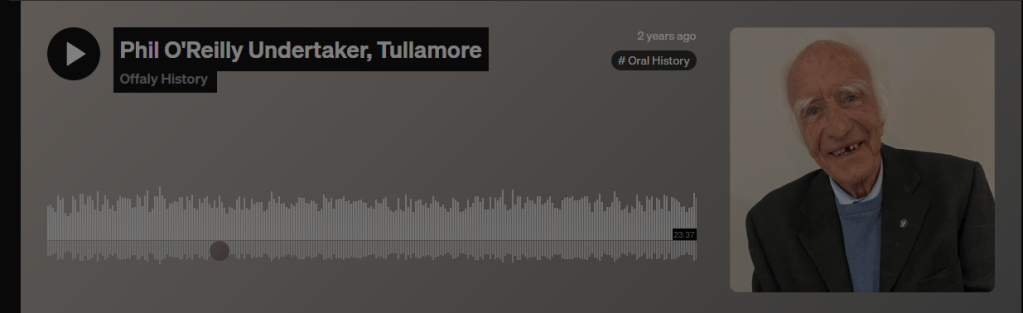
A lifetime spent in the quiet, noble service of a community leaves an indelible mark on the town that bred it. In the summer of 2024, when Shaun Wrafter, Offaly History sat down with Phil O’Reilly Snr in his beloved Harbour Street, the retired undertaker and former Offaly footballing legend looked back across his ninety years of life in Tullamore. With the news of his passing, Tullamore, County Offaly, and the wider GAA community mourn not just a giant of local history, but a man whose humble dedication, deep faith, and sporting courage touched generations.
From his earliest days kicking a ball along Harbour Street, Tullamore to the roaring, record-breaking crowds of Croke Park, and onward through over five decades of comforting grieving families as one of the town’s funeral directors, Phil O’Reilly Snr lived a life defined by decency, duty, and devotion.
Phil Reilly was born in 1993 and grew up in Tullamore
Born in 1933, Phil was a son of Tullamore and a true product of Harbour Street. His father, Phil, hailed from Tullamore, while his mother, Nora, came from Ballyhaunis, County Mayo. The couple had married in New York, where Phil’s eldest sister, Patsy, was born in 1932 before the family returned to Ireland and settled into the property on Harbour Street.
Growing up directly opposite the parish church, young Phil’s childhood was typical of 1930s town life in Ireland. As Phil recalled with a warm chuckle during his 2024 interview, he and his neighbourhood friends used to play street football down at the end of Harbour Street, always keeping a watchful eye out for the local Gardaí to ensure they stayed out of trouble and kept their footballs well clear of the church grounds.
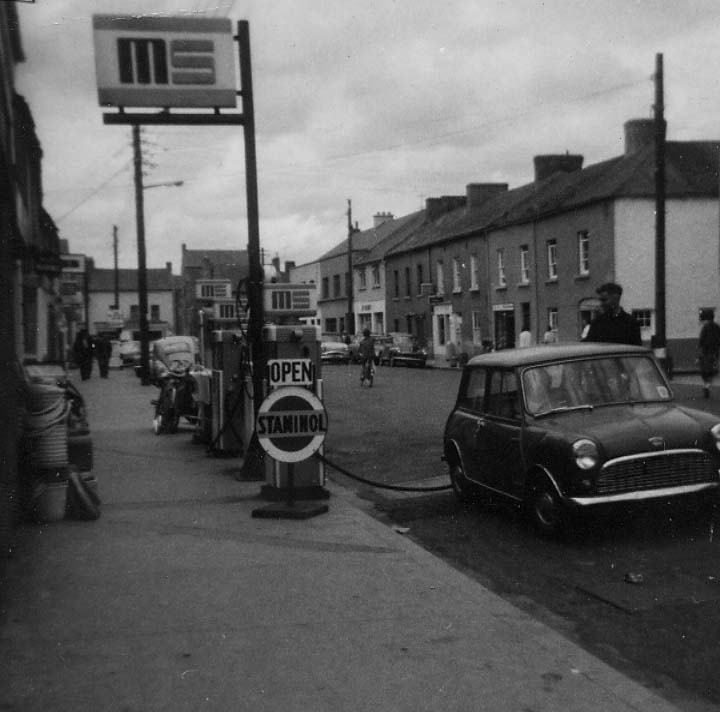
His education began locally at the Convent School before he moved on to the Christian Brothers. Recognised early for his sporting potential, Phil was sent to board for a year at Belcamp College in Dublin—a school famed at the time for its GAA pedigree. Wearing the Belcamp jersey, a young Phil lined out in both hurling and football, gaining valuable competitive experience. Upon returning home, he began his working life by taking a job at the iconic P. & H. Egan’s in Tullamore for a couple of years. This early commercial grounding provided him with invaluable experience before he returned to Harbour Street to help his family run their own expanding business.
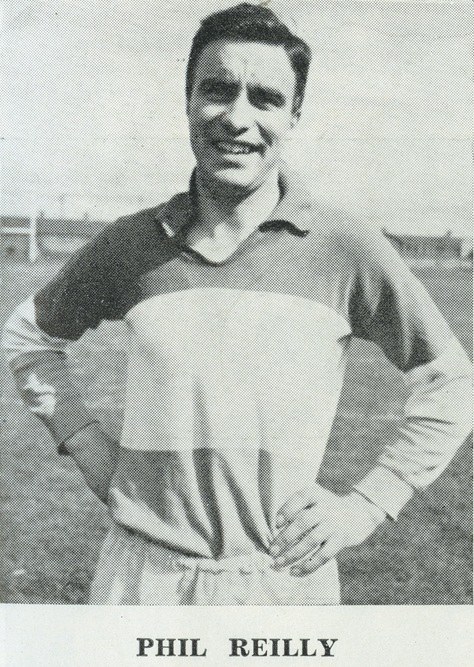
While Phil would go on to be known far and wide as a cornerstone of Tullamore’s business community, his prowess on the Gaelic football pitch made him a household name across Offaly and beyond. His journey in competitive sport began with a remarkable double victory at the minor level with Tullamore, winning both minor hurling and minor football titles. Ever modest, Phil often joked that while he secured his spot on the minor hurling team, he initially couldn’t even make his place on the minor football side!
That minor setback did not linger long. Phil quickly established himself as an indispensable presence in senior football, going on to earn three senior football county championship medals with Tullamore. His first came in 1954 when Tullamore defeated Rhode in the county final. He added a second in 1956 following a final victory over Cloghan, and capped off his club senior championship haul in 1963.
Phil’s natural athleticism, physical courage, and aerial dependability at right half-back naturally led him to the inter-county arena. Between 1956 and 1963, Phil played for Offaly in an astonishing 59 Senior Football League and Championship matches. He was an integral pillar of the historic Offaly team that broke through to claim the county’s very first Leinster Senior Football Championship title in 1960, defeating Louth in the provincial final. The Faithful County retained their crown in 1961, cementing a golden era for Offaly football.
The early 1960s saw Offaly locked in a historic, titan-like rivalry with a formidable Down team. Across two years, Phil faced Down four times in legendary All-Ireland clashes. In the 1960 All-Ireland semi-final, Offaly and Down fought to a dramatic draw before Down edged the replay.
The climax of this rivalry arrived in 1961, when Offaly marched into their first-ever All-Ireland Senior Football Championship Final against Down. September 24, 1961, remains a watershed date in Irish sporting history. Croke Park saw a historic, record-breaking attendance. Officially, over 90,000 spectators crammed into the stadium, though tens of thousands more watched from the surrounding gantries and streets after gates were broken down by eager fans. “It won’t ever happen again,” Phil reflected, remembering the sheer sea of standing supporters packed into the old Croke Park.
Though Offaly suffered an agonising one-point defeat to Down in that 1961 final, the match elevated Offaly football to the highest echelon of the sport. Shortly after, the inaugural Ground Movement Tournament was established, where Offaly finally gained a measure of revenge by defeating Down. Across those four epic encounters, the competitive ledger between Offaly and Down ended perfectly balanced: two wins for Down, one draw, and one win for Offaly, with the total cumulative scores tied—a testament to how evenly matched the two legendary sides were.
Phil’s inter-county career was also rich in travel and international camaraderie. He represented Offaly in Wembley Stadium against Kerry, played games in Birmingham, and embarked on a memorable tour to New York, playing two tough, exhibition games against Irish-American selections at Gaelic Park.
Throughout his playing career, Phil went toe-to-toe with the undisputed giants of Gaelic games. He regularly marked and shared the field with icons like Jack Kenna of Laois, Brendan Hayden of Carlow, Kieran O’Malley of Kildare, Mickey Whelan of Dublin, and the legendary Kevin Heffernan. Recalling a famous Leinster Final battle in Portlaoise, Phil shared a warm memory of Heffernan giving him a heavy shoulder-tackle that sent him over the sideline. Moments later, Heffernan walked over, held out his hand, and asked, “Phil, are you alright?” before pulling him back up to his feet—a gesture of mutual respect that encapsulated the true ethos of the amateur game.
Phil’s approach to sport was stripped of modern pretence. In his era, training was straightforward—laps of the pitch, sharp ball work, and fierce practice matches twice a week in the Reformatory grounds in Daingean under the guidance of former Dublin player Peter O’Reilly. Yet what Phil cherished most was not the medals, but the enduring friendships made along the way, often meeting former opponents for social gatherings in places like Edenderry and Newry long after their boots were hung up.
Parallel to his sporting accomplishments was Phil’s lifelong dedication to the commercial pulse of Tullamore. Following his return from P. & H. Egan’s, Phil stepped into the family business alongside his parents. In the early post-war years, the enterprise began as a modest bicycle repair and sales shop. Phil always gave huge credit to his mother, Nora, who was the driving force and engine room of the business in those early days, keeping operations running smoothly.
As commercial demands shifted, so too did the O’Reilly business. The shop transitioned from selling and repairing bicycles to offering wallpapers, paints, and fancy giftware. Phil also ran a successful School of Motoring out of the Harbour Street location for several years. Following the death of his father in October 1968 and his mother in October 1973, Phil assumed full ownership and control of the commercial premises.
An undertaker with dignity and quiet empathy
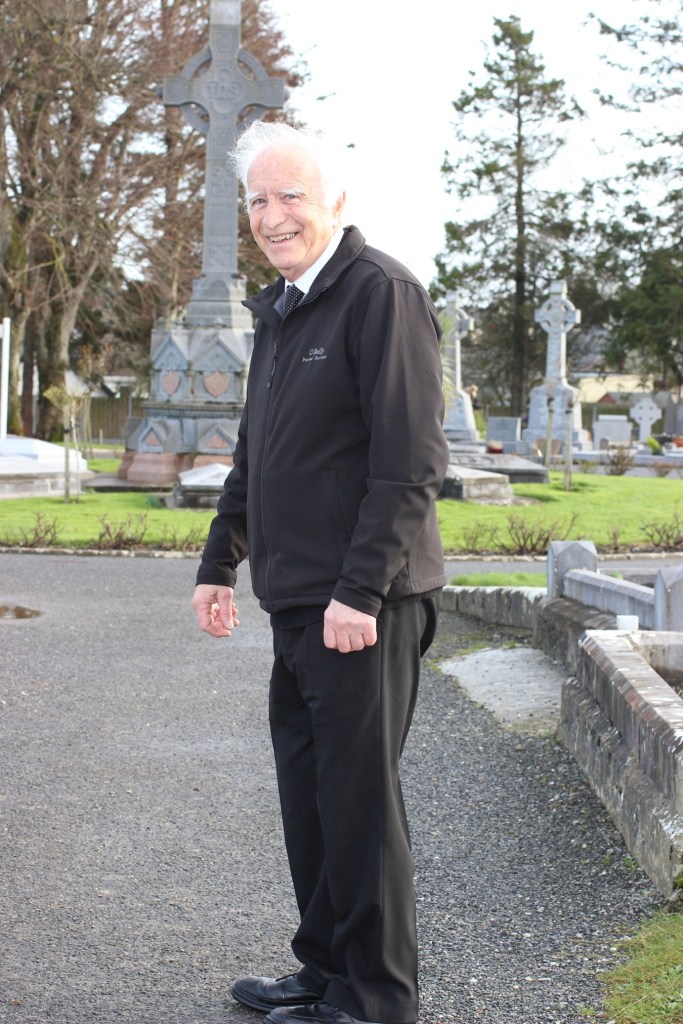
By then, Phil had already embarked on what would become his life’s primary calling. On October 1, 1970, Phil made the pivotal decision to enter the funeral undertaker business. He struck a deal with neighbour Brendan Galvin—a local publican on Harbour Street—purchasing Galvin’s hearse and existing funeral stock.
Phil’s very first funeral service was held on October 1, 1970, for the late Bill Dowling of Clontarf Road—whose son John Dowling would later serve as President of the GAA. From that single day in 1970, Phil built a funeral directing business anchored in empathy, discretion, and absolute dignity.
Over more than half a century in the trade, Phil witnessed profound transformations in Irish funeral traditions. He oversaw the shift from relying solely on hospital mortuaries to the establishment of modern, welcoming funeral homes. Phil had early foresight in this area; he initially constructed a dedicated funeral home around the corner in Market Square, and though it was ahead of its time, he later developed the state-of-the-art funeral reception facilities directly at his Harbour Street home, opposite the parish church. Through decades of societal change, including the rise of cremations and evolving wake traditions, Phil maintained one unwavering, central philosophy: every single family and every deceased individual, regardless of standing, had to be treated with equal respect, care, and dignity.
Harbour Street was not without its trials. Phil recalled the devastating night when the historic Tullamore Parish Church opposite his home burned down in 1983—a loss that deeply saddened him, even as he watched the community adapt by holding Mass in St. Mary’s Hall, the GAA centre, and local schools until the church was rebuilt. Phil’s own premises suffered a severe fire on a Sunday afternoon while he and his wife Celine were returning from an Offaly football match. Though his family and mother-in-law were safely evacuated, the damage forced the O’Reilly family to temporarily relocate to Convent View for several years while Harbour Street was painstakingly restored.
Throughout all the changes, Phil remained an anchor for the street. He held fond, detailed memories of the vibrant tapestry of local shopkeepers that once defined Harbour Street: John Kelly’s pub and grocery, the Tower Lounge, Mick Kelly’s pub, Dr. Kelly’s, Mrs. Garry’s bookmaker office, John Wrafter’s pub, Annie Kelly’s, Albert Gorry’s newsagents, and the busy operations of the North Offaly Co-op.
Beyond the football pitch and the funeral home, Phil O’Reilly Snr was a man of quiet, unwavering Catholic faith. This spiritual devotion found its highest expression in his extraordinary 40-plus years of service to the Meath Diocesan Pilgrimage to Lourdes.
The immense help he gave pilgrims visiting Lourdes
For over three decades, Phil served in the prestigious and demanding role of Chief Brancardier for the Diocese of Meath. In this capacity, he was tasked with leading and coordinating team operations for up to 800 pilgrims, including doctors, nurses, handmaids, and stretcher-bearers, ensuring the sick and elderly pilgrims were transported safely and cared for throughout their time in France.
Despite the immense physical and organisational strain of managing hundreds of pilgrims in the Lourdes hospitals, Phil carried out his duties with joyful humility. He routinely deflected praise away from himself, preferring to celebrate the great teamwork of the doctors, nurses, and clergy who volunteered alongside him. For Phil, the annual pilgrimage was not a chore, but a cherished spiritual sanctuary—a place where he prayed fervently and found immense fulfilment in helping others. Even in his late eighties and nineties, Phil made the trip to Lourdes, continuing a lifelong pilgrimage of love and service.
A family man
At the very centre of Phil’s long and fruitful life was his beloved family. In 1965, he married Celine Byrne from Strokestown, County Roscommon. Together, they built a warm, close-knit home on Harbour Street and raised four children: Monica (who settled in Charleville, Cork), Fiona, Phil, and Frankie (all of whom remained in Tullamore).
Phil was immensely proud of his family, including his four sisters—Patsy (deceased), Maire (Florida), Nuala (Tullamore), and Nora (Newry)—as well as his ten grandchildren and great-grandchild. Having his children and extended family settled around him brought him immeasurable comfort and joy in his retirement years.
When Phil O’Reilly Snr reflected on reaching his 90th birthday, he did so with the quiet contentment of a man who had fought the good fight, both on the playing field and in civic life. He was a rarity—a sporting superstar who remained completely untouched by arrogance; a businessman who viewed his work as a solemn community service rather than a mere transaction; and a man whose kindness provided a steadying hand to thousands of families during their darkest hours of bereavement.
As Tullamore bids farewell to one of its grandest sons, we offer our gratitude for a life lived so fully and so generously. To his wife Celine, his children, grandchildren, extended family, and wide circle of friends, we extend our deepest sympathies.
Phil O’Reilly Snr leaves behind a legacy written in championship medals, decades of quiet charity, and the timeless gratitude of the town he served so well. Ar Dheis Dé go raibh a anam dílis.
Offaly History extends special thanks to Aidan Barry and Shaun Wrafter for this Appreciation.
Phil O’Reilly died on the 30th of August 2026 in his 93rd year, at Midland Regional Hospital, Tullamore. Offaly History extends sympathy to his wife Céline and his family: Monica, Fiona, Phil Jnr and Frankie, sons-in-law Tadgh and Steve, and all his family and friends. Reposing at the O’Reilly Funeral Home, Harbour St, Tullamore (R35 FC84) on Wednesday (2nd September) from 2 p.m. until 7 p.m. Removal from the Funeral Home on Thursday morning (3rd September) to The Church of The Assumption, Tullamore arriving for Funeral Mass at 10 a.m. Burial after Mass in Clonminch Cemetery, Tullamore.

