
I am always intrigued, and fascinated to learn of a person, who in their time was famous, but somehow or other has faded into the mists of time. Such a person is our subject Joseph Stirling Coyne. He was during his lifetime a very famous dramatist, writing upwards of 100 plays, a theatre reviewer and one of the first editors of Punch magazine. His story is worth telling and hopefully this blog may restore him to public conscientiousness, especially in his native town.
He was born in 1803 in Birr, then known as Parsonstown. The year 1803 was a pretty good year to be born, for he shares it with Gerald Griffin, John Henry Newman and James Clarence Mangan no less, and of course with his fellow Birr man the poet John De Jean Frazer.
His parents were Denis Coyne and Bridget Coyne (née Cosgrave). Denis Coyne was a member of the Irish Commissariat. A Commissary-General for Britain had been appointed in 1793. We find Denis being described as being from Waterford, however in the Freeman`s Journal of 28th June 1833, we find a report of his death wherein he is described as being from Cork, a warehouse-keeper of the port of Cork. Further when his wife Bridget died in 1850 she was described as relict of Denis Coyne Esq., of Cork.

We do not know where exactly in Birr the Coynes lived. Birr is very fortunate in that virtually the entire 1821 census is extant. However, from an examination of the census we find that there is no family carrying the name of Coyne. Due to his father`s work with the Irish Commissariat, it is likely that the family moved on to a new location.
We do not know where exactly he had his primary schooling. In the early 1800s we know there were fourteen schools working in Birr. They were:
- Elm Grove, John Gibbs, Catholic, taught Greek and Latin.
- Castle Street, Maria Burke, Catholic, French and needlework.
- Castle Street, Ester, Protestant, French and needlework.
- Connaught Street, Wm. Sheflin, Greek and Latin.
- Church Lane, Patrick Egan, Protestant.
- Connaught Street, William Syng, Protestant.
- Connaught Street, Mary Toole, Catholic.
- Back Lane, Elizabeth Gould, Protestant.
- Graveyard, Denis Keenan, Protestant.
- Birr Glebe, John Carroll, Catholic.
- Birr Glebe, Winifred Broughally, Catholic.
- Whiteford, John Redford, Protestant.
- Burkes Lane, Patrick Grogan, Catholic.
- Lockeen, John Abbot, Catholic.
He was educated at the Royal School Dungannon. We do not have precise details of his attendance there, due to the destruction of the school records. This is a pity as it likely it would have given his Birr address. Professor Roderick Paisley of Aberdeen University who is the expert on the alumni of RSD tells me he believes he would have attended approximately 1815 until 1821. His entry occurring at the time of the Battle of Waterloo. Other well-known students at R.S.D in early 1800s include the philanthropist James Dilworth and Hugh Law, who became Lord Chancellor of Ireland.

Joseph would have been a boarder at the school in the residential facilities, some of which still exist. The Royal Dungannon School was exclusively for boys back then. Its attractiveness to parents was the considerable academic success of the school, particularly in enabling pupils to gain entry to Trinity College, Dublin. Added to this was of course the opportunity to win bursaries. Costs would have been considerably cheaper than Dublin schools. At that time the Royal School Dungannon actively sought pupils from Dublin and surrounds by advertising in the Dublin papers. The earliest known advert is in the Dublin Evening Post, 28 January 1819, page 1 col 1. It is likely there were earlier ones. The headmaster during Coyne`s time at the RSD was an active scholar and educator Dr. Lancelot Dowdall. The curriculum at the time emphasised the study of English and the classical languages Latin and Greek. Dungannon was a fair-sized town as can be seen from Pigot`s Directory of 1824.
After leaving the Royal School Dungannon, Coyne studied law, intending to pursue a legal career. It is not known to what level he studied, or indeed if he ever graduated with a law degree. Miriam van der Molen, the Archivist at the King`s Inns informs me that there is no record of him as having qualified as a Barrister.
He was developing a penchant for writing, so he abandoned his interest in law. He was writing pieces for various magazines of the time, and clearly he was showing signs of talent that would later see him develop into the top class dramatist he would become. However before he had his first play staged we find he got into a spot of bother.
FIGHTS A DUEL
In the 17th May 1834 edition of The Standard of London, we find the following report:
`AFFAIR OF HONOUR- Yesterday morning (Tuesday) 13th May 1834 at six o`clock, a hostile meeting took place between J. Sterling Coyne and Charles E. Rafferty, Esq., at the Fifth Lock, Royal Canal, the former attended by Daniel E. Alt, and the latter by Michael R. Macdermot, Esq. After an exchange of two shots each, the parties being interrupted by the country people, proceeded to Kilbarrack Church-yard, near Howth, where another shot was interchanged, Mr. Coyne`s ball passing through the breast of his adversary`s coat. The affair then terminated amicably.- (We understand that the quarrel which occasioned this duel arose out of a satirical character upon Mr. Rafferty, which appeared in an unstamped publication called the Dublin Satirist, Mr. Rafferty having imputed the authorship of the article in question to Mr. Coyne.).`
The fact that a London paper reported this suggests that he was becoming fairly well known. Their report was lifted from the Freeman`s Journal of the 14th May 1834.
Duelling as a way of settling differences was in the decline in the first half of the 1800s, the last legal duel took place in 1852. Interestingly Coyne wrote a one act farce entitled `A Duel in the Dark`, which was about a wife trapping her husband while he was `trying` to have an affair.
The underlying philosophy behind duelling is interesting. It seems the main object was not necessarily to kill your opponent, but rather you deemed the offence so great, that you were willing to risk your own life to right the wrong.
Of interest is a report in the Midland Tribune of 9th March 1963 dealing with the career of Joseph Stirling Coyne, which said he was proprietor of a public house in D`Olier Street, Dublin. I have not been able to verify this. As he was born in 1803, he would not have reached to age of majority until 1834 when he could hold a licence. We know he left for London in late 1835, so if there is any truth in it he could only held the publican`s licence for no more than one year.
THEATRE ROYAL, DUBLIN
His first break through came when his farce The Phrenologist was staged in the Theatre Royal Dublin in June 1835, which was well received. The following year he brought out two farces `Honest Cheats` and `The Four Lovers`.
DEPARTS TO LONDON:
In 1835 he went to London, with a letter of introduction from William Carleton, the Irish writer and novelist, to one Crofton Croker, the Irish antiquarian. This introduction enabled him to get employment with `Bentley`s Miscellany` and other magazines, resulting in his name becoming familiar to the reading public. Worth noting the first editor of `Bentley`s Miscellany` was Charles Dickens under the nom de plum `Boz`.
Interestingly another Offaly native Mary C.F. Monck from Banagher had her poetry published by Bentley`s Miscellany.
Coyne`s amusing farce `The Queer Subject` was staged at the Adelphi in November 1836. In the same year he joined the literary staff of the `Morning Gazette` a shortl-lived journal which was the first cheap daily. He wrote a number of pieces for the Adelphi and the Haymarket. He had a number of fine dramas staged during this time including `The Hope of the Family`, `The Secret Agent`, `Man of Many Friends` and `Black Sheep`.
MARRIAGE
In June 1840, at The Strand, London, he married a widow Anne Comyns (nee Simcocks), a native Galway lady becoming step-father to her four children. Joseph and Anne were to have four children of their own, Annie, Joseph, Georgina and Edmund.
PUNCH MAGAZINE
While still writing plays, in 1841 he was involved in establishing the magazine `Punch`, certainly a publication not universally hailed in Ireland. He met with journalist Henry Mayhew and Mark Lennon and they, with the engraver Ebenezer Landells set up the satirical publication which they based on the French magazine `Le Charivari`. Coyne`s connection with the magazine was short lived, after a charge of plagiarism from Irish papers he `withdrew` from the venture. He was among the contributors to the very first edition 17th July 1841.
His legal connection with Punch started by an Agreement dated 14th July 1841, and made between Henry Mayhew, Mark Lemon, Joseph Stirling Coyne, Ebenezer Landells and Joseph Last. By virtue of this Agreement Mayhew, Lemon, and Coyne were to own one third of the venture.
While initial sales were promising, there was a slump which resulted in the magazine getting into perilous financial difficulties. Finally to rescue the project, by an Agreement dated 6th December 1841 Lemon, Coyne and Mayhew transferred their share to Ebenezer Landells.
The magazine was to become a very anti Irish publication, with ridiculous portrayals of the Irish as apelike, uncouth and uncivilised. In fact the cartoonist Richard Doyle of county Wexford extraction left the magazine over their anti-Catholic campaigning. The magazine finally ceased publication in 2002 under the ownership of Mohamed Al-Fahed.
In 1842 Coyne published a book entitled The Scenery and Antiquities of Ireland with drawings by W.H. Barlett. Which can be accessed at http://www.libraryireland.com/SceneryIreland/Contents2.php

TROUBLE WITH THE CENSOR
In 1848 Coyne`s play `Lola Montes` attracted the notice of the censors causing him some difficulty. His portrayal of the mistress of Ludvig I of Bavaria, who had provoked a revolution, meant the play had to be withdrawn after two nights until all royal allusions were removed. The mistress was portrayed as Irish.
DRAMATIC AUTHORS SOCIETY
In 1856 he became secretary of the Dramatic Authors Society, a society set up to protect the royalty rights of authors. He was very active and indeed forceful in this role. In the newspaper The Era, we find in the Letters to Editors section, Coyne writing on behalf of Dramatic Author`s Society from 10 Lancaster Place, Wellington Street, London to complain that one Mr. George Webster of the Lyceum Theatre had not paid royalties. He performed his duties in this role with zeal up to a few days before his death in 1868.
For a considerable time he was dramatic critic of `The Sunday Times` newspaper.
He continued to write at an amazing rate, mostly farces and comedies.

SIR HENRY IRVING AND JOHN SLEEPER CLARKE
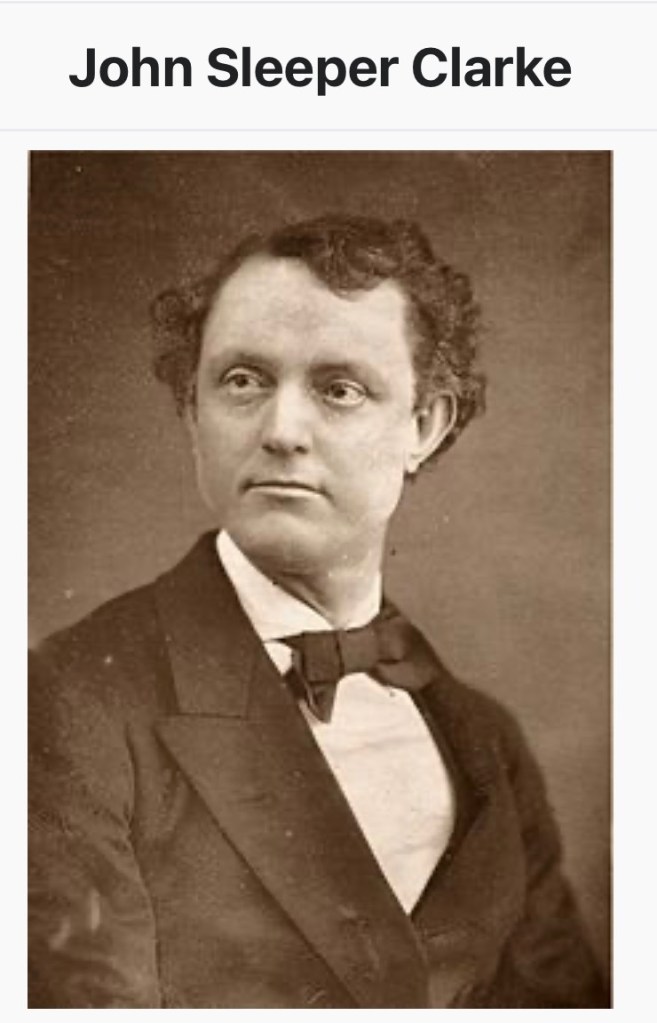
It was not until 1859 that his first serious drama called `Everyone`s Friend` was produced. This piece was later renamed `The Widow Hunt` in 1867 with the chief parts taken by Sir. Henry Irivng and John Sleeper Clarke, an American actor, who incidentally was married to Asia Booth, the sister of John Wilkes Booth, the assassin of Lincoln. The play was renamed at the insistence of Clarke. Sir Henry Irving was one of the leading actors of his day, and in today`s language he was a celebrity.
DEATH
Coyne lived at 3 Wilmington Square, Clerkenwell, before moving to 61 Talbot Road, Westbourne Park, London, where he died on 18th July 1868. He was interred in Highgate Cemetery, Camden, London, on 21st July 1868. When a Grant of Probate to his estate was extracted 8th August 1868 his estate was valued as less than £5,000.0.0
His widow Anne was to survive him by twelve years passing 25th January 1880, when she was still residing at 61 Talbot Road.
After his death we see a number of obituaries on the London newspapers all invariably lauding him, both as a person and as a dramatist. In the newspaper `The Era` of the 26th July 1868 they list no less that sixty of his plays, and indeed are fulsome in their praise of him.
Why has he been forgotten? I suppose farce and comedy are very much of their time, and no doubt would appear dated to our modern age. One will find odd references to him in various newspapers down the years. In `The Irish Monthly` of July 1904 under the chapter `The Literature of King`s County` the editor Matthew Russell, S.J. speaks of him thus: `Sterling Coyne` is very like a punning pseudonym, but it is the real name of a very clever man. Joseph Sterling Coyne was born in Birr, in the King`s County, in the year 1803- the same year as Gerald Griffin John Henry Newman and (on the other side of the Atlantic) Orestes Augustus Brownson and Ralph Waldo Emerson. Coyne was the son of an officer in the Irish Commissariat. He was intended for the Bar put preferred literary life. He was the author of half a dozen successful plays. Mr. O`Donoghue says he was responsible for several hundred dramatic pieces, some of them adapted from French and German`
It is interesting that Russell could only give him credit for half a dozen plays, clearly his work was dating a mere thirty years after his demise. The Mr. O`Donoghue referenced is Mr. David J. O`Donoghue who wrote `Poets of Ireland`.

This son of Birr was a very significant writer in his day and is surely worthy of being remembered in his own county.
Our thanks to Pádraig Turley for this piece. If you would like to contribute to this series contact us, info@offalyhistory.com. Our blogs have reached 50,000 this year alone and 500,000 since we started the series in 2016. All 500 blogs can be accessed on this site and at http://www.offalyhistory.com.
 offalyhistoryblog