
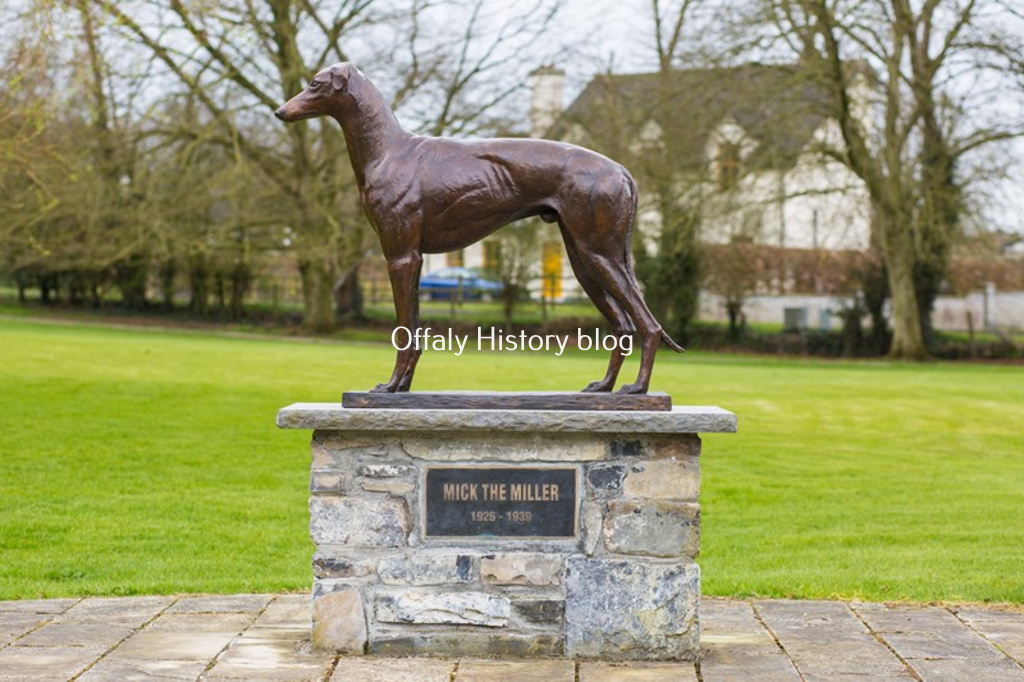
1. Sculpture of Mick the Miller by artist Elizabeth O`Kane on Killeigh village green.
Mick the Miller was the first great star of greyhound stadium racing in Britain. Born in Killeigh, Co Offaly in 1926, he had a successful Irish career before he began racing in England in 1929. By the time he retired in 1931 he had won 5 classics including the English Derby twice, the Cesarewich, the St Leger and also the Welsh Derby. He was the first greyhound to win the English Derby twice in succession and the first greyhound in the world to win 19 races in a row (both records remained unequallled for over 40 years). He won 51 of his 68 races, finished out of the top 2 positions only 6 times and also won 10 of his 13 one-on-one matches. His total prizemoney was £9,017 (€485,000 in today`s money) and he won 18 silver and 6 gold trophies. Mick equalled 2 track records and set 7 new ones (6 of which were also new world records).
He was a very exciting dog to watch and people flocked in their thousands to see him run.
When he arrived in England greyhound racing was still a new sport, having only started there in 1926. New stadiums had been built around the country but the whole affair had not yet fully taken off among the public. Mick arrived at just the right time and through his popularity did more to help promote the sport than any man, woman or dog. In fact, within a few short years more people were attending greyhound races than football matches. Mick became as famous as many of the actors, athletes or musicians of the day. He even became a movie star in 1934 when he starred in the film Wild Boy which was based on his life story. He died in 1939 but was preserved and can still be seen on display at the British Natural History Museum in Tring near London. In 2011 the people of Killeigh erected a statue on the village green in his honour.

2. A tribute to Mick in The Star newspaper dated Dec 20th 1957.
Mick was born on 29th June 1926 at Millbrook House in Killeigh village. His breeder was Fr Martin Brophy, the parish curate who was a lover of greyhounds. Fr Brophy had mated his own dam, Na Boc Lei with sire Glorious Event (owned by P.J. Meehan of Portlaoise) to produce a litter of 10. Mick the Miller was born the smallest and weakest of the litter. However, a young local man called Michael Greene who was working for Fr Brophy at the time and took a shine to Mick the Miller. Michael began looking after the little pup as if he was his own pet and even bottle fed him. In time Mick the Miller caught up in size and strength to his siblings. Fr Brophy eventually sold most of the litter but kept Mick the Miller and his brother Macoma at Millbrook House.

3. Millbrook House as it looked in the 1980s.
Michael Greene trained the dogs to slip (chase) in the yard at Millbrook House and then later in the fields around the house. Michael also exercised the dogs daily on the roads around the village. He would also enlist local school children to help him train and walk the dogs. Mick Flanagan who lived in Millbrook townsland is said to have out too. When Mick the Miller and Macoma were old enough they were brought to take part in local coursing meets such as those at Castletowngeoghan, Kilbeggan and Maryborough (Portlaoise). Macoma had more success at coursing than Mick The Miller, winning two stakes and dividing one, while Mick won one and divided two. Mick eventually turned into an average sized but muscular greyhound, brindle in colour (brown with dark patches) with a white chest, white tail-tip and white paws. He had an extra long tail and had a lovely temperament and was very people friendly. However there was no guarantee that Macoma or Mick the Miller would become as successful as they did and Fr Brophy sold them to a Mr Rebenscied in USA for £100. Mr Rebenchied then called the deal off after his circumstances changed and so the dogs remained with Fr Brophy in Killeigh.

4. Fr Brophy and his greyhounds in the yard of Millbrook House with Michael Greene and some of the local children who helped train the dogs.
It was Fr Brophy`s dream that Mick the Miller or Macoma would go on to win the holy grail of coursing, the Waterloo Cup. But things had changed by 1927 as the new outlet of oval track racing had opened up for greyhounds. Belfast`s Celtic Park was the first of these tracks to be built in Ireland, swiftly followed by the opening of Shelbourne Park in Dublin. Fr Brophy decided to bring both dogs for trials at Shelbourne. After watching them run, Michael Greene had the idea to build a dummy track back in Killeigh. He did this from chicken-wire in a half moon shape and trained the dogs to run around the bend. Fr Brophy also enlisted the services of Meath man Mick Horan who was Shelbourne`s licenced trainer. Under Mick Horan`s tutelage Mick the Miller went on to win his first 4 races at Shelbourne.

5. Report from the Irish Independent on Mick`s 4th ever race and his 4th win in a row.
Disaster then struck on May 11th, the morning after the Abercorn Cup final in Belfast when Mick was found shivering in his kennel. He was diagnosed with distemper and the vet`s orders were to let him rest. Mick convalesced back in Killeigh under the care of Michael Greene but received treatment from Dublin vet Arthur Callinan. Fr Brophy at this stage tried to sell both Mick and Macoma who was also injured but only succeeded in selling Macoma (who did go on to become a champion hurdler in England). It was November (6 months after he got sick) before Mick the Miller had regained enough strength to compete again. He resumed his coursing career with four losses and one win at Castletowngeoghan. By March 1929 he was fit to race at the track again and he won 11 of his next 15 races, coming 2nd in 4 of them.

6. Fr Martin Brophy, Macoma, Mick the Miller and Michael Greene at the coach house in Millbrook where both dogs were born.
In July 1929 Fr Brophy decided to take Mick to England for a try at the English Greyhound Derby. In his first trial run at London`s White City Stadium, Mick equalled the track record. In his next race, he set a new world record becoming the first dog ever to run 525 yards in under 30 secs. Fr Brophy was inundated with offers to buy Mick and he sold him to bookmaker Albert Williams for a fee of £800. Part of the deal was that Fr Brophy would get the trophy and prizemoney if the dog went on to win the final. Mick did indeed go on to win the final and Fr Brophy collected the £700 cheque and the silver trophy . After the race Fr Brophy was transported around the stadium on a lap of honour to the cheers of the 40,000 strong crowd. Interestingly at that time Fr Brophy was officially registered in the greyhound stud book as Mr B Murphy and the Sunday Independent in Ireland ran a front page article headlined, `Revealed The True Identity Of Mick The Miller`s Owner`. On his return home to Killeigh Fr Brophy was honoured with a torchlit procession into the village. There was also a party held on the village green with a bonfire and barrells of porter to celebrate Mick`s great victory.
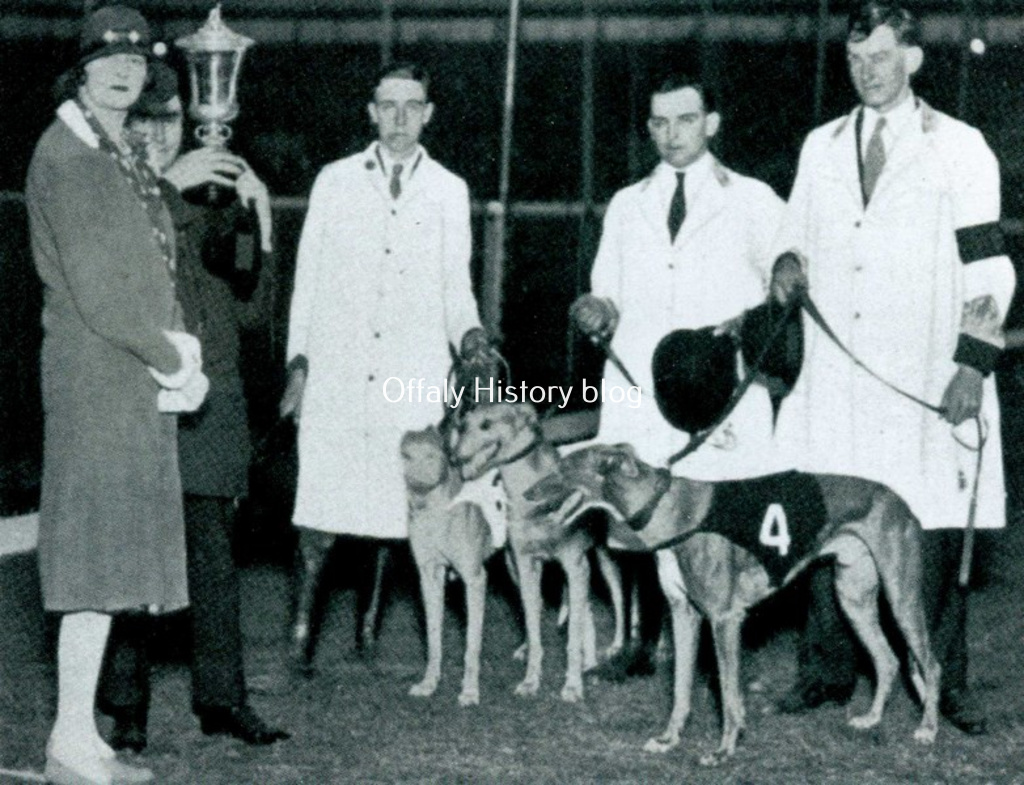
7. Fr Martin Brophy after receiving the 1929 Derby trophy. Mick Horan is on the right
holding Mick the Miller (No 4).
Mick continued his career in England under Albert Williams while being trained by Stanley Biss, winning six races and two one-on-one matches until he was sold again in November 1929 for a world record fee of £2,000. The new owner was Phyllis Kempton, whose husband Arundel had purchased Mick as her Christmas present. Arundel was a successful businessman and vice-chairman of Wimbledon Greyhound Stadium. He and his wife made a very glamorous couple and their purchase of the top greyhound in the world only increased their already high public profile. Under their ownership and while now being trained by Sydney Orton, Mick the Miller won a total of 33 races and 7 one-on-one matches. This included the 1930 English Derby, his second derby in two years. That win was watched by 50,000 people including Alfonso X111 king of Spain who presented the winning trophy. The King was so impressed by Mick the Miller that he bought several greyhounds on his return home and opened 2 new greyhound tracks.

8. Report on Mick`s 2nd English Derby win in a row, from The Greyhound Mirror.
Mick won the Welsh Derby and the English Cesarewich also in 1930. Over the course of those two campaigns alone, he managed to set 4 new world records in 40 days. At this time too he set another world record when he became the first greyhound ever to win 19 races in a row. The winning streak ended on 23rd August 1930 when he got injured in tthe Laurels at Wimbledon. He did not resume racing again until March 1931. He then won 4 races in succession and even managed to equal the track record at Wembley in the Spring Cup final. He reached the English Derby final again for the third year in a row. He won the final but the race was voided due to other dogs fighting behind him. As an ageing dog, he did not have the stamina during the re-run for a repeat performance and finished fourth. However, a few months later he ran what many would consider his greatest race of all. He was then 5 years of age, which is old for a racing greyhound but he won each round of the St Leger to reach the final. He showed tremendous heart in a very tough race to claim victory. To this day he is still the oldest greyhound to have won the St Leger.

9. Mick enjoying his newly won St Leger trophy.
Mick was retired to stud with Jack Masters after that famous win but he still remained very much in the public eye. He was often paraded before important races like the Derby or St Leger finals. And as a celebrity he was in big demand to help support charity events. One such event took place at Dunmore Park in Belfast when over 10,000 people turned up to see him run in a solo trial against the clock. A few months later he appeared in a British pathe news reel which was titled Meet Mick the Miller. Two years later he became one of the first dogs ever to appear in a BBC television broadcast. However in 1934 he really hit the big time when he starred in the film Wild Boy which was based on his life story. The film was produced by Gainsborough Pictures and directed by Albert de Courville. It also starred Sonny Hale, Gwyneth Lloyd and comic duo Flanagan and Allen and went on worldwide release.

10. Mick on left and Sonny Hale on right during the filming of Wild Boy.
Mick was so famous at that stage that he was chosen by Selfridges Department Store as the VIP to open the new roof garden of their London shop. Around that time too he was asked to attend a charity fundraising play at the Adelphi theatre in London. He took his place in a line up of other celebrities and politicians to be introduced to the King and Queen of England. In 1935 Mick found himself mentioned in Alfred Hitchcock`s latest film The 39 Steps. The last of Mick`s public appearances was at boxing tournament in January 1939 when three of his offspring were auctioned to raise money for charity. He then quietly lived out the rest of his life as the house pet of his old trainer Sidney Orton. When Mick died on 5th May 1939, just days short of his 13th birthday, it was decided he should be preserved and he was donated to the British Natural History Museum. He went on display in the museum at South Kensington, London a few months later where he immediately became a very popular exhibit.
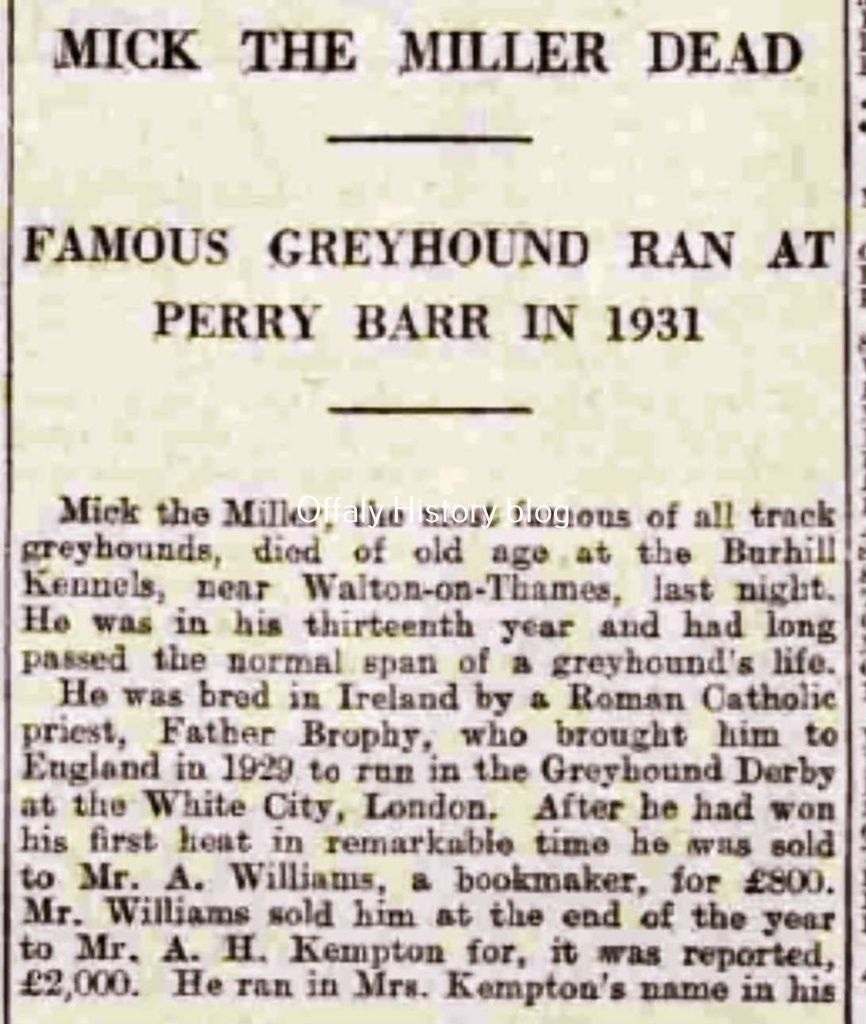
11. Mick`s death was reported in newspapers all around the world.
Over the years the celebration of Mick`s achievements continued unabated. He had many items of memorabilia produced in his name including cigarette cards, post cards, paintings, brass statuettes, calendars, photographs, badges, posters, brochures, cuff-links, key-rings, t-shirts and even tea-sets. Royal Doulton produced porcelain statues of him which were limited to 7,500 pieces. The statues even came in a customised box along with a certificate of authenticity. He has had postcards of him issued twice by The British Natural History Museum. The first version was issued in the 1970s while he was still in South Kenginston and the second version was issued in the 2010s after he was moved to the Tring, Hertfordshire branch of the museum.
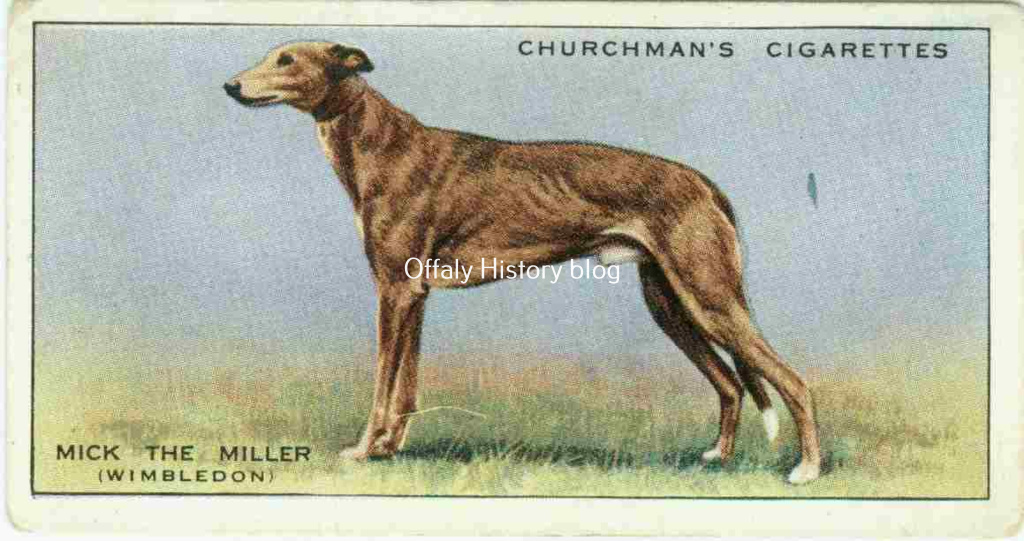
12. Churchman`s cigarette card from 1934.
He has also been honoured in many other ways since he passed away. In 1981 he was inducted at a special ceremony into the American Hall of Fame (International Section) at Abeline in Texas. In 2001 Wimbledon Greyhound Stadium renamed their grandstand the Mick the Miller Stand. The stand also housed the Mick the Miller bar which complemented the mosaic of him that lay in the stadium`s floor since the 1930`s. Bookmakers honoured him in 2002 when they named one of their new virtual dog racing stadiums Millersfield. In 2007 Curaheen Park Greyhound Stadium in Cork named one of their bars after him (their other bar was named after Mick`s ancestor Master McGrath). In 2011 By The Horns Brewery in London began brewing Mick The Miller Amber Ale which went on sale on draft in several pubs in England. He is often mentioned on TV as the subject of questions on BBC quiz shows such as They Think It`s All Over, Eggheads and The Chase and he has been mentioned in modern soaps such as Only Fools and Horses, Steptoe and Son and Coronation Street.

13. Pump clip from a pub in England.
Mick is still regularly written about in newspapers and magazines, and in recent years many books have been published that have articles and indeed entire chapters on him. These include; Please Mister – The Golden Age of Greyhound Racing by Charles Blanning, Tales Of The Dogs by John Martin, Images Of The Past – Wembley by Maurice Crow, The Story Of Your Life – A History Of The Sporting Life Newspaper by James Lambie, The Greyhound and The Hare by Charles Blanning, Players – 250 Men, Women and Animals Who Created Modern Sport by Tim Harris, Best Of British – Hendo`s Sporting Heroes by Jon Henderson, Irish Country Sports – A Heritage by the Irish Game Fair Association, Sport And Ireland – A History by Paul Rouse, Heroic Animals – 100 Amazing Creatures Great And Small by Clare Balding, Dogs Best Friend by Simon Garfield and Immortals Of British Sport by Ian Hewitt and Sampson Lloyd. In 2003 English author Michael Tanner chronicled Mick`s entire lifestory in his book The Legend Of Mick The Miller – Sporting icon of The Depression. The book was shortlisted for sports book of the year.

14. Michael Tanner`s book was published by Highdown.
Mick was not forgotten either in his native village of Killeigh. In the 1970s Danny Coughlan wrote ‘The Ballad Of Mick The Miller’ (a copy of which still hangs in the bar of the village pub). In the 1980s Fr William Prendergast, parish priest, wrote an article for the parish newsletter on Mick`s life. It was based on an interview with Mick`s handler Michael Greene.
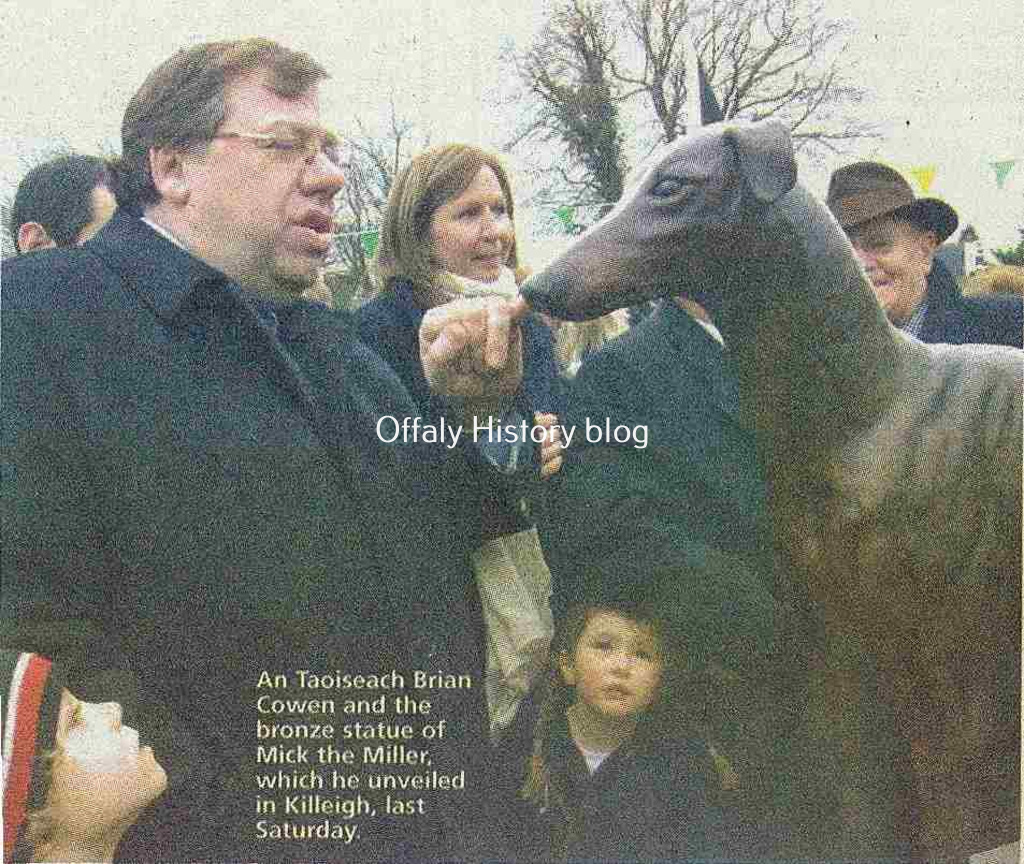
15. From The Offaly Topic newspaper article on the monument unveiling ceremony.
The Mick The Miller Commemoration Committee was formed in Killeigh in 2008 to erect a monument to Mick. The committee obtained funds mostly via donations from local people and businesses but also from the Irish Greyhound Board. Artist Elizabeth O`Kane was chosen to sculpt the bronze life-size statue to sit on a plinth, made from stone from Mick`s birthplace Millbrook House. The monument was unveiled at a ceremony on 29th January 2011 by An Taoiseach (Irish Prime Minister) Brian Cowen. Special guest was Dick O`Sullivan, Chairman of the Irish Greyhound Board. Over 500 hundred people from all over Ireland attended the event including decendants of Fr Brophy, Mick Horan and Michael Greene. The statue has since proved to be a real tourist attraction and has even brought visitors from England on several occasions.
For more information please follow http://www.facebook.com/greyhoundlegend, http://www.twitter.com/@_MickTheMiller or visit http://www.mickthemiller.com.
 offalyhistoryblog