
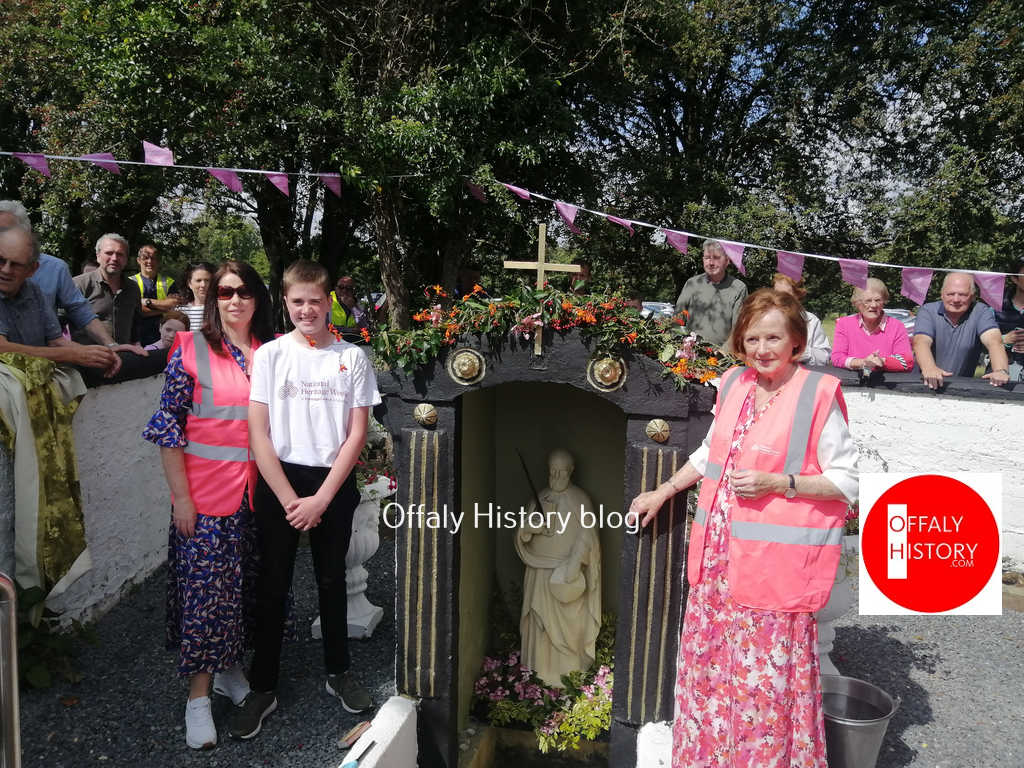
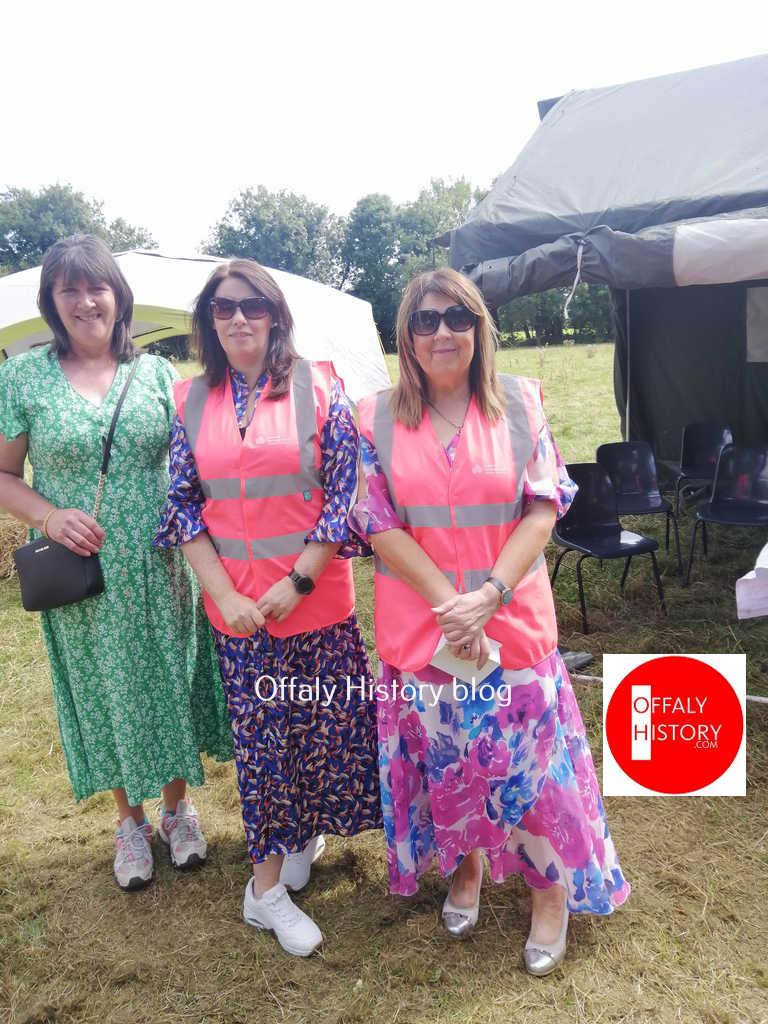
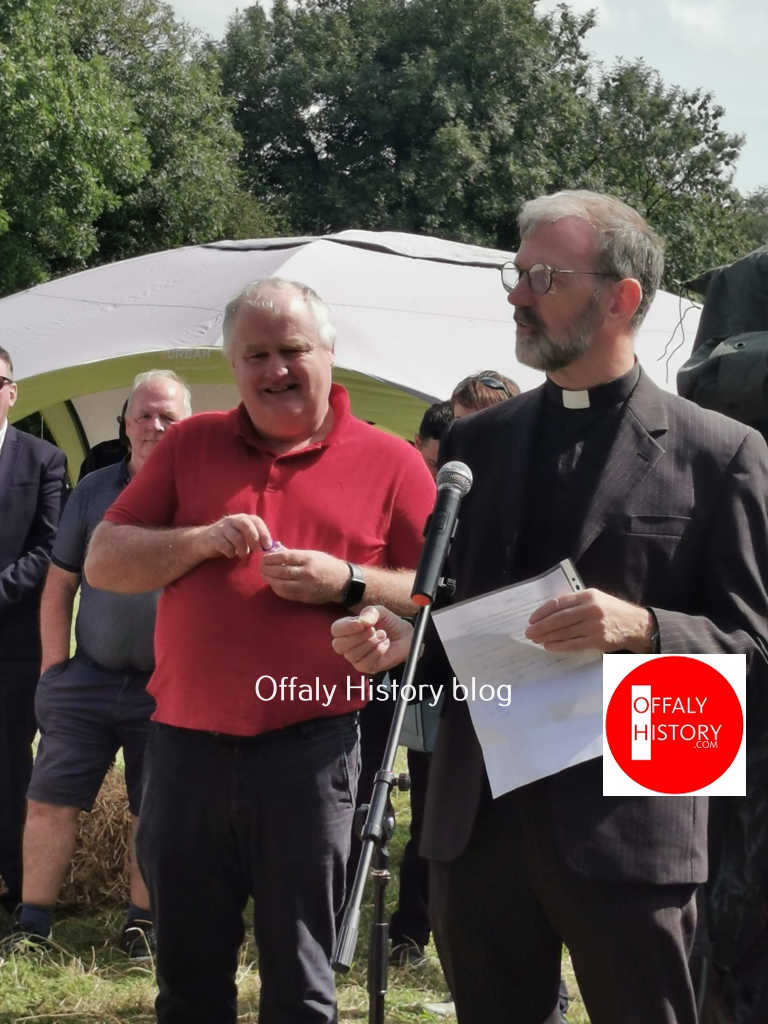
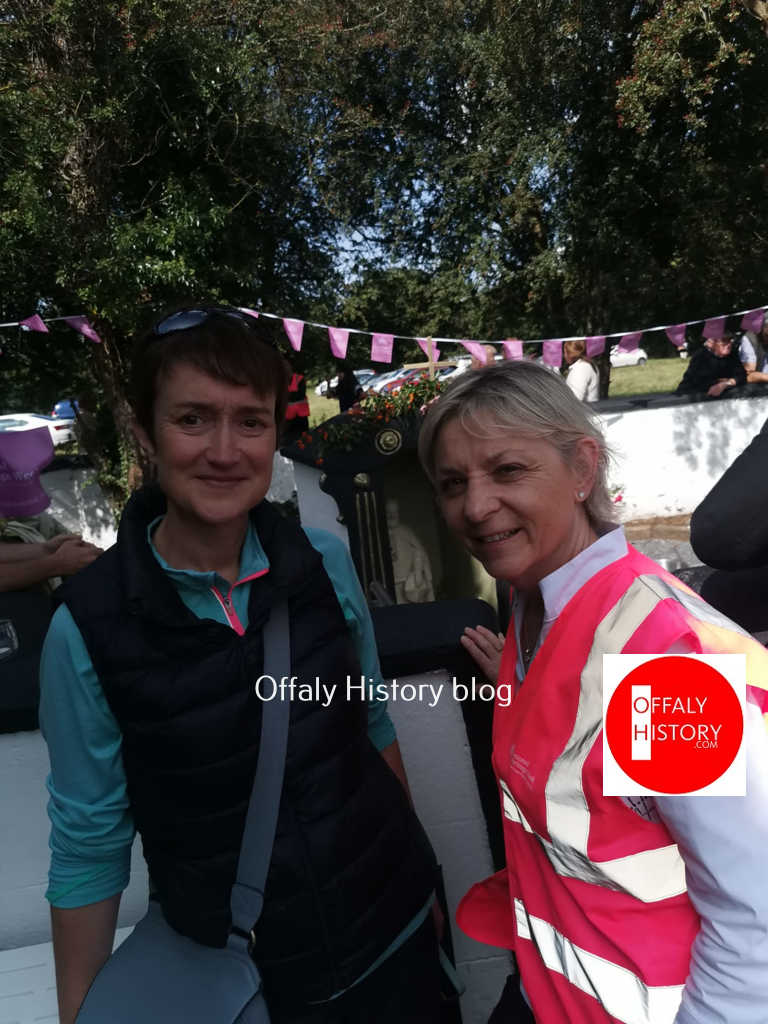
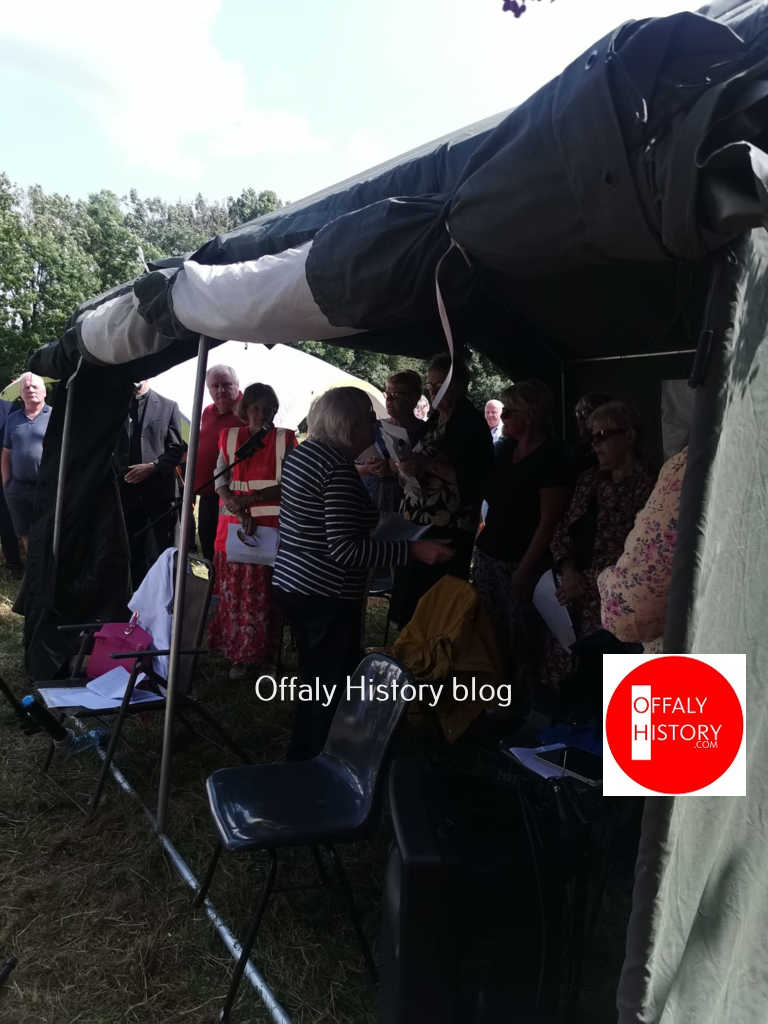
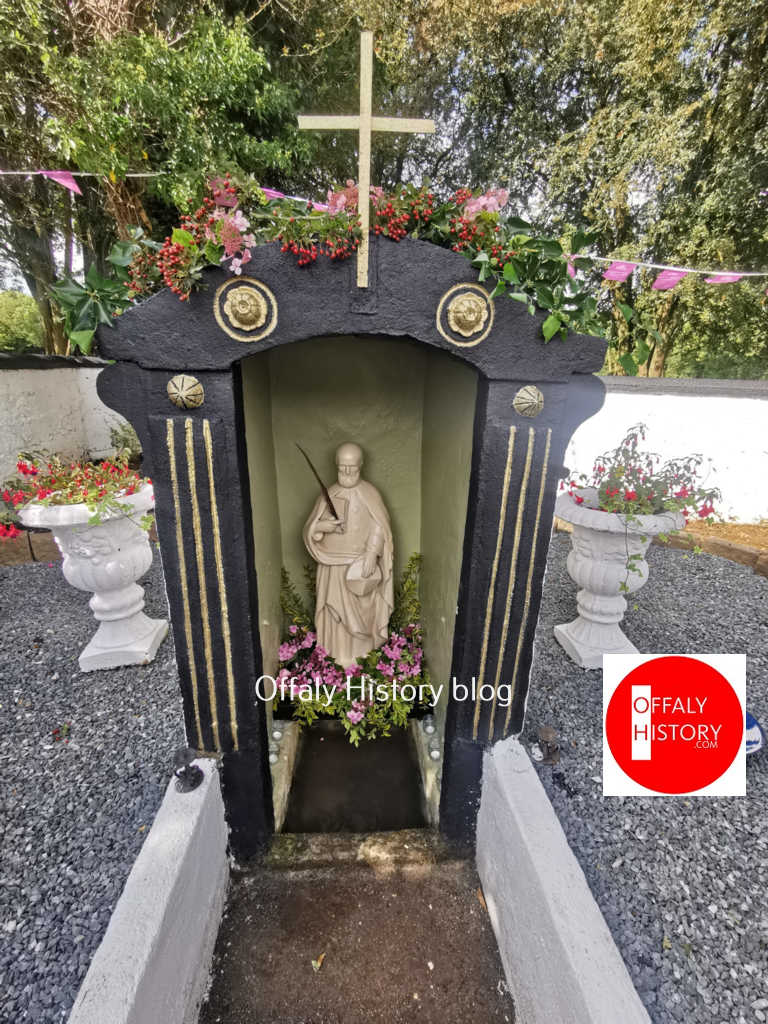
Bracknagh Heritage Society unveiled a statue of Saint Brochan in Saint Brochan’s Well, Clonsast, County Offaly for National Heritage Week. The Blessing was performed by Fr. Gregory Corcoran, P.P and by Reverend Alan Melbourne. Mary Briody on behalf of Bracknagh Heritage Society welcomed a large crowd who gathered at the Holy Well and Monastic site at Clonsast (on farmland) as Frances Cunningham unveiled the statue. Mary Delaney gave a talk on the History of St. Brochan and the 7th century monastic site. Pat Carey read an “Ode to St.Brochan’s Well”, composed by Mary Crotty.
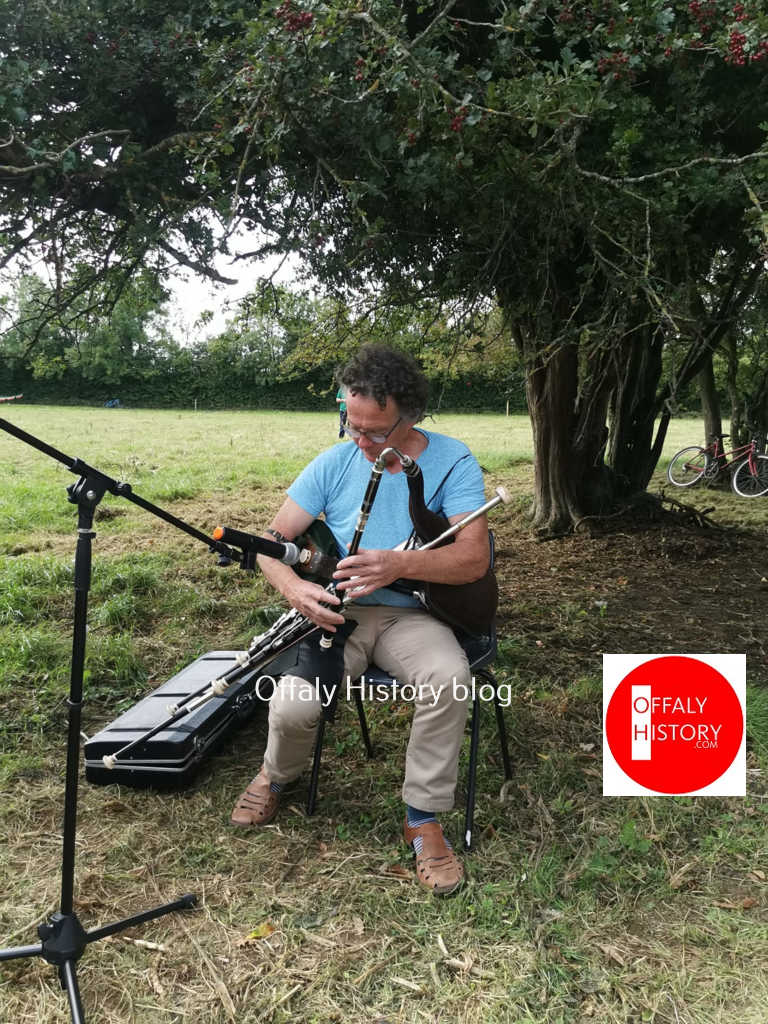
The event was accompanied by the local Choir and Ciaran Flood played the pipes.
Address from Mary Delaney, local historian and chairperson of Bracknagh Heritage Society
Good afternoon, Fr. Corcoran, Reverend Melbourne, Ladies and Gentlemen
Today we gather in this sacred place to remember Saint Broghan and to pay tribute to him by placing a statue of the Saint into this holy well. We hope that this will enhance the historical importance of the monastic ruins here in Clonshannon and will provide a valuable resource for future generations.
From the early 6th century young men and indeed some young women, as was the case of Saint Brigid, left their homes and families and decided to devote their lives to God in a special way. Some joined monasteries and convents while others like Saint Broghan established their own monasteries. Today, only fragments of the landscape they created survive. Nonetheless they left a legacy that deserves recognition. This legacy is an important part of our historical past.
The townland of Clonsast or Clúin Sasta is the site of the monastery founded by Saint Broghan in the 7th century. Monks usually chose isolated locations on which to establish their holy grounds, locations that would be free from distraction. Clonsast translates as “the meadow of tranquility” and would have provided an idyllic refuge in which Saint Broghan and his monks could pray and work. The monastery was built on a section of dry land surrounded by the Bog of Clonsast and the greater Bog of Allen and was in close proximity to Croghan Hill, another important seat of worship.
Saint Broghan was born in Scotland and has been described by early scholars as one of the four great prophets of Ireland. He has been given the title of fear dá leithe, the man of two parts, referencing the fact that he spent half his time here in Clonsast and the other half in his native Scotland.
The monks’ dwellings were called cells. The cells here seemed to have develop as a small cluster around the church which was located in the field adjacent to the well. There may have been a chapter house in the centre as was common in the early monasteries. The cells, sometimes referred to as beehive huts were probably made from wattle and daub and some may have been made from local stone, given the fact that there was a local quarry nearby. An important building in the monastery here in Clonsast was the scriptorium, where manuscripts were produced. On entering the monastery monks had to give up all their possessions and take three vows of poverty, chastity, and obedience. They were given garments called habits to wear and had their heads shaved in a style called a tonsure.
The monastery here at Clonsast would have been accessed by a wooden road known as a togher, where wooden planks were laid across the bog. Back in the 1940s archaeologists dated this road known as, St Broghan’s road, to between the eight and ninth centuries and described it as consisting of brushwood, sand and gravel[1]. It is believed that this road would have been used by Saint Broghan and his monks and later by pilgrims on their way to Croghan Hill and to other monasteries such as those at Killeigh and Clonmacnoise.
Early monasteries such as the one here in Clonsast, were the first villages and towns of Ancient Ireland. In fact, the townland of Bracknagh is derived from fearan na Breacháin, the territory of Broghan.
Some monks spent their days tending their crops and animals. In fact, the monks can be credited with introducing and developing tillage farming in this area.
There is evidence that the monks at Clonsast provided healing and curative services in the locality. In fact, monasteries could be paralleled with our health centres of today. The presence of a well at Clonsast and a Bulláun Stone suggest that this was very much the case at St Broghan’s monastery. Wells were considered a source of life by ancient druids and under the Christian tradition, many churches and monasteries were built around them. While used a source of water, they were also used as baptismal fonts and as Holy wells.
The term Bulláun is used to describe a depression in a stone which is usually filled with water. These were used as holy water vessels, for curative purposes and healing. Here in Consast, St Broghan is said to have stamped an impression of his head in the Bulláun stone. Traditionally, pilgrims would visit the site, take water from the well, place it in the Bulláun and then immerse their head in it to seek intercession from St Broghan.
To this day local people continue to visit the well and stone as a cure for headaches.
Another use of Bulláuns was for grinding corn further suggesting that some of the monks engaged in tillage farming. The monks here were known for baking bread and for leaving some for the poor at the Bread Stone also known as Claugharan House, not far from the present day football field.
Balláun stones were also used for smelting ore, indicating that metal work was important in the monastery. This would have led to the production of holy crosses and chalices as was common in sacred grounds like these in Clonsast.
Early Christian monasteries are also considered to be the first colleges or universities of Ireland and developed as learning centres. Most monks were preachers and teachers. The monastery here in Clonsast is said to have been one of the most important learning centres of Ancient Ireland
Saint Broghan is best known as a scribe, which gained him not only local recognition but indeed national and international recognition. Bearchán’s church at Clonsast is credited with the possession of a manuscript known as Leabhar Bearchán, referenced locally as Leabhar Cluain Sasta. According to Ó Riain in his Dictionary of Irish Saints, this formed part of the Library collection of the Earls of Kildare up to the sixteenth century. [2]
Its whereabouts remains unknown. However, part of this manuscript was copied and can be found in the Leabhar Breac presently in the Royal Irish Academy, Dublin. It also contains a history of Alexander the Great, which is said to have been written by St. Broghan here in Clonsast.
Manuscripts were produced on Vellum and parchment. Vellum being calf skin and parchment being the skin of sheep and goats. Broghan would have, used local berries and bog flora as ink, while he used the feathers of local birds as a quill.
The manuscript produced here is reputed to have been on a par with that of the Book of Kells.
Broghan is also remembered in the Gaelic tradition as a poet and author of The Prophecy of Berchain. In the poem consisting of 204 stanzas, he predicted the tragedy and legacy that would befall the monasteries.

There is some dispute over Broghan’s feast day but it is general understood to be the 4th of December.
However, here in Clonshannon it was celebrated on the 24th of June on the feast of John the Baptist.[3] This may have been due to the fact the feast of John the Baptist coincided with a pagan feast day to celebrate fertility and growth and locals may have chosen this date to mark the fact that the early monasteries were the first granaries of Ireland.
Celebrations of patron saints were and continue to be, part of the catholic tradition and down through the years patterns took place here in Clonshannon. It is recorded that prior to the 1840s they were a week- long celebrations and were held in the field between the well here and the church. The event included devotion, confessions and a Mass, However, the patterns here became major social events too, events that people looked forward to all year. These week- long events led to a large consumption of alcohol and this created tension between the parishioners and the local clergy. As a result, the clergy put a stop to such events.
John O Donovan quotes that the patterns at Clonsast ended as, a consequence, of the bad effect of Whiskey![4]
Banned or not they seemed to have continued as one day events up to the 1950s and were revived as a once off event in the 1970s/1980s. Many people in locality as I am sure do, some of you gathered here today, continue to have fond memories of Pattern Days in Clonshannon,- memories of dancing, entertainment, amusements, ice cream and indeed some met their prospective spouses here.
The date of Saint Broghan’s death is unclear but is recorded to have occurred between 650 and 670. It is believed that he is buried on Inis Mor on the Aran Islands along with three other Irish saints. A church was built over the burials and is known as the Church of the Four Illustrious,[5] bolstering the belief that he, was, in fact, one of the four great prophets of Ireland,
So today, we have great pride and indeed feel privileged to be placing a statue of Saint Broghan in these sacred grounds.
We do this as an acknowledgment of his contribution and the contribution of those who followed in his footsteps. His name is reflected in our school, our church, our parish and even in our sport and we are proud that the name of our village of Bracknagh is derived from his name. We hope that our event today will help to promote local history and will help to preserve our rich historical past. I would like to leave you with a quote from Caimin O Brien taken from his book, Stories from a Sacred Landscape.
“Today Offaly is a sacred Landscape, enriched by the folklore, history, poetry, art and architecture of our Christian Past. This landscape tells a story, not only of our county but of our nation. How we care for this priceless resource will be our legacy to future generations.” [6]
[1] O Brien, Caimin. Stories from a Sacred Landscape. Offaly County Council, 2006.
[2] Ó Riain, Padraig. A Dictionary of Irish Saints, Four Courts Press, Dublin, 2011, p.97
[3] The Parish History Committee “The life, the Times, the People” Topic Newspapers , Mullingar, (1993)p.195.
[4] O Brien, Caimin. Stories from a Sacred Landscape. Offaly County Council, 2006.
[5] O Brien, Caimin. Stories from a Sacred Landscape. Offaly County Council, 2006.p.199
[6]O Brien, Caimin. Stories from a Sacred Landscape. Offaly County Council, 2006
 offalyhistoryblog