
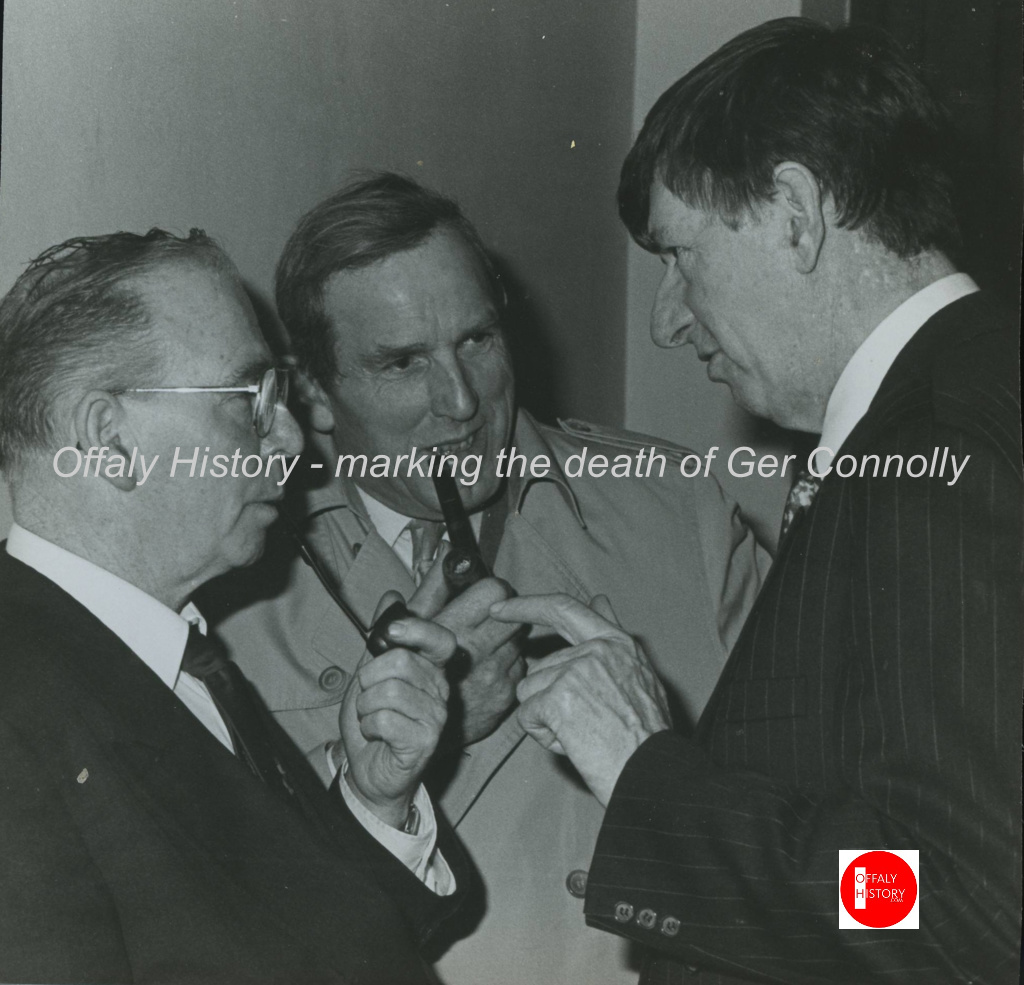
The death of Ger Connolly at Droimnin Nursing Home, Stradbally on 25th January 2024 marks the end of an era in the political life of County Offaly.
Aged 86 Gerard C (Ger) Connolly was a former Fianna Fáil councillor, TD and Minister of State who might best be described as the great survivor of Offaly politics, with an unbroken record as TD from 1969 until his retirement in 1997. He was witness to and an important figure in some of the most turbulent times in Irish politics, as a devoted supporter of Charles J Haughey during the Eighties.
His entry onto the national stage and his electoral record mark him out as one of the most significant figures in a five seat constituency with no shortage of political titans including a former Taoiseach and three former cabinet ministers.
Colourful, engaging and often provocative in political debates Ger Connolly was hugely popular throughout the constituency, securing first preference across traditional party boundaries, especially in North Offaly. He loved the cut and thrust of politics and his one liners and bot mots, delivered with theatrical flair, often enlivened debates in Offaly County Council and Dáil Eireann.
He was also a diligent constituency worker and as Minister of State made a significant contribution to the implementation of new policies on urban renewal and inner city development.
Strongly supportive of the construction industry and a firm believer in encouraging private sector development he relished his role as Minister of State at the Department of the Environment. He had a reputation as a decisive Minister of State and enjoyed good relations with civil servants, often surprising those who might have initially mistaken his mischievous smile and faux distain for detail.
Local government career: Ger Connolly was the son of an 1916 veteran and was steeped in the nationalist tradition.
A farmer and auctioneer from Bracknagh he was elected to Offaly County Council on his first electoral outing in 1967. Securing 680 votes (12.5pc) he was elected on the 8th count.[1]
Elected to the Dáil in 1969 Ger Connolly topped the poll and was again elected to Offaly County Council on the first count in the local elections of 1974 with 25.6pc of the vote.[2]
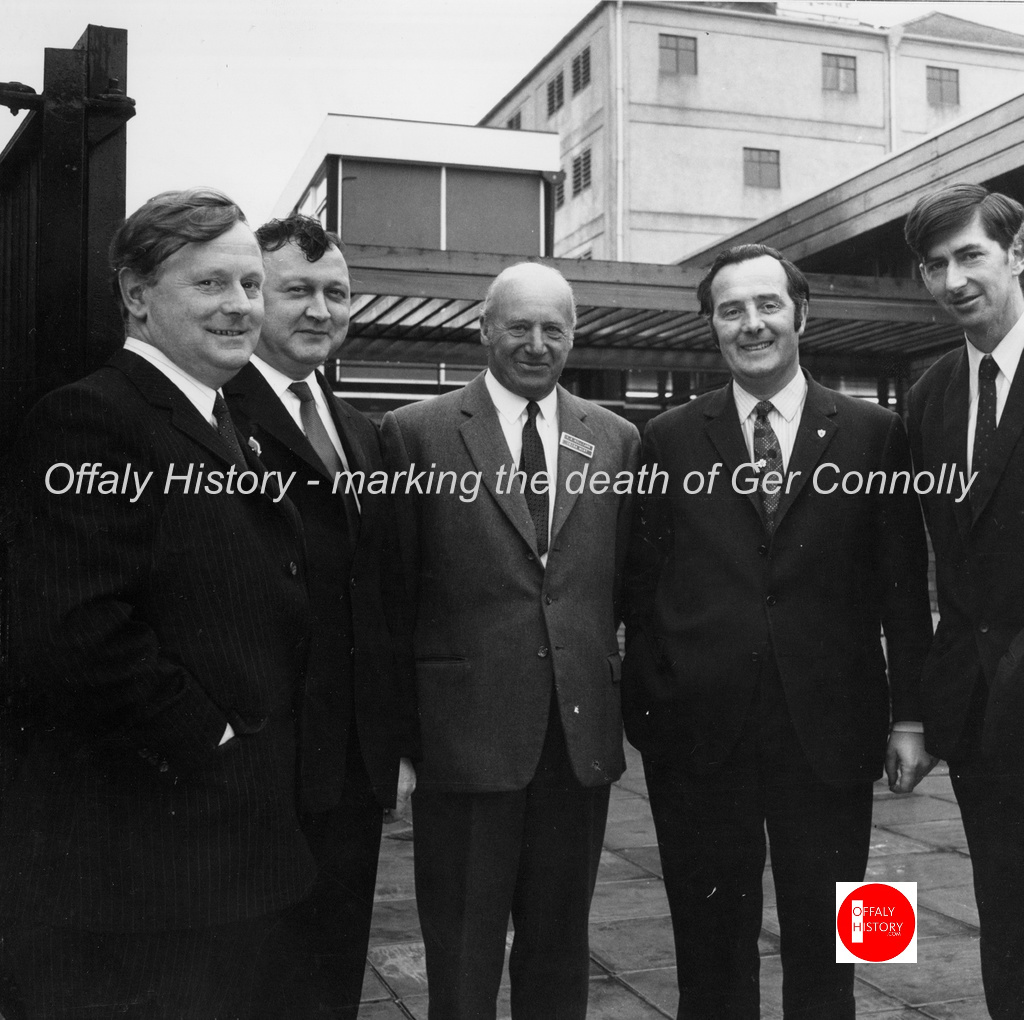
His record in local elections is illustrative of Connolly’s popularity in North Offaly. The Edenderry electoral area representatives during his council career included veteran Fine Gael Chairman of Offaly County Council for two decades Donal Dunne, independent Jack McCann, a leading figure in vocational education and colourful independent and sometime Labour councillor Jim Flanagan, unsuccessful Fine Gael Dáil candidate Michael Fox and Fianna Fail colleagues Pat Gorman, Paddy Scully and Noel Bourke.
He went on to top the poll and was elected on the first count in 1979 (23.9pc)[3] and in 1985 with a massive 28pc share of the vote. [4]
The dual mandate which allowed TDs to serve on local authorities was abolished in 2003 and TDs and senators are no longer allowed to serve on local authorities.
During my time as a journalist with the Tullamore Tribune Deputies Ger Connolly, Ber Cowen and Tom Enright were members of the Council and party political rivalries often coloured debates, especially in the run up to General Elections.
Connolly’s Fianna Fáil colleague Ber Cowen was generally less partisan than Ger or Fine Gael’s Tom Enright and their spats – often peppered with good humour, generated headlines.
Long serving Chairman Donal Dunne (FG) and his Vice Chair Eddie Joe Dooley (FF) – the author’s father, had his hands full restraining Ger in full flow as he verbally poked and prodded his political opponents. Although both were strongly committed to their respective parties I recall having an entertaining conversation with both about how the chamber would be more harmonious without the sparring of Oireachtas members long before the Oireachtas ban was introduced but from a journalist’s perspective it must be admitted that the Tom and Ger debates were enormously entertaining.
In the run up to a General Election he once warned against Fine Gael manifesto overpromising in an attempt to soft soap the electorate with a flourish of his hands proclaiming, “Lads, beware of the Palmolive bar!”.
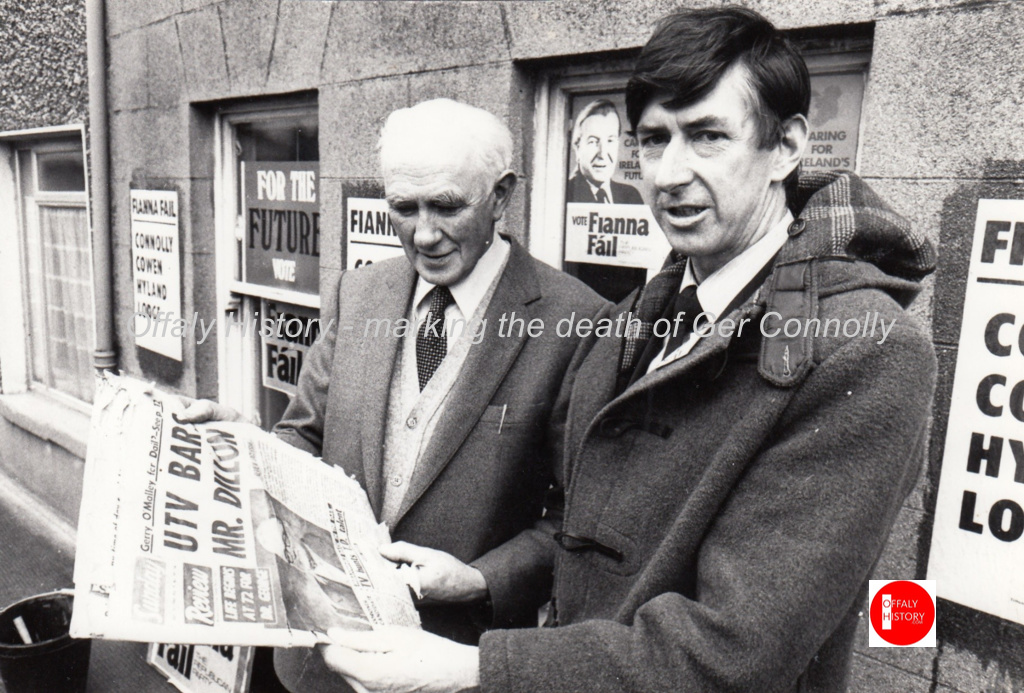
Over the years Edenderry councillors such as Pat Gorman and later Noel Bourke were among Ger Connolly’s loyal lieutenants and he used his position on Offaly County Council to maintain his profile and strengthen his network of contacts across the party organisation. He also enjoyed cordial relations across party boundaries with members of the now defunct Edenderry Town Commissioners and both Tullamore and Birr Urban District Council.
His long standing personal and political friendship with Tullamore councillor John Flanagan was influential in securing Connolly’s support for initiatives in the capital town during his tenure as Minister of State at the Department of the Environment. John Flanagan was a close friend of Connolly and was diligent in pushing the case for Tullamore at every opportunity, as he was with Ber Cowen TD and later Taoiseach Brian Cowen.
National career: Nicholas Egan was a towering presence in Offaly politics, serving on Offaly County Council from 1950 until the local elections of 1967, when he did not seek re-election. Egan topped the poll in all but one of the elections[5] during his council career.
Nicholas Egan hailed from Croghan and was a brother of the Chief of Staff of the Irish Army Major General Liam Egan, a notable figure in the Old IRA. Nicholas unsuccessfully contested the 1951 General Election[6] but was elected to the Dáil in 1954[7] and retained his seat until his retirement in 1969..
In many ways Ger Connolly assumed the mantle of Nicholas Egan, following his lead in heading the poll in the Edenderry electoral area and dominating the Fianna Fail organisation with energy and ruthless efficiency.
However, it was not a given that he would succeed Egan on the Fianna Fáil ticket in the 1969 Dáil election and his subsequent stellar electoral career is all the more remarkable when his fate at the 1969 party convention is considered.
In the 1965 General Election Nicholas Egan was elected as the only Offaly candidate with outgoing TD Kieran Egan, Banagher, (no relation) losing his seat. The other seats went to Laois candidates [8] Oliver J Flanagan (FG), Paddy Lalor (FF), T F O’Higgins (FG ) and Lar Byrne of Labour, who had inherited the mantle of William Davin, a national figure in the trade union movement.
In many respect the 1969 election marked a changing of the guard, with O’Higgins moving to a Dublin constituency and Nicholas Egan stepping down. O’Higgins, a former Minister for Health and a future presidential candidate and Chief Justice had served as a TD for Laois Offaly from 1948 and moved to a new constituency, Dublin County South.
At the Fianna Fáil convention there was a strong slate of candidates including two young members of Offaly County Council, Ber Cowen and Ger Connolly. Ber Cowen had been co-opted to the council on the death of his father Christy and was elected with an impressive vote in the 1967 [9] local election.
Among those seeking the nomination were Paddy Boland, Ferbane, a nephew of Patrick Boland, first Fianna Fáil TD for Laois/Offaly and prominent party activist in his own right, and upcoming Birr solicitor James W. Houlihan, future State solicitor and later a long serving member of the Fianna Fáil national executive.
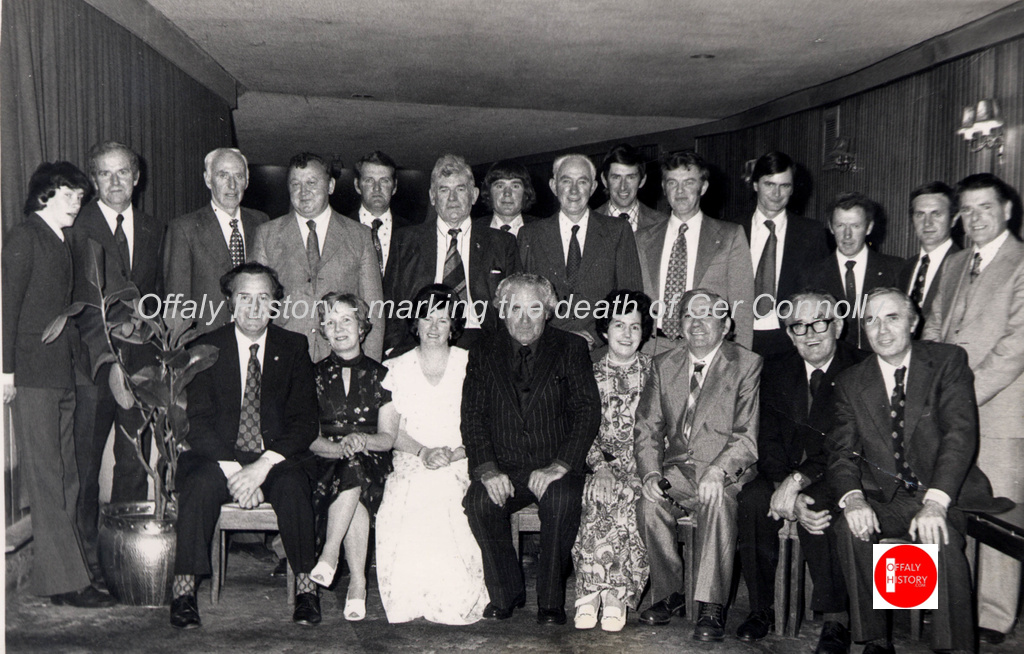
The convention selected outgoing Laois TD Paddy Lalor and Mountellick based teacher, Tom Culliton along with Cllr Ber Cowen and Jim Houlihan as part of the agreed four candidate strategy.
Fine Gael selected Birr solicitor T. W. Enright and Clara’s Cllr Frank Feery along with poll topper Oliver J. Flanagan and future senator Charles McDonald.
In a move which was to shape future political relationships and reflected his steely determination Ger Connolly decided to approach Director of Elections Charles J. Haughey urging him to add a 5th North Offaly candidate, presenting himself as am electable candidate.
On arrival at election HQ the morning after the selection convention Haughey was greeted by a North Offaly delegation led by Connolly and decided, without reference to the Offaly Comhairle Dáil Ceanntair (county executive) or its Laois equivalent to add a 5th candidate.
The decision – and the fact that many delegates learned of the addition of Ger Connolly in the national media, caused internal tensions within Fianna Fáil but Connolly’s gamble was proven to be the correct call when the votes were counted. [10]
With strong vote management Fianna Fáil took three seats – Lalor, Cowen and Connolly while Tom Enright took a seat to adjust the balance in favour of Offaly. The Birr retired solicitor is the last surviving member of the five TDs elected on that occasion.
The fateful meeting in Mount Street, Dublin, marked a long association with Haughey and in the controversial heaves against Taoiseach Jack Lynch Ger Connolly was a strong supporter of Haughey. He had an admiration for Haughey’s style of leadership although it would be hard to imagine two more different characters in terms of personality.
In his biography of Lynch, “Jack Lynch, Hero in Crisis” [11] journalist Bruce Arnold gives an insight into Connolly’s role in the Haughey campaign.
On December 6th 1979 Arnold was compiling a list of Haughey and Lynch supporters for a crucial vote. He wrote: “I lunched with Ger Connolly and Tom Meaney, whom I had listed as firm supporters of Charles Haughey ..” Arnold, a staunch Lynch supporter seems an unlikely lunch companion for Ger but his amiable nature and ability as a story teller – and his self-deprecating manner, won his many friends across the media and political spectrum. Arnold clearly trusted Connolly’s political acumen as he cross checked the list.
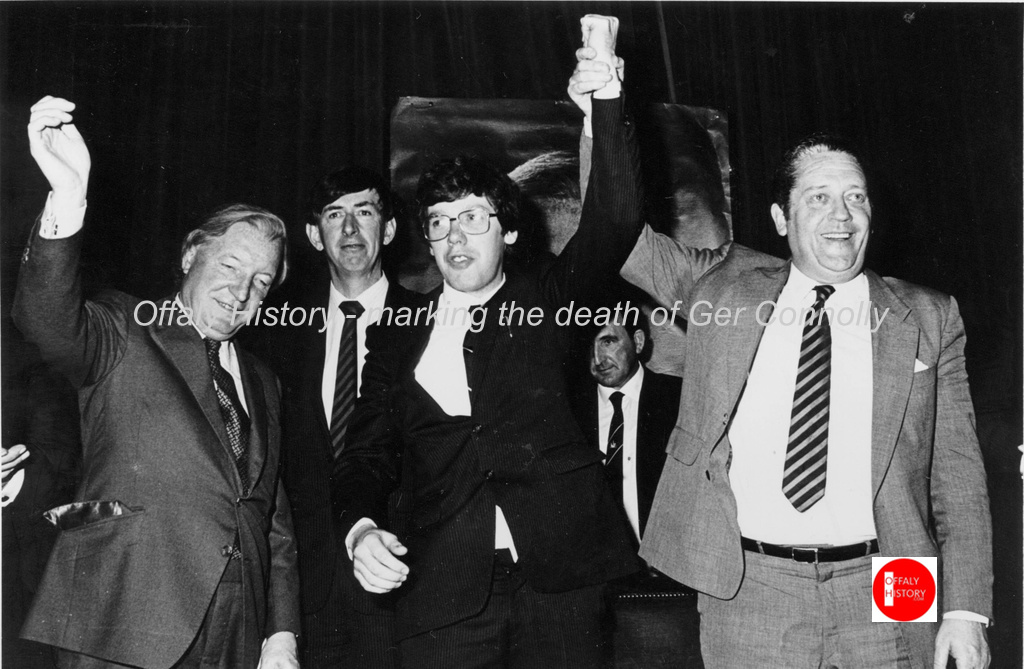
Ministerial career: On his election as Taoiseach in 1979 Charles Haughey appointed Ger Connolly Minister of State at the Department of the Environment. He was reappointed in the Haughey governments of 1982, 1987 to 19879 and again 1989 to 1992.
In the heave against Haughey by Albert Reynolds Ger Connolly was steadfastly loyal to Haughey. On his appointment as Taoiseach Alber Reynolds appointed Brian Cowen as Minister for Labour but Connolly was not re-appointed as Minister of State.
Ger Connolly enjoyed his time in the department. He had been a low key backbencher who focused on developing relations with the local rather than national media. On his arrival at the Minister of State’s office following his appointment was not recognised by the staff at ’Connell Bridge House. Other politicians might have been offended; Ger told the story against himself but remarked that they would know him by the time he left.
“A man from Bracknagh in charge of urban renewal” he would chuckle and when this author purchased an inner city apartment in Dublin’s Gardiner Street Deputy Connolly rang to ask , tongue in cheek “what do you think of my scheme!”
He would point to the Bridge Centre beside the Bridge House, Tullamore, scene of so many meetings and conventions, as an example of the type of schemes enabled by the urban renewal and town centre development programmes. When the government introduced pilot schemes to transform cities Connolly toured the country and engaged with local councils, enjoying being the bearer of good news.
He could be impatient when it came to planning objections or what he perceived as unreasonable demands but many deputations he was unfailingly courteous in receiving visitors.
Ger Connolly had what might be described as an old fashioned approach to politics. He was committed to public service and loved clinics. Likewise, he was sceptical about the need for rules on donations or lobbying and was impatient with people, like the author, who lobbied for freedom of information legislation.
When Eithne FitzGerald introduced ethics in government legislation, including the register of interests and sanctions for inappropriate payments to politicians, he simply refused to believe it was necessary.”
He told the House on October 26th, 1995, during a debate on the Ethics in Public Office Act that it was only the electorate who should impose sanctions.
“I resent the implications that politicians are corrupt. There have been very honourable people here from across the political divide. As other speakers said, if a Minister does not behave properly his fate will be decided by the electorate at the next election. That is the way democracy works.”[12]
Examining the Oireachtas record it is instructive to note the amount of time Ger Connolly spent on the Select Committee on Finance and General Affairs, often forensically challenging Eithne FitzGerald on legislation.[13]
It is equally worth noting that when the Ethics in Public Office Act was enacted Ms FitzGerald singled out Ger Connolly for his courtesy and commitment.
When the reforming Labour minister had to subsequently apologise for a fund raising lunch which was in danger of breaching ethics legislation Ger was quick to say, “I told you so” and his stance highly amused The Irish Times columnist Drapier.[14]
“Fianna Fail members are particularly chuffed at Eithne’s faux pas. They consider that she rammed her famous Ethics in Public Office Bill down their throats and lectured them for months on end in a moralising and highly self-righteous fashion. Drapier’s old friend, Ger Connolly, told them they could be creating a lot of problems for themselves as well as others, how right he was, they claim,” wrote Drapier.
Eithne FitzGerald was a reforming, diligent minister who had topped the poll on her first outing but lost her seat in the subsequent election, having concentrated on legislation at the expense of constituency work. It was a point not lost on Ger Connolly.
More recent revelations about political donations and the link between politics and business suggest that the electorate have reason to be grateful to FitzGerald. I recall a discussion with him in the Bridge House, Tullamore where he proudly declared himself a “parish pump politician”. Warming to the subject he assured me that anyone who ignored the parish pump would have plenty of time on their hands.
In his lengthy career Ger Connolly commanded the affection of many Fianna Fáil supporters and his barnstorming speeches are an abiding memory of party conferences in the Eighties and Nineties. The term rabble rouser is sometimes used as an insult but Ger Connolly’s ability to motivate a crowd was unrivalled.
His colourful turn of phrase could bring delegates to their feet as he urged them to leave a selection convention with fire in their bellies. “We will win,” he told a selection convention in Tullamore, “because we have the men on the ground.” Realising his mistake – and noting the stare of prominent female activists, he corrected himself,
“We will win because we have the men on the ground, and we will have the women on the ground along with them!”.
My late father served as Fianna Fáil Director of Election in the Eighties. He was a close friend of Ber Cowen and later of Brian and there was inevitable tension between the Cowen and Connolly camps when it came to canvassing certain areas. It was the function of the Director of Election and his team to fairly distribute areas so that the party vote would be maximised. The multi PR seat system leads to competition within parties.
Explaining his dilemma about the pressure from PD candidate Cathy Honan of Portarlington and Edenderry area candidate for Michael Fox Ger, never one for PC language, explained to Eddie Joe Dooley, “Don’t forget, I have a fox in my lawn and a PD hen in the garden!”.

When Fianna Fáil decided to make first time buyers grant available for single people Ger told a public meeting outside The Church of the Immaculate Conception, Ferbane,
“Boys, we will give you the cage, but you will have to find the bird yourself.”
On one occasion I rang Ger about a proposed voluntary redundancy scheme in the ESB. The terms were very generous but the loss of jobs would be devastating for the area. I rang him for a comment. His appraisal of the situation was honest and perceptive.
“ Do you know what. The terms are so good we will need people to help with crowd control because the workers will knock down the gates to take that offer, no matter what I tell them!”.
He was an astute political observer and when I was appointed editor of the Roscommon Champion he kindly rang to wish me well and offer some advice. “You think politics in Offaly in tough but when you cross the Shannon you are going into cowboy and Indian territory “ he cautioned. “Really?” I exclaimed. “Oh yes, and that’s not the worst of it. In Roscommon cowboys and the Indians keep swapping feathers.”
In his political life Ger had the support of his devoted wife Marie, nee Dunne, Clara.
He is survived by his children Caitríona, John, Stephen and Ger Jr and
grandchildren Eimear, Hugh, Ruth, Grace, James, Emma, Will, Cara and Ed.
Ger Connolly died on 25 Jan 2024 and was buried in his beloved Bracknagh on 28 Jan. Offaly History extends sincere sympathy to his family and friends. Our thanks to Séamus Dooley for this article.
—
[1] Offaly County Council: (Edenderry) 1967 Local Election Results, Counts, Stats and Analysis (irelandelection.com)
[2] Offaly County Council: (Edenderry) 1974 Local Election Results, Counts, Transfers (irelandelection.com)
[3] Offaly County Council: (Edenderry) 1979 Local Election Results, Counts, Transfers (irelandelection.com)
[4] Offaly County Council: (Edenderry) 1985 Local Election Results, Counts, Transfers (irelandelection.com)
[6] https://irelandelection.com/election.php?elecid=20&constitid=34
[7] https://irelandelection.com/election.php?elecid=19&constitid=34&electype=1
[8] https://irelandelection.com/election.php?elecid=14&constitid=34&electype=1
[9] Offaly County Council: (Tullamore) 1967 Local Election Results, Counts, Stats and Analysis (irelandelection.com)
[10] Laois–Offaly: 1969 general election Results, Counts, Stats and Analysis (irelandelection.com)
[11] Jack Lynch, Hero in Crisis, (Merlin Publishing, ISBN 1-908582-06-7)
[12] https://www.oireachtas.ie/en/debates/debate/dail/1995-10-26/3/#spk_88
[13] https://www.oireachtas.ie/en/debates/debate/select_committee_on_finance_and_general_affairs/1994-09-14/8/#spk_379
[14] Openness and transparency and Eithne’s suite deal – The Irish Times
 offalyhistoryblog