

Along our Grand Canal Journey from Edenderry to Shannon Harbour we come to Rathmore, a small townlands, on the south side of the canal. Rathmore is in the Electoral Division of Edenderry Rural, in Civil Parish of Monasteroris, in the Barony of Coolestown, in the County of Offaly.
The Irish name for Rathmore is An Ráth Mór meaning great, big ring-fort.
Here we can find the site of a possible Enclosure, it can be seen in outline from aerial photos. Enclosures are one of the most common sites found in Co. Offaly, with over hundred found all over the county. They are often similar to other types of enclosures defined either by a bank or a fosse, such as the Ringforts.
They are identified from other enclosures by being either very large or small and without an entrance. Many are only known as cropmarks, visible only from aerial view, they have no original dates but some may be from the Iron Age.

Rathmore (area: 216 acres): Population and houses, 1841-1911
| Townland | Pop. 1841 | Pop. 1851 | Houses 1841 | Houses 1851 | Pop. 1871 | Pop. 1911 | Houses 1871 | Houses in 1911 |
| Rathmore | 39 | 37 | 8 | 8 | 25 | 5 | 6 | 3 |

(02. Rathmore census 1911 Image Source: census of Ireland.com)
In 1911, Rathmore had one of the lowest population and houses recorded in the census, during this period the household returns and ancillary, shows us that there were three buildings all of Private Dwelling, with 2 inhabited, one of 2nd class and the other 3rd. The families that occupied these buildings are as followed:
| Class of House | Name | Age | Religion | Occupation | Family members |
| 2nd | Collins | 62 | RC | Agricultural Labourer | 4 |
| 3rd | Kenna | 33 | RC | Farmer | 1 |
In this area, the youngest on record was from the Collins family, 20 years old, the oldest was from the same family 62-year-old Peter Collins.
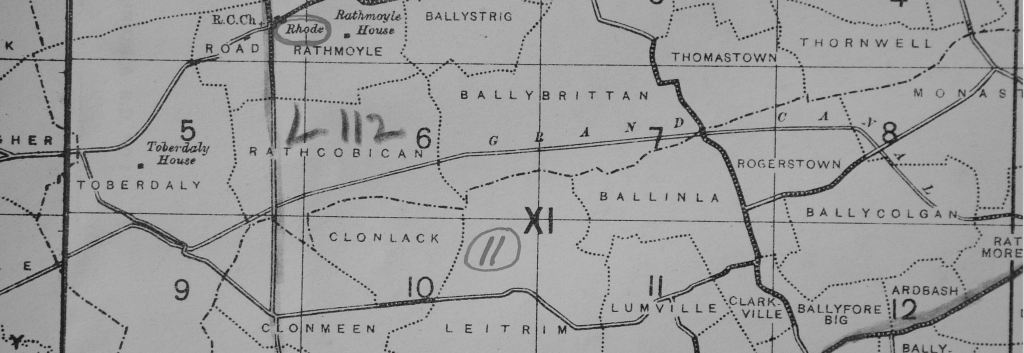
Coming into Rathmore, we look at the two distinct styles of bridges associated with the Grand Canal. Of the sixty-five bridges along the Canal, 19 are freestanding and not associated with locks, they are constructed of random rubble, have a hump- backed decks and ramped approaches, and an example of this can be seen at Rathmore Bridge.
(03. Rathmore Bridge Map of Grand Canal 001348. Image source Killaly atlas of Grand Canal. Courtesy of Waterways Ireland

(04. Rathmore Townland, where it sit along the Grand Canal. Image source, Townland.ie, Offaly history)

(05. Rathmore Bridge, Image source Offaly History Centre)
The remaining bridges cross locks, and use sides of the chambers as abutments. These bridges were built to a higher standard, to the freestanding ones. Built of limestone blocks and spandrels[1]. Lock keepers had the job of, seeing boats through the lock or locks under his control. Making sure lock dues where paid and he also had the job of keeping an eye on the lock itself, to make sure it was in good order. Paying particular attention along the banks, as the canal is built on an embankments there is always the danger of a breach occurring, which can cause damage to the walls of the lock and create a leak.

Any leaks that would have accrued would have to be quickly repaired, or else there would have been a waste of water, as well as a delay in the filling of the lock, for boats to pass. Most experienced boatmen, were allowed pass through the locks without supervision. Amateur sailors however, were essential to be supervised in case they accidently caused damage.
In the early days of the Grand Canal Company, lock keepers wages ranged from 6s to 8s per week, depending on the amount of work done that week. It was raised during the struggle of the Famine years to 7s, and increased again in 1872 due to high prices of goods, fuel and clothing[2].


(06.Rathmore, Source: www.logainm.ie) (07.Rathmore, Historical References Source: www.logainm.ie)
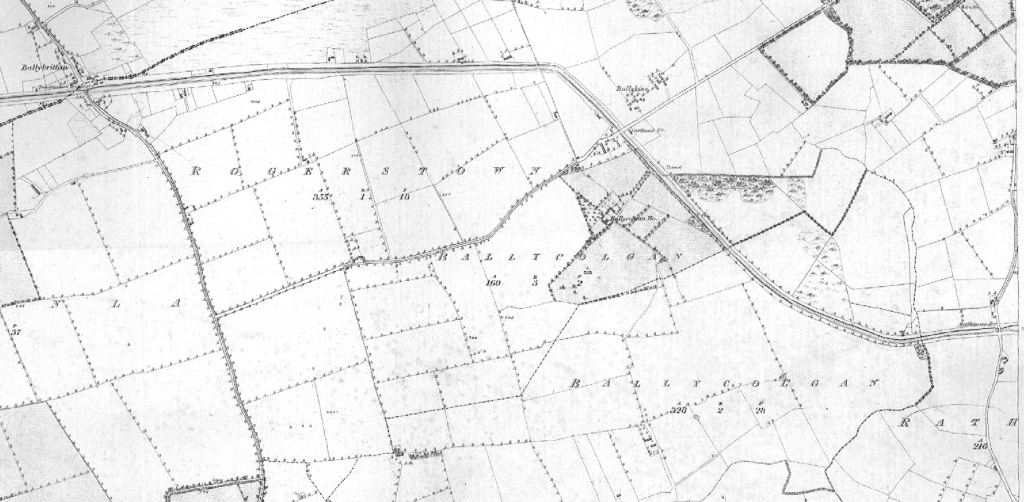
Next Stop Ballycolgan, is in the Electoral Division of Monasteroris, in Civil Parish of Ballynakill, in the Barony of Coolestown, in the County of Offaly.
The Irish name for Ballycolgan is Baile Mhic Colgan meaning MacColgan’s/land.
Ballycolgan (area: 328 acres): Population and houses, 1841-1911
| Townland | Pop 1841 | Pop 1851 | Houses 1841 | No. of Houses in 1851 | Pop. 1871 | Pop. 1911 | No. of Houses in 1871 | No. of Houses in 1911 |
| Ballycolgan | 47 | 38 | 5 | 5 | 15 | 4 | 2 | 2 |

(09. Ballycolgan census 1911. www.census.nation.archives.ie )
Ballycolgan is one of the lowest population along the line, it includes two 2nd private dwellings, one occupied by a family of four the other was empty. The family that occupied this building was are as follows:
| Class of House | Name | Age | Religion | Occupation | Family members |
| 2nd | Jellico | 89 | RC | Head of Family | 4 |
In this area, the youngest and oldest is from the same family, Youngest 9 years old and oldest is 62 years old.

(10. Ballycolgan townland, Image source Townsland.ie/ Safe Harbour, the Grand Canal at Edenderry)
Commemorative Plaques and Dates
With a high number of the road bridges over the Grand Canal named, those commorated included officials of the Grand Canal Company, Joseph Husband and John Macartney, both chairman and directors of the board of the Grand Canal Company during the time. Some bridges also follow the cut of the Canal, going from East to West.

(11.Above a photo showing Ballycolgan Bridge, Image source Safe Harbour, the Grand Canal at Edenderry)
The chart below shows the following course of the canal as it was cut. Ballycolgan Bridge also Known as Cartland Bridge, runs under a canal, date on bridge 1793, date canal opened 1798.
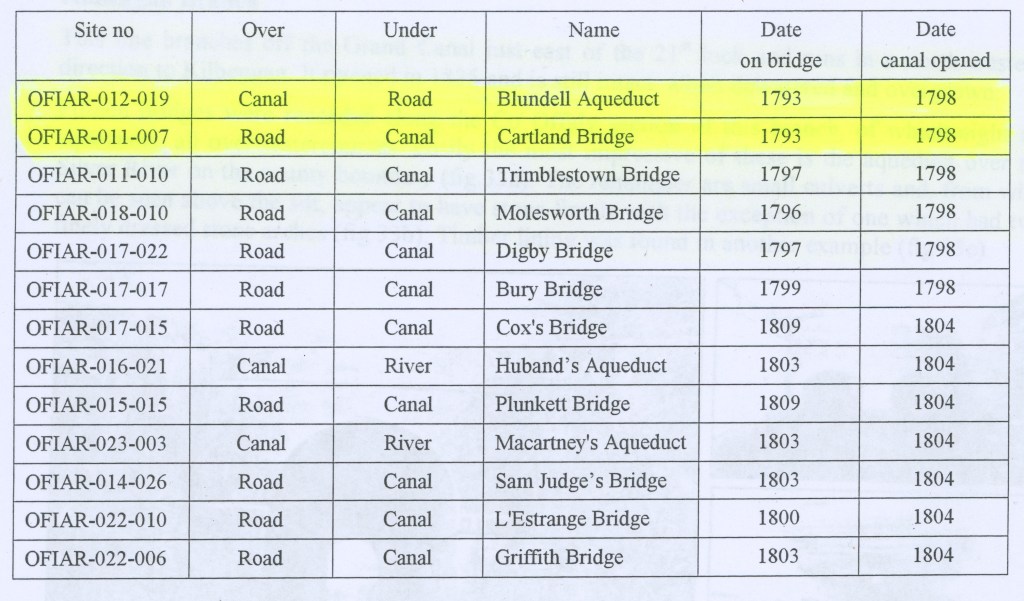
(12. Course Chart .Image source Bridges of County Offaly, A Heritage Review. By Fred Hamond. )
Travelling by Passenger Boat
On 29TH of September 1802, the very first passenger boat left the harbour, cabins were split into two divisions, 1st class 13 pence and 2nd class , six pence, half penny. Boats were drawn by horses alone the canal way during the day, and slower at night for the “night boats” these were mostly used by “peasantry” on account of its cheaper fares. Baggage weight was limited to 30 pounds. Some viewed travelling by boat “the most elegant way of travelling”-John Wesley.[3]
Special journeys where also made during the year, to fairs, Easter festivals and at Christmas time. In the pre-railway era many people chose to travel by boat, as it was more comfortable, less tiring and more reliable than road travel, with the increasing popularity of the passenger boats, in 1834,the new arrival of Fly boats, came about. These were much faster than the Passenger boats and used three horses, which had to be changed frequently to pull these lighter boats along the line.
The introduction of the fly boats, encouraged other transport services such as coaches to link

(13. Layout of a passage boat, image: The grand canal of Ireland:
Ruth Delany, 1995)
Up with canal services and carried passengers the rest of their journey, places where the canal was not yet finished. However the horse contractors found it hard to adjust to the new contract times, and many were unable to operate stages efficiently.
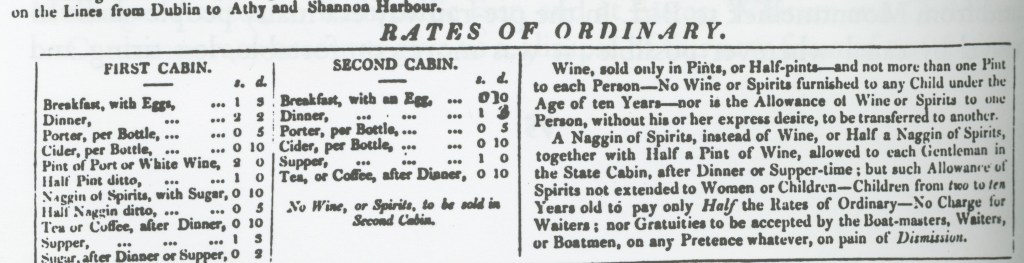
(14.Bill of Fare in 1826 .Image source Travel and Transport in Ireland, By Kevin B. Nowlan, 1973). No more than one pint of wine to each person at 2s a bottle, about 13 EURO today.
Due to the faster speeds of the boats during the day, more horses were needed to keep up with the times “mph” that the boats had to travel at. One report showed that “16 horses were needed to operate his stage of 12 Irish miles”. And with hundreds of horses passing thought the Canal branch, profit was poor, contractors incurred fines for loss of time and strict checks were kept to maintain all boats arrived on their appointed times.
There was a steady increase in passengers traveling by boat after 1834, but it was show that the increase was largely accounted for by the passenger night boats which were kept on after the introduction of the newer fly boats[4].
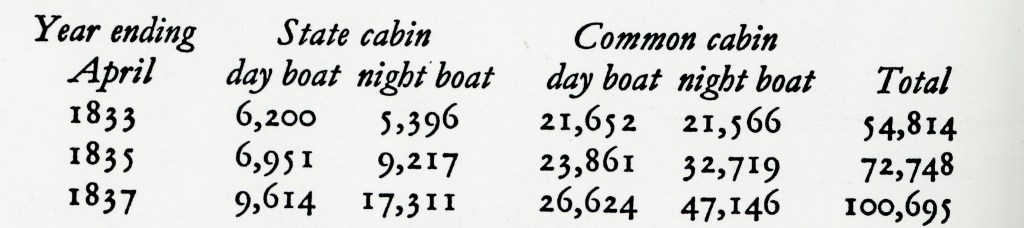
(15. Travel account, between night time boat and day time boats. The Grand Canal of Ireland, Ruth Delany. Pub 1995 /P124.)
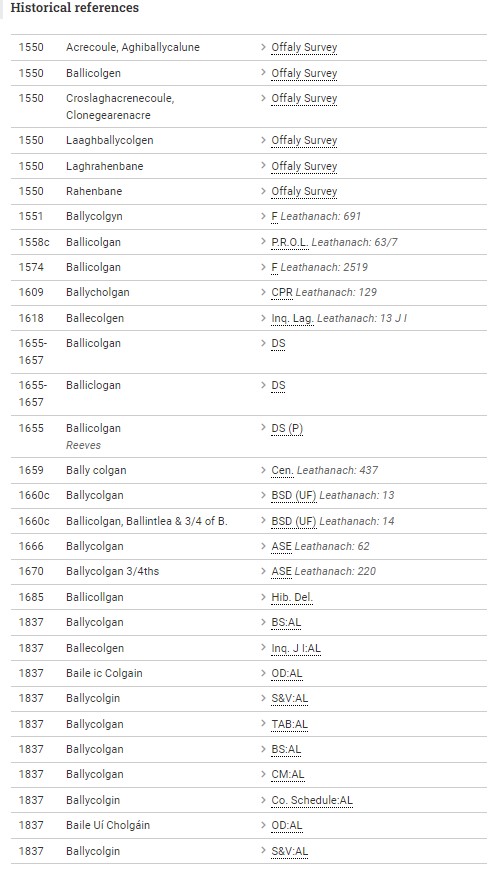
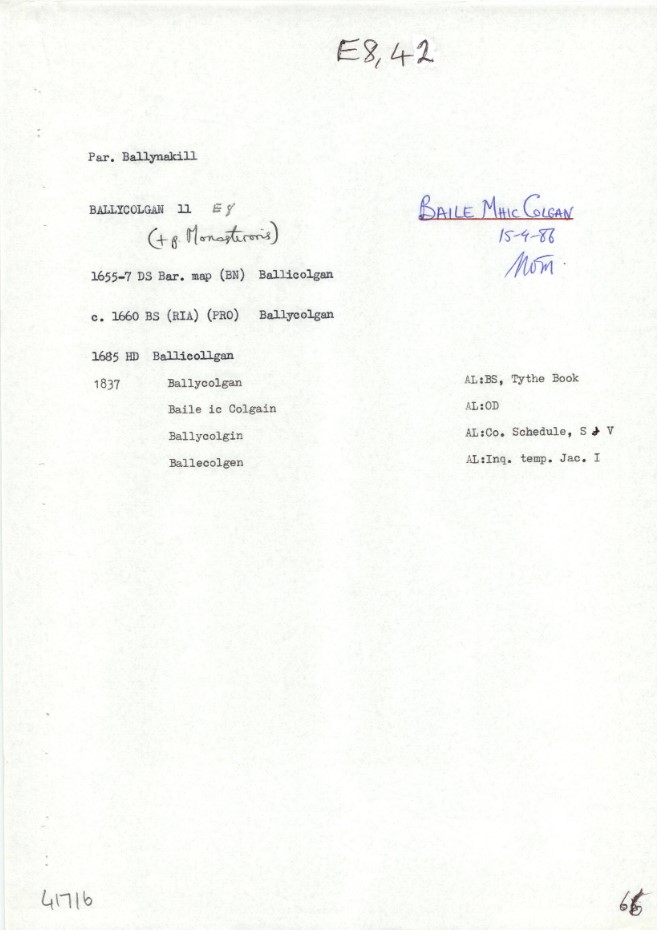
(16. Ballcolgen, Part1 Source: www.logainm.ie) (17.Ballcolgen, Part 2 Source: www.logainm.ie)
Continuing on next week we look at Rogertown, Ballybrittan and Rathcobican, we look at how safe was traveling by passenger boats and stories along the line. What will we discover next.
[1] See” Bridges of county Offaly a heritage review”. Fred Hamond, Offaly County Council, Pp 2005, P23-25.
[2] “ The Grand Canal” Ruth Delany, The Lilliput press, P 1995, Pp 183-187
[3] See “The Grand Canal of Ireland” Ruth Delany. The Lilliput Press 1995, Chapter 5, Pp 100-121
[4] See “The Grand Canal of Ireland” Ruth Delany. The Lilliput Press 1995, Chapter 5/6, Pp 100-200.
 offalyhistoryblog