

Along our Grand Canal Journey from Edenderry to Shannon Harbour we come to Rogerstown, a small townland, in the Electoral Division of Monasteroris, in the Civil Parish of Monasteroris, in the Barony of Coolestown, in the County of Offaly.
The Irish name for Rogerstown is Baile Risteird meaning Richard’s/land.

(01.Monasteroris civil parish from the Index map Kings’ County 1838. Image source Offaly History Centre)
1 Population and number of houses in Rogerstown, 1841- 1921, area 355 acres
| Townland | Pop in 1841 | Pop in 1851 | No. of Houses in 1841 | No. of Houses in 1851 | Pop in 1871 | Pop in 1911 | No. of Houses in 1871 | No. of Houses in 1911 |
| Rogerstown | 131 | 79 | 21 | 20 | 53 | 24 | 12 | 12 |
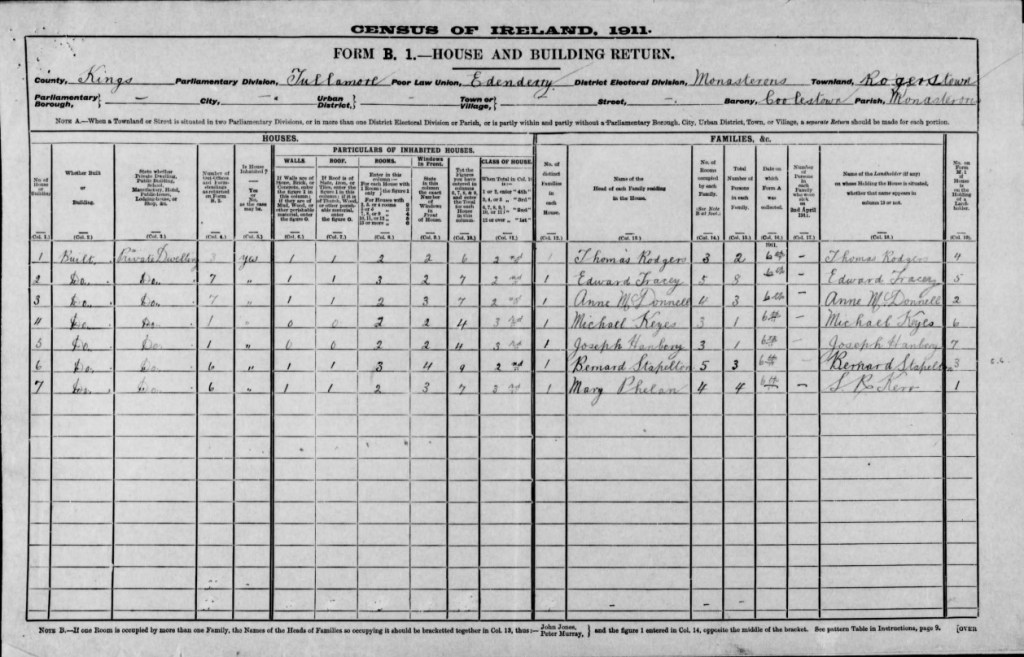
(02.Rogerstown census of 1911 Image source . www.census.nation.archives.ie)
In 1911 Rogerstown had an average record of houses in the area, during this period the household returns and ancillary, shows us that there was 7 buildings all of Private Dwelling, with all 7 inhabited, four of 2nd class and three of 3rd. The families that occupied these buildings are as followed:
| Class of House | Surname | Religion | Occupation in House | Family members |
| 3rd | Hanbery | RC | Farmer | 1 |
| 3rd | Hayes | RC | Boatman | 2 |
| 3rd | Keyes | RC | Agricultural Labourer | 1 |
| 2nd | Rogers | RC | Labourer | 2 |
| Mc Donnell | RC | Farmer | 3 | |
| 3rd | Phelan | RC | Shepherd/Farm Labourer | 4 |
| 2nd | Stapleton | RC | Agricultural Labourer | 3 |
| 2nd | Tracey | RC | Farmer/ Shepherd/ Agricultural Labourer | 8 |

(03.Rogerstown census of 1911 showing boatmen Image source . www.census.nation.archives.ie)
With the major part of the construction of the canal line to Edenderry district completed and the first passenger boat leaving the harbour, in the early 19thth century. Passengers travelled through Rogertown along their journey, most found the experience of travelling by boat, an elegant way of travelling,
But not all travelers were as satisfied, newspapers reported of incidents on boats, were becoming more frequent, with stories of drunk and disorderly, gambling and unlucky accidents, were members on board found themselves overboard.
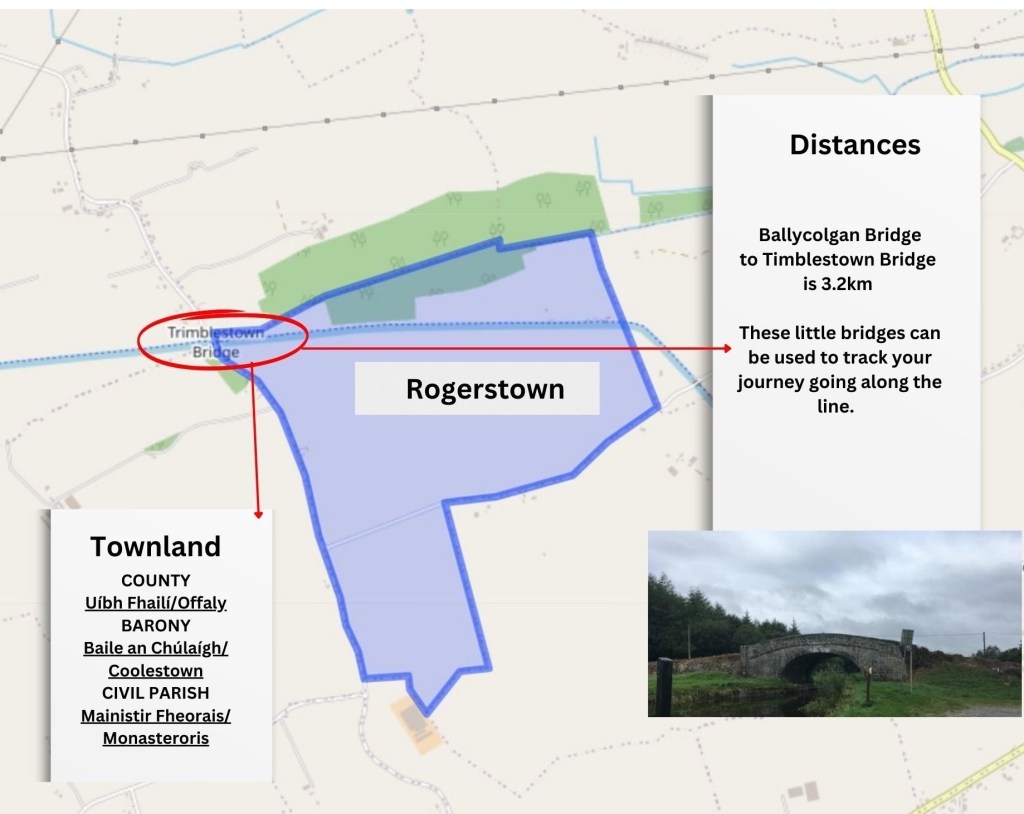
(04. Rogertown townland, Image source Townsland.ie/ )
The only serious accident recorded, was in December which 11 people perished, this accident was the only one in the history of the company that results in loss of life, even do there where incidents where passengers fell from the boats and had drowned[1].
By the late 1850s passenger canal traffic stopped, after the railway age, it was then unthinkable to travel by canal, On July 1960, saw the last Barge sail into the Edenderry harbour, It was a significant
Historical even for the town, the 48m boat, delivered its last cargo, consisting of Kegs of Guinness to the local pubs before adjourning to the Harbour house for the nights festivities[2].
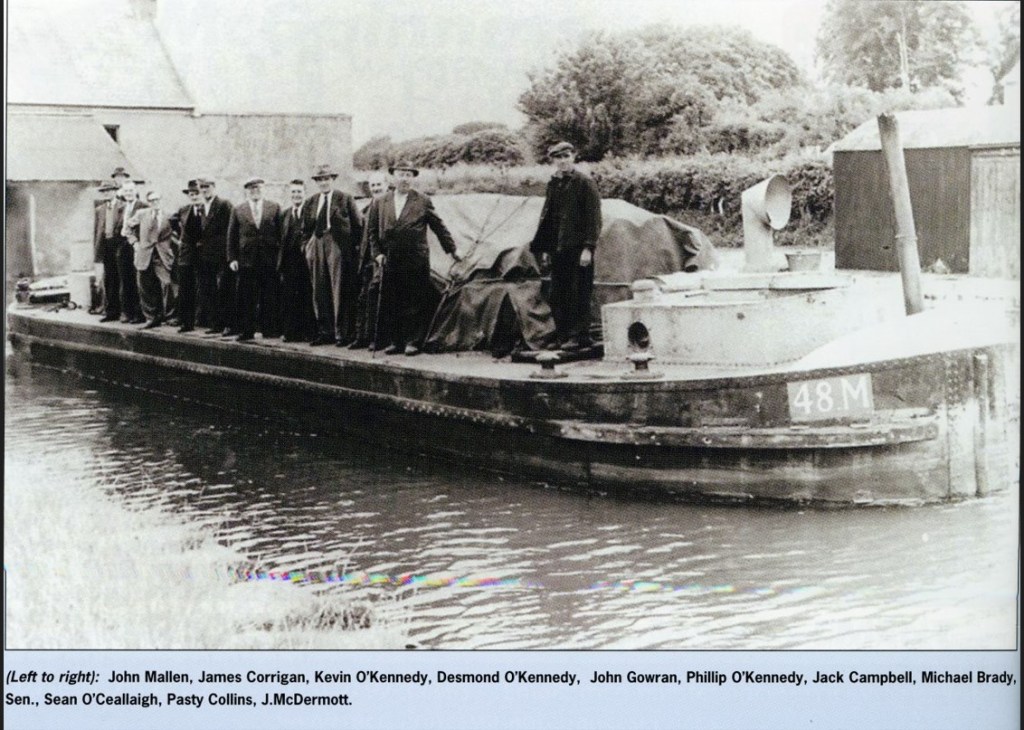
(05. The last Barge, Safe Harbour, the Grand Canal at Edenderry)
Ballybrittan:
Ballybrittan is in the Electoral Division of Ballymacwilliam, in Civil Parish of Ballymacwilliam, in the Barony of Warrenstown, in the County of Offaly.
The Irish name for Balllybrittan is Baile Bhriotáin meaning Britan’s t/land.
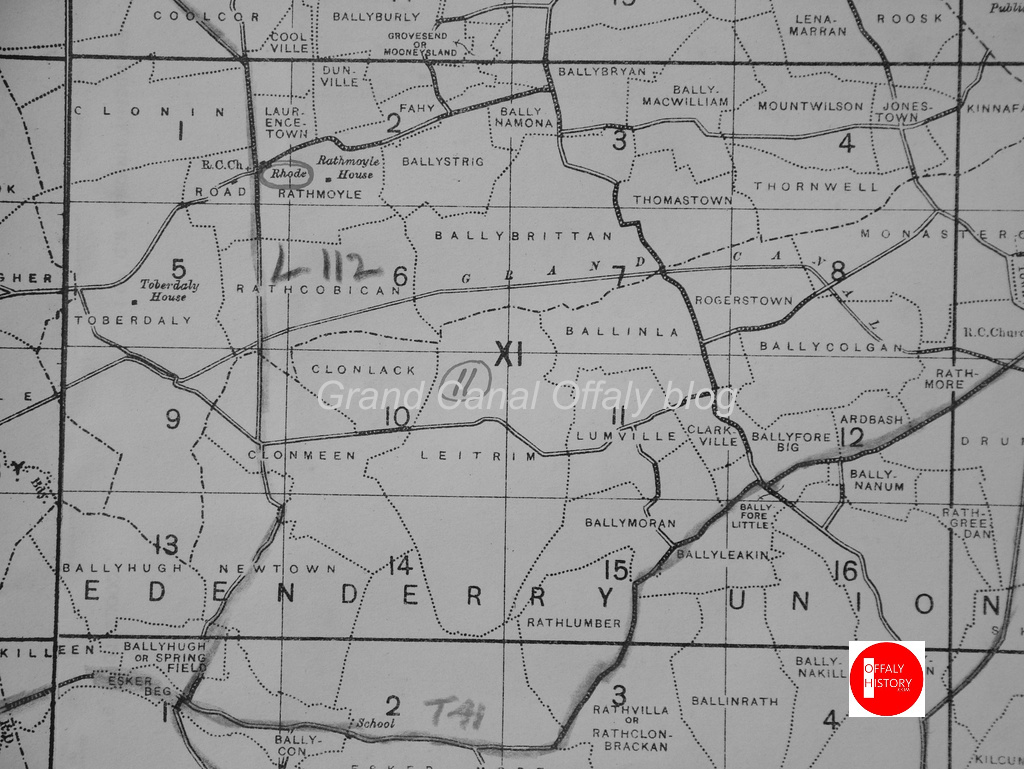
(06. Rathmore, Ballycolgan, Rogerstown, Ballybrittan, Rathcobican and Toberdaly from the Townland Index map Image source Offaly History Centre)
The area around Edenderry, is a great place to explore, the ruins of old castles. Most which were constructed during the Anglo- Norman Period. Ballybrittan Castle, is a gem along the way to stop and take a walk. Once a run down building, now a beautiful restored and refurbished establishment.
Open dates in 2023: Sept 29-30, Oct 1, 6-8, 14-15, 2pm-6pm. Fee: Free – except in case of large groups >10 fee
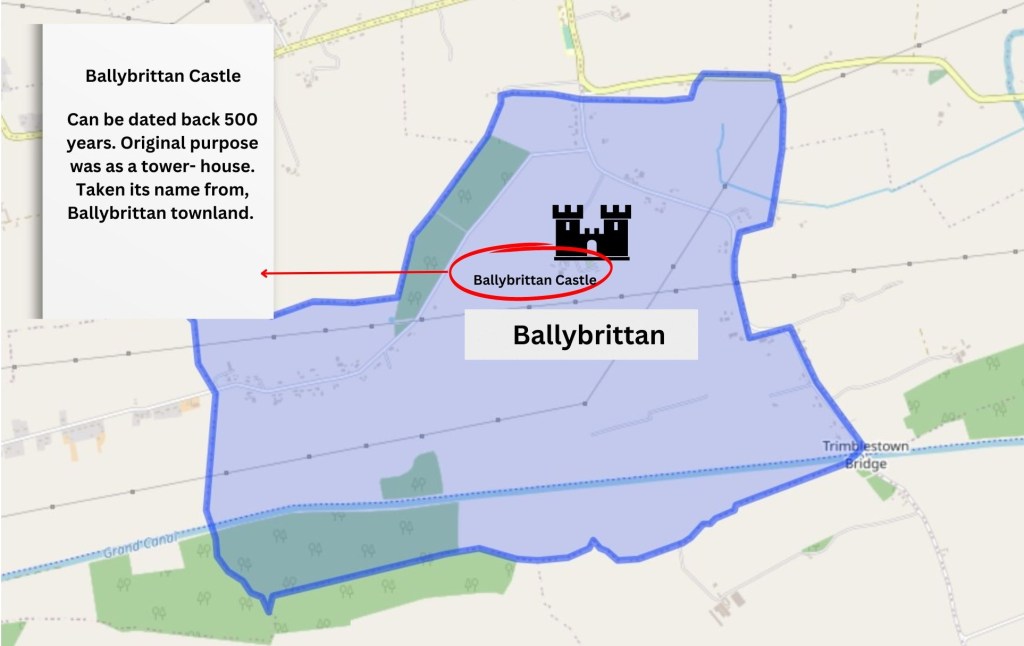
(07.Ballybrittan townland, Image source Townsland.ie/ ). landlord, Lord Trimblestown
Ballybrittan: area, population and number of houses, 1841-1911
| Townland | Pop in 1841 | Pop in 1851 | No. of Houses in 1841 | No. of Houses in 1851 | Pop in 1871 | Pop in 1911 | No. of Houses in 1871 | No. of Houses in 1911 |
| Ballybrittan | 206 | 164 | 34 | 32 | 80 | 41 | 16 | 12 |
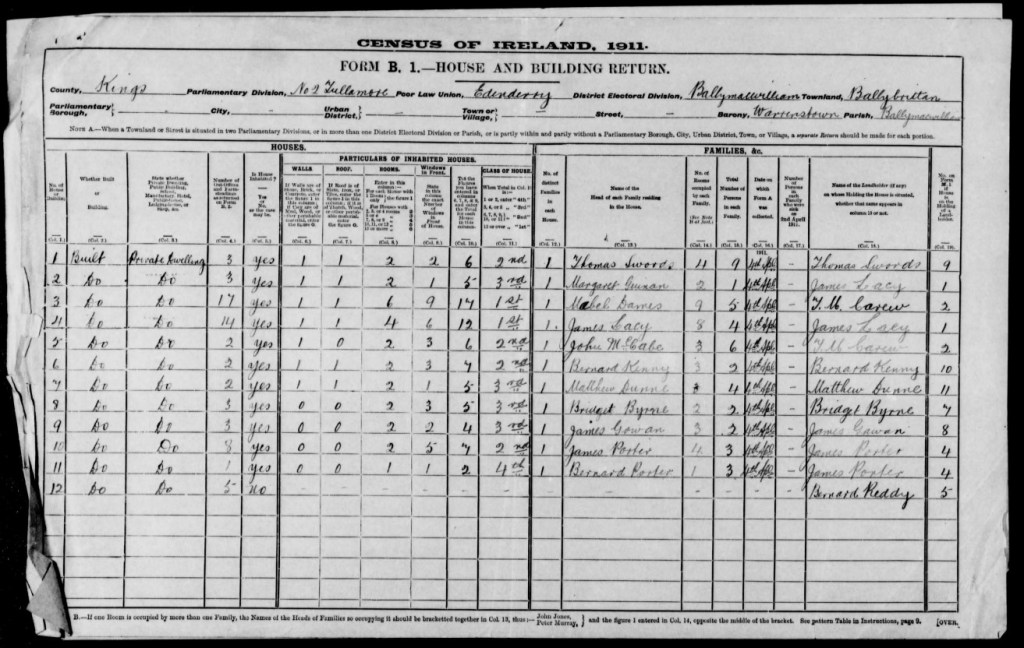
(08.Ballybrittan census of 1911 Image source . www.census.nation.archives.ie)
In 1911 Ballybrittan had one of the larger record of houses in the area, during this period the household returns and ancillary, shows us that there was 12 buildings all of Private Dwelling, with 11 inhabited, four of 2nd and 3rd class, and the remainder where of 1st class. The families that occupied these buildings are as followed:
| Class of House | Surname | Religion | Occupation in House | Family members |
| 2rd | Swords | RC | Grl Labourer General Labourer | 7 |
| 3rd | Guinan | RC | 1 | |
| 1st | Longworth Dames | CI | House Keeper, scholar Cook, Parlourmaid, Governess | 5 |
| 1nd | Lacy | RC | Farmer, Domestic Servant | 4 |
| 2nd | McCabe | RC | Shepherd | 6 |
| 2nd | Kenny | RC | Agricultural Labourer House Keeper | 2 |
| 3rd | Dunne | RC | Agricultural Labourer | 4 |
| 3rd | Byrne | RC | Farmer | 2 |
| 3rd | Gowan | RC | Agricultural Labourer | 2 |
| 2nd | Porter | RC | Farmer, House Keeper | 2 |
| 4th | Porter | RC | General Labourer | 1 |
Moving along we come to Rathcobican, in the Electoral Division of Ballymacwilliam, in Civil Parish of Ballymacwilliam, in the Barony of Warrenstown, in the County of Offaly.
The Irish name for Rathcobican is Ráth Mhic Oibicín meaning Oibican’s fort.
Here you will find a Ringfort, it is enclosed by the remains of an earthen bank, together with an external fosse.
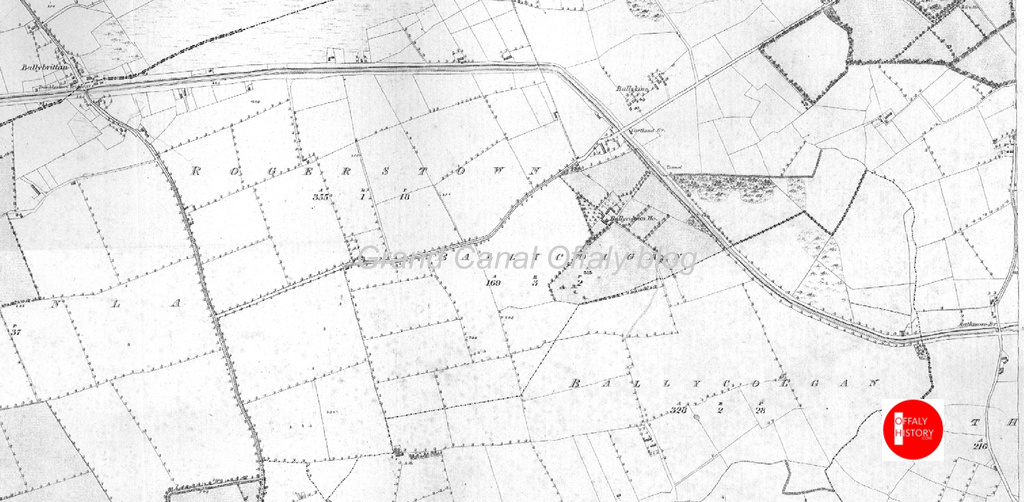
(09.Rogerstown and Ballybrittan from the OS 1838 six-inch scale, Image source Offaly History Centre)
After Trimblestown Bridge, we come to Rhode Bridge, which leads you to the small village of Rhode, just 1.5km to the north. As Rhode was inland and not close to the canal, Goods from the Boats, were dropped off at the bank of the canal, collected and dispatched to their last destination. Agents of the G.C.C were responsible for the handing of goods on the canal, from arranging collections to despatch. Along with task of daily book keeping, filing of payments received, records of good inwards and outwards[3].
Ballybrittan: area 675 acres, population and number of houses, 1841-1911
| Townland | Pop in 1841 | Pop in 1851 | No. of Houses in 1841 | No. of Houses in 1851 | Pop in 1871 | Pop in 1911 | No. of Houses in 1871 | No. of Houses in 1911 |
| Rathcobican | 328 | 317 | 58 | 50 | 248 | 168 | 53 | 38 |
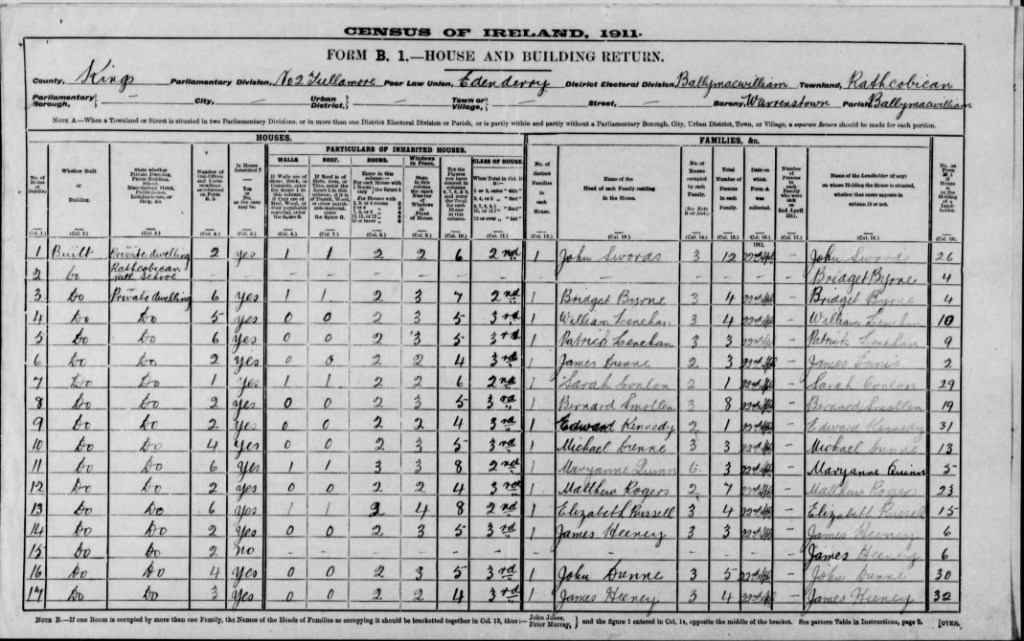
(10. Rathcobican census of 1911 Image source . www.census.nation.archives.ie)
In 1911 Rathcobican had a large record of houses in the area, during this period the household returns and ancillary, shows us that there was 17 buildings all of Private Dwelling, with 15 buildings inhabited, they all consisted of 2nd and 3rd class houses. The families that occupied these buildings are as followed:
| Class of House | Surname | Religion | Occupation in House | Family members |
| 2nd | Swords | RC | Agricultural Labourer | 12 |
| 2nd | Byrne | RC | Farmer/ Farmer Servant | 4 |
| 3rd | Lenehan/McDonald | RC | General Labourer | 4 |
| 3rd | Lenehan | RC | General Labourer | 3 |
| 3rd | Dunne | RC | General Labourer | 3 |
| 2nd | Conlon | RC | House Keeper | 1 |
| 3rd | Smullen | RC | General Labourer | 8 |
| 3rd | Kennedy | RC | General Labourer | 1 |
| 3rd | Dunne | RC | Farmer | 3 |
| 2nd | Quinn | RC | Farmer | 3 |
| 3rd | Rogers | RC | General Labourer | 7 |
| 3rd | Heeney | RC | Stone Mason | 3 |
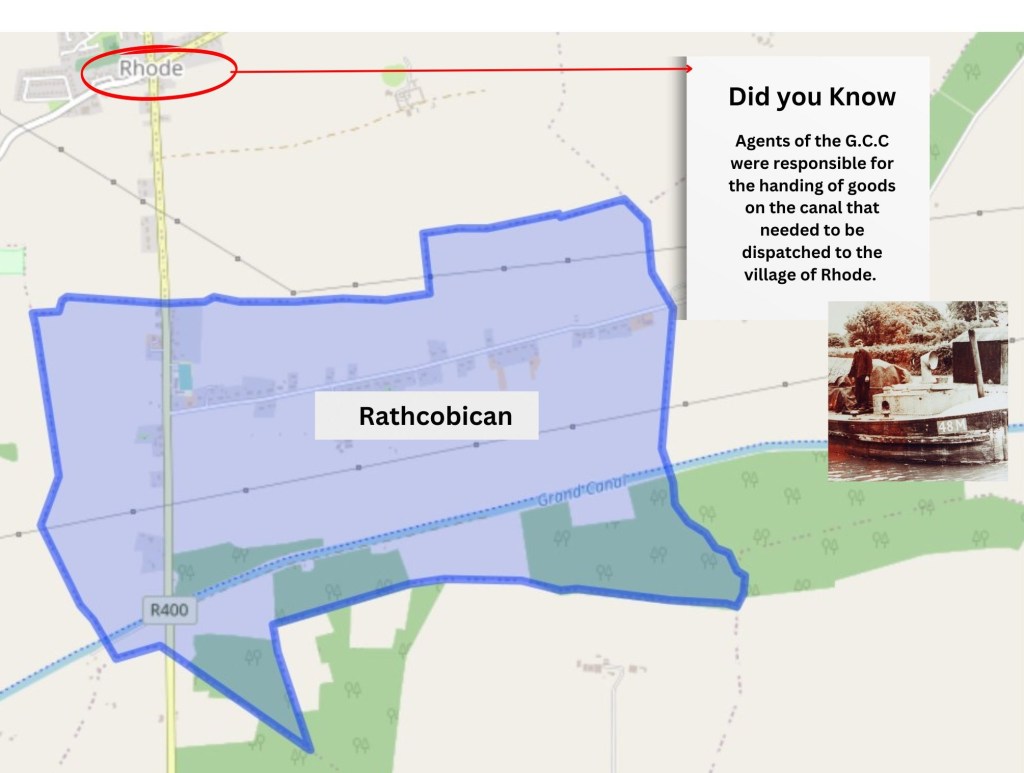
(11. Rathcobican townland, Image source Townsland.ie/ Offaly History Centre)
Working on the Canal:
As well as Agents of the G.C.C, to maintain a smooth running along the Canal, there was a lot of other key features that played an important part, to ensure that things kept running in a successful manner. The boatmen are the most known about figures that worked along the Grand Canal, but there were not alone, as for the boatmen to have a successful journey from point A to B, the had to rely on help from others.
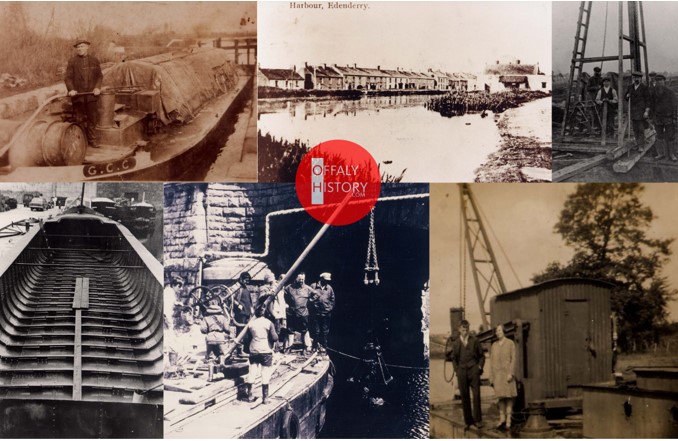
(12. A selection of photos showing the working men of the Grand Canal, source, Offaly History)
To manage the record keeping of the boats along the canal, managers of the Grand Canal Company were appointed at each station along the line. They took records of each boat that stopped and the length of time of each stop.
Lock keepers had the job of, seeing boats through the lock or locks under his control. Making sure lock dues where paid and he also had the job of keeping an eye on the lock itself, to make sure it was in good order. Paying particular attention along the banks, as the canal is built on an embankments there is always the danger of a breach occurring, which can cause damage to the walls of the lock and create a leak. Any leaks that would have accrued would have to be quickly repaired, or else there would have been a waste of water, as well as a delay in the filling of the lock, for boats to pass. Most experienced boatmen, were allowed pass through the locks without supervision.
In the early days of the Grand Canal Company, lock keepers wages ranged from 6s to 8s per week, depending on the amount of work done that week. It was raised during the struggle of the famine years to 7s, and increased again in 1872 due to high prices of goods, fuel and clothing[4].
Join us next time, as we look at Toberdaly, Coole and Cappyroe. Taken a look at one of the most historical events that happened along the Edenderry Canal Line as well as the future of trading on the Grand Canal 19th Century.
[1] See“Travel and Transport in Ireland” Kevin B. Nowlan. P Gill & Macmillan 1993, Pp 73-80.
[2] Edenderry Annual, Mary O’ Connor, 2015, Pp13/14
[3] See “Towpath tours a guide to cycling Ireland’s Waterways” John Dunne. Collins Press, 2005. P85
[4] See “Portrait of the Grand Canal”, Gerard D’ Arcy. Pub Transport Research Associates, 1969, 43/49
 offalyhistoryblog