
Was it chance and circumstances that led fourteen Offaly men to be present in early July 1863 on the fields, hills, and laneways of Gettysburg in what was, and still is to this day, the single most important battle in American history?
Chance: the absence of any cause of events that can be predicted, understood, or controlled
Circumstances: a condition, fact, or event accompanying, conditioning, or determining another
On reading any account of the single most pivotal battle in American History it quickly becomes obvious to even those with zero knowledge of battlefield tactics and military history that the main factors that decided the final outcome came about as a result of chance and circumstances, good and bad luck, decisions that only after the dust settled on the fields of Pennsylvania in early July 1863 were deemed correct and, fatally, one single decision made by a seemingly invincible General Robert E. Lee that doomed his Confederate Army to defeat and almost by accident won a victory for a Union Army commanded by a seemingly hesitant General George Meade. The margin of victory for the Union army, in the opinion of most military historians, was so tight that small and snap decisions were the deciding factor and not brilliant military tactics. It seems that in the late evening of the 3rd of July 1863 it was chance and circumstances that had played the most important role in the outcome of the battle.
Chance and Circumstances are two words we may not use that often, but combining these words somehow makes them become more relevant and, to some people, can partially explain the situations faced in their daily life. When put together they can produce a (very) loose definition as follows:
Chance Circumstances: An unpredictable and uncontrollable set of events that determines the conditioning and outcome of accompanying or connected events.
Every human who has ever lived has likely, looked back upon their existence, and pinpointed a single moment, or a turn of events, that led them towards the most pivotal moment of their life. It is usually a decision taken without any definite knowledge of what its impact will be and the significance of which will only be realised at a much later date. Pathways are taken that don’t seem that significant at the time. Luck, good and bad, can play a part. Outside influences can push you in a certain direction that can seem to leave you with no other options. Chance and circumstances are directing you. Was it chance and circumstances that led fourteen Offaly men to be present in early July 1863 on the fields, hills, and laneways of Gettysburg in what was, and still is to this day, the single most important battle in American history? Was it chance and circumstances that brought them from the towns and villages of Offaly to be present at the most defining moment of the US Civil War?
This story starts in the late 2022 when myself, and good friend Danny Leavy, who now lives in New York, were in regular contact with each other in relation to items of local Offaly history and in particular people and families who had lived in the Rhode and Edenderry area. Danny, unbelievable as it seemed to me (as almost 40 years ago he had questioned my sanity in deciding upon including honours history as one of my subjects for the leaving certificate exam of 1987. I regularly remind him of this fact) had now become a huge fan of history and an avid and brilliant researcher of anything relating to the Irish, and particularly, the Offaly connections in America. Danny had written some great articles and had made some excellent and fascinating presentations when back in Rhode and Edenderry. It was while researching some families in the Edenderry area that by chance we discovered some evidence of a US military connection to Offaly, and particularly, to the US Civil War. Both of us were instantly fascinated by this connection and continued our research in this area and amazingly to date we have now found, at last count, 435 names of Offaly men who we can connect to this conflict. The list has become a heavy one and contains any information we could find in old documents and family trees and is, and probably always will be, a “work in progress”. Within that large volume of information there are fourteen names of Offaly men who we can say were present between the 1st and 3rd of July 1863 at the legendary Battle of Gettysburg. Almost 200,000 men from both sides engaged in this deadly conflict over three days, and when all was said and done, over 50,000 men from both sides lay dead on the field of battle. It is these men that we have tried to investigate further and maybe understand how chance and circumstance had led them from Offaly to Gettysburg.

- Michael Bennett, Edenderry
Michael Bennett is the one name on our list of 14 that can be blamed for triggering the research into the connection with Offaly and the US Civil War. Danny Leavy had previously come across the Bennett family, who were originally from the Edenderry area while investigating the life of Cornelius Heeney, another Edenderry exile. Heeney had settled in New York and had become a very wealthy and important person. Danny uncovered how Heeney had helped lots of Irish immigrants at the time settle in New York, and it seems he made sure that many people from his hometown and surrounding areas were looked after. The Bennett and Fullard families from Edenderry were especially important to Heeney as he had previous connections to them as a young man working in Edenderry. Heeney, as a wealthy man in New York, paid for many members of both families to join him in America. Michael Bennett, who was born in Monasteroris, Edenderry on 28th July 1826 to parents William Bennett and Margaret Fullard was one of the recipients of that generosity and in 1849 he arrived in New York. The 1840s’s were horrific years for Ireland as the population was decimated by a relentless potato famine and a British government who refused to intervene and assist the starving. It is no coincidence that many of the men we have discovered arrived in America during this period. The famine was the initial and most important piece of circumstance that would lead these men to Gettysburg. In Michael Bennett’s case it was also the chance connection to Cornelius Heeney that pushed him further along that fateful path.
Baptism Record of Michael Bennett (Edenderry Parish Register – August 1826)


Michael Bennett settled quickly in Brooklyn, New York. Over time he became an extremely successful and popular member of that community. He eventually established a hotel on the corner of Flatbush Avenue and Fifth Avenue and was to remain in business successfully for almost 40 years. It was during this time of peace that he helped raise a local militia of Irish immigrants from the Brooklyn area and became the first Colonel and commanding officer of the newly organised 72nd New York State Militia Regiment. These small militia regiments comprised of men of normal occupations of the day but with little military training and experience. At the outset of the Civil War, President Abraham Lincoln attempted to call up 75,000 of these state militia men into the regular army but was unable to come close to achieving this number. A plan was devised in early Summer 1861 to bring as many small militia groupings as possible together, along with newly volunteered regular soldiers, into one location close to Washington DC to begin training these very inexperienced men in military discipline and general warfare. The 72nd Militia was then incorporated into the 28th New York State Militia Regiment (The Rifles) and the commanding officer appointed was Colonel Michael Bennett from Edenderry, Co. Offaly. A piece of bad luck, or maybe pure chance, struck Michael Bennett as he was preparing his men to leave for Washington when he was thrown from a wagon, sustaining a severe head injury which in some reports was said to be a fracture of the skull. Against Doctor’s advice Michael did take part in the boisterous parade as the regiments left New York in April 1861 but was to remain behind to recuperate.
The following are extracts from the 1912 New York State Historical Records:

Soldiers from the 22nd New York State Milita in Camp 1861

On recovering from his injuries but, again against Doctor’s advice, Colonel Michael Bennett reunited with his regiment in an area called Arlington Heights in Washington DC. It was here that he would supervise the building of a temporary fort close to the larger Fort Corcoran. A series of these type of defensive forts were being built in this area to protect the country’s capital city. In an amazing tribute, to a man born in Edenderry Co. Offaly, this newly created fortification was subsequently named Fort Bennett in his honour.


On completion of this work towards the end of the Summer of 1861, Michael’s regiment returned to New York and was eventually mustered out of service on 5th August of that year. While we have no details exactly what his regiment’s role was for the next two years, we do know that at this time most of these militias were generally engaged in guarding vital locations and assisting in the policing of the city.
By June 1863 the Civil War was careering inevitably towards its most pivotal battle. President Abraham Lincoln responding to the possible impending invasion of Maryland and Pennsylvania once again called for 100,000 Militia volunteers, if possible, with military experience to help repel the expected attacks. 33,000 Militia Volunteers responded and were organised into a newly created Department of the Susquehanna. Michael’s unit was again mustered back into service for an agreed 30-day term and this time was incorporated into the 2nd Brigade, 1st Division of the newly created Department of the Susquehanna. Little did Michael or his men realise that the next 30 days would be some of the most important days in US history.
His unit was sent to the vital Union Army supply and transport hub of Harrisburg in Pennsylvania at a time when the Confederate Armies under Generals Richard Ewell and Jubal Early were threatening that area. If Harrisburg fell into Confederate hands the next City under threat was the Capital, Washington. Camp Curtin located near Harrisburg was being used as a training and gathering area for the thousands of Union recruits and Milita and it is more than likely here where Michael Bennett’s unit was initially stationed. They again would likely initially fulfil roles in protecting vital locations and thereby releasing regular army men for the looming battles. Although there are some reports of New York Militia units being involved in skirmishes on 20th June 1863 with Confederate soldiers near a town called Greencastle not far from Harrisburg. It was said this single casualty on the Union side of this small skirmish was the first casualty in the Gettysburg campaign.
It seemed just a matter of time before the Confederate forces under General Ewell and Early would attack Harrisburg. Instead, the charismatic Confederate commander General Robert E. Lee learning of the close presence of the larger Union Army of the Potomac, under the newly appointed Union General George Meade, recalled his forces and moved them to an area close to the South Mountain range bordering the states of Pennsylvania and Maryland. A tactical decision designed to cover the movements of the larger opposing force. This decision that would eventually lead to the convergence of the Union army under the Command of George Meade and the Confederate army led by Robert E. Lee on the small Pennsylvanian town of Gettysburg.
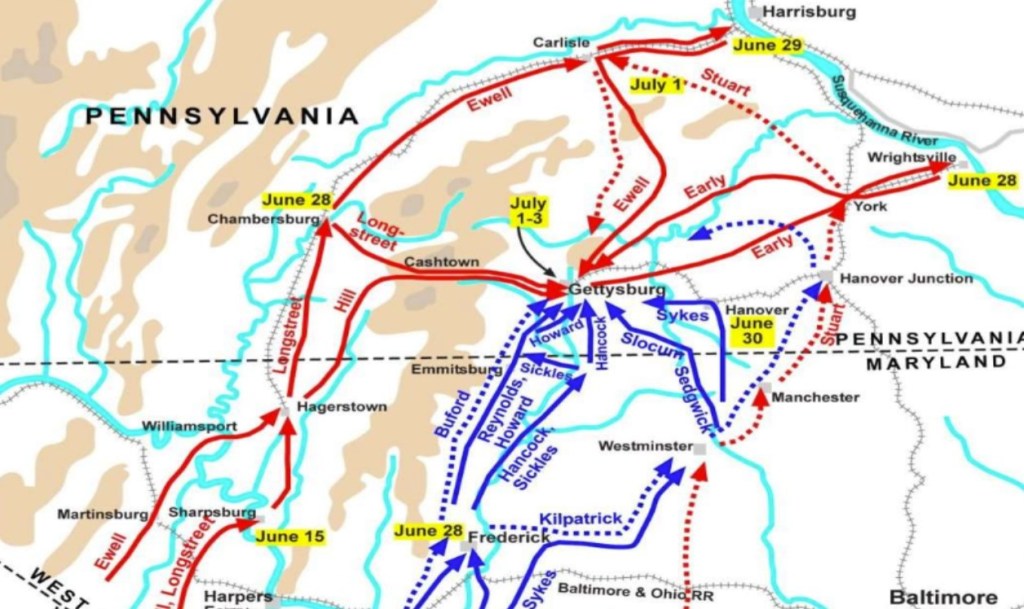
The newly created Commanding officer of the Department of the Susquehanna was Major General Darius Couch, an extremely capable commander who had refused President Lincolns earlier offer of command of the Army of the Potomac. Couch organised the new militia groupings into Brigades and Division mostly based on their military experience. Michael Bennett’s division was put to work in guard duty but more importantly, those of military knowledge, were sent on scouting missions to observe the movements of the Confederate forces. The information supplied by these units sent on scouting missions was invaluable to the leadership of the Union Army and made its way up the chain of command through Major General Couch to General George Meade, in fact Meade was usually anxiously awaiting any information he could get from Couch and from the scouting units as his following communication to Couch would suggest.

Move and counter move over the next day’s finally culminated in both side clashing near the town of Gettysburg. After some initial skirmishes on the outskirts of the town the major battle commenced on the 1st of July 1863. It would continue to rage over the next 3 days and would result in the largest casualties of the entire conflict and its outcome would change the course of the US Civil War. As the battle raged over those early days in July 1863, Michael’s unit had been brought under the direct command of General Couch who had been instructed by Meade to arrange his best men and harass at the rear of Lee’s confederate forces as they approached Gettysburg. Mention is also made of these units being asked to attack the left flank of Lee during the main Battle of Gettysburg.
At the close on July 3rd, 1863, the Union Army under General George Meade would emerge victorious. As stated earlier, the deciding factor that swayed the battle in the Unions favour was a rare tactical mistake by the seemingly, and up to that point, invincible Robert E. Lee. Fate, chance, or possibly just bad luck would play its part in ending the Confederates hope of overall victory and at the same time it would also end Michael Bennett’s military career. At some stage during those three days, he would sustain another bad injury, this time fracturing his leg and ending any possible further participation in the Battle of Gettysburg. One can only assume, when you consider his previous stubbornness when badly injured, ending his participation in the war in this way would have been a very hard pill for Michael Bennett to swallow.
Fighting at The Battle of Gettysburg

Michael was sent to a military hospital and from there, when fit enough, would make his way back to New York. General Darius Couch and some of his Militia units would stay on in Gettysburg and be given the task of organising the clearing of the battle site and burying the thousands of dead soldiers in preparation for the newly planned Gettysburg National Cemetery. General Robert E Lee’s army of Northern Virginia would make a retreat towards the Potomac River and make for a point called Falling Rivers, the heavy rains and the rising waters would delay his troops from making the slow crossing. His weary army was in an extremely precarious position and General Lee knew it. He would eventually see the last of his men cross in the darkness of the night and into the safety of Virginia. Meanwhile General George Meade, in a move that he would have to justify for the rest of his life, hesitated in pursuing the Confederates as they retreated from Gettysburg much to the frustration of President Abraham Lincoln. In many peoples view Meade’s decision to allow Lee’s Army to retreat unhindered would lead to the Civil War continuing for another bloody two years.
A very interesting twist of fate that distantly connects Michael Bennett and Edenderry to General George Meade was uncovered by Danny Leavy while studying the 6000 documents he has in his possession belonging to Cornelius Heeney. If you recall, Heeney was the man we mentioned earlier who had paid for the Bennett family to emigrate to America. General George Meade’s Great Grandfather was born in Limerick and settled in Philadelphia where he became a successful Merchant. His son, also named George, carried on that business, and employed a certain young Edenderry man named Cornelius Heeney. Danny uncovered many documents and receipts signed by Heeney including proof that Cornelius Heeney was one of the executors of the will of General George Meades Grandfather.
The later years of Michael Bennett life would see him return to his Hotel in Brooklyn and run it successfully until 1893. He would remain a hugely respected member of the Brooklyn community and would be heavily involved in many local charities including the Society of St. Vincent De Paul. His most notable contribution to the Brooklyn would be as one of the founding members of the Catholic Parish of St. Augustine.
St. Augustine Church, Brooklyn
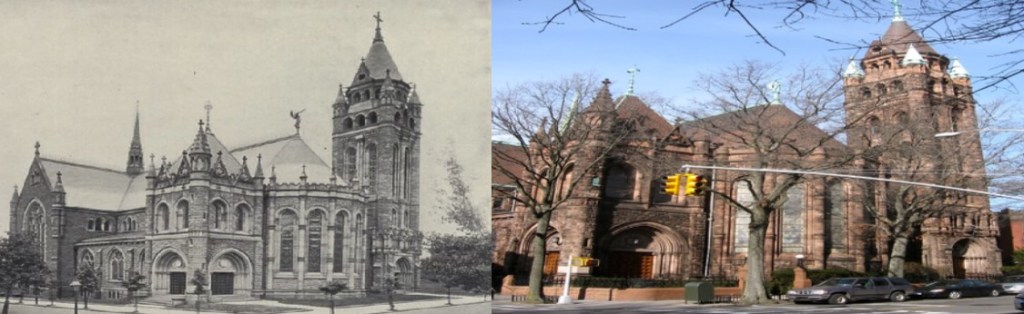
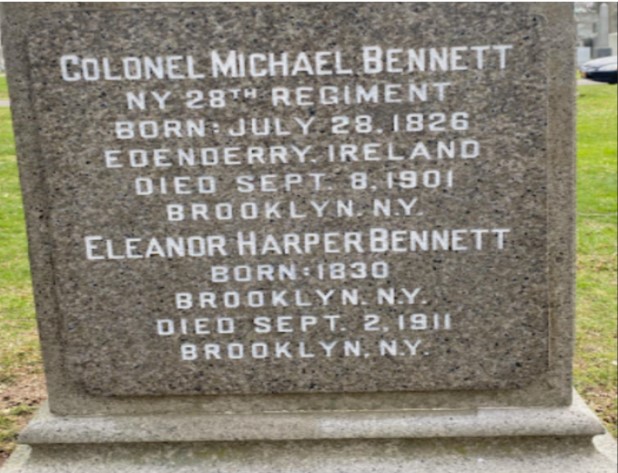
Michael Bennett, born in Edenderry, Offaly in 1826 would pass away at his home in Brooklyn on September 10th, 1901, after a brief illness. He was survived by his wife Eleanor (Harper), two daughters and two sons. His funeral service would be fittingly held at his beloved St. Augustine’s Church, and he is buried in Holy Cross Cemetery, Brooklyn. But this is not the end of the story of Michael Bennett. There is one more twist of fate, or chance, in this remarkable man’s tale.
Colonel Michael Bennett

Cadie Robertson is a direct descendant of Michael Bennett and has valuable information on the Bennett family from Edenderry. She and Danny Leavy have been in constant contact over the past years. Cadie’s information has been invaluable in putting together Michael’s story and along with Danny Leavy, I cannot thank them enough for making sure we were in some way able to put together his story. Cadie and Danny uncovered an amazing piece of information while researching Michael. As strange as it sounds the Bennett family plot in Brooklyn, which was paid for by Michael Bennett, does not bear his name on its impressive marker. The reason seems entirely unclear. Why would this man who had done so much not have his name on his family plot? Cadie has found evidence from 1969 where her family had tried to correct this strange anomaly, but up to this time the name of Colonel Michael Bennett is not inscribed on the marker.

Cadie Robertson, it seems, has inherited the same determination that her relation Michael Bennett demonstrated all through his life. She and Danny have spent a few years trying to negotiate the process to finally have Michael’s name inscribed on the stone and their persistence has apparently paid off. As of February 2024, she has got confirmation that the wording for the marker has been agreed and will be completed, weather permitting, at the soonest possible date. And so, it seems, as a Veteran of the US Civil War, Michael will finally get the deserved recognition for his contribution to the very existence of the United States of America.
** March 26th 2023 – Brooklyn, New York

- James Campbell, Edenderry
James Campbell was born in Edenderry in 1833 to parents John Campbell and Elizabeth Bennett. His baptism record can be found in the Rhode Parish Register. This was not unusual at the time as several residents of the Monasteroris area were baptised within the parish of Rhode. You will notice the name Bennett appearing again, and there is a direct connection to Colonel Michael Bennett. James Campbell was in fact a nephew of Michael Bennett and Grandson of Margaret Fullard. The Bennett, Fullard and Campbell families were living in the same area in the early 1800s and the Griffiths Valuation, a British Government survey of all property in Ireland completed in the 1850’s, would still show Campbell and Bennett families living close by each other in this district of Monasteroris.
Baptism Record 1833

Griffith’s Valuation – 1853

Just as the Bennett family were helped in emigrating to the US, so it seems that the very influential Edenderry emigrant, Cornelius Heeney, would also play a part in a helping several members of the Campbell family, including a then 4-year-old James, leaving Edenderry for America in 1837. Both families would settle in New York and on checking up as far as the 1860 US Census the records show that the Campbells and the Bennetts would still be living side by side in the Brooklyn area.
John Campbell would open a guesthouse called Fisherman’s Hall in an area called Gowanus Bay near Brooklyn. James would likely have worked in this business with his father as a young man. He would also become involved in the local Militia regiments being created and would serve under his uncle Michael Bennett in 72nd New York Militia. As the Civil War loomed in 1860, James was appointed Captain of Company E in the newly created 28th New York Regiment again under the overall command of his uncle. As with his life up to this point, James Campbell would follow a similar pathway through the war as Michael Bennett. He would be in Washington DC in 1861 with his uncle as they built the soon to be named Fort Bennett and would return to New York with his regiment in August 1861 at the end of their 3 months of service. James Campbell would then enlist in the 158th New York Volunteer Infantry and this Regiment would serve for 6 months of 1862 under the command of Union General George McClellan in Virginia as he attempted, and ultimately failed, to take the Confederate Capital of Richmond in a period of the war called The Peninsula Campaign.
James Campbell would return to serve in the 28th New York Regiment in June 1863 as it was mustered bank into service and incorporated into the Department of the Susquehanna and, as we have discussed earlier, this company would be involved in The Battle of Gettysburg as it raged over the first three days of July 1863. James would serve as Captain of his regiment and once again be under the overall command of his uncle, Colonel Michael Bennett. In a remarkable twist of fate and set of seemingly chance circumstances the uncle and nephew from County Offaly, who had lived side by side as children in Edenderry, who had emigrated to the distant shores of America, who had then again lived side by side in New York, would once again be side by side but this time on the most famous battlefield on American soil. The 28th New York Regiment returned to Brooklyn in late July 1863 and James Campbell and his Uncle Michael Bennett would return to normal Militia duties until the end of the war in April 1865.
The 1890 Census of Surviving Soldiers of Civil War


At the close of the war James Campbell would join the New York Municipal Police Force and serve for 2 years in the Manhattan area of New York. In 1867, on the disbanding of the Municipal Force, James would join the newly formed New York Police Department and serve in his local area of Brooklyn. By 1873 James Campbell was once again appointed as a Captain, this time he served that role in his local precinct of Brooklyn. Towards the end of his career in law enforcement James would be appointed Inspector for the Coney Island District of New York. He would also serve on the board of Police Benevolent Organisations created at that time. On his retirement in December 1903, after nearly 40 years of service, James was recognised as a highly respected figure in law enforcement in New York. In articles written at the time of his retirement it was said that he was always fair, firm, but fearless in the execution of his duties.

In his private life James Campbell would also serve his local community and once again he would join with his Uncle Michael Bennett in many of these endeavours. Both would be heavily involved in the founding of the local Catholic Parish and Church of St. Augustine in Brooklyn. James would repay his debt to Cornelius Heeney and serve on the board of the Brooklyn Benevolent Society created by Heeney. The Benevolent Society, which is still in existence today, originally provided fuel in winter to the poor, clothing for schoolchildren, and paid the salaries of teachers of those children. Today it still aids the poor of the Brooklyn area and offers scholarships to children who could not otherwise afford it.
James Campbell would pass away in 1922 at the age of 89 at his home in Brooklyn. His wife Mary (Desmond) had pre-deceased him by 2 years. There would be no children in the marriage of James and Mary. Reports in the local papers state that James was in good health right up to the day he died and had in fact been out for a long walk the day before his passing. In the final connection to his uncle, Michael Bennett, the funeral service of James Campbell would also be held in St. Augustine’s Church in Brooklyn, and both are buried in Holy Cross Cemetery not far from each other. The end of this story finds the two men who were from the same small area of County Offaly, who both emigrated to the US and lived in the same area of New York, who fought bravely together at Gettysburg would rest together for eternity in the same plot of ground.
On the afternoon of November 19, 1863, four and a half months after the Union armies defeated Confederate forces in the Battle of Gettysburg, President Abraham Lincoln stood to make a speech at the dedication ceremony to the dead of Gettysburg. His words would be few, only 271, but would become maybe the most famous speech made by any US President in history. Part of that famous speech reads as follows.
“The world will little note, nor long remember what we say here, but it can never forget what they did here. It is for us the living, rather, to be dedicated here to the unfinished work which they who fought here have thus far so nobly advanced”.
Our thanks to Kevin Guing for this valuable piece of research and to Danny Leavy for his assistance. For this editor and the late Stephen McNeill this article has special resonance as we were guests of Brigadier General Jim Cullen at Gettysburg in 2015.
 offalyhistoryblog