

The history of passenger steamers on the Shannon, covering a period of 140 years, was traced by Dr McNeill of Southampton University, in a lecture jointly sponsored by the Old Athlone Society and the local branch of the Inland Waterways Association, and held in the Prince of Wales Hotel, Athlone, in January 1966.[1] Dr McNeill soon after published two volumes on the subject of steamer transport. Ruth Delany has also published material in her The Shannon Navigation (Dublin, 2008).[2]
McNeill, in his 1966 Athlone lecture, said that Ireland had a tremendous heritage of water transport. Mentioning that the first experiment in the idea of iron bulkheads in streamers was tried out on the Shannon in 1829, he said that we were apt to forget the work done by Irishmen in the technical field in the last 150 years. Iron steamers were cradled in Ireland in the 1820s.
Mr. McNeill acknowledged his debt to the late Dr Vincent Delany and to the files of the Westmeath Independent for much information on Shannon steamers.
Recalling that in 1829, the first commercial passenger steamer service commenced plying on the lower Shannon, he said it was operated by the City of Dublin Steampacket Company for roughly thirty years. The fleet included the Garryowen, the largest iron steamer in the world at that time and first development of the new idea of iron bulk-heads. Another steamers, Erin Go Brath, made marine history at that time by keeping her engines running for six days without stopping.
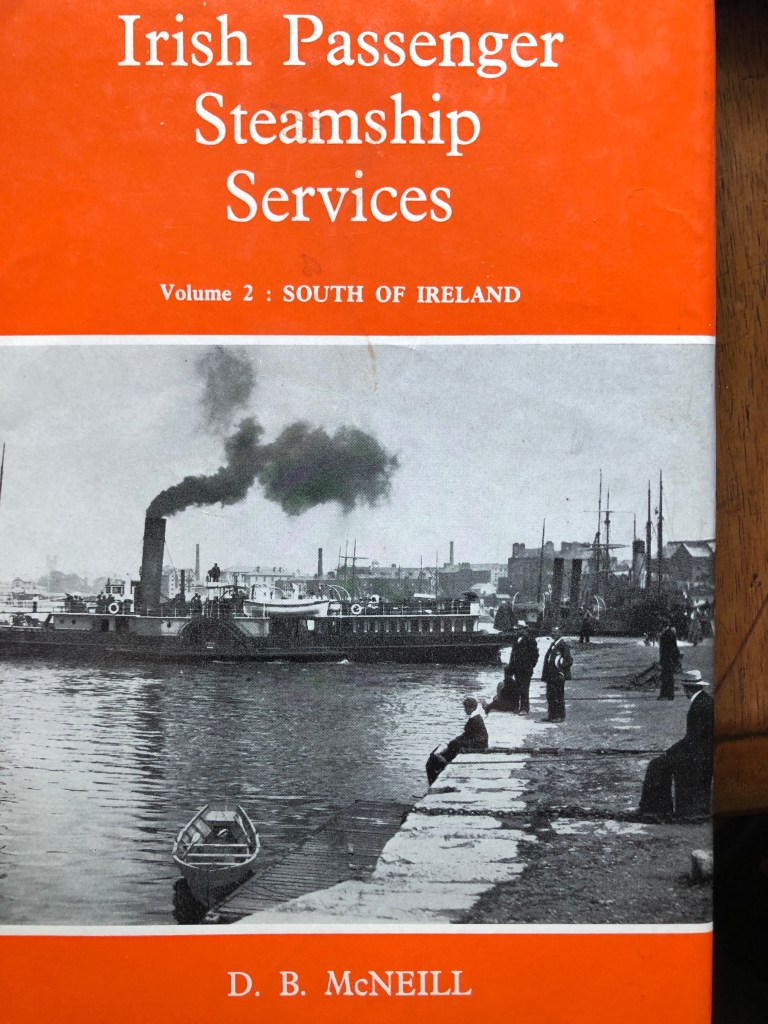
First Steamer
Mr. McNeill said that the first steamer appeared on the upper Shannon in 1826 and was the first iron steamer to ply on inland waterways. In 1829 the Inland Steamship Navigation Company dominated the traffic on the upper Shannon and continued to do so until 1860.
The first golden age of the Shannon commenced in 1848, when there were five regular steamers plying on the upper reaches of the river. They included the Lady Lansdowne, (launched in 1834) Clanricarde, Avonmore, the Marquis Wellesley and led a new era in Shannon passenger traffic.
In her study of the Shannon navigation Ruth Delany refers to 1827 experiments at Shannon Harbour and to the Wye steamer which was small enough to fit on the Grand Canal and was used to pull two boats. Avonmore and Dunalley were running between Portumna and Shannon Harbour and Wellesley between Shannon Harbour and Athlone. The bulk of the tonnage carried on the steamships was from Dublin to Limerick via the Grand Canal.[3]
In 1842 the Company carried out experiments in the burning of turn instead of coal and cut fuel costs by forty per cent. In 1853 the Midland and Great Western Railway Company (M.G.W.R.) took a seven years’ lease of the Grand Canal and Shannon services were provided to link-up with the railways. By 1857 there were some very fast passenger boats on the Shannon. One to arrive from England was the Duchess of Argyle. It was re-assembled in Athlone and did the journey from Athlone to Killaloe in 4 ½ hours.
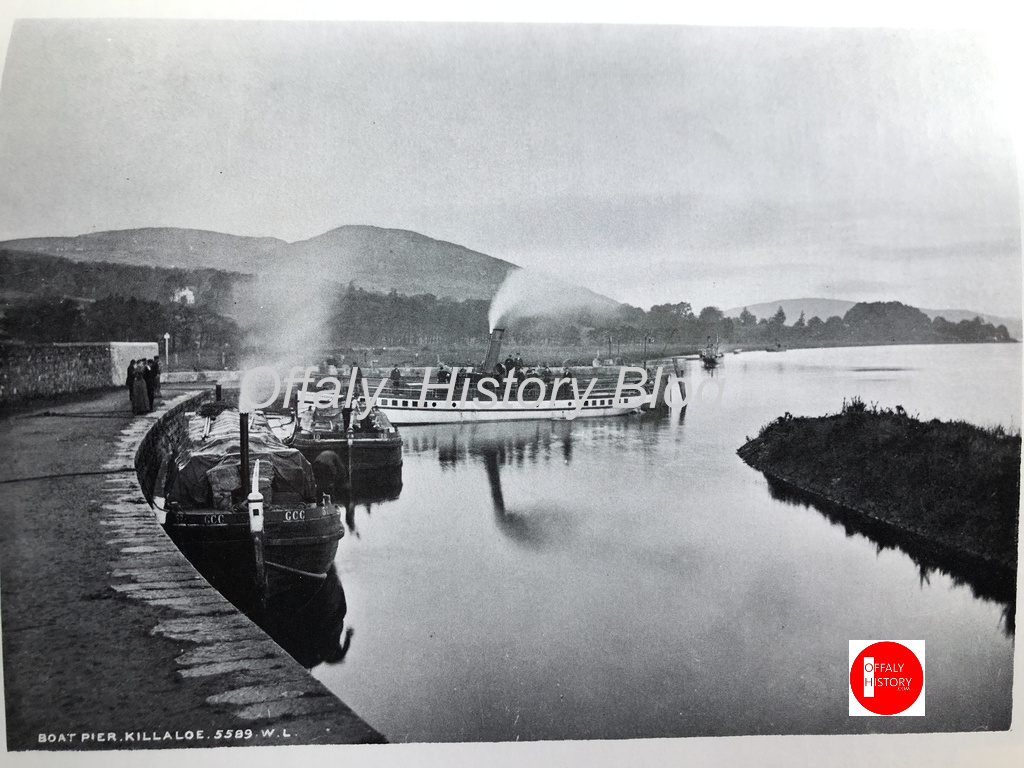
The service in 1854 was reported on in glowing terms:
‘Nothing can exceed the regularity with which the Burgoyne steamer makes her trips from Athlone to Limerick, or the punctuality with which she arrives at our quays to meet the evening train to Dublin, whilst to the comfort and convenience of passengers, the utmost attention is paid by Captain Winder. Tourists visiting Ireland during the approaching summer, when taking this route from Dublin via Athlone to Killarney, have the best opportunity of judging the capabilities of this noble river as well as viewing the delightful scenery with which the lower ‘Shannon abounds.’[4]
The 1850s was a time of heavy emigration including what might now be described as less than voluntary such as this report in 1853 of the departure of 180 women from the workhouse in Athlone bound for Canada;
‘On Thursday 180 healthy looking female paupers were marched from the Athlone Workhouse to the quays. There they boarded the Shannon steamer, Burgoyne for Limerick, where a vessel has been provided to take them to Quebec. The girls have been inmates of the workhouse for periods varying from two to five years. The Board of Guardians provided them liberally with clothing and necessaries for the long voyage. The ship that will take them to Quebec is the Jane Black.’[5]
Service Ceases by 1863
In 1860 the Inland Navigation Company withdrew from the Shannon, leaving then only the M.G.W.R. steamers. Within a year or two they went also, so that from 1863 until 1897 not a single passenger steamer was to be seen on the Shannon. There were a few gloried barges like the Lord Lorton and the Lady of the Lake, but for 35 years, from 1862, it was again the dark ages as far as fare-paying passenger boats on the Shannon was concerned.
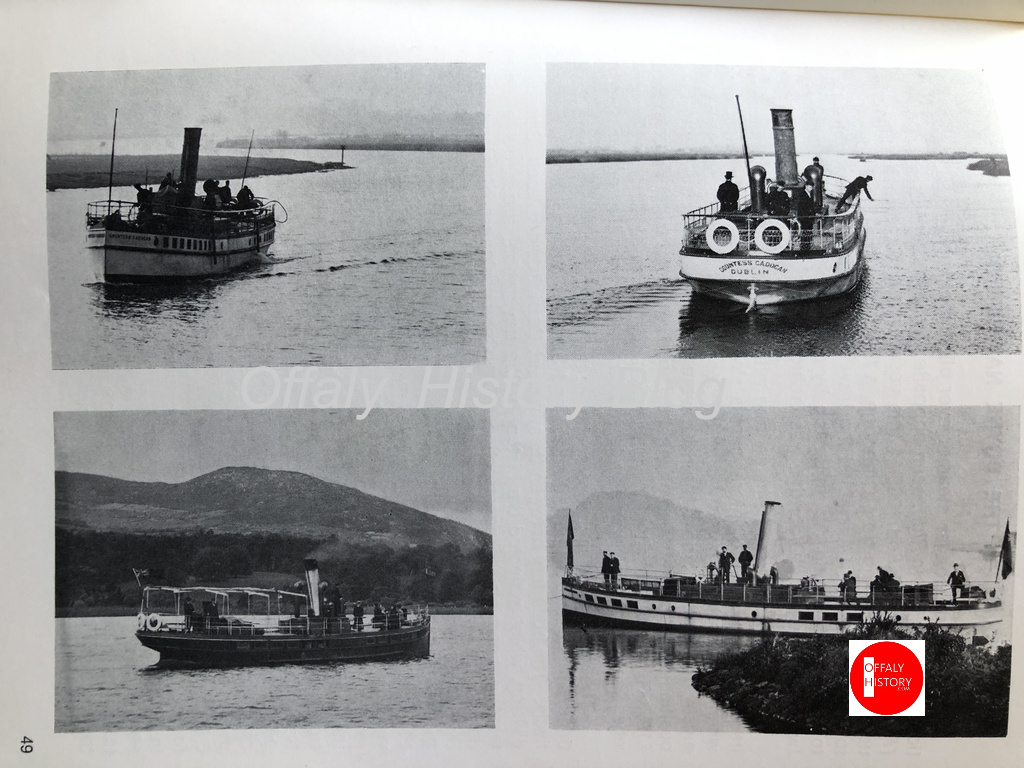
Steamboats on the Shannon from 1897 to 1914
In 1896, a Shannon Development Company was formed with Government aid and subsidy from counties adjoining the Shannon (including King’s County) and within two years the river was once again carrying passenger steam of Wellesley, the ‘Burgoyne and the Gazelle. [6] The new steam powered boats of the late 1890s included the Fairy Queen, the Lady Betty Balfour, The Countess of Mayo, Countess Cadogan, and the ‘Shannon Queen.’ The year 1898 was the great heyday of Shannon steamers and it continued until 1913-14. After that the service virtually ceased until 1955 when C.I.E. put two cruisers on the Shannon.
The setting up of the service in 1897 was reported thus:
In July of 1897 the King’s County Grand Jury were invited to a steamboat tour on the Shannon courtesy of the Shannon Development Syndicate. The Fairy Queen was the first of the steamers acquired by the syndicate with plans to run a service from Athlone to Killaloe. Two other boats were to be added to the fleet – the Countess Cadogan and the Countess of Mayo. Fairy Queen could accommodate 231 passengers. Even the entire printing and composing staff at the Birr Chronicle were treated to a break and steamboat tour. Banagher was to be a terminus much to the annoyance of Athlone.[7] The new service was subsidised by the surrounding counties.

The Fairy Queen at Banagher in July 1897
‘On Sunday the people of Birr will have an opportunity of exploring Lough Derg and the Upper Shannon. The Fairy Queen will ply from Banagher to Killaloe, a truly delightful run. Brakes will leave Birr in connection with the steamer at 9.15 a.m., remaining in Banagher to bring back the excursionists. seats should be booked at once from Mathew’s hotel, Clavin’s hotel [formerly Dooly’s], P. Egan’s or any other posting establishment. The return fare Birr to Banagher, will be 1s. Tickets for the Fairy Queen 2s. 6d. Refreshments can be had on board at a moderate tariff.[8]

In the late summer of 1897 Banagher was favoured with a Royal visit:
The visit to Banagher of the Duke and Duchess of York (later George V and his wife Queen Mary) as reported by the Midland Tribune – no friend to royalty.
‘On Wednesday their Royal Highnesses, the Duke and Duchess of York, sailed up the Shannon from Killaloe to Banagher [on the Countess of Mayo]. Throughout the country the reception given to the Royal visitors was courteous if cold. The Royal tour has proved conclusively that outside of Dublin, Unionists and Castle flunkeys are a very small factor in the population. The decorations in Killaloe and Banagher were altogether one-sided. The attempt to get up anything approaching a popular display was a miserable failure. The Conservatives had the cheering all to themselves. At Killaloe an address was presented to the Duke signed by three gentlemen, who seem to be altogether unknown to history. The grand old river was seen to the greatest possible disadvantage. The sail was right through a most depressing deluge. At Banagher the distinguished tourists were received by the Right Hon. the Earl of Rosse, Captain Daly [the Tullamore distiller and high sheriff in 1897] etc., and were at once conducted to Lord Rosse’s carriage, in which they drove to the railway station [the Banagher to Clara]. Lord and Lady Dunraven, Mr G. Balfour, and the rest of the party going on foot. At the railway station an address was presented to the Duke signed by several local men. Lord and Lady Rosse, the Hon. Muriel Parsons, and Mrs. Daly had the honour of being presented to their royal Highnesses. Miss Sherrard, the five-year-old daughter of the Rector of Banagher, presented a bouquet to the Duchess and a button-hole to the Duke. The Duchess also accepted handsome flower bouquets from Mrs Captain Daly and Mr George Hackett. After a very brief delay the royal party entered the special train and steamed on en route for Newton-Stewart. The constabulary guard of honour on Portumna bridge was one of the things best worth seeing en route. Every man in it was over six feet in height and of magnificent physique.’
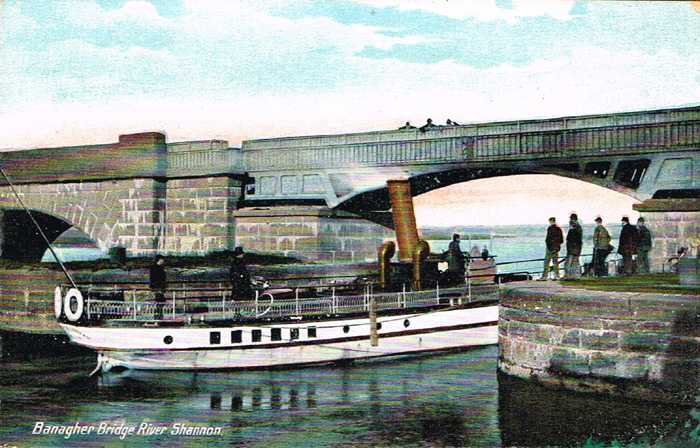
Midland Tribune, 4 September 1897
Banagher and the River Shannon was popular as a base and presented no logistical problems for the boarding school of the La Sainte Union des Sacres Coeurs established there in 1859. The boarders were out on the river in 1902.
‘The community of La Sainte Union des Sacres Coeurs, Banagher, had a pleasant excursion on the Shannon on Tuesday. The Shannon lake steamer Countess Cadogan was chartered for the occasion, and the party, consisting of Nuns of the community, local priests, and over 100 boys and girls, of the boarding schools of the convent, started from Banagher at 9 o’clock in the morning, and had a most delightful sail to Killaloe, the weather being charming. When they arrived at their destination, the hampers, which were varied and plentiful, were fittingly appreciated. After a brief adjournment in Killaloe, the homeward journey was made, under most happy circumstances.’[9]
According to Ruth Delany the Shannon Queen was the last of the company’s steamers to operate and if the published timetable of June 1914 can be relied on the service had been reduced to one return trip daily between Banagher and Killaloe. It was possible to travel by train from Dublin to Banagher and by steamer to Killaloe where a branch line met the boat to link with the main line back to Dublin. The fare was 14s 6d first class and 11s third class with luncheon and tea on board the steamer. The river trip lasted five hours with the steamer calling at Meelick, Portumna, Rossmore, Williamstown and Dromineer. This service ceased when the war started.[10]
Trade tonnage on the river was up to 100,000 tons by 1910 with the Grand Canal Company having in the 1890s and early 1900s four or five steamers. Towing by steamer was much faster even after the Bolinder engine was introduced for canal boats in 1911.[11]
As the First World War progressed motorised transport by road came into use. This led in turn to the development of bus services in the midlands by the 1920s and later to lorries carrying goods in place of the canal boats and steamers. The fuel rationing during the Second World War provided a boost for canal and river trade that declined again once the war ended. The further reductions in the 1950s combined with the amalgamation of the Grand Canal Company with the nationalised transport authority CIE led to the almost complete closure of the Grand Canal and Shannon carrying trade in 1959.[12]
[1] Offaly Independent, 8 Jan. 1966
[2] Some copies available from Offaly History Centre.
[3] Ruth Delany, The Shannon Navigation (Dublin, 2008), pp 157–69.
[4] Offaly Independent, 10 Aug. 1968 in re 1854 file.
[5] Ibid, 31 Dec. 1966 possibly re 1853
[6] See also Delany, Shannon Navigation, pp 179–80.
[7] King’s County Chronicle, 1 July 1897; 8 July 1897.
[8] Midland Tribune, 15 July 1897
[9] Midland Tribune, 12 July 1902.
[10] Delany, Shannon Navigation, p. 182.
[11] Ibid., p. 187.
[12] Ibid., p. 226.
 offalyhistoryblog