
Kieran Keenaghan began his professional journey in 1967 as a civil engineer working on motorway construction in County Down. After gaining experience in the North, he returned to his native Offaly in 1969 to work for Bantile, a precast concrete factory near his home. He later moved to Charleville, Co. Cork to work as a project engineer for Golden Vale, overseeing significant building projects during a period of major investment in the dairy industry. In 1976, Kieran took a significant entrepreneurial risk by partnering with five others to buy the insolvent Bantile premises and establish Banagher Concrete. Under his leadership as Managing Director for over 40 years, the business grew from a small local operation into a national leader employing up to 500 people. Throughout his career, he integrated his professional engineering expertise with a deep commitment to the GAA, often leading major local development projects such as the Faithful Fields in Kilcormac.
(more…)Category: Banagher
-
Shannon Bases and Viking Raids in Offaly. By John Dolan. Blog No 761, 21 Nov. 2025
There are a number of references in the Annals to Viking bases been set up on the Shannon, particularly in the larger lakes of Lough Derg and Lough Ree. There were two distinct periods of Viking activity on Lough Ree starting In the ninth century when the Vikings had a fleet on the lough. The Annals of Ulster for 845AD say ‘There was an encampment of the foreigners i.e. under Tuirgéis on Loch Rí, and they plundered Connacht and Mide, and burned Cluain Moccu Nóis (Clonmacnoise) with its oratories, and Cluain Ferta Brénainn (Clonfert), and Tír dá Glas (Terryglass) and Lothra (Lorrha) and other monasteries’. Later another base was built between Dromineer and Castlelough in the lands of the O’Sextons. It was from the Shannon that the majority of raids into County Offaly were carried out. A very early and unusual entry in the Annals of Ulster for 749 says ‘ships with their crews were seen in the air above Cluain Moccu Nóis’.
The following year Tuirgéis was captured by Maelsechlainn and drowned by him in Lough Owel outside Mullingar. The Annals of Ulster for 922AD say ‘The fleet of Limerick, that is of Ailche’s son went on Loch Rí, plundered Clonmacnoise and all the islands on Loch Rí and took great booty in gold, silver and much treasure’. In 924AD the entry reads ‘Kolli son of Bárðr ‘Lord of Luimnech’ raids Lough Ree’.
(more…)
-
William Bulfin: Birr’s Fenian Travel Writer. By Luke Condron. No. 19 in the Offaly History Anniversaries Series. Blog No 749, 20th Sept 2025
On the 1st of February, 1910, a Gaelic League nationalist died quietly in his home in Derrinlough House, Birr, County Offaly. Four days later, in An Claidheamh Soluis, he was briefly memorialised in print by Seán Ó Ceallaigh:
On Tuesday, Lá Fhéile Brighde, the first day of spring, Señor Bulfin was carried off by a sudden attack of pneumonia, before even his friends knew he was ill. The Gaelic League loses in him a great champion of its ideals, and the Irish of Argentina their leader… He was known and admired wherever an Irish class existed.
The name William Bulfin, in our time, does not live up to the description offered above, though it may well arouse some curiosity at the mention of an Irish Argentine. However, Bulfin, though his credentials remain firmly intact — An Irish nationalist, a Gaelic Leaguer who was present at the opening of the Argentine Gaelic League branch in 1899 and at many important league summits in Ireland — has largely fallen by the wayside in the discussion of Irish nationalist figures of the late nineteenth and early twentieth centuries. When reading the musings and sophisticated theses of Rambles in Éirinn, his seminal work, one realises that obscurity ought not to be the final resting place of this man of two countries, who loved both so well.
(more…)
-
Banagher Ancient Cross is now on exhibit in the National Museum. By Kieran Keenaghan. Blog No 746, 12th Sept 2025
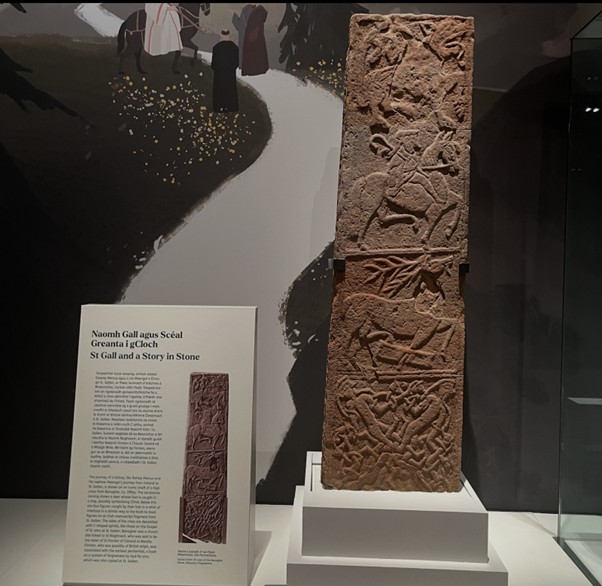
MUSEUM CAPTION :‘In preparation for our major temporary exhibition Words on the Wave: Ireland and St. Gallen in Early Medieval Europe, opening in late May this year, we reveal the ongoing conservation and scanning work on the famous high cross shaft from Banagher, Co. Offaly (1929:1497). The cross helps tell the story of the connections between art, belief and society in the world which produced the manuscripts.
‘The journey of a bishop, like Bishop Marcus and his nephew Moéngal’s journey from Ireland to St. Gallen, is shown on an iconic shaft of a high cross from Banagher, Co. Offaly. The sandstone carving shows a deer whose foot is caught in a trap, possibly symbolising Christ. Below this are four figures caught by their hair in a whirl of interlace in a similar way to the back-to-back figures on an Irish manuscript fragment from St. Gallen. The sides of the cross are decorated with C-shaped spirals, like those on the Gospel of St. John at St. Gallen. Banagher was a church site linked to St. Ríoghnach, who was said to be the sister of St. Finnian of Clonard or Movilla. Finnian, who was possibly of British origin, was associated with the earliest penitential, a book on a system of forgiveness by God for sins, which was also copied at St. Gallen.’
(more…)
-
That Beats Banagher and Banagher Beats The Devil! Offaly History – a very special Bangs Banagher book launch on Friday 27 June. No 18 in the Offaly History Anniversaries Series. Blog No 724, 23rd June 2025
Two local historians have collaborated to create a new lavishly illustrated book exploring the meaning behind the regularly used phrase ‘That Beats Banagher! and Banagher Beats the Devil! The book was written by Kieran Keenaghan, a retired businessman and engineer living in Banagher and James Scully, a retired primary school teacher originally from Tullamore and now living just outside of Banagher in Clonfert, Eyrecourt, County Galway.
The book, designed and printed by the Guinan Brothers, Ciarán and Diarmuid, at Brosna Press, Ferbane, explores the Banagher phrase that dates back to 1787 and how history formed the saying which became a humorous expression of amazement used since all around the country, throughout Britain and across several continents.
(more…)
-
Thomas Lalor Cooke (TLC) ‘the only antiquarian now living’ according to John O’Donovan in letters from Birr in 1838. The first in a series of articles to mark Cooke anniversaries. No. 15 in the 2025 Anniversaries Series from Offaly History. By Michael Byrne. Blog No 714, 21st May 2025
Thomas Lalor Cooke’s Picture of Parsonstown was first published in 1826 and a revised edition by his son William Antisell Cooke in 1875. So this year marks the 150th anniversary of the revised issue and in 2026 we mark the 200th anniversary of T.L. Cooke’s first and now rare book, the Picture of Parsonstown. A reprint of the 1875 greatly expanded history was issued by Esker Press in 1989 with a new introduction by Margaret Hogan. It is now also out of print. A reissue of the 1826 book is now under active consideration.
(more…)
-
George Petrie (1790–1866), a key landscape painter for Offaly’s ‘heritage of ruins on the landscape’. No 3 in a series on the paintings and drawings of County Offaly, 1750-2000, explored through the works of artists from or associated with County Offaly. Blog No 709, 15th April 2025
George Petrie was born in Dublin in 1790 and has a strong King’s/ County Offaly connection through his work at Clonmacnoise, Birr, Banagher, Clonony, Lemanaghan and Rahan. He may have been the most significant topographical artist so far as Offaly is concerned. He was certainly the greatest exponent of the heritage of Clonmacnoise first visiting the site in 1818–22. Dates differ as the visits to Clonmacnoise as was noted in the most attractive publication by Peter Murray and published by the Crawford Gallery in 2004.[1] The other great work on Petrie is that of William Stokes, The life and labours in art and archaeology of George Petrie (Longmans, London, 1868). Also important is Crookshank and Knight of Glin, Irish painters, 1600–1940 (Yale, 2002).
The Dictionary of Irish Biography (DIB) entry by David Cooper records that Petrie, was an artist, antiquary and collector of Irish traditional music, and was born on 1 January 1790 in Dame Street, Dublin, the only child of James Petrie, portrait painter, of Dublin, and Elizabeth Petrie (née Simpson) of Edinburgh, Scotland. James Petrie (d. 1819) was born in Dublin of Scottish parents and studied at the drawing school of the Dublin Society. Afterwards he practised as a miniature painter and a dealer in jewellery, coins, and antique objects at 83 Dame Street. The collecting instinct would stand Irish heritage in good stead with James Petrie’s son George performing an outstanding archival and museum service.
(more…)
-
Richard Rothwell the Irish Portrait Artist. By Daniel Byrne-Rothwell. No 1 in a series on the paintings and drawings heritage of County Offaly, 1750-2000 explored through the works of artists from or associated with County Offaly. Blog No 704, 26th March 2025
Richard Rothwell holds a place as Ireland’s foremost portrait painter of the 19th century but there has been much confusion about his identity owing to W.E. Strickland’s biography of him in ‘A Dictionary of Irish Painters’ (1913), which had him born in Athlone, a son of James Rothwell, and a descendent of the Rothwells of Co Meath, none of which was correct. This was repeated by other art historian and in a 1961 family history by his descendant Desmond Rothwell of Montreal, where Desmond wrote that Richard’s grandfather was Thomas Rothwell of Lisdaly, Co. Offaly, and that his father, James Rothwell, married Elizabeth Holmes and had seven children. He states that James fled Ireland in 1798, perhaps to America, after he allowed forces to rest overnight in his barns during the 1798 rebellion. This tradition, however, is not compatible another tradition recorded by Desmond of Richard supposedly being born in Athlone in 1800.
(more…)
-
Banagher Brontë Group Book Launch, Blog No 677, 5th Dec 2024
AND WREATH LAYING THIS WEEKEND
BOOK LAUNCH
The Banagher Brontë Group will round off a great inaugural year with two events this coming weekend. On Saturday 7th December the group will launch Martina Devlin’s Charlotte at 2.30 p.m. in the Crank House, Banagher. The book will be launched by Nigel West whose ancestors lived in Hill House, (now Charlotte’s Way, a well-appointed guesthouse), until 1959 when it was sold to the local Church of Ireland community.
(more…)
-
22 Bussing in the Midlands from Tullamore to Birr, Banagher and back again: Lennox Robinson (1886–1958) on tour in the early Fifties. No 22 in the Offaly History Anniversaries Series. Blog No 671, 20th Nov 2024
At one time I didn’t think, but now I definitely do think, that the pleasantest way of seeing Ireland is from a seat in a bus. I do not mean one of those eight-day bus tours, conducted and excellent and comfortable as they may be, I mean the couple of hours spent bussing from one country town to another. [So announced Lennox Robinson in an article first published in the Irish Press and later in his compilation I sometimes think (Dublin, 1956). He would possibly have been amused to know that bussing has another meaning nowadays when students get together in a college dorm. Robinson was not inspired by some of the women who joined his Tullamore to Banagher and Birr bus. Now read on.]
If you travel in a friend’s car, you are cribbed and confined, he or she has to make talk with you and you have to return the ball of conversation; a train nearly always looks for and finds, the most poor and uninteresting country to travel through, and when it reaches an interesting town, Portarlington, for instance, is careful to stop a mile away from the place, John Gilpinish.
But a country bus swirls along, is very swift, and yet can be leisurely, picks up a parcel here and delivers a bundle of papers there.

We are, back in the old coaching days : the conductor knows everyone-or nearly everyone-and has a friendly word for each on-comer or down-getter. He sets down Mrs. Maloney at the Cross and helps an old Jack who is off to spend the day, his pension-day, in the town: yet he can be severe and inexorable on the question of accepting bikes.
I am beginning slowly to fall in love with the midlands slowly, because there is nothing tempestuous or flashy about them. The vivacity of Kerry and Donegal, the cuteness of Cork and Antrim-these are lacking, and instead there is a lovely autumn-afternoon placidity, golden and Veronese-woman-like atmosphere. The very names of sleepy; they are bees in August Lime-trees: Birr, Clogher, Ferbane, Clara, Mountrath.
(more…)

 offalyhistoryblog