
The Cottage in O’Moore Street, Tullamore is one of the few examples in Offaly of cottage ornée architecture. This was an architectural style that may have begun with Walpole’s Strawberry Hill, built over the period from 1749 to the 1770s. One of the best-known examples in Ireland is the Swiss Cottage in Cahir. These cottages were built by the well-off to play at rusticity and, as with this house, have carefully hidden its actual size and its impressive garden. The Cottage was built about 1809 and is one of three or four fine houses in the street, the best being Moore Hall and Tullamore House at the junction with Cormac Street.
The Cottage is on the list of structures to be preserved and was reroofed and plastered in the year 2000. It is an important part of the architectural heritage of Tullamore and like some of the houses across the street in Victoria Terrace needs urgent attention. Unfortunately, even in the 100 years before 1990 The Cottage appears to have always been let and therefore denied the major investment that an owner occupier would provide.

From the 1800s until the 1850s the housing on the northern side of O’Moore Street was very mixed. About 10 poor cabins near the present-day filling station of Heffernan’s were removed between 1843 and 1854 in the post-Famine adjustment. The Masonic lodge on the town side of the Cottage was revamped in the 1850s as a Quaker Meeting House and as a Masonic Lodge in 1884. The terrace of six houses between the lodge and Tyrrell’s shop were rebuilt in 1858 while the seven-house Victoria Terrace opposite the Cottage is 1837-38 in date and was fully completed by 1843. The site of the Cottage was the end of the garden of the 1750s house in High Street (no. 29 now known as Angelo’s) as was part, but not all, of Moore Hall. Plans to demolish the five single-storey shops and offices at the junction of High Street and build apartments fell in the late Tiger years. These units formed part of the Tullamore Motor Works and were the site of the small houses and shops, including Parker’s, up to the 1960s. Does anyone have a picture?

Built by the son of a distiller

‘The Cottage’ is a single-story house over basement with a pointed doorcase. This house was built in 1808 or 1809 and is known as ‘The Cottage’ because it is in the cottage ornée style. A visit to the country was something to be enjoyed rather than endured. In this case the ‘county cottage’ was near the town on the road to Killeigh and facing south. Its actual size was carefully screened to look as if it was in size a poor man’s house. Perhaps it was thatched when constructed and that the windows are of the time of construction, albeit more pointed, rather than later. In 1802 Moore Hall house, inclusive of one acre, was sold by Samuel Collins of High Street to Henry Pilkington of Tore, County Westmeath for a fine of £50 and an annual rent of £45, by way of three lives renewable. The lives mentioned were Henry, Edward his son and Anne Hamilton Pilkington wife of Henry). Pilkington came to live in Tullamore with his wife and son. The description in the sale document states it (Moore Hall) was the dwelling house where Samuel Collins lately dwelt, bounded on the east by the garden of Richard Moore, on the west the garden of Mrs Smith (possibly now the Masonic lodge), on the north by the garden of Thomas Benson, and on the south by the Killeigh road and comprising about one acre. Pilkington paid a fine of only £50, but also a substantial rent of £45. He was able to reduce this in 1810 by selling part of the land to Andrew James O’Flanagan who built ‘the Cottage’ and agreed to pay a rent of £8 or £9. Pilkington appears to have been aware of his impending demise for in the same year he settled his house on trustees to hold for his son in the event that his wife remarried. He died that year, his son in 1836 and his wife in 1841.
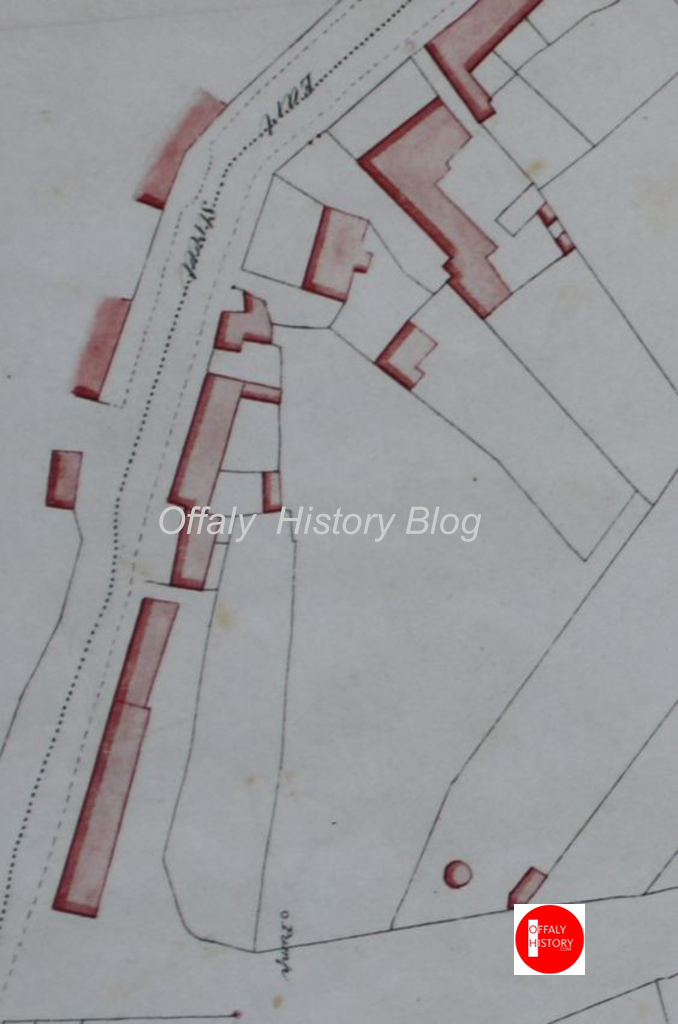
The following year the reversionary interest in Moore Hall was sold by O’Flanagan of the adjoining ‘Cottage,’ The ownership of the freehold of the two houses by O’Flanagan after 1810 and before 1842 may explain the common boundary railings on both houses. As to when exactly Flanagan acquired Moore Hall has not been established. Suffice to say that his family maintained an interest in the ground rent until 1917 when the last of the Tullamore O’Flanagan family died. His house at that time was in High Street opposite what is now Shishir, and is like the Cottage, going into disrepair, near to the Presbyterian church. It has been so for many years. Taxes and incentives are needed to sort things out and secure the restoration of these long-neglected houses. New incentives, and for the Cottage special tax reliefs such as s. 482 are needed. We need to be more proactive about sorting these issues with many good houses in High Street in need of attention.
Ill fares the land, to hastening ills a prey,
Where wealth accumulates, and men decay:
Princes and lords may flourish, or may fade;
A breath can make them, as a breath has made;
But a bold peasantry, their country’s pride,
When once destroyed, can never be supplied.
Goldsmith’s verse can be applied to the taking for granted of fine architecture/fine houses as if things can be allowed to drift without intervention for good.
There is no map on the 1810 sale document, but 62 feet in front in mentioned and at a rent of £9. Flanagan had been in the malting business at 6 Patrick Street (the former Williams Head Office) and sold this in 1809, He was a son of Joseph Flanagan the distiller and was also involved in the lease of the two houses adjoining the Presbyterian church on the town side.

Large Wyatt windows and pointed doorcase
The Cottage was described by Garner (1980) as: ‘a three-bay, single-story house with lime-rendered walls and a gable ended roof. It has Wyatt windows with brackets on the mullions and a remarkable pointed doorcase with slender gothic piers inset in a wide pointed arch. This large doorcase is emphasised by white paintwork.The garden is fronted by a low wall and neo-Greek railings similar to those in front of Moore Hall.’
Anne O’Flanagan was the occupier in 1843 when the valuation surveyor noted that it was a remarkably neat cottage with basement, stables, ash house, coach house and garden house. The rental value was considered about £10 per year. Andrew O’Flanagan was the occupier in 1854.
In 1917 the executors of Andrew Pilkington O’Flanagan (died 4 November 1916, a member of the Church of Ireland and buried at Annagharvey) by his will of 27 May 1916, Flanagan’s interest in the 1802 lease, now believed to include Moore Hall ground rent was sold to Patrick Gowing for £150. The following year Gowing converted his lease for lives into a fee farm grant subject to a rent of £41. 11s. This was purchased from Brown and Benson, who were the successors in title to Samuel Collins who had died in 1808. These people were the successor in title to the Crofton-Kearney lease of 29 High Street (back to 1758) based around Revd Walter Thomas Turpin who had the freehold interest by 1857-8. The map attached to this conveyance shows the Moore Hall and Cottage properties. The last of the O’Flanagans in Tullamore described himself as an engineer, aged 54, born in Westmeath, and a bachelor in the 1901 census. He lived in High Street in the house beside the Presbyterian church that his family had taken a lease of in the early 1800s. The sale of his ground rent entitlements came up in 1917 and included the two houses in High Street opposite Shishir and the old mill where the six apartments are today on the river at the end of the garden of these two houses. Pilkington O’Flanagan was Church of Ireland and in 1912 gave a grant of right of way on the Cottage land to the Trustees of the adjoining Masonic lodge – R. H. Goodbody, J. A. Denning, Robert McMullen and Hugh Thomas Love.

Kennedy, Conway, O’Regan and McFaddens
The Cottage was occupied in 1901 by Dr Prior Kennedy and his family who later bought Elmfield, Tullamore which was sold for the county offices site in the late 1990s. In 1911 the solicitor, Thomas Conway, occupied The Cottage with one servant. By 1913 it was let again to a medical man, Dr O’Regan, who had come in from Kinnitty, and was a leading light in the Tullamore Volunteers in 1914. From 1940 it was lived in for many years by the McFadden family, the drapers in Patrick Street.
A cinema in O’Moore Street?
The Patrick Gowing freehold interest in the properties at Moore Hall and The Cottage were sold by him in 1928 to Patrick McMahon, of O’Moore Street, a commercial traveller, who later moved to Blackpool. England. McMahon sold to the local authority officials, Stephen Cloonan and James Mahon, in 1939. These men had already taken a lease of the Foresters Cinema in Market Square and were now intent on building a new cinema in Tullamore. This was a large site but fortunately they found a better one in High Street and opened the Ritz Cinema there in 1946. Otherwise the Cottage might have been demolished in the 1940s. The Cottage was sold by the Mahon Cloonan estate in 1990.
The Cottage and Moore Hall are now on the Preserved Structures list, but the Cottage badly needs investment to secure its future. In 2000 it was reroofed and in 2014 the hoarding to the front was removed by the Tidy Towns Committee and the boarded windows at ground level painted to simulate windows.
More articles in this series: Wednesday 3 July, Moore Hall, followed by big hitters such as Hurst’s garage and Tullamore Court Hotel.
We have a walking tour of the Grand Canal from Bury /Whitehall to Cox/ Clara Bridge on Sunday 7 July at 2 30 pm., and of O’Moore St and Cormac St on 13 July Sat at 10 30 am. Free to all

 offalyhistoryblog