In 1852 Birr in King’s County decided to have a town commission/council in an attempt to improve facilities in the town that had aspirations to be the county town in the 1640s and perhaps up to the 1780s. The earl of Charleville ensured that Tullamore was named as the capital of King’s County after legislation was passed in the House of Commons in 1832 before becoming the capital town in 1835. This was by way of becoming the chief assize town with the full apparatus of county courthouse and jail.
How people travelled in the country towns in the midlands during these years is a mystery as the state of the roads were an absolute disgrace from mud and horse droppings that made travel impossible and unhealthy as the threat of cholera and typhoid fever was prevalent in the country and killed more people than the years of the Great Famine. Indeed, King’s County despite a low death rate from 1847 experienced emigration to an unprecedented level and Birr was no exception as the town suffered a serious decline in the population in the post-famine period.
Many may find it hard to believe, but Ireland has a pretty good planning structure and system.
Some years ago we embarked on an exercise of estimating where as a nation- indeed as an island – we should be going. How many people would we need to cater for, where would they live, how would they get around and what about climate change?
The outcome was Project 2040 which set out a broad overall framework and most importantly had a dedicated budget to deliver it. Its national vision is now filtering down through regional planning, to county planning, then to more detailed statutory plans for the cities and finally for the more important towns.
As a ‘Key Town’, Tullamore has a particular role to play and, in anticipation of an additional population projection of 1 million persons in the State by 2040, is presently making its own contribution by upping its housing projections to provide for an additional c. 2,000 houses and identifying an ambitious new employment and enterprise zone with direct access to the national road network.
Did you have old friends or family in Church Street 125 years ago? Probably not. It was a busier trading street 125 ago than it is today. That could be said even sixty years. As to its trade it probably suffered from the introduction of one-way systems and restricted parking in the 1960s. Yet another factor may well have been the closing of the markets in Market Square, and also the decline of the Methodist community in the street. Back in 1901 and further back to the first printed valuation of the mid-1850s it had about 57 rateable units – almost all private houses and shops, but also including Hayes’ Hotel, the Methodist church, the Costello private second-level school, the county infirmary (from 1942 the County Library), Charleville School (until 2006) and the Foresters Hall and Shambles (the meat and veg market).
Church Street is an interesting street to study with a good mix of mostly middle-class housing, good shops and trades, institutions, and good terraces with lots of boarders and lodgers to add novelty.
You might wonder what was Library Hall used for before being transformed into 15 apartments in about 1995 with a new block of ten to the rear (PD 2824). Yes, some will recall when it was the county library and the happy hours borrowing books and perhaps sitting in the large windows or close to its pot-bellied stove in winter. That was almost fifty years ago. From 1923 to 1927 the building served as the first garda station in Tullamore. And before that: yes, it was the county infirmary or county hospital from 1788 to 1921. How many beds? It had 50 and thirty were generally in use. Budget was £2000 per annum by 1920. That might get you ‘a procedure’ now or a very ‘short stay’.
It is strange that we should start with the most modern of buildings in Tullamore completed in 2001 and since 2015 Boots Pharmacy. Prior to that it was Menarys fashion and homeware and opened in 2001 as #1 Bar and Restaurant. It is the newest of the new buildings in the town and replaced one of the oldest – Hayes’ Hotel. The hotel was built in 1785 as a new hotel for Tullamore but was perhaps a refurbishment and not a new build.
The building is in a strategic location with four streets intersecting and was known for many years as Hayes’ Cross. The original building was L-plan in shape not unlike no 3 in O’Connor Square (the insurance brokers) and its neighbour south of the river Flynn’s bakery, also L-plan until street widening in 1938 removed the two front rooms to Bridge Street. The hotel was on the south-west corner of the narrow part of Church Street – the oldest part dating back to at least 1726 when the first Protestant church was built in what was later the Shambles and market south of the Foresters Hall, now as to the ground floor a Thai restaurant.
Two local historians have collaborated to create a new lavishly illustrated book exploring the meaning behind the regularly used phrase ‘That Beats Banagher! and Banagher Beats the Devil! The book was written by Kieran Keenaghan, a retired businessman and engineer living in Banagher and James Scully, a retired primary school teacher originally from Tullamore and now living just outside of Banagher in Clonfert, Eyrecourt, County Galway.
The book, designed and printed by the Guinan Brothers, Ciarán and Diarmuid, at Brosna Press, Ferbane, explores the Banagher phrase that dates back to 1787 and how history formed the saying which became a humorous expression of amazement used since all around the country, throughout Britain and across several continents.
The first indication that Birr/ Parsonstown (as often called in the 19th cent.) had used gas to illuminate the town during the dark winter months was an editorial comment that appeared in the King’s County Chronicle of January 9 1850[1] that extolled how the use of portable gas had made the town safer to move around at night.
This volume of essays brings together the contributions of eighteen people who kept a keen eye on developments in Tullamore in the 1960s. Perhaps none more so than the late Joe Kenny who came to Tullamore in the 1950s as a vocational schoolteacher and was held in high esteem for his sound judgement and abilities as an impartial chairman. In that capacity he was the inaugural president of Tullamore Credit Union in 1963. Fergal MacCabe, as a Tullamore native, with a professional life in architecture and town planning in Dublin, brings a unique contribution by way of his recollections of Tullamore in the 1950s and his review of the first town plan of the 1960s. The same can be said of Vincent Hussey as a planning officer with Offaly County Council with his recollections of Tullamore since the 1960s. Niall Sweeney, an engineer and former Offaly County Manager, takes a close look at the provision of public infrastructure in Tullamore over the period from the 1960s to 2014. The late Jack Taaffe, as town clerk in Tullamore in 1970–72 demonstrates just how underfunded urban authorities were in those years. He went on to become county manager in Westmeath presiding over the progress of the county from 1981 to 1988. Michael Byrne looks at the history of business in Tullamore and sought to cover the principal enterprises of the 1960s in manufacturing, distribution, shopping, entertainment and dancing. Noel Guerin, as a former employee of ‘the bacon factory’, was able to write of a company that employed up to 100 people in Tullamore over forty years and made the name of the town famous for the Tullamore sausage. Ronnie Colton, from his own extensive involvement in the motor business brings a knowledge from the garage floor and sales yard that few others can match.
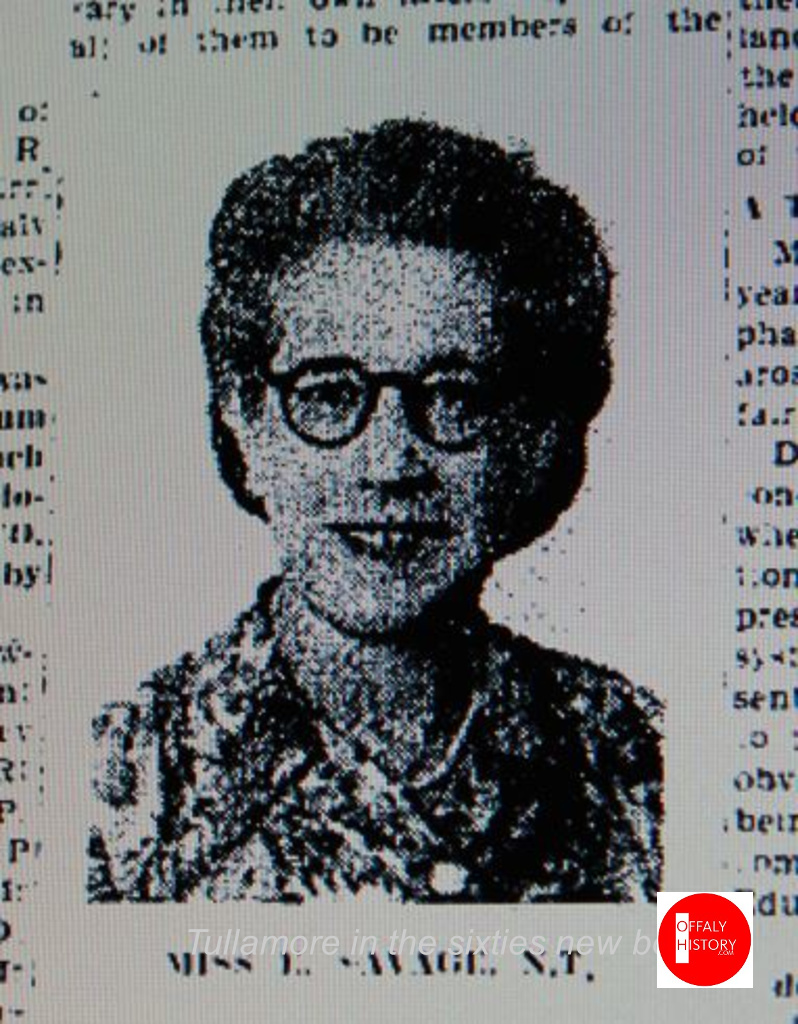
Miss Savage, a well-loved teacher in the Mercy primary school
Alan Mahon, as the grandson of an innovative cinema proprietor, recalls two cinemas in Tullamore whose cultural contribution is perhaps forgotten now but was all important to the people of Tullamore and district over a period of sixty or seventy years, if one takes it from the commencement of the Foresters cinema (later the Grand Central) in 1914.
Sport, so important to so many, brings us to the essay by Kevin Corrigan who looks at a formative decade leading on to the GAA Senior Football All-Ireland victories in the 1970s. Kevin had the challenging job of reducing to a short essay what could fill twenty books were one to address in detail each of the sporting activities that came to the forefront in the sixties.
Very soon now Tullamore will have a new Aldi Store at Tay Lane/O’Connell Street, Tullamore. This is the company’s second store in the town/The first was opened in 2000 at Cloncollog and preceded Tesco in 2004 (who once occupied the adjoining Tay Lane site and are near neighbours of Aldi at Cloncollog). Lidl and Dunnes already have two stores each in Tullamore and now Aldi will join this grouping with an investment in Tay Lane of close on €20 million when all expenses are taken into account.
Tea Lane (‘Tay’ Lane) is a popular old street name in Tullamore and most people seem to know that it was the area from the Al Conroy Printing Works (now again Stella Press under Brian Conroy) as far as the Offaly History Centre on the corner of Bury Quay and the former bonded warehouse (the Tullamore DEW Old Bonded Warehouse, 2000–20) and since December 2022 the Old Warehouse bar and restaurant (proprietor Shane Lowry). The name was in existence as early as 1821. The northern part of the lane was called the Old Fair Fields on a 1791 lease map. More changes are now in hand with the opening of a new Aldi store in late November 2024, following on the demolition of all the Irish Mist warehouses (erected from 1970 to 1985) and the great oats store of 1929. Irish Mist and Williams constituted the third layer. The first was that of long gardens from Patrick Street to almost the canal bank and before the canal (1801) the old fair fields. The second was the Williams buildings on these lands post 1897 and before their demolition for the new Irish Mist buildings of 1970-1985. Now Aldi will provide the fourth layer.
This handsome house was built in 1786 by Thomas Acres and is set well in from the street. The valuer of 1843 wrote: ‘This has always been considered the best house in Tullamore – it is well situate – extensive pleasure grounds in front and rear, and well walled garden.’[1] Acres Hall, the town hall since 1992, is a five-bay, two-storey house with a limestone ashlar façade. In this respect it bears comparison with the house of Dr Wilson of 1789 (now Farrellys) in High Street and was built at the same time.