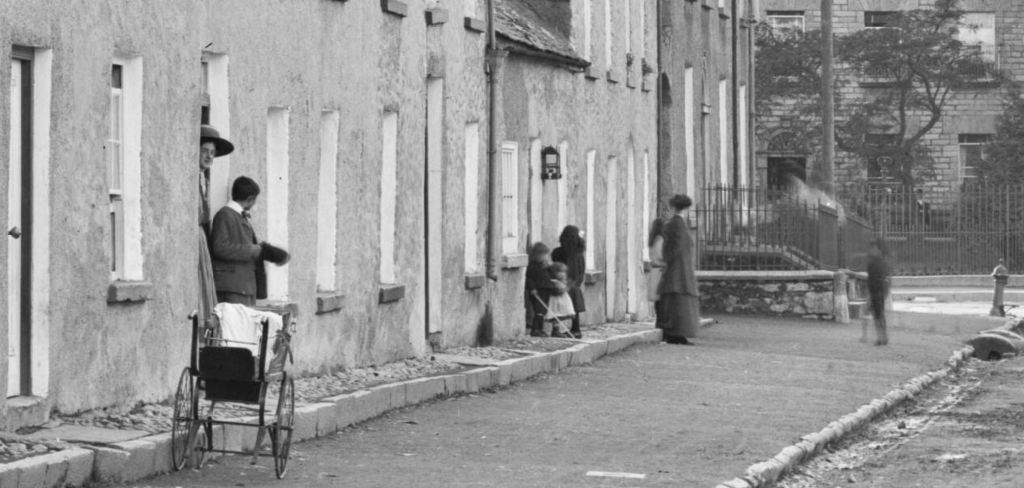
Last week we set out reasons why Cormac Street can be considered so good. Anybody getting off the train, visiting the town park or the courthouse cannot but be impressed. The street is very largely intact since it was built and has been enhanced by the town park. The restoration of the full Kilcruttin Hill beside the folly should be undertaken by the municipal council given its historic importance. Charleville/Cormac Street was the outer extremity of the town when building started here in the 1780s. Probably the Elmfield house (now the location of the Aras an Chontae) dates to 1795. Both Norris of that house and Acres of Acres Hall (dated to 1786) were functionaries of the young landlord’s family and both built on the road to the demesne. Bury came of age in June 1786 and so could regulate matters himself. While there were some cabins on Charleville Road these were temporary structures and aside from Elmfield no building leases were granted here until that to Daniel E. Williams in 1898. He completed Dew Park by 1900 and it was then regarded as the best house in Tullamore having taken that honour from Acres Hall. It reflected changing times with the demise and relative impoverishment of the Acres family and the growing importance of the new Catholic merchant class of Egan’s and Williams. While Williams had a virtual freehold in Dew Park lands the Egan family took a long lease from the Acres Pierce family of Acres Hall in 1891. The third big house that of Elmfield may well have earned the first-place honour but the Goodbodys sold this house in the 1880s and moved to Dublin. Richard Bull, the sub-sheriff moved in and departed after 1904 when the house was taken by Dr Kennedy who had moved from The Cottage in O’Moore Street.
Cormac Street is somewhat unique in the story of Tullamore Street development with its forty houses, two major institutional buildings, a folly and a town park. Rarely is a street preserved without blemish with so many elements over a two-hundred-year period. Cormac Street was also the home of the town’s major property developer and rentier Thomas Acres (d. 1836) who built his Acres Hall in 1786 (now the home of Tullamore Municipal Council). To the earl of Charleville and Thomas Acres is due most of the credit for the transformation of a green field site with Kilcruttin Hill and cemetery to the western side and the Windmill Hill to the east with the terraces in Cormac Street and O’Moore Street. Acres could thank the war with France, 1793–1815, for the boost to the local economy that provided him with tenants for the terrace of houses on the east side. The expansion of Tullamore after 1798 due to the Grand Canal connection with Dublin and the Shannon provided the impetus to secure a new county jail (1826–30), county town status in 1832 and to take effect in 1835 with the completion of the county courthouse. War, politics and pride of place all contributed to the mix. The Bury contribution was rounded off when Alfred (later the fifth earl) got a new railway station at Kilcruttin in place of that at Clonminch in about 1865. Alfred died in 1875 soon after he succeeded his nephew to the earldom.
As we conclude our series on O’Moore Street and move to Cormac Street it is opportune to look at the oldest terrace on the street but starting with No 1 O’Moore Street being Tullamore House, the home of the Bannon family. So many have lived here since that great house was built about 1800. We will go into more detail on this one as part of the Cormac Street series. For now let’s look at the terrace from no. 2 to no. 9 in the 1843-54 valuation records. The terrace was built in the years from say 1795 to 1805 with a few houses rebuilt in recent years.
The developer/rentier was Thomas Acres of nearby Acres Hall (now the Town Hall) and he was building on a nice lease for ever from the young landlord Charles William Bury of Charleville (Lord, Tullamore 1797 earl of Charleville 1806). It was a lease of the Windmill Plot from Victoria Terrace to the county courthouse.
O’Moore street, c 1910. Courtesy of National Library of Ireland At the two doors may be the O’Rourke and the Carroll families, nos 4 and 6.(more…)
The fourth head lease in O’Moore Street granted by the earls of Charleville, and the last of significance, was that to the Tullamore printer Richard Willis in 1838 for the construction of the seven houses in Victoria Terrace, O’Moore Street. The lease from the second Lord Charleville was for 99 years from 25 March 1838 at £21 per year or £3 ground rent for each house. The first earl died in 1835 and, his son, the profligate second earl, was determined to extract more money from his estate to fund his expensive lifestyle and political ambitions. No more sweetheart deals as was done by the first earl for Thomas Acres in the 1790s who developed part of O’Moore Street and most of Cormac Street. The lease of 100 years instead of three lives renewable for ever was a change of policy on the part of the second earl who was disgruntled at his father having virtually alienated or sold much of Tullamore town for small money, as he believed.
Richard Willis was in the printing business for over fifty years. A few of his publications survive in the RIA (Hardiman pamphlets) and Offaly Archives. He worked from what is now the Insurance offices of Gray Cunniffe Flaherty and had a lane of cabins to the rear that was closed by 1854.
The two big garages in O’Moore Street, Tullamore of Roberts Motor Works and Hurst were famous from the 1920s and 1930s. The Hurst boiler, in particular, will be remembered by patrons of Georgie Egan’s in Harbour Street where, as a pot-bellied iron stove, it heated that old pub, now gone. Hurst was the first to open in 1925 and was building on a tradition of engineering in the Killeigh/Geashill area that may owe its origins to the service of large farm machines for the fine farms in the parish of Geashill and Killeigh, by men such as George Matthews in the 1900s. Matthews came to farms with his threshing equipment much as farm machinery services are provided today. The Roberts family was probably that connected with serious prize-winning gardening at Charleville back in the 1880s. The Motor Works garage was opened in the mid-1930s in the former Presbyterian manse after the departure of Revd Mr Humphreys.
Why mention the garages now with both long closed. We do so to illustrate how lack of planning in the 1750s still impacts on street development in O’Moore Street 275 years later. That said the first earl of Charleville (d. 1764) was concentrating on the main road from Charleville Gate to High Street and Pound Street (now Columcille St). The old church was in Church Street and the Crofton House at the junction with the Killeigh Road (now O’Moore Street) was the first in view from the demesne entrance on the avenue left of the main gate. The earl’s grand nephew successor, when he came of age in 1786, started working on making the demesne more picturesque and employed Leggatt (see IGS jn. no 26 (2023) in the late 1780s and J.C. Loudon in 1811 as the castle was nearing completion. Loudon is said to have laid out Bachelors Walk as an attractive drive to the new church at Hop Hill, then in progress and completed in 1815.
The Cottage in O’Moore Street, Tullamore is one of the few examples in Offaly of cottage ornée architecture. This was an architectural style that may have begun with Walpole’s Strawberry Hill, built over the period from 1749 to the 1770s. One of the best-known examples in Ireland is the Swiss Cottage in Cahir. These cottages were built by the well-off to play at rusticity and, as with this house, have carefully hidden its actual size and its impressive garden. The Cottage was built about 1809 and is one of three or four fine houses in the street, the best being Moore Hall and Tullamore House at the junction with Cormac Street.
This is the story of eight new houses built by Tullamore Urban District Council in 1923 in what is now John Dillon Street. Turning into the street from Charleville Road, the first eight houses on the right were built as part of the Provisional Government’s £1 million scheme launch in 1922 in the midst of the Civil War. Opposite them are houses built by the Irish Soldiers and Sailors Land Trust for veterans of World War I. The eight houses may only have made a small dent in Tullamore’s chronically bad housing conditions in the early 20th century, but the circumstances surrounding when and how they were built provide some valuable insights into the history of the town and the country in these turbulent years.
The line of the Grand canal to Philipstown and Tullamore is the only navigation through this county, and is material advantage to the district, through which it passes. Levels have been taken, and the line laid out for a further extension of this canal to the Shannon, with off branches to Birr and other towns, which is not yet put into execution.
The terminus of the line from Dublin to the Shannon was Tullamore for the years 1798 to 1804 when the link with the Shannon was at last completed. In the 1790s a line to Kilcormac and Birr was considered but on the grounds of expense that along the Brosna was selected.
[175] Ballicowan village is the estate of the [176] Earl of Mountrath, and here are the ruins of a castle, which gives name to the barony. Turf fuel is in plenty, and had on the cheapest terms. . .
Ballycowan castle c. 1958, it took its present configuration in 1626 and was destroyed by the Cromwellians in the early 1650s with the Cootes succeeding to the estate forfeited by the Herberts.
Tullamore is the market for grain, and indeed the produce of many adjoining baronies is sent thither, there being the fairest sale and a good demand amongst the buyers, occasioned principally on account of the many stores, which were established by the Grand Canal extending here, and which divides this barony for some distance. This proves the value of inland navigation and gives the farmer in these distant parts the advantage (as we may say), of bringing Dublin market home to his door.
Thursday May 19th 1938 was a big day in Tullamore. The occasion was the opening of 146 new houses on O’Molloy Street and the opening of a new outdoor Swimming Pool by the Tánaiste and Minister of Local Government and Public Health Mr. Sean T. O’Kelly. By Damien Byrne
The local newspapers of the day describe the town as being “profusely decorated with flags and bunting” with O’Molloy Street being “richly festooned with the Tricolour being strongly in evidence”.
The Tánaiste on his arrival at Tullamore, at 12:15 p.m., passed through a guard of honour of Civic Guards, drawn up outside Hayes Hotel. He was met at the door of the hotel by the members of the Council and public officials, and proceeded at once through Patrick St., Kilbride St., and Clara Bridge, where his arrival at O’Molloy Street was awaited by many clergy of all denominations and representatives of the laity. Along the route large numbers of people had gathered, and the Tánaiste smilingly bowed his acknowledgements of their greetings.
This article looks at the north Offaly towns featured in Major (later general) Vallancey’s report carried out in 1771 and designed to support the construction of the new Grand Canal line to Tullamore and the Shannon. Vallancey was then a young engineer, employed to report to the Commissioners of Inland Navigation and his findings were published in, AReport on the Grand Canal or Southern Line (Dublin 1771).[1] This report is useful as a window on some of the north King’s County (hereafter generally referred to as Offaly) towns and villages.[2]