
The two big garages in O’Moore Street, Tullamore of Roberts Motor Works and Hurst were famous from the 1920s and 1930s. The Hurst boiler, in particular, will be remembered by patrons of Georgie Egan’s in Harbour Street where, as a pot-bellied iron stove, it heated that old pub, now gone. Hurst was the first to open in 1925 and was building on a tradition of engineering in the Killeigh/Geashill area that may owe its origins to the service of large farm machines for the fine farms in the parish of Geashill and Killeigh, by men such as George Matthews in the 1900s. Matthews came to farms with his threshing equipment much as farm machinery services are provided today. The Roberts family was probably that connected with serious prize-winning gardening at Charleville back in the 1880s. The Motor Works garage was opened in the mid-1930s in the former Presbyterian manse after the departure of Revd Mr Humphreys.
Why mention the garages now with both long closed. We do so to illustrate how lack of planning in the 1750s still impacts on street development in O’Moore Street 275 years later. That said the first earl of Charleville (d. 1764) was concentrating on the main road from Charleville Gate to High Street and Pound Street (now Columcille St). The old church was in Church Street and the Crofton House at the junction with the Killeigh Road (now O’Moore Street) was the first in view from the demesne entrance on the avenue left of the main gate. The earl’s grand nephew successor, when he came of age in 1786, started working on making the demesne more picturesque and employed Leggatt (see IGS jn. no 26 (2023) in the late 1780s and J.C. Loudon in 1811 as the castle was nearing completion. Loudon is said to have laid out Bachelors Walk as an attractive drive to the new church at Hop Hill, then in progress and completed in 1815.
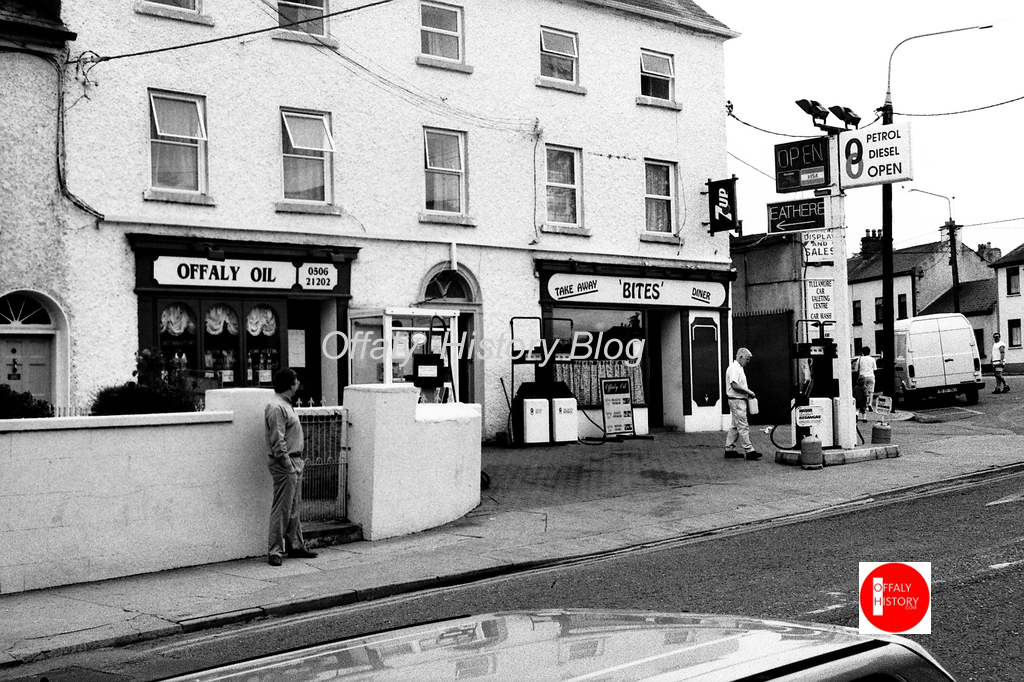
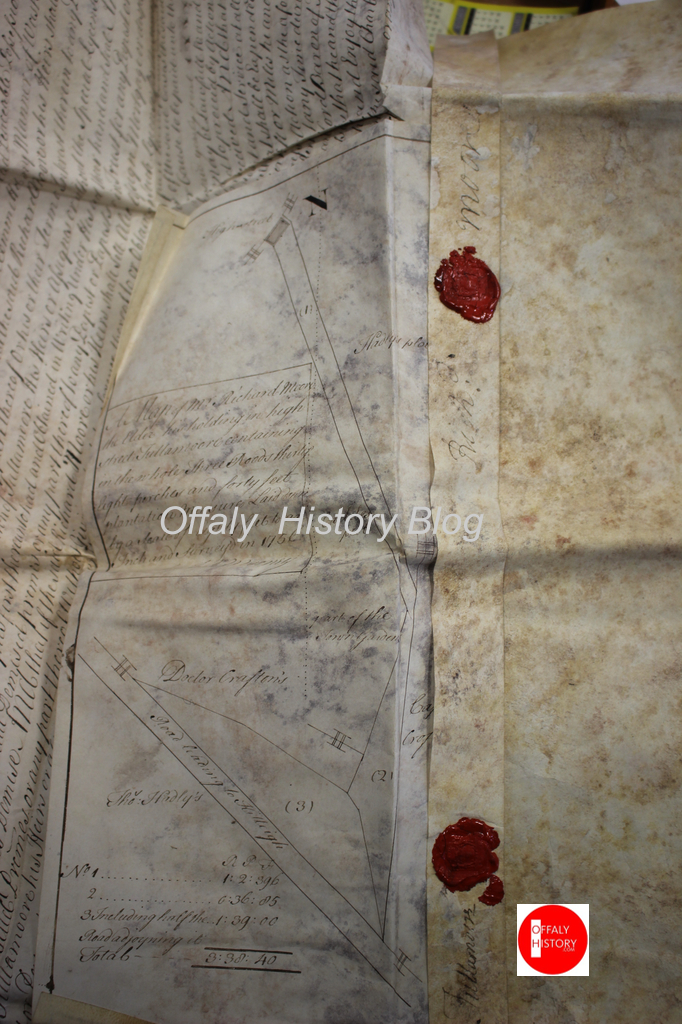
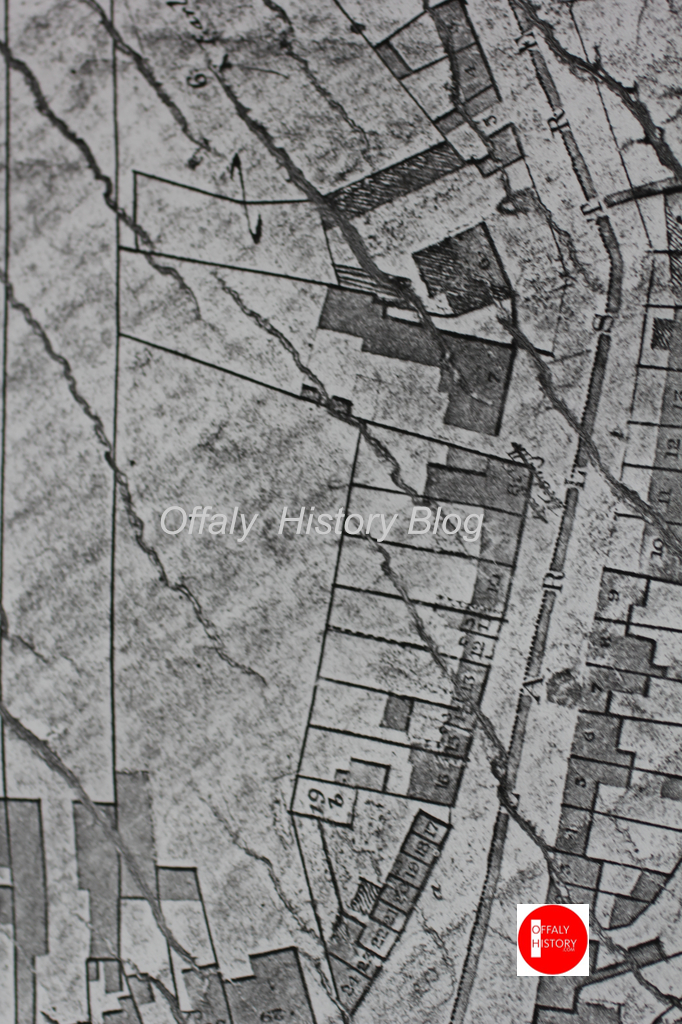
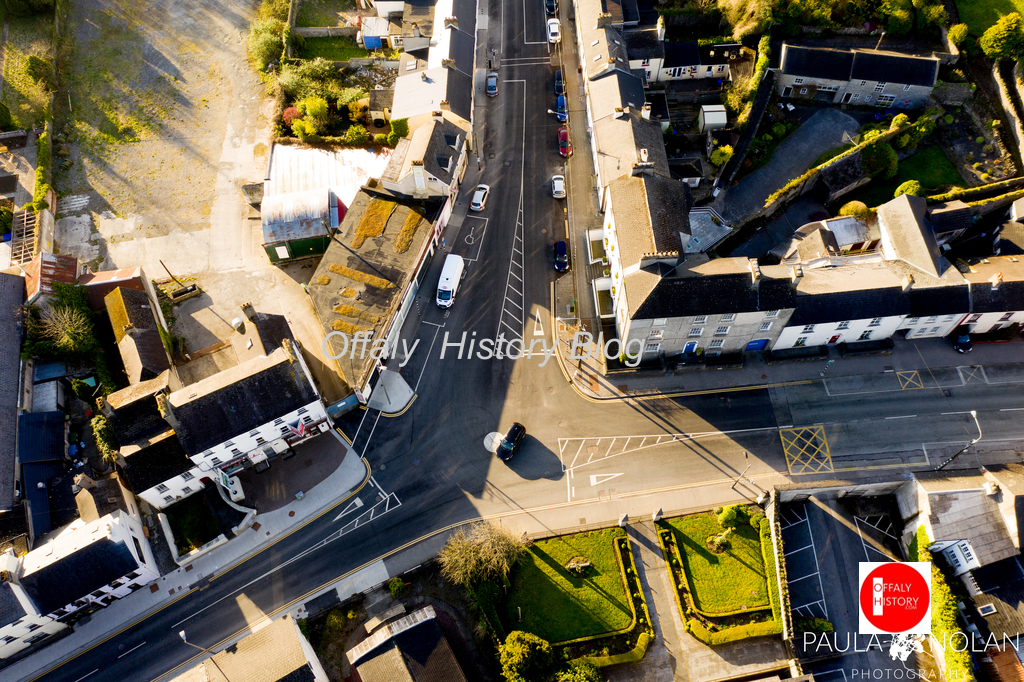
We mentioned in previous articles the legacy of the two great large-garden leases at either end of O’Moore Street on the north side. The leases, from the first earl of Charleville (d. 1764, owner of the town of Tullamore) go back to 1756 (Hurst) and 1758 (Motor Works) and were connected with significant leases for Moore (1756, Hurst 1920s) and Dr Crofton (1758, Roberts 1930s). Both holdings had long gardens to the Killeigh road verging on the countryside in the 1750s to 1800s period. Both fronts to the Killeigh Road or Windmill/Earl/O’Moore Street took all of the street on the northern side, but with house nos GV 6 and 7 built on the Crofton leasehold together with over 10 cabins or poorish houses from the corner with High Street and extending to the Cottage. And as to Hurst from the pair of houses east of Moore Hall to the entrance to the Colaiste Choilm school, itself built on the park of what was the Williams’ house up to 1951 when bought by the Christian Brothers (the house is now that of Farrellys).
The Hurst garage site was comprised of a haggard in the 1920s and had been a site for about ten cabins cleared after the Famine and before the valuation of 1854. The Roberts (Motor Works) shops were built on the site of old houses dating back to the 1800s and to west of what is now Tyrrell’s shop and of which Parker’s was the best known (15 to 24 Earl Street).
In an article on the Hurst garage published almost sixty years the virtues of hard work were strongly emphasized. Something that was popular with the ‘I paid my own way’ generation. The writer of the article/puff in 1967 wrote as follows:
Imagine standing on the roadside and looking in at a haggard, a bleak and desolate piece of land, turn your thoughts to what can be made out of such a place and you will immediately see that in order to put it into any kind of shape at all needs quite an amount of thinking, planning, and most important of all, a willingness to work hard and overcome all the inevitable obstacle
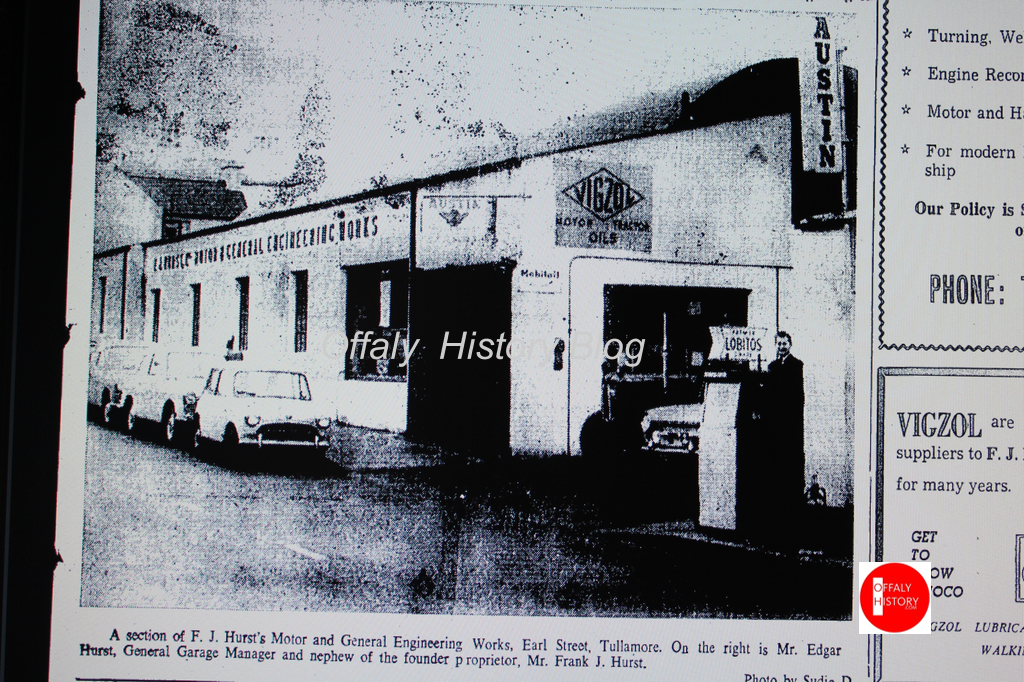
The son of a Killeigh farmer had such an experience just 42 years ago [1925] as he glanced from Earl St., Tullamore, in across what once was a farm haggard. He saw prospects for this place and immediately set about transforming that desolate area into what has now become not alone an ordinary motor garage, but a most imposing structure with offices, stores, repair sheds and showrooms. It wasn’t an easy job, but this man, whose father at one time worked seven threshing machines and who, before he started this work, had spent some time in England building steam rollers had a most vital attribute – the will to work and succeed.
FROM SMALL BEGININNING
The man in question is, of course, Frank Hurst, proprietor of the Hurst Motor Works in Earl St., Tullamore.
From a small beginning on a Killeigh farm, Mr. Hurst has progressed by leaps and bounds to an establishment that has to be seen to be believed. Aided initially by his two brothers, Harry and George, who later emigrated to Canada, where they are both in the engineering line, he overcame all possible obstacles and indeed they were many, and built up what has now become one of the most up-to-date and popular garages throughout the Midlands, and even farther afield. He is main dealer for Austin, Wolseley and Nuffield tractors and his spacious showrooms bear witness to this with models of all shapes, sizes and prices, displaced with taste and efficiency.
Total staff employed numbers in the region of forty. Edgar Hurst, nephew of the founder is general garage manager, while the engineering works manager, George Wynne, has been with the firm for thirty years. Peter Cronly is the garage works manager and he has given unfailing service to this establishment for the past 28 years. Another man who was there right from the beginning, Jim Plunkett, is still there giving the service that his experience and dedication have taught him. With such long-serving employees, it is little wonder that such a high standard of workmanship has been maintained down the years and nothing is left undune to ensure the utmost satisfaction of the customers. Two other men who play an important role in the running of the business are Billy Mitchell, stores manager, and Maurice Fitzsimons, the office manager.
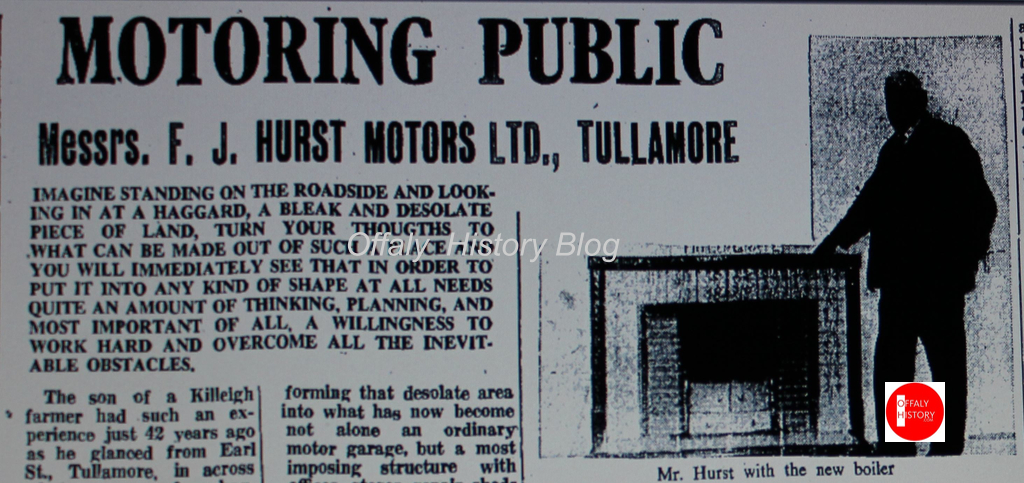
The ‘F.J.H. patented, fuel and oil central heating boiler’ [This is the back boiler in the tiled fireplaces of the 1960s to 1980s with brass surrounds and wooden lintel. The pot-bellied stove was fine for commercial settings until made popular by Jotul and others.]
But let’s turn back to the man who started it all. Strangely enough, while his association with the business has been the keenest imaginable, it is not so much in the actual motoring end of things that he is concerned with, but rather the engineering side and particularly with a ‘baby’ he has created in the form of a central heating boiler. The ‘F.J.H. patented, fuel and oil central heating boiler’ is, to say the least of it, a work of art. It has taken long years of toil and thought to bring it to its present position, and it can now be seen in a showroom, beautifully designed and ready to work. This boiler heats fifteen radiators and he has another one, which is so convenient for modern homes that heats nine radiators and domestic water as well. For about 3/6 worth of briquettes, it will give all the heat and water necessary to last 10 to 12 hours. [presumably the price of a bale in 1967].
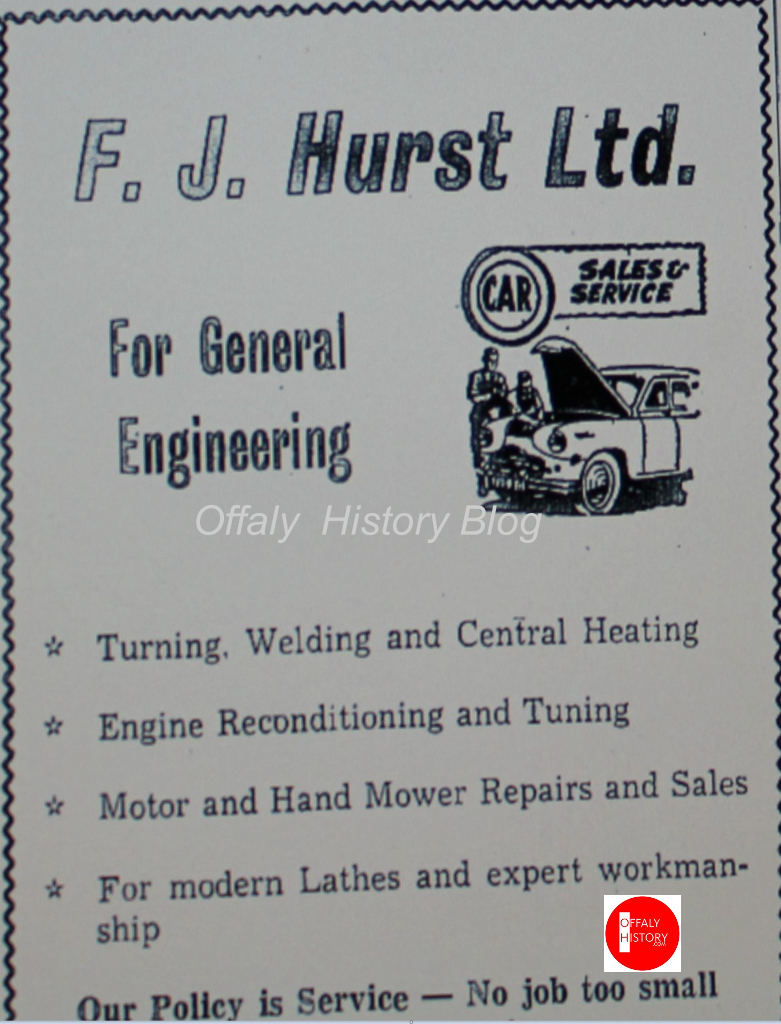
It’s all so interesting to hear Mr. Hurst demonstrate them and he will stress the fact time and time again, that it all took years of frustration and planning before the present standard was reached. He is only too willing to show them to prospective customers to anyone else who may be interested and also, he has received enquiries from all over Ireland and overseas.
In this ‘Buy Irish’ age, with so much stress of the purchase of home-made articles, here is a perfect, example of where true patriotism can be shown. Not alone is the purchaser, if he is local, buying Irish, he is also supporting a firm and an article made right in his own town. If we had more men with the drive and initiative of Mr. Hurst then we would have no fears for the future of our economy. As an employer he is an outstanding example of how to treat those under him. No job of work holds any fears for him and his friendly attitude to his employees plus his working example all add to make the Hurst motor ‘family’ a true family and a happy one.[1]
Next article: 6, Victoria Terrace and Furlong’s/Tullamore Court Hotel
Tullamore Walking Tours on 7 and 13 July
7 July, Sunday, from 2 30 p.m. at Bury bridge – 90 minutes. From Bury (Whitehall) to Cox’s (Clara bridge). A walking tour taking in the impact of the canal on the growth of Tullamore. We start at Whitehall bridge, Tullamore at 2 30 p.m. on Sunday 7 July We are providing teas and lemonade at Offaly History Centre after the walk. Everybody is welcome. You do not have to be a member. Your guide is Michael Byrne
13 July, Saturday, 10 30 a.m. O’Moore Street and Cormac Street, Tullamore – 90 minutes. A morning walk. This is a follow on from the walks in O’Connor Square and High Street last year. We are currently publishing blog articles on this (see our website www.offalyhistory.com for all the blog articles). Thanks to the Heritage Council for its support. The tour is free and all are welcome to attend. We meet at the carpark in the town park opposite the courthouse and start the conversation outside the town hall and opposite what was Windmill Hill. You do not have to book and the walk is free of charge. Everybody is welcome. Your guide is Michael Byrne
[1] Offaly Independent, 29 April 1967

 offalyhistoryblog