Would you like to know more about public sculptures in Birr and Offaly? Who commissioned them and what do they tell us? Author, Architect and Town Planner Fergal McCabe will focus on the sculptures in and around Birr town, The Maid of Erin, The Column in Emmet Square, the Hurler, the third Earl and the Tullamore Road entrance piece ‘Looking to the Future’ with some other examples from the county. He will be joined by photographer Paul Moore who documented the sculptures in 2023 and he will talk about his experience of how the images were photographed and the story behind each sculpture. This illustrated talk will be on Monday 15 January 2024 at 8 p.m. in County Arms Hotel, Birr. Signed copies of the new book Faithful Images will be available on the night for €20.00. All are welcome.
For those who believe that the setting of public art is the key to its artistic success or failure, Birr offers five of the very best examples.
The square proper never had a public house until that in GV 5 in recent times, while the Brewery Tap on the western side at GV 3 High Street has served the public for well over 100 years. It was only in 2018 that a new public house and night club was opened at GV 5, now known as The Phoenix. The great garage of G.N. Walshe (GV 1 High Street) replaced the Goodbody hardware store which was in business from the 1840s to 1930 and with a tobacco factory at the rear until 1886.
The publications below are available from Offaly History’s history shop at Bury Quay, Tullamore beside the Old Warehouse restaurant, online 24/7, and open Mon to Fri 9 to 4. 30. We are also in Bridge Centre from 14th to 24 Dec. as in previous years. We look forward to seeing you. All our work is to promote Offaly History on a selfless basis. All the publications below are from authors pro bono, pro deo, pro condado.
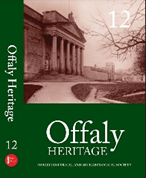
Offaly History is delighted to produce another volume of Offaly Heritage which is the twelfth collections of essays and writings on the history of the Faithful County’. The essays in section one reflect the ongoing research in Offaly into aspects of life in Ireland 100 years ago as we come to the end of the Decade of Commemoration (1912-1923). The essays reflect the changing nature of society in Offaly at that time, particularly during the years 1920 to 1923 and readers will enjoy contributions as varied as they end of the Wakely family of Rhode; the final years of the Leinster Regiment at Birr; the Protestant minority in Offaly during the revolutionary period; the courts of assize in King’s County in the years 1914-21; the burning of Tullamore courthouse, jail and barracks in 1922; the story of Belgian refugees in Portarlington, and Offaly claimants in 1916. A series of short lives are presented in this volume, as they were in Offaly 11 and includes entries on individuals as diverse as J.L. Stirling, Averil Deverell. Middleton Biddulph; Robert Hames Goodbody and volunteer Sean Barry. This volume of Offaly Heritage is also strengthened by a wide array of essays on aspects of Offaly history stretching from Colmcille to early soccer activity in Offaly in the late nineteenth century. The editors are particularly pleased to include essays from a number of contributors for the first time. The compilation of writings on Offaly history topics continues in this volume. The volume concludes with information on the Offaly Historical and Archaeological Society, the county’s heritage office and reviews of recent books of Offaly interest.
Over a series of articles, it is intended to examine the evolution of the ‘market place’, Tullamore to the fine square it is today. It is intended to look first at the evolution of the square over the period from 1713 to 1820 with additional comments on the building history in the last 300 years in the second article. This will be followed with analysis of the return for the 1901 and 1911 censuses and thereafter case studies of two of the houses in the square. Both are public houses, the Brewery Tap and The Phoenix, and business is conducted in the original houses albeit that both have been extended. Both are well known with the Brewery Tap one of the oldest pubs in Tullamore and The Phoenix the newest. The Brewery Tap house can be dated to 1713 and The Phoenix as a house to 1752.
Standing at the bridge in Bridge Street and looking south towards the Windmill hill at Cormac Street is to observe 300 years of development comprised of three and two-storey houses and no single-storey properties or ‘cabins’. The latter were reserved for the lanes, side streets and long gardens to the rear of these large houses. When Arthur Young passed through Tullamore in 1770 he remarked that part of the town was well built. We have already looked at the intended first class development of Crow/Tara Street in an earlier article. T.W. Freeman, the geographer, noted in his 1948 article on Tullamore that there was firm ground on either side of the inconspicuous bridge and a slight rise northward to the canal, 203ft. above O.D., some ten feet higher than the river, and southwards to the courthouse, at 225ft. O.D. Near to the bridge on the west side was the town watermill drawing on the power from the Tullamore or Maiden River and at the high ground behind O’Moore Street and Cormac Street was a windmill dating from the early 1700s. One hundred years later the building of the street was almost completed.
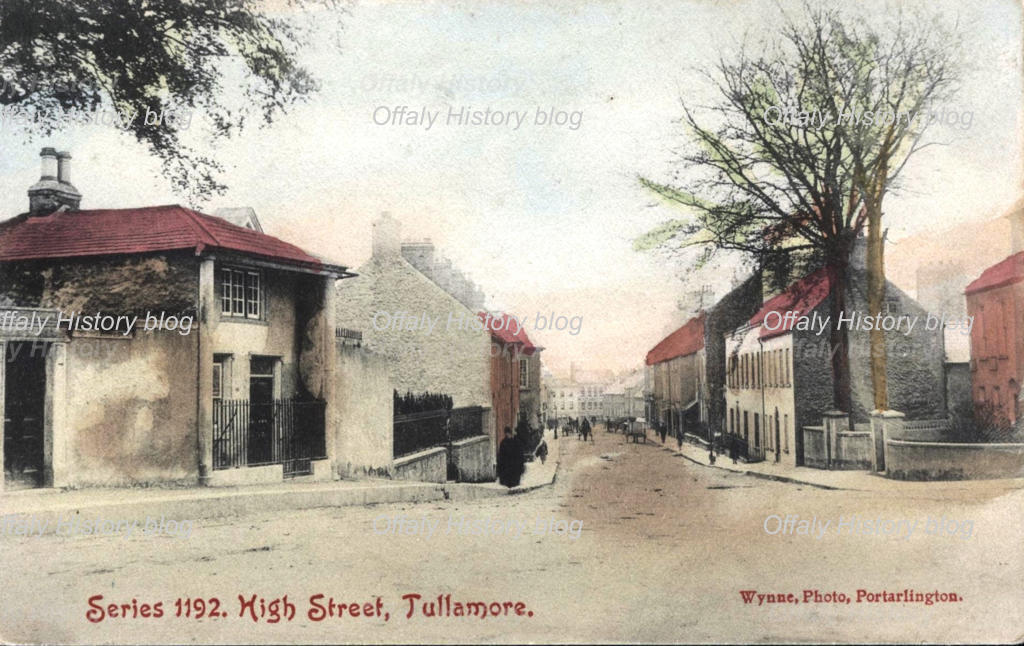
High Street in 1821 contained eighty-four houses and 543 inhabitants. As almost all the houses were built before 1821 and there were only forty-two in 1901 this would suggest that this calculation includes the houses in Bridge Street and sub-divided properties.
In 1901 High Street with a population of 225had forty inhabited and two uninhabited houses and forty-one families of whom 158 were Roman Catholic, 50 were C of I, 4 Presbyterians and thirteen Methodists. The houses were all slated and stone-walled, twenty-six were placed in the first division and fourteen in the second. As to out buildings there were nineteen stables, five coach houses, three harness rooms, two cow houses, one calf house, one piggery and five fowl houses.