
The fourth head lease in O’Moore Street granted by the earls of Charleville, and the last of significance, was that to the Tullamore printer Richard Willis in 1838 for the construction of the seven houses in Victoria Terrace, O’Moore Street. The lease from the second Lord Charleville was for 99 years from 25 March 1838 at £21 per year or £3 ground rent for each house. The first earl died in 1835 and, his son, the profligate second earl, was determined to extract more money from his estate to fund his expensive lifestyle and political ambitions. No more sweetheart deals as was done by the first earl for Thomas Acres in the 1790s who developed part of O’Moore Street and most of Cormac Street. The lease of 100 years instead of three lives renewable for ever was a change of policy on the part of the second earl who was disgruntled at his father having virtually alienated or sold much of Tullamore town for small money, as he believed.
Richard Willis was in the printing business for over fifty years. A few of his publications survive in the RIA (Hardiman pamphlets) and Offaly Archives. He worked from what is now the Insurance offices of Gray Cunniffe Flaherty and had a lane of cabins to the rear that was closed by 1854.
Willis also built the ambitious Victoria Terrace in O’Moore Street and was in the property letting business. Mr Willis and the then town clerk, Robert English, were the subject of an anonymous letter sent to The Irish Times in 1864 on the matter of good landlords and rent abatement. Something that was fashionable from 2007 but not in 2024. The writer was supposedly Katty Doolin with an address in Swaddling Lane (later Ruddock’s Lane and now Bride’s Lane, off Patrick Street). Robert English [possibly an ancestor of the late Billy and Cecil] was the Tullamore town clerk until 1872.
To the Editor of The Irish Times
13/03/1864
Swaddling Lane, Tullamore,
Sir- My attention has been drawn to an article in the Morning News, headed “Good landlords”, givin’ credit to Mr Richard Willis and Mr Robert English, of Tullamore, for makin’ an allowance of 15 per cent to their tenants in this neighbourhood.
Yer honor, whin I red this article, me sides almost split wid lafter, for I well now that neither of those gintilmin possessed as much land as “sod a lark”. Mr Englis is clark of petty sessions, has berried two wives, Lord rest their sowls in glory, and is lookin’ for a rich widdy in this town; the other, Mr Willis, on the rong side of sixty, is after a buxom widdy in Dublin- and both these gintilmin, for fare to show there gray whiskirs, are as close shaivin as a sally noggin. And I’m tould, yer hon-onour, that the widdys won’t have them now, as they’ve learnt that the gay Lothorios are becomin’ as wake as emasculated cats, as O’Connell used to say. If yo insert this yill hear from me agin, widdout dout – Yours – Katty Doolin.
Richard Willis died in September 1880 at the age of 82 and seems to have held the profit rent on the houses over his long life. In 1910 the rental was offered for sale reciting that the occupiers’ rent was on average £25 per year for each of the seven houses and showed a profit of £156 per annum.[1] A tidy sum in the nineteenth century and for current values multiply by 100 to 150. This plot was to the front of the street and was carved out of the ‘Windmill hill field’ which from the early 1800s was in the tenure of Tullamore miller, George Hamilton, for the remainder of three lives.[2] Hamilton was the successor to Barrett and his water mill was on the river at Barrack/Patrick Street. Most leases in Tullamore in the time of the earls of Charleville before 1836 were for three lives renewable forever for residential holdings and three lives and or 31 years for farms and town parks. The tenant or subtenant of a house site named three healthy lives for the lease duration and when the three were dead had to renew the lease and pay a fine of perhaps 50% of the annual rent and legal costs. From 1849 leaseholders could convert their three lives for ever lease to a freehold fee farm grant.
O’ Moore Street, Victoria Terrace – the Richard Willis estate
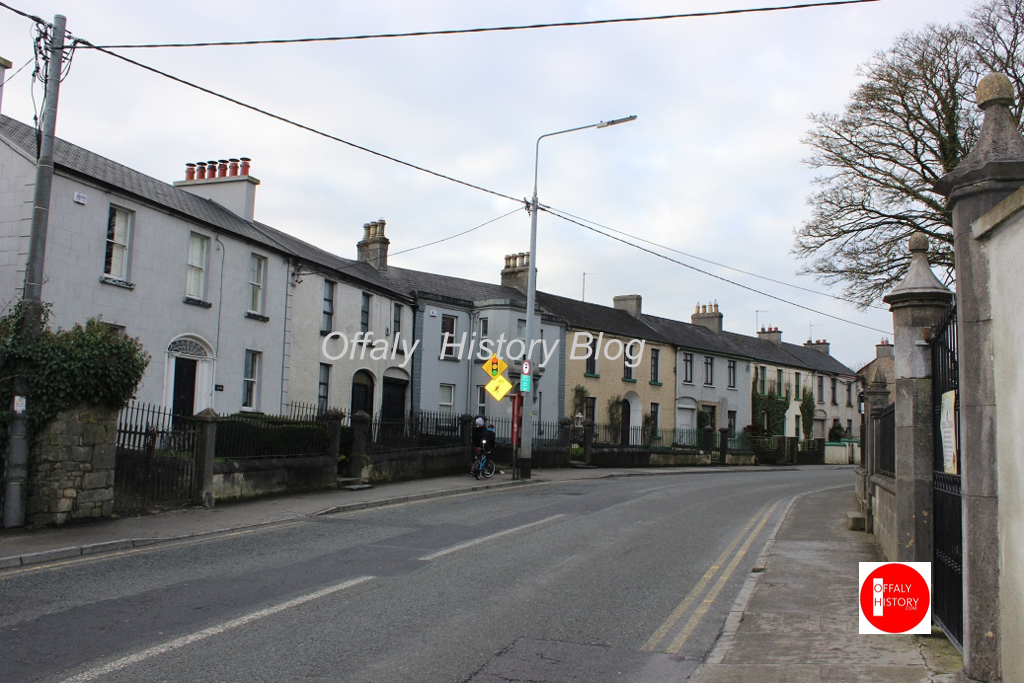
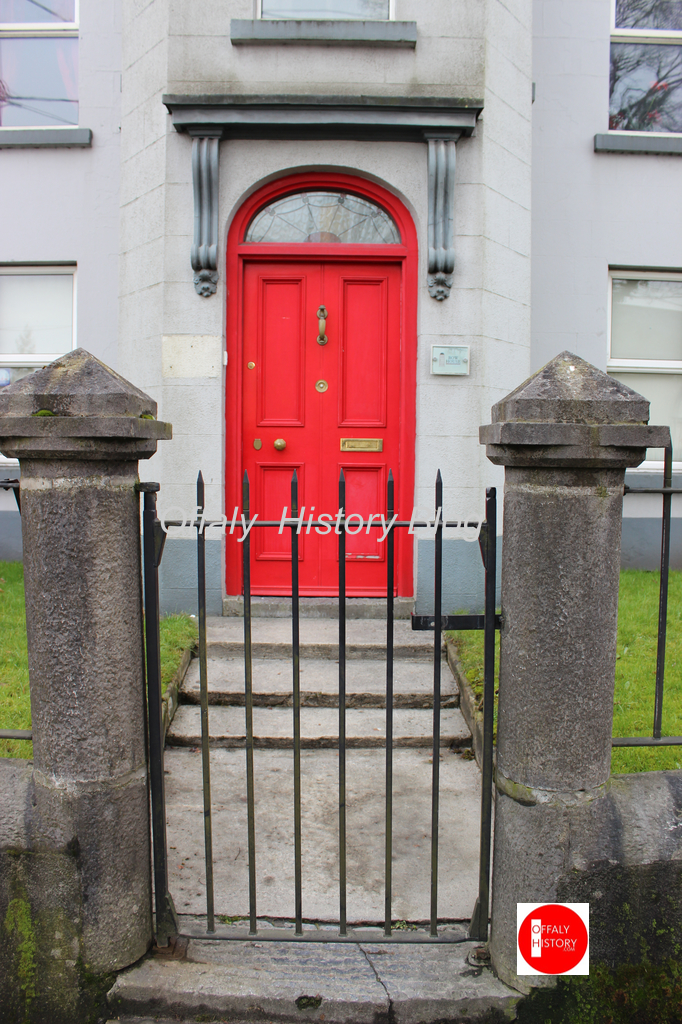
Willis gave similar leases of the houses, i.e three lives renewable for £14 each annual rent. This worked out at £3 per site perpetual rent and £11 profit rent to meet the building costs over perhaps a twenty-year spread. It will be noticed that one house has a full-height, half-octagon bow with a cornice supported by console brackets over the door. The end house, nearest the mid-1990s apartment block known as Furlong Grove, has a Doric door-case and wide elliptical-headed fanlight. The original railings and gate piers to some of these houses survive.
The terrace consists of seven two-storey three-bay houses, all having round-headed door-cases with the exception of two which were altered in the 1960s. The projecting two-storey porch of the fifth house (no. 14) is probably a later addition. Willis was the immediate lessor of all the houses in 1843. The houses had slightly varied frontages in the region of 25 feet to 32 feet with a uniform height of 16 feet and, as lately built, were given 1B+ status and valuations of £12 in 1843, reduced to £10 in 1844 and to £7 in the Griffith valuation of 1854.
No. 10 (484) O’Moore Street
1843 Robert Crosthwaite.
1854 Fredrick Forbes.
No. 11 (482) O’Moore Street
1843 John W Briscoe, attorney.[3]
1854 Commissioners of Public Works.
No. 12 (483) O’Moore Street
1843 William Crowthers, Revenue Officer.
1854 William Wilkinson.
No. 13 O’Moore Street
1843 Addison Low.
1854 Eliza Woods.
No. 14 O’Moore Street
1843 Mathew Bonham.
1854 William Lumley.
No. 15 O’Moore Street
1843 Robert Goodbody [the founding father who died in 1860]
1854 Vacant.
The upper part of the house was used as a Quaker meeting room in 1843 with Robert Goodbody as the tenant. Goodbody lived at 43 High Street at this time (now Donal Farrelly’s). The vacancy of 1854 reflects the fact that the house west of ‘The Cottage’, no. 8, had been adopted for use as a meeting house in 1852.[4]
No. 16 O’Moore Street
1843 Samuel Drought
1854 Same
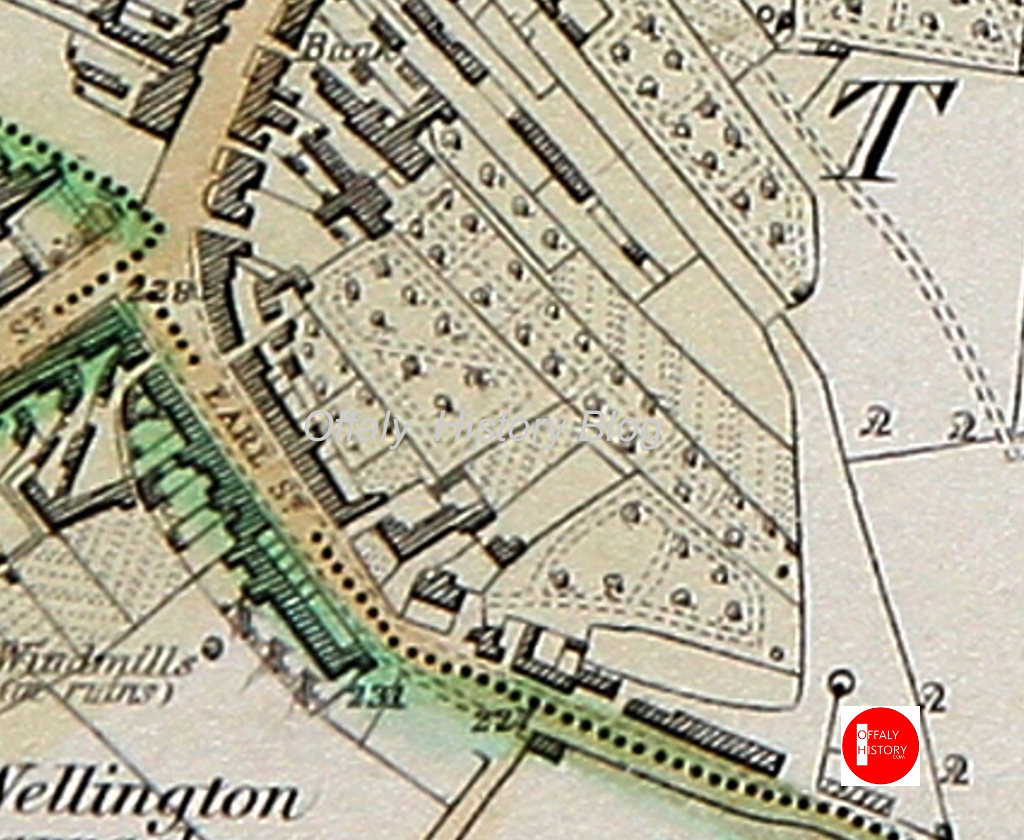
Summary with rents and description of buildings as to Q quality, LR leasehold rent, DF footage in front:
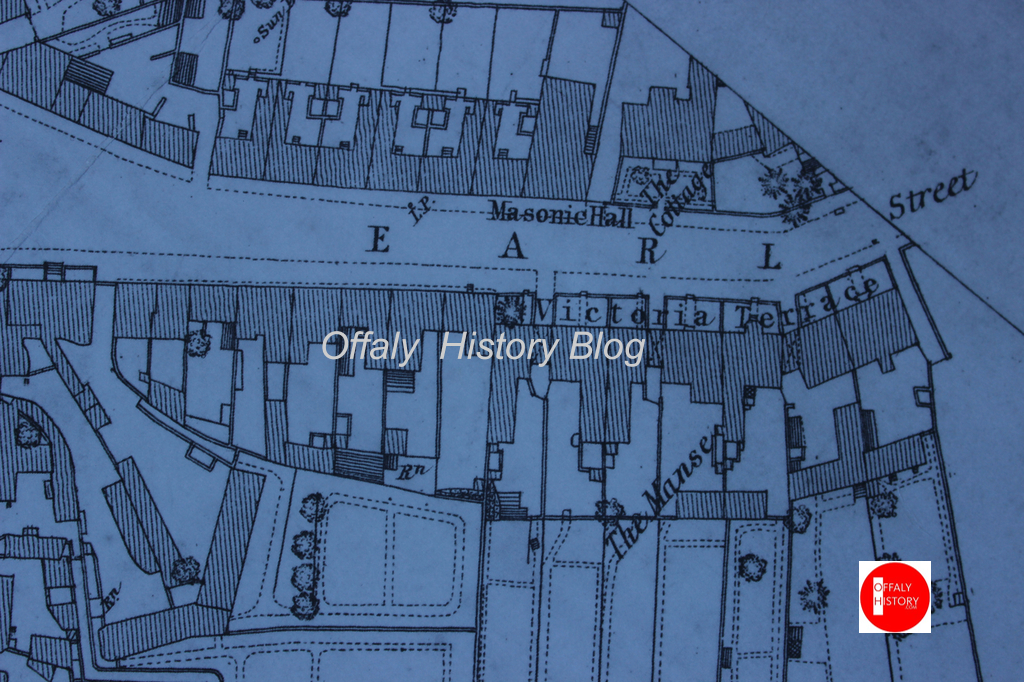
10. (484) [Fredrick Forbes] – [Willis]
Robert Crosthwaite
D.F.29.6, H.16.0, Q.L. 1B+ [1.B], Y.R.£12.0.0, L.R.(£)10.4.0
Crosthwaite holds from Mr Willis of Charleville Square –the premises are enclosed and in good repair
11. (482) {Commissioner of Public Works – G.V.P.V.}
[Vacant]
John W. Briscoe – attorney
D.F.27.0, H.16.0, Q.L. 1B+, Y.R.£12.0.0, L.R.(£10.4.0)
Briscoe holds from Mr Willis of Charleville Square – the premises are enclosed
and in good repair
12. (483) [William Wilkinson] [Willis]
William Crowthers – revenue officer
D.F.25.0, H.16.0, 1B+, Y.R.£12.0.0, L.R.(£10.4.0)

13. (484) [Eliza Woods – Willis]
Addison Low
D.F.29.0, H.16.0, 1B+, Y.R.£12.0.0, L.R.(£10.4.0)
Low holds from Mr Willis of Charleville Square.
14. (485) [William Lumley]
Mathew Bonham
D.F.29.0, H.16.0, 1B+, Y.R.£12.0.0, L.R.(£10.4.0)
Bonham holds from Willis – the premises are enclosed and in good repair.
15. (486) [Vacant]
Robert Goodbody
28.0, H.16.0, Y.R.£12.0.0, L.R.(£10.4.0
a Quaker meeting is held in the upper part of this house
16. (487) Samuel Drought
D.F.32, H.16.0, 1B+, Y.R.14.0, L.R.11.80.0
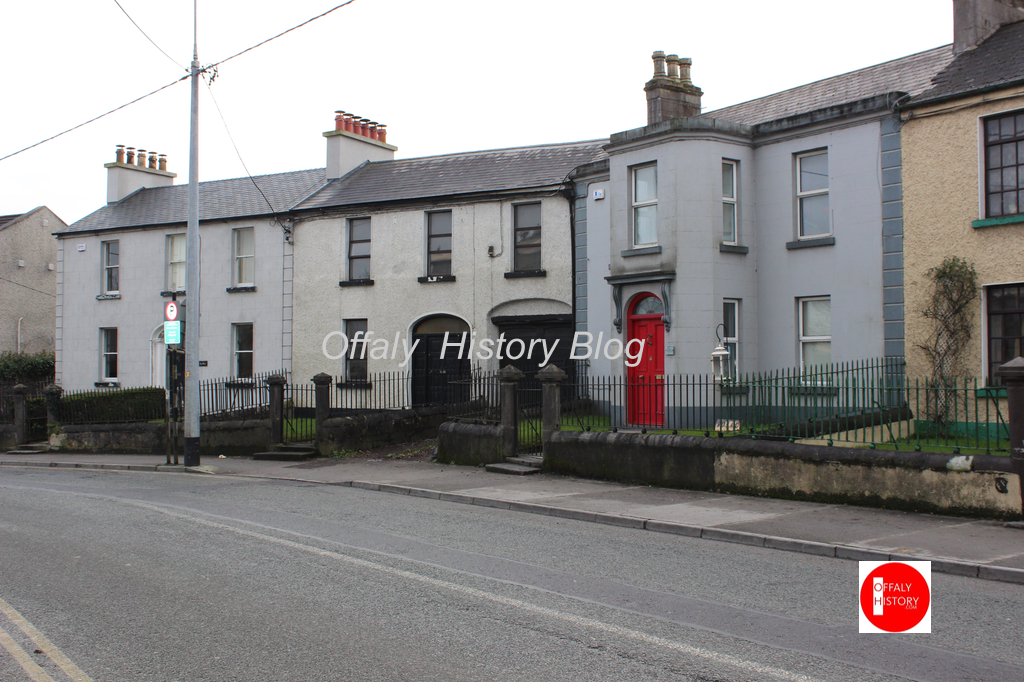
Occupiers in 1901
Victoria Terrace on the Willis estate in 1901 census – starting with no. 16 in 1854 GV i.e that nearest the Furlong Grove development of the 1990s.
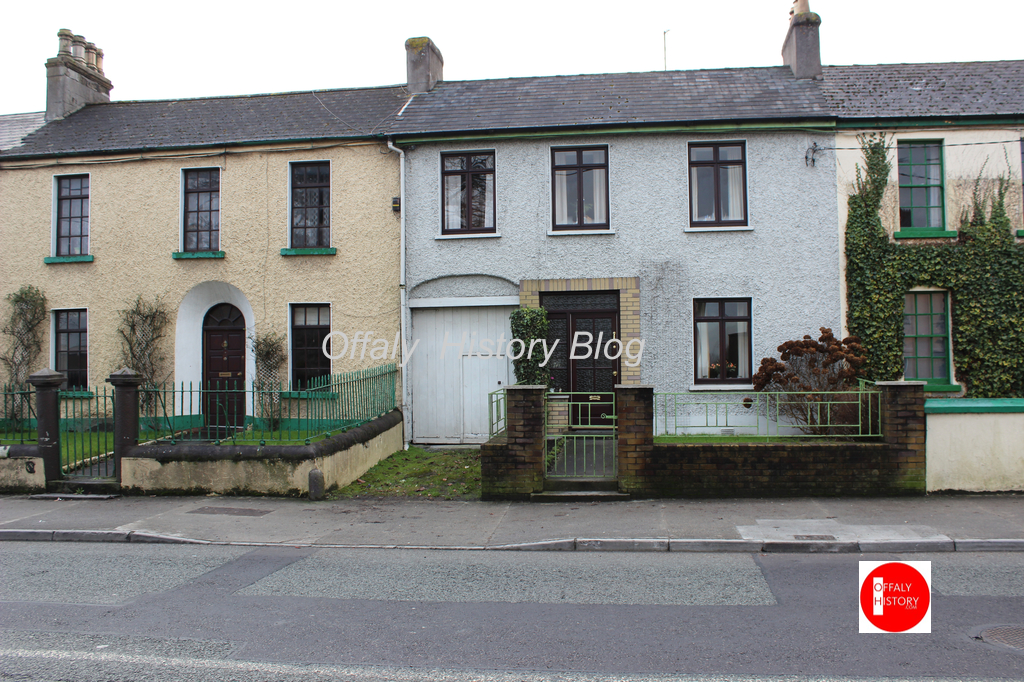
- James Rogers, from Knock, County Mayo, then a solicitor’s managing clerk with an apprenticeship pending, married, aged 27 to a Limerick-born woman of 36, both Roman Catholics, in a household of two. (Rogers was a well-known solicitor up to his death in the 1960s – see Byrne, Tullamore in 1916 and Legal Offaly.) Later T.V. Costello. A scullery ran along the back of the front dining and parlour rooms.
- Catherine Dann, the 99-year widowed Methodist heading up an all-female household of five, with her niece, two boarders and a Roman Catholic servant. [Of the Dann grain-handling family giving the name.]
- John Humphreys, the Tyrone-born Presbyterian clergyman, with four in his family, a Quaker lady housekeeper and a Roman Catholic domestic servant., first class category. Later he lived at 29 High Street.
- John Butler, the superannuated excise officer, with three sons and one servant, all Roman Catholic. (Humhreys was the local Presbyterian minister and with Rogers did a tremendous amount of work to advance technical education in Tullamore,)
- Hugh Thomas Love, the 32-year old sorting clerk and telegraphist, with his wife and daughter, all 3 Church of Ireland. (The family were in charge of the old post office pre 1900 post office in Tullamore for many years.)
- Thomas R. Dixon, the 25-year old English-born maltster. He was a Presbyterian and his wife Church of England. They lived with a sister-in-law and one Catholic servant. Dixon was a councillor from 1913 to 1918 and a maltster.
- James Mitchell, a 62-year old Church of Ireland farmer with a household of six including one boarder.
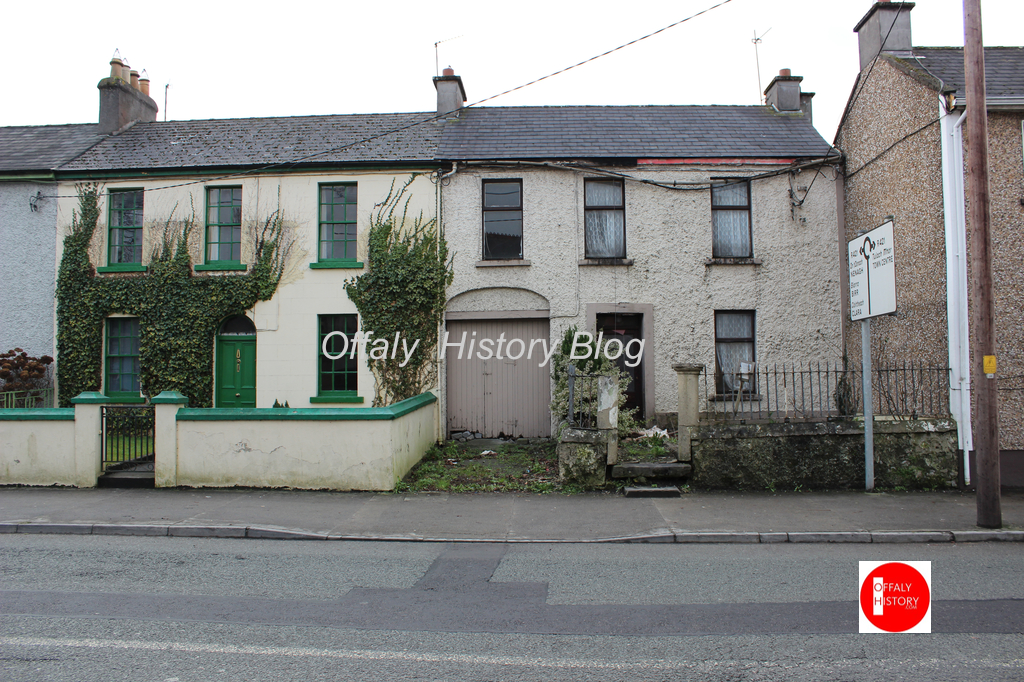
Victoria Terrace in 1911 census
- As in 1901 James Rogers (2)
- John F. Kavanagh (3), a national teacher from Kilkenny
- James T. Doody (9), a first-class officer, Customs and Excise and from Co. Limerick
- Margaret Lawler and private school, select academy (7), a maternity nurse
- Samuel R. Irvine (7), a Methodist shopman from Wicklow
- Patrick Smyth (10), a commercial clerk hardware and whiskey from Meath, aged 37 and [secretary to D.E. Williams Limited, died 1949]
- As in 1901 James Mitchell (6), now included a boarder, Alexander Hawthorne, a Methodist auctioneer
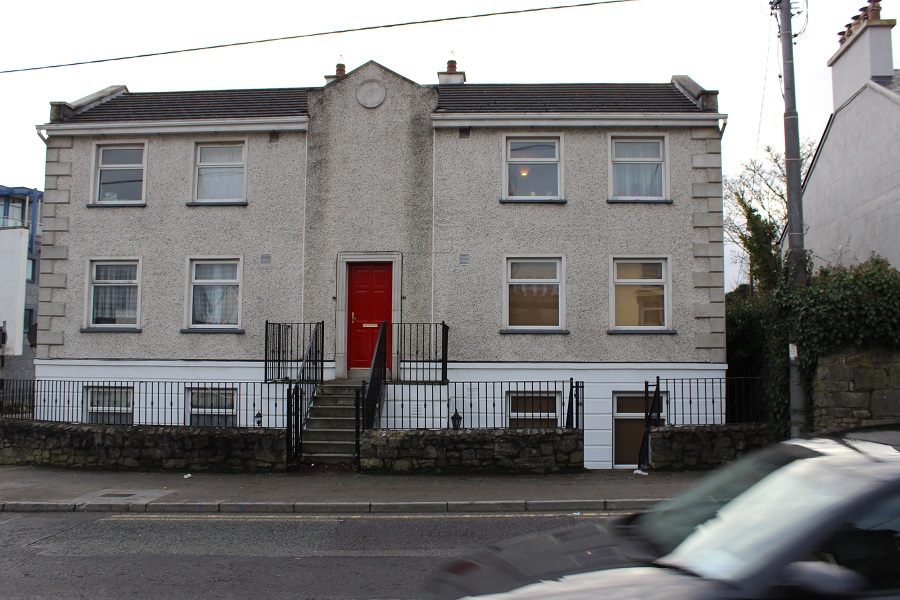
Furlong Grove apartments were the first block on this street
The 16 apartments here were erected by a Kildare firm, Reindeer Construction Limited, in 1996 and to a design of McCarthy O’Hora, architects. Part of the site had been used as a tennis court by the owner of Moore Hall, Dermot Williams, in the late 1940s. In 1950 James J. Smyth sold the site to Mary Kenny. On her death in 1994 the land was sold to Creative Properties Limited for £150,000 and the apartments completed.[5] Four of the apartments front O’Moore Street with the balance to the rear on the Spollanstown Road.
Furlong family
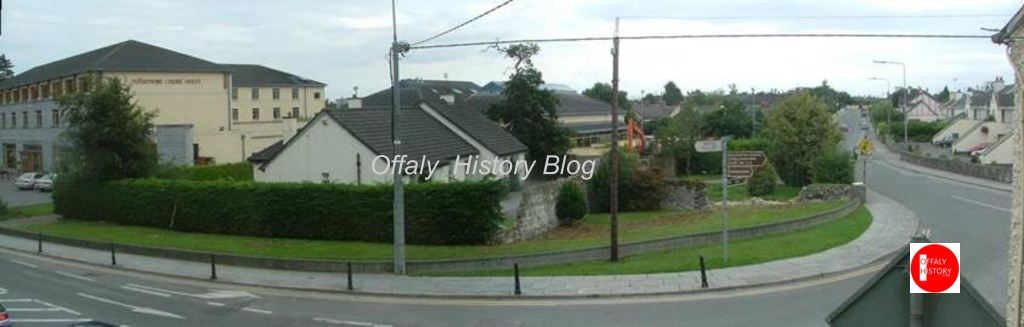
We can ignore the fifth lot of ground being the field where the hotel was built in 1997. This was part of the Clonminch house property up to the 1990s. A scheme of town council cottages was suggested for this location in the early 1900s but the then owners, Egans, offered the field where the O’Brien Street houses were built in lieu in 1912 and this was accepted by the council for 18 to 20 houses competed by 1914. This fifth field in the O’Moore Street mix had the Furlong cottage/house in the corner nearest Tullamore up to the building of the hotel in 1997. It then provided a site for the manager’s new house until it too was demolished by 2003–4, later to make way for the extension to the hotel.
The Furlong family home was demolished in 1995 as part of the development of the site of the Court Hotel on land acquired from the Mahon family of Clonminch House nearby. There had been a proposal in the early 1900s to build a council housing scheme here, but no houses were built in this area save at O’Brien Street in Spollanstown. The house here is shown on the 1838 map and was a single-storey house with a corrugated roof – almost certainly originally thatched. The last occupiers of the house were the well- known Furlong family who gave so much to Gaelic sport. The family name is preserved in some rooms in the Court Hotel and in the block of apartments across the road known as Furlong Grove. A sporting family history of the Furlongs was published in 2014.[6]
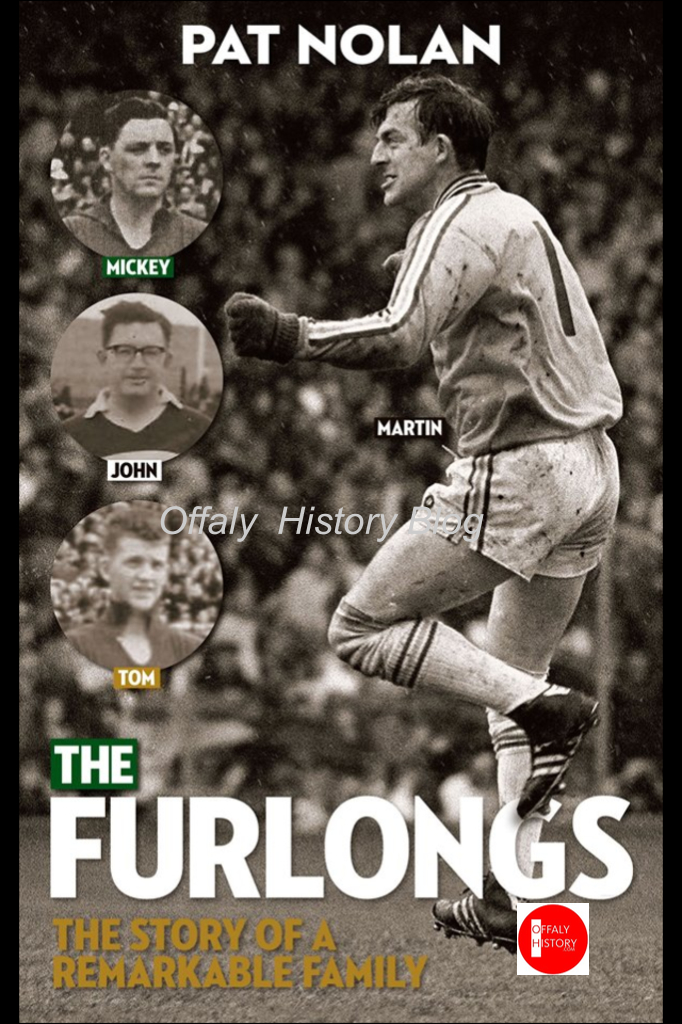
Pat Nolan wrote in a blog published by Offaly History in this series in 2021 wrote about Tom Furlong who came to Tullamore from Wexford via Cavan, in the late 1920s. It was a lifestyle that must have been that of many labouring men in Tullamore since the 1860s:
Tom Furlong knew how to work a farm better than he knew anything else. Moreover, he enjoyed it and had a flair for it, not to mention an appetite for hard work to match. He applied for the job and was hired by Frank Deegan, for whom he would work for several years to come.
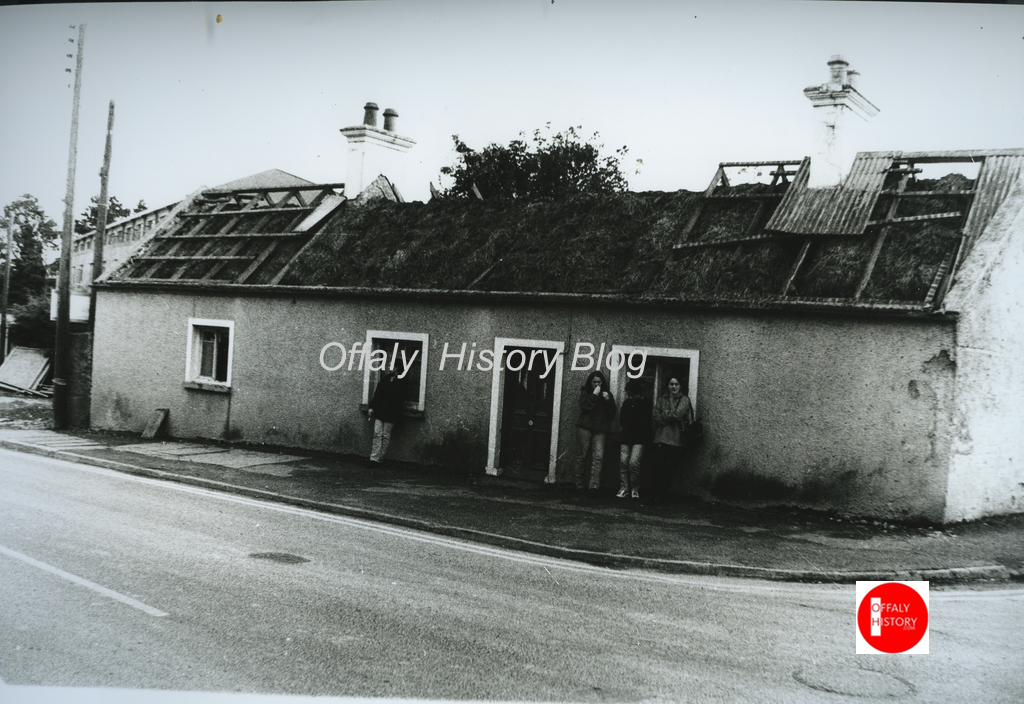
Margaret Furlong, Tom Furlong house at O’Moore Street shortly before demolition in the mid 1990s
Tom and Margaret initially took up residence in Puttaghaun on the north side of Tullamore before settling in a two-bedroomed house on O’Moore Street a few years later for an initial weekly rent of six shillings and sixpence a week (6/6d). It would remain the family home for 60 years from then on.
Tom didn’t spare himself in terms of workload. Margaret would make her way up to the Deegan farm in Clonminch with a bottle of tea and a sandwich for him in the middle of the day. He’d pull the horse in for a few minutes, feed up on whatever she had and set off about his work again. He rented a patch of land on Church Road and kept a few bullocks and cows and chickens and reared pigs as well as having an ass for working on the bog. His livestock were always well fed and sought after at the local mart.
This picture is of Michael with his sons. Front, left to right Jim, Michael and Tom Furlong. Back, left to right, John and Mick Furlong. Lurking at the right hand side of the picture are a young Martin Furlong and his aunt, Mary-Kate Moloney (his mother’s sister).er two pictures are from the 90th birthday of Michael Furlong, Martin’s grandfather. He lived to be 94.
Margaret didn’t leave her farming instincts behind her in Wexford either and picked up the slack while Tom worked during the day. When a sow was farrowing her motherly nature was always apparent, staying up at night rubbing her belly and making sure she didn’t smother the offspring. Her sons still remember her hauling buckets of slop that seemed like they would pull her arms from the sockets.
In later years, Tom worked in the building trade with a local man named Larry Young, as well as the Flanagans, while continuing his own relatively modest farming activity on the side. He never learned to drive and while working in construction was a regular sight around Tullamore, wheeling his tools and materials around town on a buggy from one job to the next.[7]
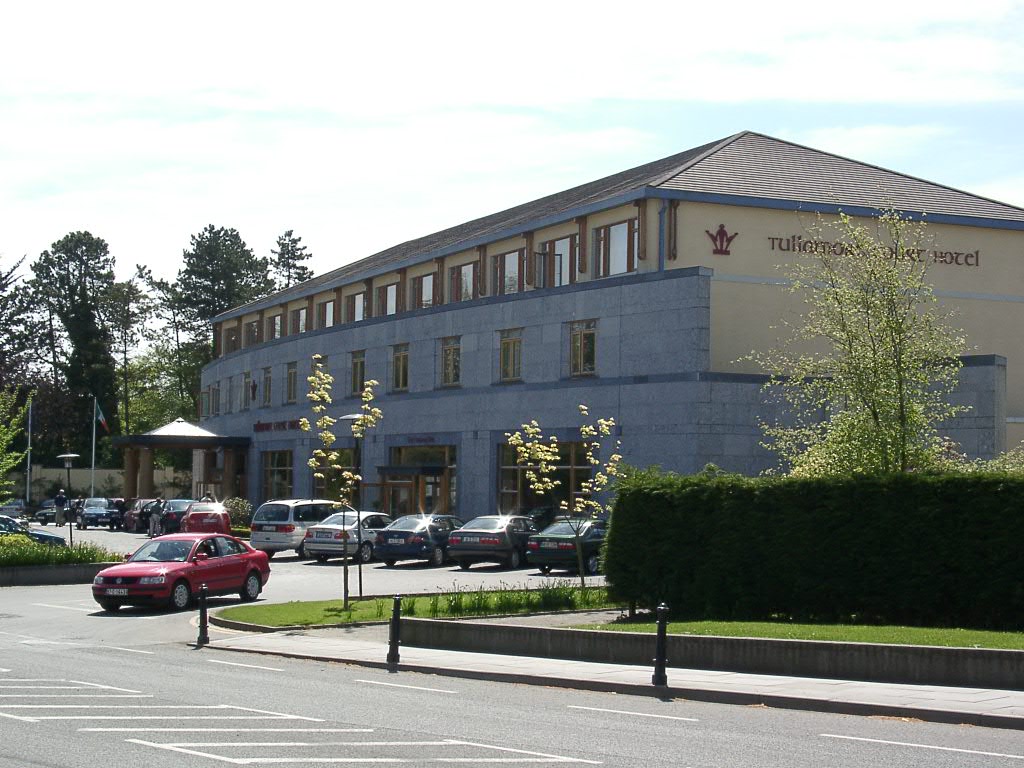
Tullamore Court Hotel
Tullamore Court Hotel opened to great acclaim in November 1997 – a project of the Flanagan Group it was officially opened by the then Taoiseach, Bertie Ahern, in January 1998.[8] The hotel was the first major hotel project in Tullamore in almost 200 years. Prior to the 1980s Tullamore depended on Hayes’ Hotel and Bolger’s hotel, but by the mid-1980s both had moved away from accommodation in favour of bar and entertainment facilities. For thirty years the Tullamore Chamber of Commerce had wanted a new hotel – a dream that was realised only in 1997. Few would have thought that within ten years Tullamore would have perhaps 250 beds available for visitors. Tullamore Court Hotel was built at a cost of £8m and in 1997 had 72-bedrooms with 6,000 sq. ft, a conference centre to seat 800 and a 20-metre swimming pool and leisure centre. Designed by Burke Kennedy Doyle the facility was built by the Flanagan Group taking advantage of the tax reliefs on capital investment then available. An additional 33 bedrooms and more conference rooms were added in 2007, together with extensive further conference facilities. Many of the great entrepreneur families of Tullamore are recalled in the names of the various suites in the hotel. The Irish Times recorded:[9].
Irish Times, 16/1/1998 -The first four-star hotel in the Midlands was officially opened by the Taoiseach in Tullamore, Co Offaly, yesterday. Mr Ahern said that the 72-bedroom Tullamore Court Hotel, which has been built at a cost of £8 million, enhanced the potential of the area to develop “a vibrant tourism industry”.
The hotel has been developed by the Flanagan Group, the building contractors and plant hire company, in its first venture into the hotel business.
Mr John Flanagan, the chairman of the group, said the investment in a four-star facility brought a new level of entertainment and service to the Midlands, which would be important for its business and tourism profile.
The hotel complex, located on the town’s Portlaoise road, includes a 6,000 sq ft conference centre, which seats 800 people, and a 20-metre swimming pool and leisure centre which will be open to the public from next Monday.
Mr Ahern cited the hotel’s contribution to the tourism growth in the Midlands and said that local attractions such as Clonmacnoise, Birr Castle, Locke’s Distillery in Kilbeggan, the River Shannon and Slieve Bloom provided “a tremendous variety of activity”.
He added: “I know that local representatives and local enterprise and business groups are determined to ensure that the Midlands lay claim to their share of that developing market.”
He said that the Genealogical Research Centre for Laois and Offaly, which is situated in Tullamore, would act as a magnet for families who came from the area.
The Tullamore Court Hotel, he added, would be central to the success of efforts to build up the tourism industry “creating more employment and more prosperity for the entire area”.
Mr Flanagan said that local limestone materials had been used in building the hotel which was designed by architects, Burke Kennedy Doyle. He said that there had been a good response from the community to the hotel and its 120-seat restaurant over the Christmas period following the opening of the premises in November.
Mr Flanagan started his business in the 1940s. His son, John, who is also a director of the company, said: “We are onto a winner. The market is there. We have a good product and we are looking forward to the future.”
[1] Westmeath Independent, 12 November 1910; see also in Offaly History: index to Tullamore Church of Ireland burials and Charleville rental.
[2] See note on Charleville leaseholders’ map of 1869 in Offaly Archives.
[3] Briscoe practised in Tullamore in the 1840s – see Byrne, Legal Offaly, 302.
[4] See MS valuation, Tullamore, 1843, property no. 486;
[5] See Book of Title to Furlong Grove.
[6] See the blog
[9] Irish Times, 16/1/1998 –

[7] Offaly History Blog, 17 July 2021: ‘Tom Furlong of Wexford and Tullamore: saved by the Truce from a British noose. Furlong was the father of a great GAA dynasty.’ By Pat Nolan
[8] TT, 24/1/1998.
 offalyhistoryblog