
PROJECT 2040
Many may find it hard to believe, but Ireland has a pretty good planning structure and system.
Some years ago we embarked on an exercise of estimating where as a nation- indeed as an island – we should be going. How many people would we need to cater for, where would they live, how would they get around and what about climate change?
The outcome was Project 2040 which set out a broad overall framework and most importantly had a dedicated budget to deliver it. Its national vision is now filtering down through regional planning, to county planning, then to more detailed statutory plans for the cities and finally for the more important towns.
As a ‘Key Town’, Tullamore has a particular role to play and, in anticipation of an additional population projection of 1 million persons in the State by 2040, is presently making its own contribution by upping its housing projections to provide for an additional c. 2,000 houses and identifying an ambitious new employment and enterprise zone with direct access to the national road network.
THE URBAN REGENERATION AND DEVELOPMENT FUND
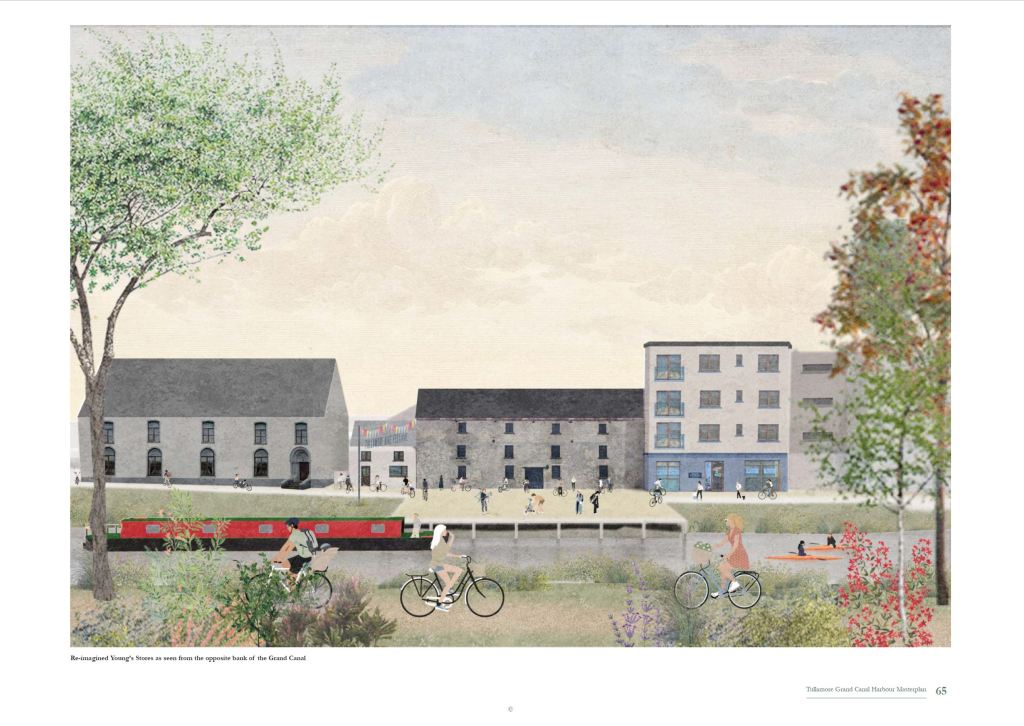
A central plank of Project 2040 is the improvement of the centres of our cities and towns which in recent years have been characterised by depopulation and a lack of investment often resulting in vacancy and decay . The main driver for bringing back life and attractiveness to these is the Urban Regeneration and Development Fund (URDF).
Administered by the Department of Housing, Local Government and Heritage, the Fund supports public sector-led regeneration in the cities and the key towns. Funding is delivered through two programmes:
- Capital Grants: For major urban renewal and infrastructural projects, the Exchequer provides up to 75% of the costs, while the remaining 25% must be matched by local authorities or other public/private sources.
- Revolving Funds: For tackling vacancy or dereliction, the Department provides funding to local authorities to acquire and renovate properties. When these are sold on, the proceeds go back into the fund to keep the initiative running.
TULLAMORE AND URDF
As a ‘Key Town’ Tullamore has benefited from funding under this programme and investment focussed on improving its historic core.
The first round funded the Tullamore Street Enhancement Scheme which delivered a pedestrianised O’Connor Square, the new Millenium Square, street tree planting and well designed shaded seating spaces. (illus.) These have had a transformative impact on the quality of life in the town centre.

In 2021 a second funding round identified a further six projects.
Provide a new street linking High Street to the Tanyard Lane
Historically, traffic on the Tanyard Lane has come through a narrow gap and crosses the busy O’Connor Square to get to High Street. The extension of the Lane directly westwards to avoid the dog-leg and make a direct link to High Street has been an objective of successive Tullamore Town Development Plans.
Following the public consultation process required by Part 8 of the Planning Regulations, the road was approved and constructed in 2025. Its opening facilitated the creation of a 67 space surface car park which more than compensated for the 30 spaces removed to accommodate the pedestrianisation of the northern side of O’Connor Square.
Provide a plan to guide the future of the Grand Canal Harbour
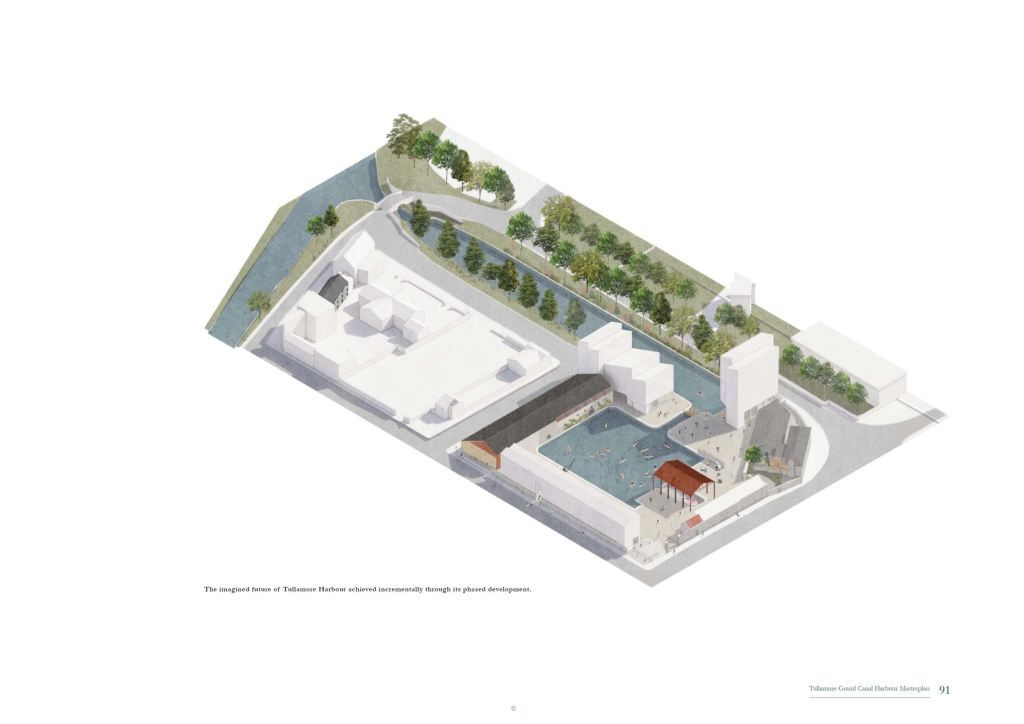
Surrounded by high walls, for two hundred and thirty years the Grand Canal Harbour has been invisible and inaccessible. Its redevelopment and integration with the town centre has been an objective of every Development Plan since 1967.
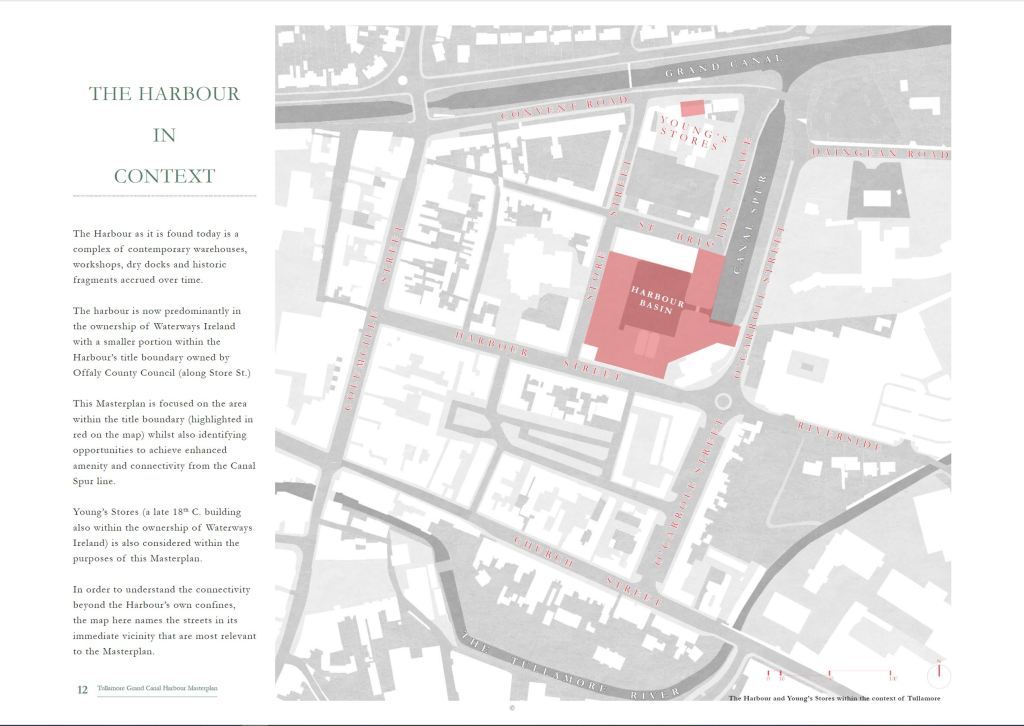
Grafton Architects were commissioned by its joint owners, Waterways Ireland and Offaly County Council, to consider how to unlock its potential as a place to live, work, visit and relax. Their Masterplan was delivered in June 2024.
The next step was to be the establishment of a Working Group to prioritise opportunities for development, identify related funding pathways and optimum development and operating models. Its establishment is still awaited.
Presumably the relocation of Waterways Ireland’s maintenance depot to its new facility at Cappincur (which was scheduled for June 2026) will be the catalyst.
Provide a public realm, regeneration & renewal framework for the town centre.
This Regeneration Framework Plan (RFP) was delivered in June 2024..
Prepared by an experienced team of planning and architectural consultants, the RFP makes sketch proposals for the development of seven key opportunity sites. These plans are well considered but two sites in particular may present difficulties.
Distillery Yard/ Patrick Street/Kilbride Street.
A proposal in 2022 for a substantial residential development on these lands was welcomed by many including the Tullamore Chamber of Commerce. However, An Bord Pleanala turned it down due to the height of the thirteen storey block in which most of the apartments were to be provided.
Though no height or streetscape study for central Tullamore has ever been revealed, both Offaly County Council and the Bord felt that the high block when viewed from Patrick, Colmcille, Harbour and Kilbride Streets as well as from High Street and along the Grand Canal, would represent an incongruous addition to the streetscape of Tullamore.
Meanwhile the RFP has suggested that a range of three storey buildings would be a more appropriate height for any new developments.
The conflict between these two visions of the future of a key central site needs to be resolved.
Former Coens Site, Church Road
In May 2021 An Bord Pleanala granted permission for an extensive retail development on these lands but no work has commenced and it would appear that the permission has now lapsed.
The RFP suggests that the site should now be the location for a substantial residential development with only an ancillary backland commercial element. However, the Members of Offaly County Council have resolved that these lands are an integral part of the retail core of the town centre and should be reserved entirely for large-scale shopping.
This dilemma will need to be resolved also before any new proposals can proceed.
Other Sites
Four other sites including the backlands of O’Connor Square, the car park and adjoining lands at O’Neills Place, the Council’s extensive site beside the Courthouse at Cormac Street/ Spollanstown and those on either side of the railway and adjoining the Station were earmarked for a mixture of residential and enterprise uses and outline layouts suggested..
However, no applications for their redevelopment have yet been made,
Landscape the setting of Acres Folly and permit public access.

The Protected Structure of Acres Folly stands on the wooded rise of Kilcrutten Hill and overlooks the town. It is an eye-catching feature for visitors arriving by train.
The restoration of the Folly in 2022 was promoted by the Historic Structures and Creative Ireland Fund. Its replastering in white lime mortar enhanced its prominence as a local landmark. Unfortunately that pristine appearance is now beginning to fade. (illus.).
On foot of URDF funding and approved plans, the public would be able to access the site and ascend the restored internal staircase to a viewing platform. Landscaping works would improve the Folly’s setting and provide ten car parking spaces behind the southern boundary wall and hidden from public view.
In 2023 the Council removed part of the eastern side of Kilcrutten Hill to provide twenty prominent parking spaces for its own staff. The Folly and its grounds are closed to the public.
Develop Meath Lane as a key pedestrian route.
The reopening of the historic lane was first suggested in the 1986 Tullamore Town Plan .
The recently published Tullamore Transportation and Framework Plans suggests that in the longer term Meath Lane will be part of a pedestrian route linking High Street to New Main Street across Millennium Bridge .
The development of the Esker Art Centre has delivered the first stage of the route and its design and landscaping are very attractive and enticing but it is not open to the public. (illus.).

Its continuation to High Street is presumably dependent on the present redevelopment of the former ’Copper Pot’ public house. This project, which contains an attractive range of apartments facing onto the lane and a sensitive conservation of the High Street frontage, would appear to be close to completion.
Hopefully the pedestrian link to High Street will arrive along with the opening of this project.
Link O’Connor Square to Church Street via an Urban Garden, Civic Space and Remote Working Hub
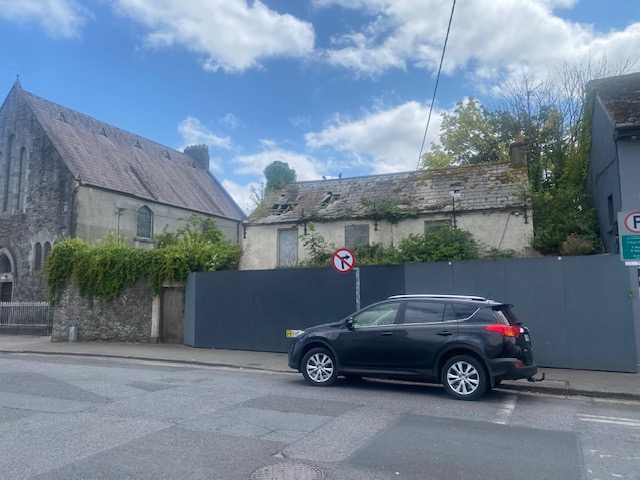
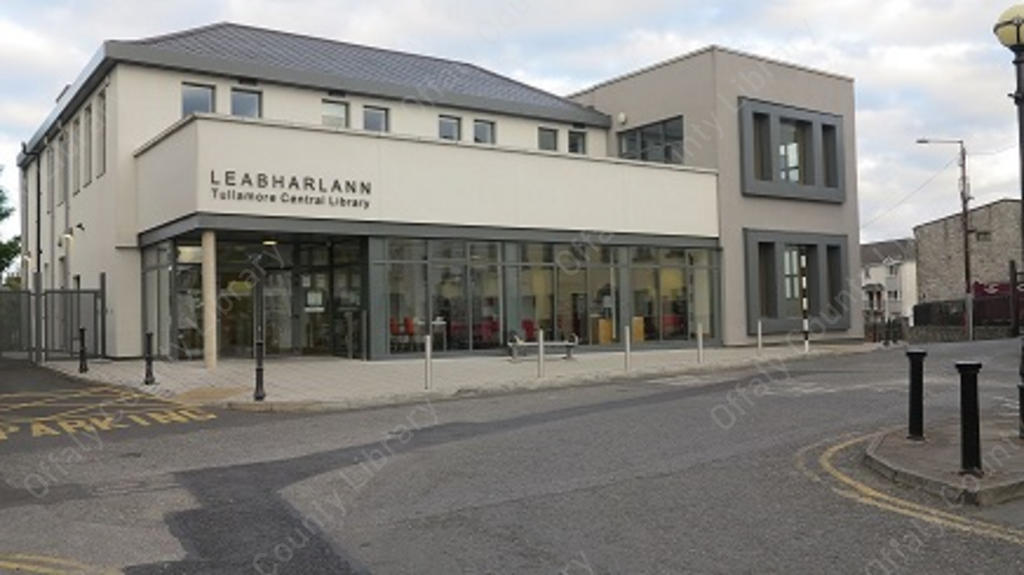
A cut stone bridge of indeterminate age spans the Tullamore River at the rear of the County Library. Colloquially called ‘The Hidden Bridge’ it is a Protected Structure and is in the ownership of the Council which has also acquired a prominent derelict building (illus.) which presents an eyesore on the Church Street frontage.
The pedestrianisation of the northern side of O’Connor Square and the linkage of O’Connor Square with Market Square were conceived in 2004 as unified projects whose intention was to promote the renewal and redevelopment of the eastern side of the town centre. The O’Connor Square leg of the project was opened in 2021.

In September 2023 Tobin Consulting Engineers were commissioned to design a public realm project titled the ‘O’Connor Square to Church Street link, Urban Garden, Civic Space and Remote Working Hub.’ Their report has yet to be published.
The consultancy firm DBFL was also commissioned to carry out a comprehensive plan for future traffic movements in Tullamore with an emphasis on shifting the balance of trips away from cars and more towards cycling and walking. It might have been expected that the long anticipated pedestrian link between O’Connor Square and Church Street would be a central feature of their plan.
However, their recently published Tullamore Transport Plan describes the project as ‘O’Connor Square to Church Street link, Urban Garden and Remote Working Hub – Provides a visual link between O’Connor Square and Market Square via a disused bridge over the Tullamore River…..Construction commenced in 2024′.

In addition the DBFL report, while outlining a comprehensive scheme of walking routes around the town, does not appear to show any physical link across ‘The Hidden Bridge’. It is unclear what works commenced in 2024.
The reference to a ‘visual’ rather than a ‘physical’ link might suggest that for whatever reasons, the bridge is no longer intended to be a pedestrian through route and, while there may be a garden on it, it might not be accessible to the public. However, omitting the link across the river would diminish the opportunity to encourage walking created by the pedestrianisation of O’Connor Square and reduce the renewal potential of the eastern side of the town centre.
A Part 8 application describing the nature, extent and timing of the proposed O’Connor Square/Church Street link would clarify these doubts.
TODAY AND TOMORROW
While the first tranche of URDF money delivered significant tangible improvements in the centre of the town, the second round has not been as fruitful.
The only physical project to be delivered is a new road (without a cycle lane) and thirty additional surface car parking spaces. In the short term at least, it is hard to reconcile these with the designation of Tullamore as a Decarbonising Zone.
The two outline planning schemes produced enticing visions for the future but have no statutory backing and so far no concrete results have emerged from them. The three other schemes appear to have stalled.
Presumably, in the fullness of time all of these long-awaited projects will be completed in one form or another and a new series of initiatives to further improve the attractiveness of the town centre will be identified.
They might include a modest first phase of the development of the increasingly busy Railway Station as a public transportation hub; particularly if it included a more attractive presentation of its entrance. Possibly the regeneration of the Harbour should be realistically recognised as a long term project and a small scale dockside public park actually delivered at an early date. The conservation and public use of a prominent building of architectural merit such as the Town Hall or Charleville Estate Office would add to the prestige of the town..
However such projects can only emerge through the statutory planning process in which public consultation is the bedrock.
The recently adopted 2024 Planning Act will change the lifetime of Development Plans from the present six to ten years. Most importantly, the new Act replaces the old Local Area Plan concept with two new devices- the Priority Area Plan and the Urban Area Plan.
A Priority Area Plan guides the development, renewal, or regeneration of a specific district and its procedures and powers are tailormade for the longer term delivery of the Grand Canal Harbour project.
Urban Area Plans are very like the old Local Area Plans and will provide a detailed three dimensional vision for the town.The Regeneration Framework Plan and the Tullamore Transport Plan have done much of the groundwork but the missing ingredient is- as it always has been- the lack of a professional study of the urban heritage of the town and the role it can play in its future. Its input will be essential to any new comprehensive Plan.
Soon we will embark on the creation of an exciting realisable project for a future Tullamore and finally remove the stigma of its being the only Key Town in Ireland without a statutory unified vision for its historic core or a coherent plan for the protection and exploitation of its marvellous streetscapes.

Fergal MacCabe is the author of ‘Modest Prosperity- Essays on the Urban Heritage of Tullamore 1600-1960’ and is a former President of the Irish Planning Institute.
His new book is brimful of ideas and available from Offaly History Centre and online (ed.)
 offalyhistoryblog