
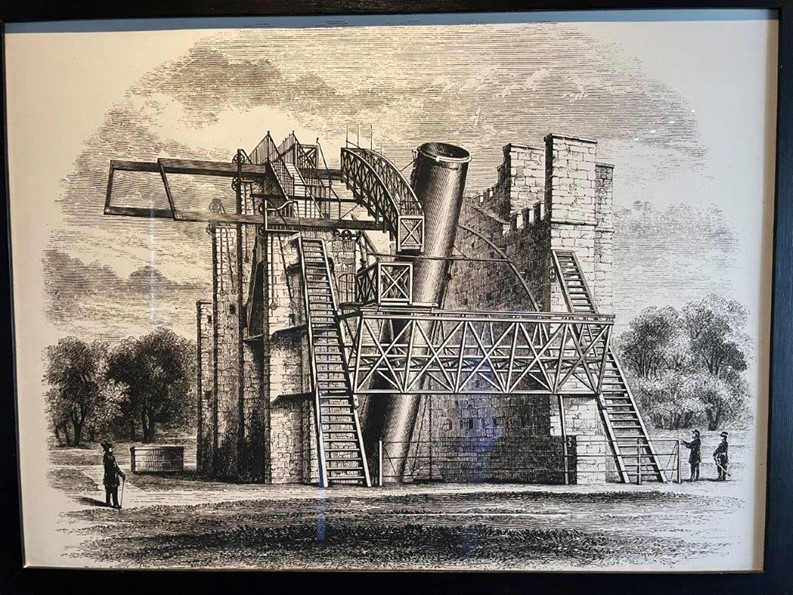
The Great Telescope at Birr
Agenda for the Festival
Friday 9am to 5pm – Discover Birr Castle Demesne by taking on the engineering trail through the gardens and science centre.
Friday 7pm – Welcome reception with tea and sandwiches followed by opening lecture(1) – 8pm. Note: All lectures in Birr Theatre and Arts Centre
- 8.00pm Lady Alicia Clements – Introduction to the Engineering Weekend Festival
- 8.15pm John Burgess – The Parsons Families of the 19th Century
Saturday – 10.00am Lecture (2) – Power on Land
- Brian Leddin TD – Chair of the Joint Oireachtas Committee on Climate Action – Welcome and Opening Remarks
- Geoff Horseman (Formerly Head of Turbine-Generator Engineering at Parsons and Chief Turbine Engineer at Siemens Newcastle-Upon-Tyne) – Evolution of the Parsons Land Steam Turbine
Saturday – 11.30am guided discovery tour in Birr Castle Gardens to visit (Please note to wear non-slip footwear and outdoor gear for walking on garden trails):
- The Leviathan and LOFAR Telescopes – Peter Gallagher or Joe McCauley
- The refurbished suspension bridge,
- Rejuvenated hydro-electric turbine, and
- The secret of the lake’s ingenious water level management system.
Saturday – 1.15pm Lunch at the Kellys Bar
Saturday – 2.30pm Lecture (3) – Power at Sea
- 2.30pm Ian Whitehead – Turbinia – a daring venture in marine propulsion
- 3.00pm Geoff Horseman – Engines of the First Giant Turbine Passenger Liners
- 4.00pm Jody Power – Marine Propulsion Steam Turbines – A Personal Journey
A recess of 2 hours from 4.30pm to regroup at 6.30pm in John’s Hall
Saturday – 6.30 pm Exhibition in John’s Hall, Birr.
8.00 pm Dinner in Doolys Hotel
Sunday – 10am – Lecture (4) – Power to Change
- 10.00am – Benita Stoney – The Stoney family collaboration and achievements
- 10.45am – Una O’Grady – Renewable Energy in the Midlands – Wind, Water and Stars
- 11.30am – Stephen Grant – Engineering at a time of change – 21st to 19th Centuries parallels to inform a paradigm shift in addressing climate change
- 12.15pm – Lady Alicia Clements – Farewell notes
Sunday 1pm and 2pm – Guided tours of castle

The inaugural Birr Engineering Heritage Festival, STEA2M, will run from Friday to Sunday the 18th to 20th October, 2024. This festival will focus on the endeavours of the Parsons and Stoney families from the 19th century townland of Birr in the fields of Science, Technology, Engineering, Art, Astronomy and Mathematics. The contributions members of both families gave to society both at home and to the world were really quite remarkable. Their achievements often pass unnoticed by many who work in science and engineering today.
The festival will draw together leading practitioners and engineering heritage conservation enthusiasts to elaborate on several fascinating aspects of Ireland’s contributions to the world’s industrial and scientific development of the 19th and 20th centuries.
Lord and Lady Rosse, Brendan and Alison Parsons, cordially invite you to attend what is going to be a smorgasbord of engineering and scientific discovery over this three-day festival. Details of the agenda, the speakers and their presentations, tours of the Birr Castle Demesne and Science Centre and registration for the event can be found on the Heritage Society of Engineers Ireland web page here: Birr Engineering Festival | Engineers Ireland .
Attendance at the festival will also provide an opportunity to contribute to one’s own Continuing Professional Development (CPD) and certificates of attendance will be issued to those who attend.
A short summary of the proceedings follows here to provide a taste of what to expect over the 3-day event:
“The Parsons Families of the 19th Century” – Providing an overview of the Parsons families of the 2nd and 3rd Earls of Rosse in the context of local, national and European history, the opening presentation of the festival on Friday evening will shed light on scientific and engineering progress made in Birr in the 19th Century. Laurence Parsons, the 2nd Earl of Rosse, with his partner Alice Lloyd of Gloster House from nearby Shinrone, pushed the boundaries of engineering in the late 18th, early 19th centuries by designing the waterways and mill streams on the Castle Demesne between the Camcor and Little Brosna rivers. This included the design and construction of a multiple-wire cable suspension bridge, possibly the earliest surviving in Europe. This had a major influence on their eldest son, William Parsons, the 3rd Earl of Rosse.
And so, from the peat-burning foundries of the castle that were used to manufacture tools for working the land, William also harnessed the power of steam to build the largest telescope in the world with the help of his partner Mary Field. From these scientific endeavours, the next generation of the family was to draw so much inspiration in their own individual paths in scientific and engineering leadership. The history of these achievements has been superbly captured in the Science Galleries at the Castle Demesne, providing visitors a deeper understanding of Birr throughout this time.
Guided tours through the Castle gardens before lunch on Saturday will give attendees a chance to see the Leviathan telescope of the 1840’s up close. The more recent addition of the LOFAR radio telescope whose receiving ‘dish’ reaches across Europe might appear to be a less exciting structure, that is until the scientists explain the serious computing power being applied to processing the accumulated data!

Picture 1 – The refurbished Leviathan Telescope in 1997
It was here in Birr, and in Newcastle-Upon-Tyne, that the lives of Parsons and Stoney families pirouetted in a dance of phenomenal scientific achievement such as making electricity available to the world through efficient steam-driven turbines, coining the term ‘electron’, building the Dublin docklands using innovative construction techniques, developing waste-water networks and pumping technology used in cities worldwide, driving ships to speeds beyond the imagination of the Admiralty and many other advancements in technology.
Over the course of the weekend, attendees will have access to a variety of differing learning, discovery and sharing / networking environments under three areas of focus:
- Power on Land
On Saturday morning, Geoff Horseman, formerly Head of Turbine-Generator Engineering at Parsons and Chief Turbine Engineer of Siemens Newcastle-Upon-Tyne,will present on the “Evolution of the Land Steam Turbine”. Geoff will describe how the turbines produced for power station use changed from the World’s first steam turbine-generator of 1884 through the pioneering designs which superseded the reciprocating steam engine in electricity generation, the rapid growth in machine sizes from 50 MW to 800 MW and subsequent generations of turbine until CA Parsons & Co Ltd became part of Siemens in 1997.

Picture 2 – Typical 120 MW Turbine in the Parsons Factory in Newcastle-Upon-Tyne
- Power at Sea
On Saturday afternoon, Ian Whitehead, retired curator of the Maritime Collections at Discovery Museum in Newcastle-Upon-Tyne, will tell us about the building, in 1894, of Charles Parsons’s experimental steam yacht, Turbinia and her subsequent career. “Turbinia -Turbine Testbed to Heritage Flagship”, starts with Charles Parsons’s early designs and experimentswithmodels in 1894, and carries through to Turbinia’s current position as a prized exhibit displayed in the entrance hall to Newcastle’s Discovery Museum. The R&D work in the building of the Turbinia, and the constant experimentation and innovation from 1894 to 1897 culminated in a maximum speed of 34.5 knots that was unparalleled at the time. A venture of entrepreneurial bravery, innovation and brilliance in engineering R&D, the success of the Turbinia resulted in a transformation of marine propulsion systems. Unusually, the talk also covers in detail the period from 1908 to the present day when Turbinia was out of the water and, at times, dismembered.
It did not take long for word to spread about this new technology – the Parson Steam Turbine. Geoff Horseman will navigate the waters of the late 19th, early 20th century to tell us about the engines of the first giant turbine passenger liners. Starting in 1902, Cunard and subsequently the White Star Line proposed to build a family of giant passenger liners using turbine propulsion which would be larger than previous ships, more opulent than any built to date with more powerful engines than ever contemplated before so they could cross the Atlantic at high speed. In this talk, Geoff Horseman will provide an insight into the engines of these magnificent ships including the story of their development and show a little of the life-style which could be enjoyed by the first, second and third class passengers.
And this is where Jody Power, Fellow of the Institute of Marine, Engineering, Science and Technology andformer Extra First Class Combined Chief Engineer Officer in Steam and Motor Propulsion Vessels with Shell Tankers UK Ltd, will follow on to expand on “Marine Propulsion Steam Turbines from Parsons to the Modern Era”. The development of steam turbines as an alternative to steam driven reciprocating engines was to have a major impact on the propulsion of sea-going vessels in the 20th Century. Arising from the success of the ‘Turbinia’, many navy fleets adopted the Parsons turbine in their continued push for supremacy at sea before and during the First World War. The desire to provide passenger comfort from shorter travel times and reduced vibration led to considerable developments in ocean-going cruise liners, with the Mauretania holding the ‘Blue Riband’ record for trans-Atlantic crossing for 20 years.
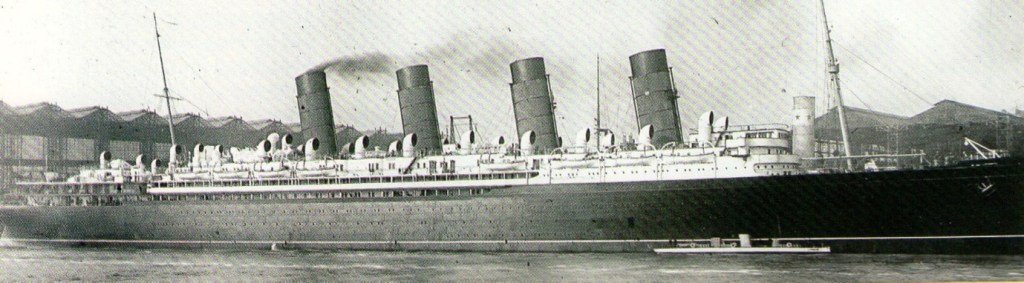
Picture 3 – Turbinia and the Mauretania
Reception in John’s Hall
There will be an interlude following the afternoon lecture to allow people explore the gardens of the Castle Demesne at their own pace and to explore the town of Birr before an opportunity to regroup in the exquisite John’s Hall for a reception and exhibition of Art and Astronomy at 6.30pm. John’s Hall, a neo-classical, temple fronted structure, was completed in 1833 by the Second Earl of Rosse, to commemorate the death of his twenty-six year old son, John Clere Parsons, who died of scarlet fever. A statue of John’s brother, William, stands in front of the hall.
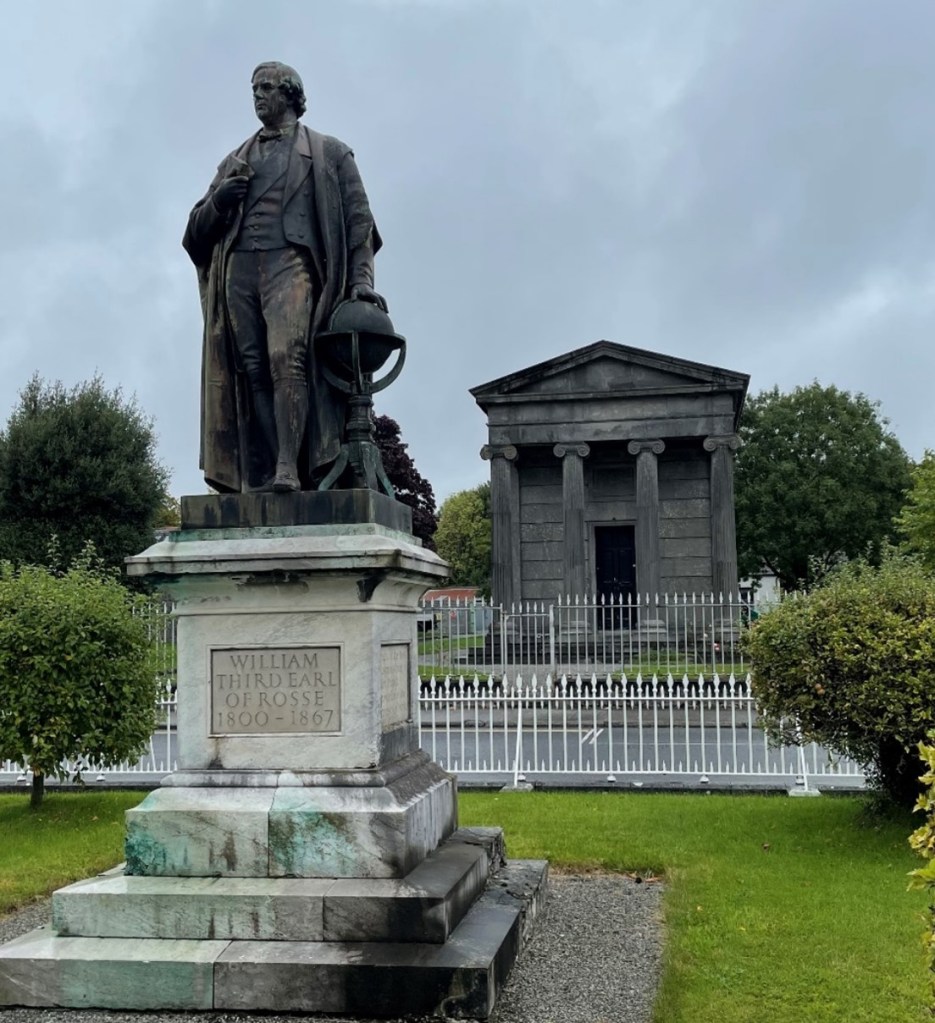
Picture 4 – William Parsons, the 3rd Earl (foreground) and John’s Hall, Birr
- Power to Change
Early on Sunday morning, festivities continue with a series of presentations to turn our attention to the engineering challenges of today.
Benita Stoney, an accomplished portrait artist and author, will provide an overview of the achievements of several members of the Stoney family, many of whom have made many significant scientific and engineering contributions to Ireland and the world. These exploits had an influence on world history that many do not realise. Benita will touch on some of these people and their achievements, framing a narrative that shows how scientists and engineers play a major role in shaping the future.
Now as we look at the challenge we all face today in responding to anthropogenic induced climate change, Una O’Grady, a chartered engineer hailing from Birr, will present “New technologies for renewable energy generation”. Una believes the engineering heritage of the Midlands serves as a powerful enabler for change and that this region can make significant contributions to achieving Ireland’s Renewable Energy targets as set out in the Climate Action Plan.
And to finish off the morning presentations, Stephen Grant, Founder and Managing Director of Grant Engineering, will inform attendees about “The use of renewable energy technologies in the decarbonisation of heat”. As we face into the ambitious carbon dioxide reduction targets set by EU policy, the removal of fossil fuels from the heat generation market remains one of our most difficult challenges. Stephen will discuss this challenge and present solutions that can help us achieve the ambitious zero-carbon 2050 targets.
Following the last of the festival’s presentations in the Birr Theatre and Arts Centre, there will be a chance to take a breather in the environs of the castle and gardens before availing of an opportunity to take a guided tour of the Castle where one will learn more about the formidable Parsons family.
We look forward to catching up with fellow engineering heritage enthusiasts over what will be a most interesting and entertaining weekend. Please do take the time to review the agenda, speakers’ biographies and presentation summaries and explore the website of the Birr Castle Demesne engineering trail, all available here: Birr Engineering Festival | Engineers Ireland . Options to register for the full weekend or for specific days are available. Advice regarding accommodation is also provided. Do book early to avoid disappointment.
 offalyhistoryblog