
The 1824 Survey of Irish schools and the reason it was carried out must be put in context. That context probably can be traced back to the Gavelkind Act, enacted in the Protestant Irish Parliament 120 years earlier in 1704. This act brought into force what became known infamously as the Penal Laws.
The Penal Laws were intended to protect the interests of the Protestant Ascendency from any future threat from the Catholic majority. Amongst these laws was one stating that “No Catholic may attend a university, keep a school, or send his children to be educated abroad. £10 reward is offered for the discovery of a Roman catholic teacher.”
These laws were severe, but as time went by, were more observed in the breach. Teachers, many of whom lived an itinerant lifestyle for fear of discovery and arrest, moved around the country, being sheltered by families in the areas where they would provide lessons for local children, often in outdoor, secluded areas, protected from view by hedges and the alert observations of a well-positioned look-out. This led to the use of the term ‘hedge school’, the convenor of which was known as the ‘Hedge School Master’.
The content of lessons was usually dictated by the strengths and talents of the available teacher. Some teachers had studied for some time for the priesthood in France or other countries and their pupils could expect to learn some Latin as well as the acquisition of basic literacy and arithmetic skills. Few teachers had formal training , and most had simply apprenticed at the foot of their own school master. Payment was rudimentary, with food, fuel or shelter regularly taking the place of monetary reward.
As with the laws forbidding assembly for church services for denominations other than the Established Church, laws concerning schools became less observed as the 18th Century progressed. The law was certainly not observed in Killoughey or Ballyboy, as was the case in most other areas. When Bishop Plunkett of Meath visited the Parish in 1788, he recorded that there were 7 hedge schools, attended by both Catholic and Protestant children.
In ‘A Survey of the King’s Co.’, published in 1801 however, author Charles Coote, painted a bleak picture on the quality of farming and farmland and the welfare of the people. On Education, Coote noted
“ The peasantry are not more illiterate than elsewhere, but there is no system of education other than their small schools. The poor cannot be said to want
industry, as they all assiduously seek employment and they are strictly honest. They all speak English and Irish with equal fluency’.
Act of Union
The 1800 Act of Union came in the wake of the 1798 Rebellion and created the United Kingdom of Great Britain and Ireland. Debate amongst the ascendancy on the Education of the majority of Irish children and how to bring them up as loyal subjects continued. Several surveys were carried out and progress towards a properly organised and resourced education system was very slow. In perhaps the most significant of these, The Commissioners of Irish Education established The Education Inquiry in 1824 and reported in 1826 on what was essentially a census of Irish schools.
The facts revealed in the report were interesting and indicative of a rapidly expanding population. There was very large number of schools ranging from those of patronage of various religious orders or societies which were economically and structurally better equipped to the vast majority of schools where there was no such support in place, with the buildings themselves in many cases comprising mud huts and others of inferior quality.
The Population of Ireland according to the survey was 7.1 million people, with 135, 579 of those living in Offaly or Kings Co. as it was known, over 50,000 larger than today’s population for the County. Of that population, 35,847 were aged between 5 and 15 years, with only 10,234 of those attending school. There was a total of 254 schools in Offaly in 1824 in contrast with the County’s 83 primary and secondary schools today. The average number of children in Offaly schools was 40 pupils, similar to the average in surrounding counties at the time.
Killoughey schools
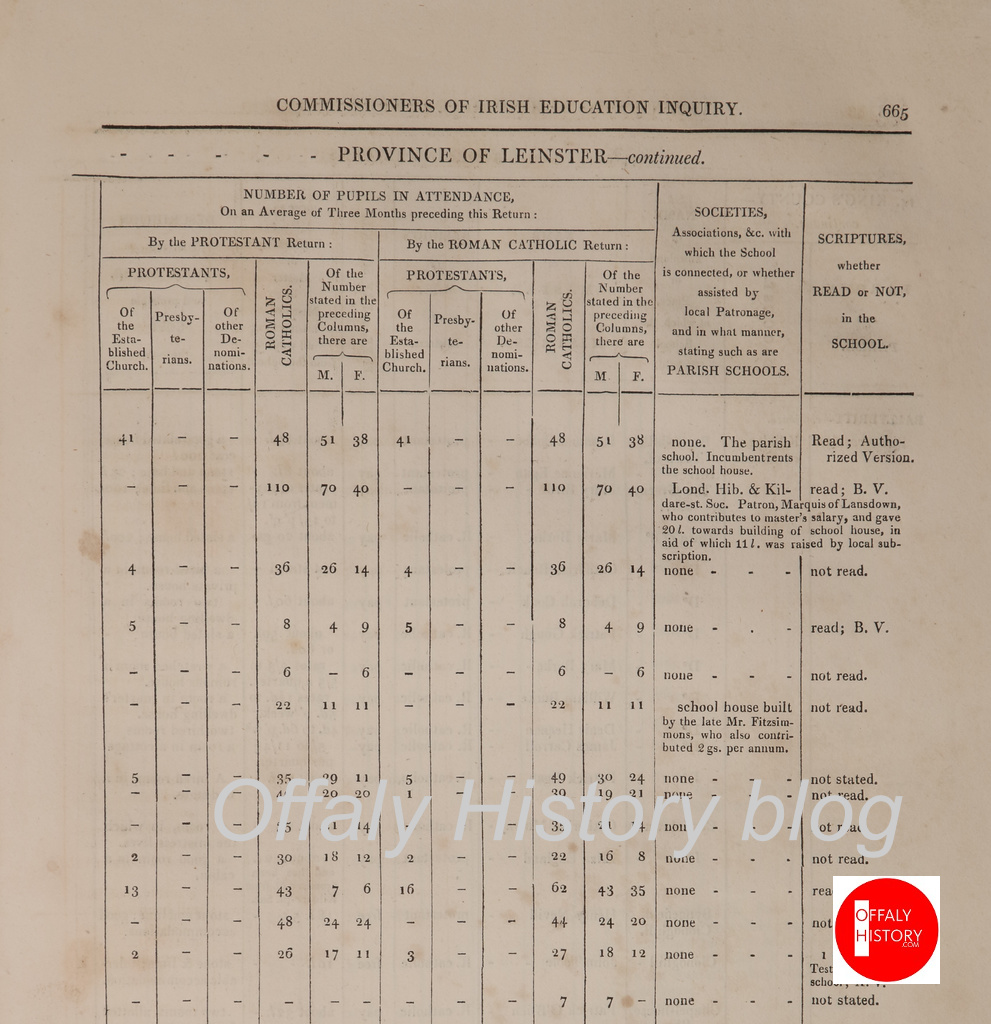
The commissioners report gave details of 14 schools in the parish of Killoughey and Ballyboy, with 8 of those in the Killoughey area. Before the report was issued, the commissioners asked the Protestant and Catholic clergy to separately conduct a survey of all the schools in Ireland to determine the amount of boys and girls in the school and to which denomination they belonged. In most cases, the figures of the two surveys corresponded with each other the small differences were found in many parishes. Details are both sets of figures are given in the report for all schools. None of the Killoughey schools was connected with any society or association nor were they assisted by patronage, whereas the Catholic school in Ballyboy village was under the auspices of the London Hibernian and Kildare Place Society.
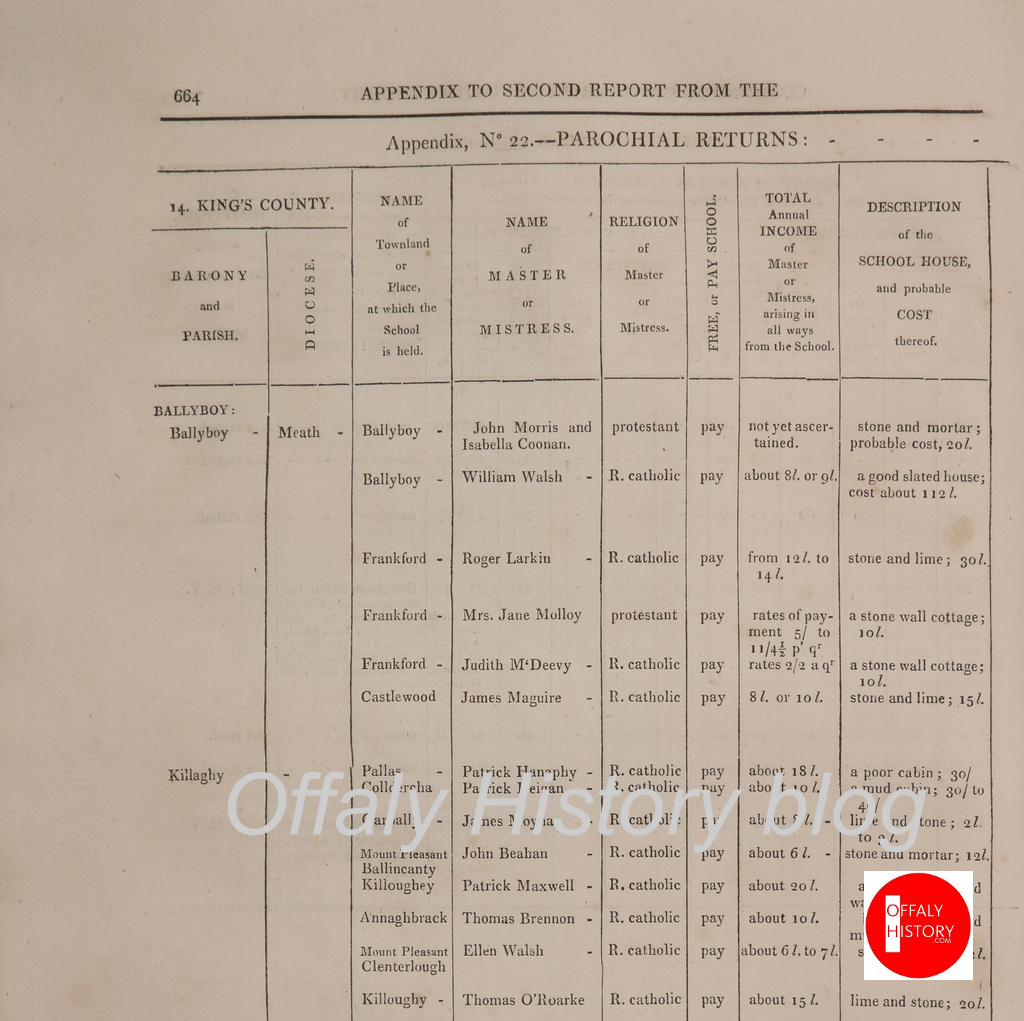
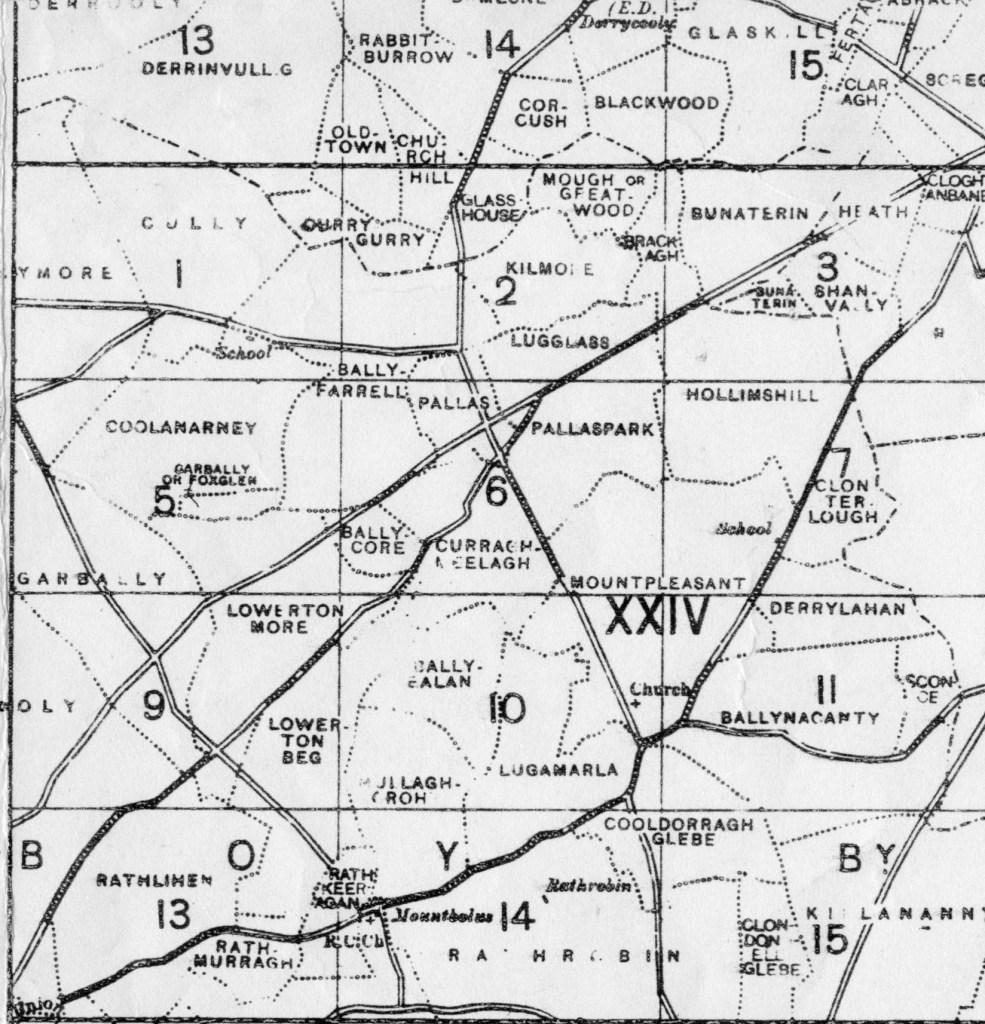
The schools in Killoughey were situated in Pallas, Cooldercha (now spelt Cooldorragh ), Garbally, Annaghbrack, Mount Pleasant-Ballincanty, Mount Pleasant- Clonterlough and 2 schools at Killoughey.
Most of these schools were in extremely poor condition. The Pallas schoolhouse, where Patrick Hanaphy taught, and the Cooldercha school run by Patrick Deigan were mere mud cabins. Thomas Brennan taught in a stone and mud building in Annaghbrack, similar to Ellen Walsh’s school in Clonterlough, close to today’s Gortnamona school. Patrick Maxwell taught in a similarly described building at Killoughey. These mud and stone schools all had a very low valuation with the Clonterlough school being the lowest ranking with a valuation of only £2. Two schools were built from the plentiful supply of lime and stone in the area – Garbally school of James Moyna and the renowned school of Thomas O’ Rourke at Killoughey which enjoyed the highest valuation of £20.
Preparation for Priesthood
Some schools at this time were preparation schools for the priesthood and it is quite possible that Thomas O’Rourke‘s was one of them. O’Rourke himself could speak English, Irish, Latin and French fluently. He had been a student for the priesthood but finding that his vocation lay elsewhere, turned to teaching at which he excelled. His emphasis on the classics obviously had an impact on many of his students at any rate, as at least seven of them went on to become priests. These included William Quarter, the first Catholic Bishop of Chicago, his brother Walter, who served as a parish priest in New York as well as Vicar General in his brother’s diocese, and their brother James , who also joined the priesthood but sadly died before his ordination. The Quarters intended to serve in their native Diocese of Kildare and Leighlin, their native Killurin being part constituent parish of Killeigh, but the parish priest Fr. McAwley, having been to New York, prevailed on the brothers to travel across the Atlantic to support the needs of the poor Irish immigrants there. Bishop Quarter had a very productive and successful 4 years in the Chicago diocese before succumbing to illness at the young age of 42. The GAA park in Killurin is named in his honour. Another pupil of Thomas O’Rourke was John Joseph Conroy, a native of Clonaslee, who served as Bishop of Albany, New York from 1865 to 1877.
I have no concrete evidence to suggest that O’Rourke’s school was a seminary for the priesthood, but from the 1826 report I have found some grounds for this claim.
1. In 1826, the school was the only exclusively male school in the parish.
2. It was the only school entirely populated by Catholic pupils.
3. There was another , better attended school in the same Killoughey
townland.
4. There were only 7 pupils in attendance at the time, suggesting that these
boys were getting specialised attention directed towards a life in the
priesthood.
5. Thomas O’ Rourke was a very influential Catholic parishioner, leading a
successful deputation to the Bishop of Meath for the appointment of recently ordained and newly appointed curate Walter Lynch as Parish Priest, following the resignation of the incumbent Fr McAwley. This was a most unusual promotion but shows the influence of O’ Rourke.
Apart from Thomas O’Rourke’s school, all others were single teacher schools and quite well attended by both Catholic and Protestant children, both male and female. The other school at Killoughey saw Patrick Maxwell take charge of 78 pupils, including 16 Protestants. This incidentally, was the only school in the parish recorded in the report in which the authorised version of the bible was read. If others did so it is not recorded. Patrick Hanaphy also taught a big group of 54 pupils. In only one of the schools, Cooldercha , was there a greater attendance of girls ( 21) than boys (19).
In total , according to the Catholic records, there were 178 boys and 134 girls, for a total of 312 children attending schools in the Killoughey end of the parish. Leaving out Thomas O’ Rourke’s preparatory school, that averages out at 22 boys and 18 girls , meeting the exact average of 40 pupils per Offaly school.
Catholic Emancipation and the National School System
At this time parliamentarians such as Daniel O’ Connell were powerful advocates for reform in Ireland, particularly in support of the needs of the majority of people not attached to the Established Church. O’Connell’s consistently persuasive oratory and argument led to Catholic Emancipation from 1829, and the establishment of the National School System followed in 1831.
The decision to establish a national system of education in Ireland in 1831, apart from being a consequence to O’Connell’s persuasions on the many issues affecting Catholics and those of other non-ascendency faiths, responded to a number of political, social, economic and religious factors unique to the British Empire’s closest colony. It was seen as a vehicle through which firmer ties could be established and compliance could be established.
It was also a social and economic response to the widespread poverty and the quest for education evident in Ireland, with the intention that basic literacy and numeracy would improve the position of Ireland’s citizens in future generations.
The effects of the legislation we’re not fully felt in Killoughey for several years, as was the case in other areas. The first National schools were established in Mountbolus in 1850 with separate schools for boys and girls under the leadership of teachers Michael Crosbie and Jane Hughes respectively. Michael Crosbie was the grandfather of ‘School around the Corner’ presenter Paddy Crosbie, and great grandfather to well-known Dublin businessman Harry Crosbie.
Gortnamona NS followed in 1857 thanks to the combined work of Parish Priest Fr. Walter Lynch PP and Maria O’Connor Morris of Mountpleasant House, who gave the site free of charge, with John Kavanagh as first principal. Jane Hughes, who spent only one year in Mountbolus Girls NS before moving to Frankford (now Kilcormac) would return to Killoughey as Mrs Jane Carolan to become principal of Gortnamona in 1885.

A third National school was established in Coolanarney in 1886, replacing a previous temporary school in nearby Cully. Colonel Biddulph of Rathrobin House donated the site and Mary Kennedy was appointed as the first Principal.
Today, the three schools in Killoughey- Mountbolus ( now a Co-Ed school) , Gortnamona and Coolanarney remain open, currently serving the educational needs of 192 children.
Damian White
Bibliography
‘The Parish of Killoughey’ – Rev. Andrew Shaw PP
‘A Tour of Ireland ‘ -A. Young
‘A Survey of King’s Co. (1801) -Charles Coote
Irish Education Inquiry – 2nd Report (1826)- Leinster ( National Library)
‘Irish Education- It’s History and Structure’- John P. Coolahan
‘ Memories’ – Wm. O’ Connor Morris
Prof. Tom Collins ( Maynooth ) – quote in passage under ‘Catholic Emancipation’
 offalyhistoryblog