
As we wait the outcome of the General Election today (30 Nov. 2024) we could look back to 1969 when Offaly returned three TDs in the five-seater Laois Offaly Constituency.[1]
How many in Offaly did not vote yesterday? We should recall that between 1885 and 1922 there was no opportunity to vote in North Offaly save in the Adams- Graham by-election of 1914 when Graham won by 79 votes as an unofficial candidate not backed by the Irish Parliamentary Party.
For the 1969 general election the slogan was ‘Let’s back Jack’. It was a campaign in which Fianna Fáil ran five candidates and secured three seats in Laois-Offaly. Tom Enright of Fine Gael picked up the O’Higgins seat. None of the winning candidates was from Tullamore. It was a reflection of the fact that Fianna Fáil (F.F.) back to the late 1920s, was strongest in Clara, Ferbane and west Offaly. In the event Offaly secured three new TDs and a first for the towns of Clara and Birr where Ber Cowen (F.F.) and Tom Enright (F.G.) were elected while Ger Connolly of Bracknagh was elected for F.F., having been added to the ticket. Fianna Fáil, with the help of some adroit redrawing of boundaries, secured two more seats than they had in 1965, and Labour had set itself against a coalition. Fianna Fáil won 51.7 of the seats with 45.7 per cent of the votes.[2]
In the 2024 GE Offaly may return three new TDs but that is all for counting now and Carol Nolan as the sitting TD (Independent) is in there with good prospects. The third seat will be hard to call so let’s wait. [In fact the first seat in GE 2024 was filled by Carol Nolan followed by Tony McCormack and John Clendennen,]
When it came to the 1965 general election Fianna Fáil fought the campaign on its performance in job creation (‘Let Lemass lead on’) and contrasted the position in 1957, when the last Inter-Party government was in power, with the outcome of Fianna Fáil rule over the succeeding eight years. In 1957 when the Coalition left office unemployment was the highest ever recorded at 95,000 – emigration was at its peak since the 1880s.[3]
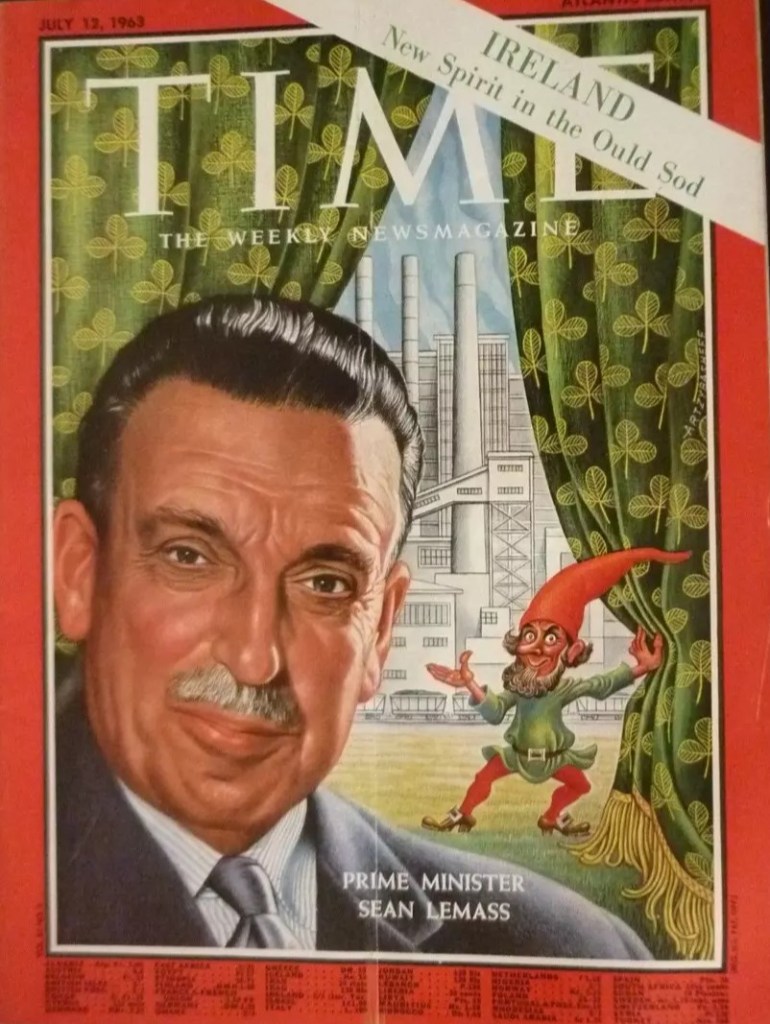
Lemass won the 1965 election but not by the majority he had hoped for. He recovered the votes lost in the previous election and secured half of the seats.[4] James Dillon retired as leader of Fine Gael and was replaced by Liam Cosgrave. In Laois-Offaly there had been no change in the 1961 general election from that of 1957 with Fianna Fáil retaining its third seat and Fine Gael taking the other two.
In 1965 Labour recovered a seat it had lost in the 1956 by-election with Henry Byrne regaining the seat held from 1922 to 1956 by William Davin (1890–1956) and defeating Kieran P. Egan, the outgoing Fianna Fáil deputy.[5] Oliver Flanagan (1920–87), 21 years a Laois-Offaly Fine Gael deputy in 1965, congratulated his colleague T.F O’Higgins (1916–2003). The Fianna Fáil deputies elected were Paddy Lalor and Nicholas Egan.[6]
T.F. O’Higgins (49), the Laois-Offaly TD selected as Fine Gael candidate in the 1966 Presidential election, was a surprise choice.[7] O’ Higgins came within one per cent of defeating de Valera for his second term as president. His presidential campaign had been launched in Tullamore where Oliver Flanagan described de Valera as in his eighties and out of touch. The most important thing for the country said Flanagan was not the restoration of the Irish language, but improved standards of education and equal opportunity [8] O’Higgins ran an American-style campaign in which his fashionably dressed wife and young family were prominent.[9]
One factor which may have worked against Lemass in the mid-1960s was his introduction of the Turnover Tax in 1963. The new sales tax was at a rate of 2.5 per cent. The sales tax came in on 1 November after some mild protests. One such protest was from Oliver J. Flanagan, who compared Taoiseach Seán Lemass to an Irish Khrushchev or Castro. He accused two independent TDs of having sold their votes to Fianna Fáil for £3,500 each.[10] The new tax would, by 1972, lead on to a standard VAT at 23 per cent for many goods and services. The 1964 budget was severe with imported spirits increased by an extra 4d. per glass, 3d. on cigarettes and 3d. on petrol. The hikes would, it was said, put the price charged higher than in all but a few countries. The owners of dance halls and cinemas, it was noted, were lucky to escape Dr James Ryan’s (minister for finance 1957–65) net with the dancing and bingo craze then in full swing.[11]
The sudden retirement of Lemass in November 1966 marked the end of an era. He was one of the last of the prominent figures of his generation.[12] He had embraced the Sinn Féin ideal of developing native industries behind tariff walls, but from the late 1950s was willing to accept that a change of course was necessary. His efforts were aimed at bringing about change by improving the productive capacity of the country. These changes were very much in evidence in County Offaly in the development of peat-fired power stations and bringing much-needed employment and prosperity to east and west Offaly. Now there were ‘1,000 men at work where only the snipe lived’.
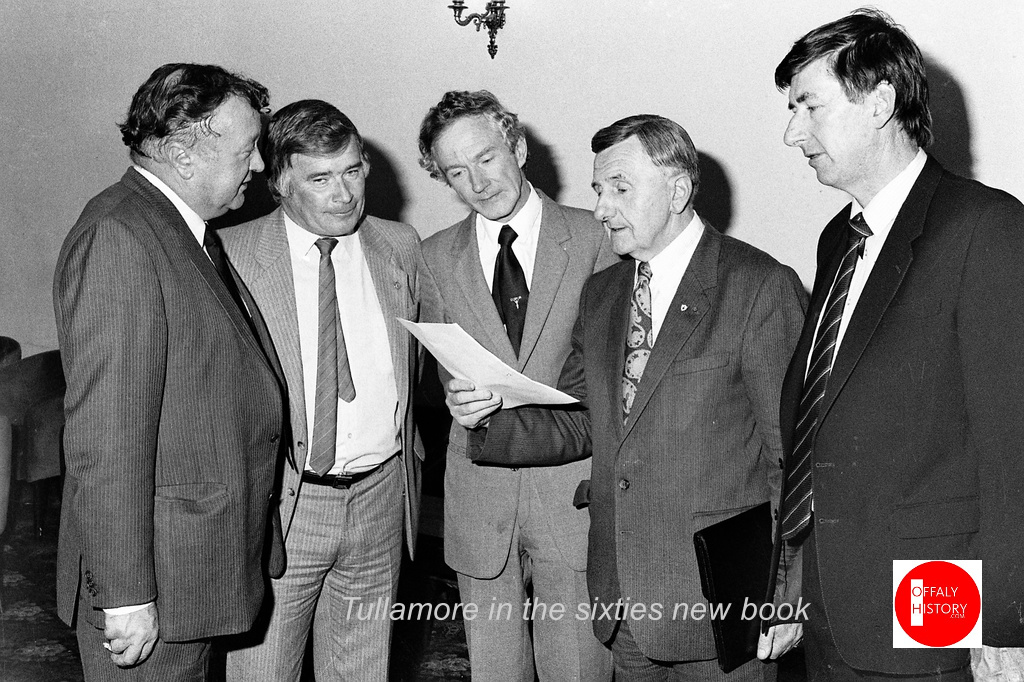
When Oliver J. marked his 25th anniversary to the Dail in 1968 he announced that:
“To be a real good politician one must have great friends and bitter enemies. A successful politician is one who at the same time is loved by some and detested by others.
“To be a politician is perhaps the great calling after the Church, and all of us who are politicians are very proud to be in the profession and to serve our people nobly and well in our Parliament, and to help in the making and moulding of the laws which make up our society.
The amiable Jack Lynch succeeded Lemass as Taoiseach. Of those elected in Offaly in 1969:
Ber Cowen died in 1984. He was succeeded by his son Brian in what was only the fifth by-election in Offaly since 1800.
Ger Connolly died in 2024 (see the obit by Seamus Dooley as an Offaly History blog in Jan. 2024).
Happily Tom Enright is fighting fit and the south Offaly dominance of Fine Gael is likely to be repeated in the November 2024 GE the pundits tell us.
For more about the Sixties why not reach for a copy of Tullamore in the Sixties (published Nov. 2024).
[1] Laois Offaly was into two three-seat constituencies by the latest electoral commission ‘This would be the first time that the Offaly constituency would fully align with its county boundary.’ For the 2016 General Election Laois and Offaly were divided and to the Offaly constituency was added 24 electoral divisions from North Tipperary. Laois-Offaly was adopted again for the 2020 general election.
[2] Mary E. Daly, Sixties Ireland: reshaping the Economy, State and Society, 1957–1973 (Cambridge, 2016), p. 282.
[3] OI, 3/4/1965.
[4] Brian Farrell, Seán Lemass (Dublin, 1983), p. 122.
[5] OI, 17/4/1965.
[6] OI, 17/4/1965.
[7] OI, 5/02/1966.
[8] MT, 8 May 1966.
[9] DIB, entry for O’Higgins, Thomas Francis by Maume, Patrick and Costello, Kevin; OI, 17/4/1965.
[10] Tony Farmar, Privileged lives: a social history of middle-class Ireland, 1882-1989 (Dublin, 2010), p. 249; OI, 5/10/1963.
[11] OI, 18/4/1964
[12] OI, 19/11/1966


 offalyhistoryblog