On the morning of Sunday October 12th 1924, two excursion trains from Birr and Tullamore bringing approximately 1000 Offaly supporters left the county for Croke Park in Dublin. As the Birr train pulled into Ballybrophy, a large train full of Cork supporters was seen in waiting. However, as the Offaly train was placed in front of its Cork counterpart for departure, one excited Faithful supporter prophetically exclaimed, ‘Gosh we’re ahead of Cork, we’ll be that way all day’. His enthusiasm was greeted with the response ‘we hope so’, as the Midland Tribune (MT) reporter who witnessed the event noted the contrast in the Cork supporters who seemed unable for a moment to countenance ‘the idea of defeat’, while the Offaly supporters were travelling more ‘in hope’ of victory but with the knowledge that their team which had come through a long campaign ‘were determined to fight in every ounce of their strength’ to land the county’s first national title.

The long campaign to this title win had begun on May 27th 1923 just as the Civil War was coming to its end. Offaly opened the defence of their Leinster title won the previous year with a resounding victory by 20 points over Kildare in Athlone on a score line of 9 –1 to 2 – 2. This result is all the more surprising when one considers that the Tribune reporter present claimed that ‘Offaly were slow to get going’ after Kildare had actually opened the scoring with a goal and he expressed the view that ‘ a couple of changes in the team were going to be necessary to defeat the winners of Kilkenny and Dublin’. As might be expected, the more partisan Leinster Leader gave a very small report on the match, claiming the Kildare forwards ‘lost several goal opportunities against their more experienced opponents’, and the paper not surprisingly on this occasion devoted much more attention to Kildare’s win against Longford in a junior football tie at the same venue on the same day.

Offaly’s next outing was against Dublin in Athy on July 29th. Dublin had the better of the exchanges for three-quarters of this match and Offaly were grateful for the brilliant display of their goalie Mick Spain, and finished the stronger team to win a tight struggle on the score line of 1 – 4 to 1 – 2. The Leinster Leader described the contest as ‘a fine ding-dong rattling game’ with Dublin ahead by one goal at half time, but cheered on by a large following, Offaly quickened the pace of their game near the end to come out on top. However, a surprise lay in store for Offaly when a Leinster Council meeting in August declared the game null and void. Dublin had lodged an objection to Offaly on the grounds that they had not submitted a list of 22 players before the match commenced, this being a new directive that had been introduced into the official GAA rule book at the start of that year. However, the rule also stated that the offended county or club were expected to protest this breach to the referee prior to the start of the match taking place, and since Dublin had clearly failed to do this, the Council took the decision to declare the game null and void. A replay was then agreed which took place in early November, again in Athy, on the same day when Offaly Junior footballers went down to a strong Carlow side in the Leinster semi-final.
The first contest on that occasion saw the hurlers win comprehensively by 5 – 2 to 2 – 1, having led by three points at half time despite playing against the elements. On a day when the backline frustrated all the very best that Dublin could muster, one forward who stood out was Jim O’Regan, a Cork teacher based in Birr, who would later enjoy a most successful playing career after moving back to his native county later in the decade. The team and its loyal supporters now had another Leinster final to look forward to, but not before another Dublin objection at Leinster Council. On this occasion, the Metropolitans objected on the grounds that the listed Offaly player Jim Conlon was actually William Cordial. Dublin presented two witnesses at the meeting who identified Cordial as he had also been summoned to appear at the meeting. However, when Dublin proposed that they be awarded the match, they got no seconder for their motion, while Offaly’s counter motion that the match be awarded to them was won by 6 votes to 1. The scene was now set for the final against Laois which took place in Ballyduff Park, Tullamore on December 16th
Despite the fact the game was taking place so late in the year, a large crowd turned up to witness what the Midland Tribune described as ‘one of the most strenuous and exciting contests witnessed for a long time’. Again, Offaly started the game slowly and were thankful for the first half displays by defenders Jimmy Murphy and Frank Doherty. Despite doing most of the attacking, Laois ended the half with only one point scored while Offaly’s captain Stephen Cloonan had his side’s only score when goaling from a long distance. Into the second half, Offaly’s keeper Jim O’Donnell brought off a series of fine saves as Willie Ryan enjoyed this time upfront by scoring three goals. It looked like the game was about to result in an easy Offaly victory but Laois rallied and battled bravely by scoring 2 goals late in the game before having a player sent off. The last 4 minutes were played in a frantic pace before the Dublin referee Mc Donnell ended proceedings with Offaly retaining their Leinster title. However, a report in the Irish Independent in late January 1924 claimed that Laois lodged an objection to the result on the grounds that only 24 minutes were played in the first half. The official Leinster Council minutes on the other hand claim the objection was based on the Laois view that the referee had failed to allow 6 extra minutes in the half for an injury to a player. Either way the Council rejected the appeal and upheld the official referee’s report of the game. For the record, the team that brought Offaly its third Leinsters J. H. title was; Jim O’Donnell, Jim Carroll , Jack Horan, Joe Carroll (Coolderry) Jim O’Regan, Willie Ryan, Paddy Sullivan, Gus Tully, (Birr), Jack Fleury (Drumcullen), Mick Grogan, Denis Mooney. (Kinnitty), Frank Doherty, Mick Carroll, Jimmy Murphy (Killoughey), Stephen Cloonan ( captain) , Tullamore. Substitutes, Jim Halligan ( Kinnitty), Paddy Grimes ( Drumcullen) and Larry Behan ( Killoughey).

It was to be over six months before Offaly got to play their All-Ireland semi-final against Galway who had faced no competition in Connacht and were therefore very much an unknown proposition. The fixture took place in Athlone and a very large Offaly contingent travelled to the game with the pitch being described as heavy and waterlogged in many places. The match itself was totally one sided with Offaly emerging as clear winners on the score line of 7-5 to 0-1. The GAA correspondent to the Connacht Tribune was anything but impressed by the Galway effort noting that their selectors ‘fielded anyone who happened to turn up’ while some of the selected ‘complained of not having received notification’ of the fixture. Describing the match as a ‘fiasco’, with the Galway team beaten in every department by a ‘splendidly well-balanced Offaly combination’, he did temper this praise for Offaly by claiming that ‘their knowledge of the rules was faulty’ with fouls ‘very much’ in evidence.’ The Offaly Independent however claimed that while ‘a little rough play was indulged in at one period of the game,’ only a few players from both teams received nasty bruises. These issues were unlikely to have bothered either the Offaly players or supporters after the game as the dream of winning a first All-Ireland was now a huge possibility.
However, a major issue arose surrounding the upcoming final that could easily have led to a major split within Offaly GAA circles. Central Council decided to fix the final for Sunday July 6th with Thurles as the venue. Many GAA matches that summer had been disrupted as attempts were made to clear a backlog of fixtures for 1923. Games were left unplayed because a number of counties including Kerry (in football) and Limerick in hurling opted not to fulfil fixture because of the tense political situation regarding the continued imprisonment and internment of IRA men since the final months of the Civil War. As a result, Cork whose chairman, Sean McCarthy, was one of those still being held, refused to travel to Thurles and a subsequent meeting of the Central Council decided to award the All-Ireland to Offaly, as the majority of its players had indicated they would travel after a meeting with the county secretary Stephen Cloonan, who as noted had captained the side to Leinster honours.
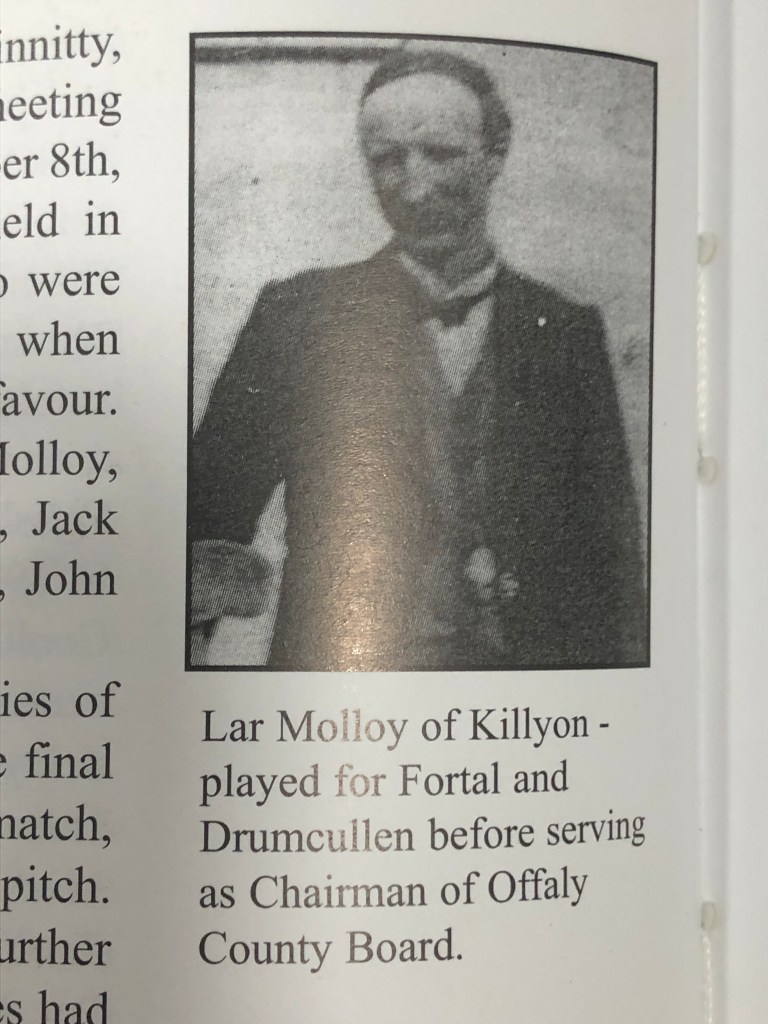
This decision by the majority of the Offaly players to fulfill the fixture did not meet with universal approval among all the Gaels of the county, including the county board chairman Lar Molloy. A very hot-tempered county board meeting on July 20th that lasted 4 hours showed the extent of the strong feeling on the issue when a Rhode motion, ‘that we the members of the Offaly County Board GAA repudiate the action of certain members of the junior hurling team in talking a walk-over from Cork, and we endorse the action of the Cork County Board in refusing to carry out the fixture when some of our best Gaels were interned without trial. We suggest that the Co. Board take action and have the match played when circumstances permit.’ This motion led to a rather heated debate with delegates voicing support for and against the decision of the team to travel but the most important potential split was that between Molloy and Stephen Cloonan, who were at loggerheads over the issue. An outright split between the chairman and secretary would have been a disaster for the GAA in the county going forward, but thankfully at the end of the meetings a resolution, ‘That we the members of the Offaly Co. Board refuse to take a walk-over in the Junior All-Ireland Hurling Final from Cork in the 1923 Championship, and we are willing to play Cork when a fixture is possible’, was passed unanimously. At a subsequent Central Council meeting on Sunday August 10th, a decision was made to re-fix all the All-Ireland ties that had not been played. By that stage Sean McCarthy (and the other IRA prisoners) had been released and he was one of those who actually attended the Central Council meeting that made this decision.
The long-deferred final was eventually played in Croke Park on October 12th, 1924. The Offaly team that lined out in the final was unrecognisable from that which played Kildare 18 months earlier. In fact, only four of the original 15 were on the team with three more among the subs. Remarkably, six players who lined out in the 1923 senior championship were now on the side and while it had been over a year since they played senior, strictly by the letter of GAA rules they were illegal. But Cork were virtually in the same boat, which meant that two very talented sides took the field for the final, a game that has gone down in history as a splendid contest, and the highlight in Offaly’s GAA history to that date, 40 years after the foundation of the Association. The national papers were even more gushing in their praise of the spectacle than the local Midland Tribune and Offaly Independent. Both the Freeman’s Journal and Leinster Leader contained the same match report, claiming that ‘few senior finals could have excelled it in hurling merit, and none in respect of the cleanness, sharpness and quickness of caman play as both sides hurled with delightful skill and enthusiasm.’ Meanwhile, the Irish Independent stated that the ‘hurling was a capital exhibition splendidly contested all the way, but particularly in the closing stages when play was generally admitted to have reached a standard rarely exceeded by seniors.’

At no stage did Cork lead in the match, with the sides level as 2-1 each at half time. Coming towards the end, Offaly had built up a five-point lead ‘but a Cork goal with five minutes to go led to a frantic finish, before the final whistle sounded with Offaly ahead by 3-4 to 3-2. The Midland Tribune claimed that ‘every man played so well’ that while it was almost ‘impossible to pick out any player especially deserving of praise,’ the report went on to credit Bill Fox as giving the ‘best display on the field.’ In truth, Offaly had 16 heroes on the day who lined out as follows, Ned Hayes (goalie), Kinnitty, Peter Lyons, Drumcullen, Jack Halligan (captain), Kinnitty, Bill Fox, Pat Fox, Drumcullen, Nicolas White, Erin’s Own, Jim Carroll, Jack Horan, Coolderry, Mick Carroll, Will Cordial, Kinnitty, Martin Whelan, Birr, Jimmy Murphy, Erin’s Own, Mick Cordial, Andy Cordial, Kinnitty, Willie Ryan, Birr. Subs Dick Conway, Kinnitty for Mick Cordial, Stephen Cloonan, Tullamore, Mick Spain, Drumcullen, Frank Doherty, Erin’s Own and Tom Sullivan, Birr.

There were no real after match celebrations except a meal in Dublin. Some players stayed behind in Dublin to attend a silent movie while the other players returned home by train. However, there were no marked receptions for the returning heroes in either Tullamore or Birr. After six matches, three appeals and an acrimonious county board meeting during the campaign, the rocky road to Offaly’s first All-Ireland success was completed with no after match fuss or fanfare. Offaly would retain their Leinster crown for 1924 and thus became the first team in Leinster to achieve three-in-a-row victories in junior hurling.

Our thanks to Sean McEvoy for this valuable article and to those who helped with photographs.
Pics and captions Offaly History.
 offalyhistoryblog