
On January 19th 1947 Ireland saw the beginning of a freak weather event. A ‘cold easterly regime set in’ as Kevin Kearns puts it in his 2011 book, Ireland’s Arctic siege.[i] Night frost and snowfalls began from the night of the 19th and by the 24th temperatures dropped to between -20c and -60c. With the reduction of the goods train service an increase in cargo haulage on the barges along the Grand Canal brought with it trouble for the canal workers. The owners of the barges were working to capacity.[ii] The Grand Canal froze at night making it difficult for barge traffic to move as the bargemen slowly broke through the ice in the early morning. A repetition of this continued for weeks into February and March.
Beginning around the 24th January the canal began freezing over. For the next six weeks, every morning the bargemen made slow progress hacking and smashing their way through the ice.
According to Kevin Kearns:
…their food rations were not sufficient for men who worked so physically hard. Nor had they enough turf to keep their primitive cabins warm. They appealed to their union in Dublin for assistance with food and fuel, but to no avail.[iii]
In Tullamore in early February it was reported that the snow brought with it fun for the children of the town but threats of snowballs for the adults.

The blizzard and the icy cold conditions of the past week reached the climax on Saturday night with a severe snowstorm, which made conditions on Sunday very in convenient and uncomfortable for all sorts of traffic. Roads and streets were practically impassable and pedestrians found it extremely difficult to get about. The youth and children of the town, however, welcomed the visitation for indulging in the pastime of snowballing for which they had material and “targets” in abundance. Had they restricted their operations to “pitched battles” amongst themselves there would have been no cause for complaint, but innocent passers-by of both sexes and of all ages did not go unmolested, while people on their way to Mass were subjected to a regular fusilade, which continued as they were passing through the church gates. Some damage is reported as a result of the snowballing, including the breaking of the windows of a number of shops and private houses. The thaw set in towards evening and the disappearing snow was followed by masses of slush on the streets and roads.[iv]
Many Tullamore families’ homes were fireless and the water supply was affected in some parts of the town.[v]
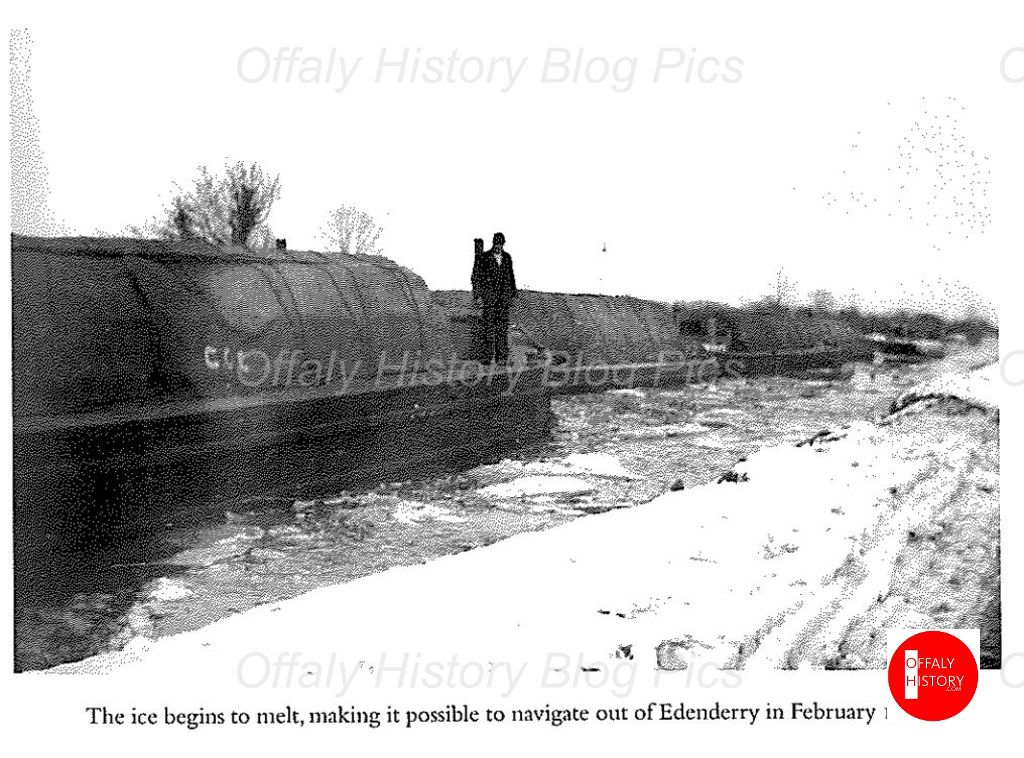
The blizzard that struck on the 25th February was the single greatest level of snowfall in the recorded history of the island of Ireland. Around the Edenderry area of the canal the barges had been brought to a standstill. ‘There are the crews of over twenty Grand Canal Company barges, whose vessels have been jammed in the ice, within a mile of Edenderry since Tuesday and Wednesday of last week.’[vi] The bargemen spent their time begging for food from local residents along the canal. Close to Edenderry in late February a member of one of the canal barges, Anthony Hutchinson, rang the Labour TD, James Larkin Jnr, who went before the Department of Supplies. By mid-day local bakeries were instructed by the Department to supply every boat with three loaves of bread. Still, days later there was no thaw on the canal, and lorries were sent to bring hundreds of tons of beet lying at Edenderry harbour down to Carlow.[vii]
In mid-March it was reported that ‘traffic has been resumed on the Grand Canal after a long spell of inactivity… Tullamore Harbour presented a scene of great activity on Monday where four boats were being discharged together. Each of them had a mixed general cargo, and their arrival was very welcome, as local merchants were urgently in need of some of the goods that arrived.’[viii]
The freeze had brought about death, hunger and hardship at a time when Ireland struggled already with a poor living standard. The sudden drop in energy sources showed the vulnerability Ireland continued to face since independence in 1922 and until the economic growth that was to begin in the 1960s.
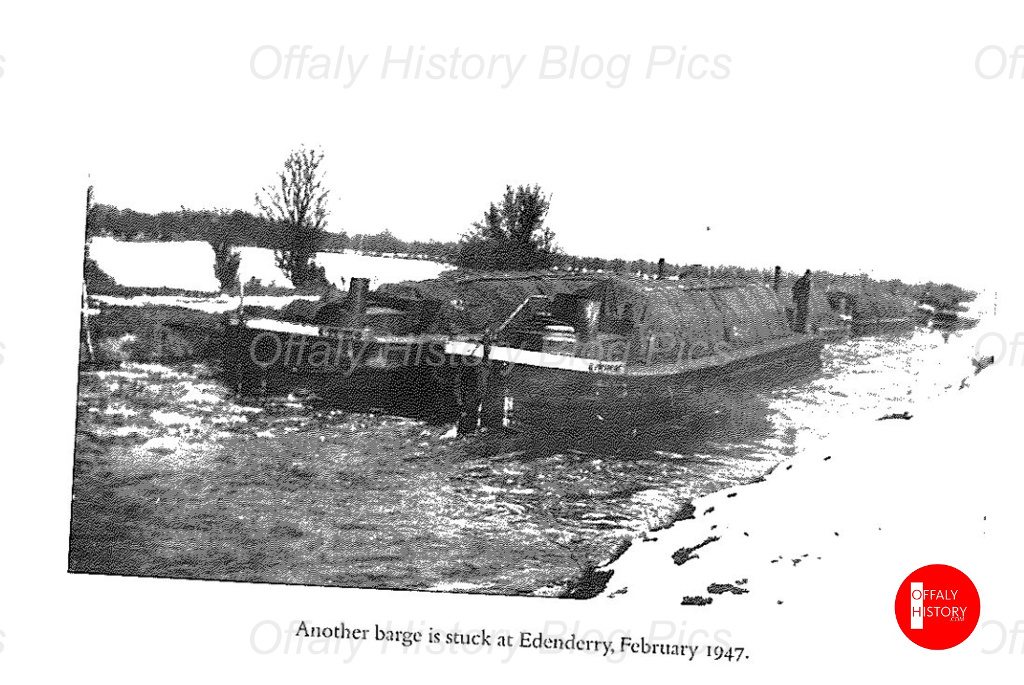
Image Sources
‘A barge stuck at Edenderry canal,’ Edenderry Historical Society, Images of Ireland: Edenderry (Dublin, 2009), p. 18.
‘The ice begins to melt at Edenderry canal,’ Edenderry Historical Society, Images of Ireland: Edenderry (Dublin, 2009), p. 19.
‘Tullamore canal frozen,’ Ger Scully, ‘HISTORY: A look at the story of the Grand Canal in Offaly in the 20th century,’ Offaly Express (https://www.offalyexpress.ie/news/home/1017020/history-a-look-at-the-story-of-the-grand-canal-in-offaly-in-the-20th-century.html) (8 Mar. 2024)
[i] Kevin C. Kearns, Ireland’s Arctic siege: the big freeze of 1947 (Dublin, 2011), p. 3.
[ii] Kearns, Ireland’s Arctic siege, p. 132.
[iii] Kearns, Ireland’s Arctic siege, p. 268.
[iv] Offaly Independent, 8 Feb. 1947.
[v] Midland Tribune, 8 Feb. 1947.
[vi] Irish Independent, 28 Feb. 1947.
[vii] Offaly Independent, 1 Mar. 1947.
[viii] Midland Tribune, 15 Mar. 1947.
 offalyhistoryblog