
This blog post will trace the decline of the canal as a means of transport and critical element in the economic development of Edenderry and the surrounding area. The transition of the canal and harbour as a tourist and leisure amenity will be discussed further on. The introduction of the railways in the mid-nineteenth century weakened the canals importance to the economy. Both the canal and railway had to compete for the limited inland trade. A struggle the canal was also going to lose.[i]
In the summer of 1846 it was reported that the people of Edenderry had averted an accidental breach in the branch canal to the town harbour.[ii] Another serious breach occurred between Ticknevin lock (20th) and the Blundell aqueduct in February 1849. The breach occurred in the bog embankment.[iii] The repairs were carried out under the Grand Canal Company’s (G.C.C.) new engineer, Christopher Mulvany. While repairs occurred Mulvany constructed dams and laid a tramway along the canals north bank allowing trade to continue. If the first half of the nineteenth century saw the rise of the canal as a revolutionary mode of transport, so too can the railway be seen to replace the canal.

In 1835 Thomas Murray derided the idea of the possibility of a rail link to Edenderry:
‘There is nothing to be sent from this but a few passengers which only fill about three or four coaches every day and which will not pay almost anything.’[iv]
Although the Midland Great Western Railway (M.G.W.R.) and Great Southern and Western Railway (G.S.W.R.) both showed an interest in buying the G.C.C. in the 1850s, nothing came of it, and the Company remained independent.[v]
In 1871 before the beginning of the Land War, the Downshires still owned 14,000 acres of Edenderry as they had done at the beginning of the century, now with an annual rental of £6,800. The M. G. W. R. established a train station in Edenderry in 1877. It had reached Enfield twenty-seven years earlier. By the 1880s traffic on the canal had begun to decrease, although the G.C.C. was still running at a profit. In 1888 the Alesbury brothers moved their premises to the Grand Canal and built a factory there. The Alesburys used their own canal boat to transport timber for use in making furniture.[vi] In 1911 the G.C.C.’s engineer, Henry Wayte, was allowed by the Board to become the Irish agent for Bolinder engines and four of these were fitted. By 1911 the G.C.C. was converting its horse-drawn fleet to the Bolinder diesel engine. By 1914 twenty-eight canal boats had been converted to Bolinder engines.[vii]
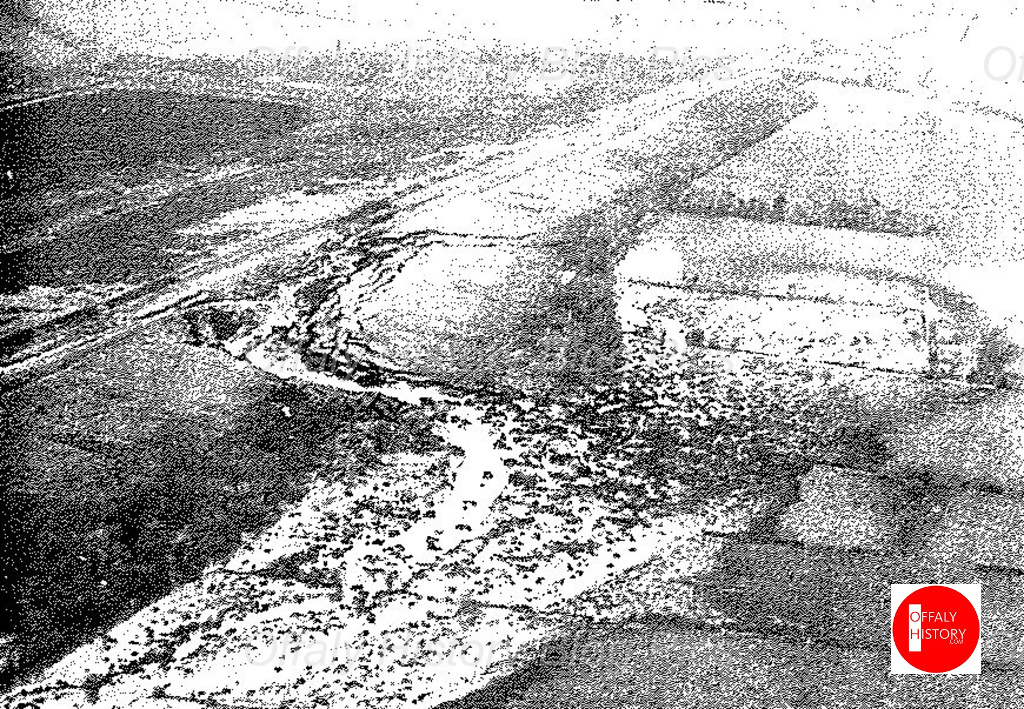
In 1916, again, there was a breach in the canal at Edenderry in the north bank of the canal near Blundell Aqueduct. On 11 January 1916, 300 yards of bank were carried away. Wayte had dams erected to try and keep trade moving and to help in bringing clay to the sit. The Leinster Leader vividly depicted the aftermath of the breach:
‘…no description, however graphic, could have prepared them for what they saw-the havoc wrought by the muddy rushing water, the enormous force that must have pressed it outwards, the utter impotence of the protecting line to resist the pressure and the great cataclysm that resulted….Again the breach took place on exactly the same spot as the great breach of 60 years ago.’[viii]
The cause of the breach was attributed by Gordon Thomas, engineer to the Grand Junction and Regent’s Canals, to ‘boisterous weather’ and ‘heavy rainfall.’[ix] Soon after Wayte decided to use three rows of new piles, backed and filled in with clay and bog material. Work in February was hampered by gales and snow with the workers exhausted. In March snows and blizzards continued to slow down progress. In early April, Wayte was able to report in his weekly report to the G.C.C. Board that the repair work had been completed.[x]

From 1917 to 1920 the government subsidised maintenance costs of the canal and paid war bonuses to the G.C.C. employees.[xi] During the Civil War conflict erupted on the canal when stores were burned and boats were attacked. By 1922, with the end of the revolutionary period, the Downshire estate consisted of 6,780 acres, most of it being unleased bog land. And in 1923 with the passage of the Irish Free State’s Land Act, the process of land purchase was completed. In 1950 the Grand Canal was nationalised under Córas Iompair Éireann at a cost of 1.25 million.[xii]
With the development of the River Shannon as a tourist amenity it was shown the Grand Canal still had a post-nineteenth century role for the Irish economy. The final barge to leave Edenderry Harbour was the 48M Canal Barge in May 1960, ending over 150 years of service.[xiii] The Edenderry branch had become impassable with weeds and was cleared and reopened for the opportunity tourism brought with it. An advertisement for the sale of the warehouse at the harbour, as part of the winding up of the financial use of the canal, was placed in the Offaly Independent in October 1960.[xiv]

The canal breach of January 15th 1989 was the worst seen since 1916. 400 meters of the north embankment broke away at the midway point between Blundell Aqueduct and the Edenderry line.[xv] £1 million worth of damages was caused by the breach.[xvi] It would not be until March 1990 that the Office of Public Works would complete the repairs of the Edenderry canal.[xvii]
Stephen Rynne summed up the canal’s history as:
Fifty years in the thinking-out and arguing; fifty years in the making; almost fifty years flourishing; over a hundred years staggering along and not knowing from year to year when the final blow would fall.[xviii]
Since the 1990s festivals have become a recurrent sight during the summer season in Edenderry harbour. Canoeing too is popular today on the canal along with fishing. Among the fish inhabitants of the canal are roach, bream, perch and pike.[xix] The local inhabitants of Edenderry and the surrounding townlands and villages use the canal year-round as a walking route. The successful transition of Edenderry harbour and canal into a leisure and tourist amenity has given it a new lease of life into the twenty-first century.

Image Sources
‘Alesbury’s factory’, Mairead Evans and Therese Abbott, Safe harbour, p. 22.
‘Breach at Edenderry, 1989’, Safe harbour, p. 17.
‘Edenderry harbour and storehouse, 1971’, Waterways Ireland, (https://archive.waterwaysireland.org/collections/4/the-delany-photographic-collection/290/edenderry-harbour-in-1971) (11 Mar. 2024).
‘Last barge, 1960’, Safe harbour, p. 26.
‘Map of the canal and railway lines’, Ruth Delany, The Grand Canal, figure 23.
[i] Ruth Delany, A celebration of 250 years of Ireland’s Inland Waterways (Belfast, 1992), p. 5.
[ii] Delany, The Grand Canal (Newton Abbot, 1973), p. 165.
[iii] Delany, The Grand Canal of Ireland (Dublin, 1995), p. 175.
[iv] W. A. Maguire, ‘Missing persons: Edenderry under the Blundells and the Downshires, 1707-1922’ in William Nolan and Timothy P. O’Neill (eds), Offaly: history & society (Dublin, 1998), pp 515-42 at p. 537.
[v] Delany, Ireland’s Inland Waterways, p. 140.
[vi] Mairead Evans and Therese Abbott, Safe harbour: the Grand Canal at Edenderry (Edenderry, 2002), p 22.
[vii] Delany, The Grand Canal (1973), p. 203.
[viii] Leinster Leader, 22 Jan. 1916.
[ix] Delany, The Grand Canal (1973), p. 209.
[x] Delany, The Grand Canal (1973), p. 210.
[xi] Delany, Ireland’s Inland Waterways, p. 141.
[xii] Mícheál Ó Riain, On the move, Córas Iompair Éireann, 1945-95 (Dublin, 1995), p. 123; Transport Act, 1950/12 [R.I.] (17 May 1950), sec. 23.
[xiii] Evans and Abbott, Safe harbour, p. 24.
[xiv] Offaly Independent, 8 Oct. 1960.
[xv] ‘Major breach near Edenderry,’ Waterways Ireland, (https://archive.waterwaysireland.org/collections/4/the-delany-photographic-collection/1942/major-breach-near-edenderry) (7 Mar. 2024).
[xvi] Offaly Independent, 20 Jan. 1989.
[xvii] Tullamore Tribune, 17 Mar. 1990.
[xviii] Evans and Abbott, Safe harbour, p. 25.
[xix] ‘Angling on the Grand Canal,’ Waterways Ireland, (https://www.waterwaysireland.org/places-to-go/grand-canal/angling) (11 Mar. 2024).
 offalyhistoryblog