
The current success of the Irish rugby side owes much in the opinion of many people to the success of our four provincial sides in the various competitions that are open to them. Yet when one thinks of Inter Provincial competitions, it is the GAA Railway Cups that most older followers of sport remember with great fondness. Sadly these competitions were last played for in 2016, and don’t seem like resuming at any time in the near future. The popularity of the games which were usually played at final stage on St. Patrick’s Day reached a height in 1954 when a crowd of 49,023 attended the final that year in Croke Park. The events were still popular despite lower attendances into the next two decades but a dramatic decline in those travelling to the final took place in the 1980s. A number of reasons can be put forward for this trend including the decision to televise the final from 1962, the growth in popularity of the club championship since 1971, as well as the greater and ever growing emphasis on individual county training regimes over the last 50 years or so.
There have been a number of strands to the evolution and concept of Irish Provincial competitions in the GAA . Firstly in 1905, a Railway Shield competition was started when the Great Southern and Western Railway Company donated two shields for hurling and football contests. One strange rule that formed part of the competitions was that if any Province should win the competition either two years running or three times in total, they would retain possession of the shield. This accounts for the very short shelf life of this venture for in football while Leinster were the inaugural winners in 1905 by beating Connacht 1-10 to 0-4 in the final, Munster won the next two finals in 1906 and 1907 thus bringing the competition to an end. A very noticeable feature of the Leinster teams which took part during the years stated were the fact that the lineouts were dominated by a small number of counties. For instance in 1905, 9 players from Kildare, 3 from Wexford, 2 from Dublin and Kilkenny each made up the team, while in 1907 the team was selected from players who had played with Dublin, Kildare and Kilkenny only. This may have been due to a reluctance to spread the net wide within the Province on the part of the selection committee. It is also quite possibly that many of the other Leinster counties at this time (like Offaly) were simply not that bothered about such a competition. In many respects and in hindsight, this may have proved a mistake for the counties concerned, for as John Clarke, the former Offaly GAA historian of note years later pointed out, those counties in the early years of the GAA who were not “county or provincial conscious”, struggled to make the breakthrough in their own Provincial and All Ireland Championships in the years and decades ahead.
The second phase of Inter Provincial events occurred during the Tailteann games of 1924 and 1928. There was a better representation of six counties on the Leinster team in 1924 that lost the final to Munster by one point, having overcome Connacht in the Semi-Final. There were no formal Inter-Provincial competitions included in the programme for the 1928 event but a once off game between Leinster and Ulster took place in a curtain raiser to the Ireland – American Hurling International. On that occasion the Leinster side had an easy victory by 6-7 to 1-6 but sadly no player from Offaly was picked to play in either 1924 or 1928. When the third and final Tailteann Games took place in 1932, there were no Inter-Provincial games on the programme for by that point, the Railway Cups were up and running.
This third strand of Inter-Provincial competition had started in 1927, attracting a good crowd of 10,000 to the first finals. By 1939, the attendance figures had jumped to 21,151 and continued to rise during the years of the second World War despite the travel restrictions and petrol shortages during the 1939-1945 period. In fact it was often a common sight for GAA supporters from counties like Offaly to cycle to the finals in Croke Park on St. Patricks day. The selection of Tom McEvoy from Gracefield at full back on the winning Leinster side in 1939 also helped to spark a great interest among GAA followers in Offaly towards the Railway Cups from that year onwards. Tom has the distinction of being the first player from the county to win a Railway Cup football medal. The following list is a compilation of Offaly footballers who followed the success of Tom McEvoy and the years are listed when they lined out or were substitutes on successful Leinster sides. It was always regarded as a great honour among players to be selected for their province, and in many respects an Inter-Provincial medal was regarded very highly like All-Star awards are at present. The first player from Offaly to be selected for Leinster was Bill Mulhall of Walsh Island. He was initially selected at left half back on the team to play Munster in Portlaoise in 1937, while Tommy Connor from the famed Island club was chosen as a substitute. However when two of the Meath players selected to play had to cry off, the Leinster selectors then altered their lineout and Mulhall took his place at right left back while Tommy Connor came in at centre half forward on the day when Leinster went down to Munster in the Semi-Final of the competition.
Offaly Inter-Provincial Winners with Leinster. Key (s) = Substitute
| Player | Club | Year(s) |
| Tom McEvoy | Gracefield | 1939, 1940, 1944 (s) |
| Bill Mulhall | Walsh Island | 1939 (s), 1940 |
| Jim Kelly | Tullamore | 1945 (s) |
| Paddy McIntyre | Cloghan , Sean McDermotts | 1945 |
| Mick Casey | Rhode | 1952(s), 1953 (s) |
| Paddy Casey | Rhode | 1954 (s), 1955 |
| Greg Hughes | Cloghan | 1959, 1961, 1962 |
| Peter Nolan | Clara | 1959 |
| Sean Brereton | Clonbullogue , W. Island , Daingean | 1959, 1961, 1962 |
| Willie Nolan | Clara | 1961, 1962 |
| Paddy McCormack | Rhode | 1961, 1962 |
| Johnny Egan | Doon, Tullamore, Kickhams | 1961 |
| Mick Brady | Edenderry | 1961 |
| Charlie Wrenn | Air Corps, Killeigh | 1961, 1962 |
| Sean Foran | Edenderry | 1961, 1962 (s) |
| Har Donnelly | Air Corps | 1962 (s) |
| Tommy Greene | Daingean | 1962 |
| Kevin Kilmurray | Daingean | 1973 with Combined Universities |
| Sean Evans | Ballyfore , Edenderry | 1974 (s) |
| Martin Furlong | Tullamore | 1974 |
| Mick Ryan | Tullamore | 1974 |
| Mick O’Rourke | St. Marys , Killeigh | 1974 |
| Eugene Mulligan | Rhode | 1974 |
| Sean Lowry | Ferbane | 1974 |
| Paddy Fenning | Tullamore | 1974 |
| Sean Cooney | Erin’s Rovers | 1974 |
| Willie Bryan | Walsh Island | 1974 |
| Johnny Mooney | Rhode and Raheen | 1985, 1986 |
| Padraig Dunne | Gracefield | 1985 |
| Richie Connor | Walsh Island | 1985 (s) |
| Mick Fitzgerald | Gracefield | 1985 (s) |
| Brendan Lowry | Ferbane | 1986 (s), 1987 |
| Denis Kelly | Ferbane | 1988 |
| Dave Kavanagh | Tullamore | 1988 |
| Peter Brady | Edenderry | 1988 |
| Mark Plunkett | Tullamore | 1988 (s) |
| Jimmy Stewart | Clara | 1988 (s) |
| Finbarr Cullen | Edenderry | 1996 (s) 1997 (s) |
| Cathal Daly | Tullamore | 2001 |
| Ciaran McManus | Tubber | 2001, 2002 |
| Colm Quinn | Ballycumber | 2001, 2002 |
| Padraig Kelly | Shamrocks | 2005 (s) |
| Karol Slattery | Gracefield | 2002, 2006 |
Tom McTeague and Matt Connor, two of Offaly’s greatest forwards don’t feature on the winners’ list despite playing regularly for Leinster. In total, 43 Offaly players have won Railway Cup medals while Jody Flaherty (1941) and John Dowling (1960) have refereed finals.

The last Offaly player to play in a Railway Cup football final was Brian Connor of Walsh Island when he lined out at right half forward in the defeat to Ulster at Croke Park on February 24th 2013. Later in 2015 Offaly players Alan Mulhall, Johnny Maloney, Graham Guilfoyle and Niall McNamee were selected on the Leinster panel for the provincial semi-final, but due to inclement weather, the two semi-finals for that year were cancelled and never rescheduled. The last time that a Leinster side took the field was at Parnell Park on December 11th 2016, when Connacht were victorious by one point in the second semi-final by 2-17 to 1-19. The last 4 players from Offaly to represent the province that day were Alan Mulhall as goalkeeper, Nigel Dunne at right corner forward, while both Graham Guilfoyle and Peter Cunningham made appearances as substitutes. It seems fitting to point out that there was a family link between Alan Mulhall from 2016 and Bill Mulhall (his grandfather) who won his first medal in 1939. It is also important to note that 3 of the players listed earlier, namely Willie Nolan (1961), Greg Hughes (1962) and Martin Furlong (1974) captained Leinster to provincial success. In the years of the Railway Cups, no Offaly player managed to win interprovincial medals in both hurling and football, nor has any player from the county managed to line out in both competitions. The only players from Leinster who won medals in both were Des and Lar Foley, Mick Holden and Conal Kearney (all of Dublin) and Pat Dunny of Kildare. Other players who played both codes for Leinster were Nicky Rackard of Wexford, Paddy Quirke of Carlow and Des Ferguson of Dublin.

Incidentally no Leinster player ever managed to captain his county to Leinster SFC success, All Ireland success, and Railway Cup success in the one calendar year. Those who come closest to achieving this feat were Paddy Meegan of Meath who then captained Leinster in 1952, but he lost out in the All-Ireland to Cavan, Willie Nolan of Offaly in 1961 going out to Down in the All-Ireland, Brian Mullins of Dublin in 1985 losing that year’s All-Ireland to Kerry while the last to come close was Stephen Cluxton , who led the Dubs to Leinster and All-Ireland success in 2013, but lost out as captain of Leinster against Ulster that same year. In the roll of honour, Ulster have won most interprovincial football finals with 32 victories, Leinster have 28 wins, Munster have 15 wins, Connacht have 10 wins, while the combined universities have one victory from 1973. Before the Railway Cups ended in 2016, the years 1990, 2010, 2011 and 2015 saw no games in the competition.

Much of the research for this blog was kindly taken with permission from Dermot Kavanagh’s book “The Story of Interprovincial Football”. Dermot also published a similar book on the history of the Railway Cup hurling finals, and he still has some copies of both for sale. These beautifully presented books retail at 20 euro each, which includes P + P. Dermot can be contacted at dermotkavanagh@yahoo.com for anyone who wishes to purchase his books.
If I have omitted any winning player from the list compiled, please feel free to contact me on (086) 3376115 so that the record can be put in order.
Our thanks to Sean McEvoy for his great research on GAA sports.
If you have have a story to publish and wish to prepare one why not contact us at info@offalyhistory.com You too can join a sort of Hall of Fame of Offaly History bloggers – meaning contributors to our weekly articles on the cultural heritage of Offaly. So go to the keyboard and stop talking about doing it.!
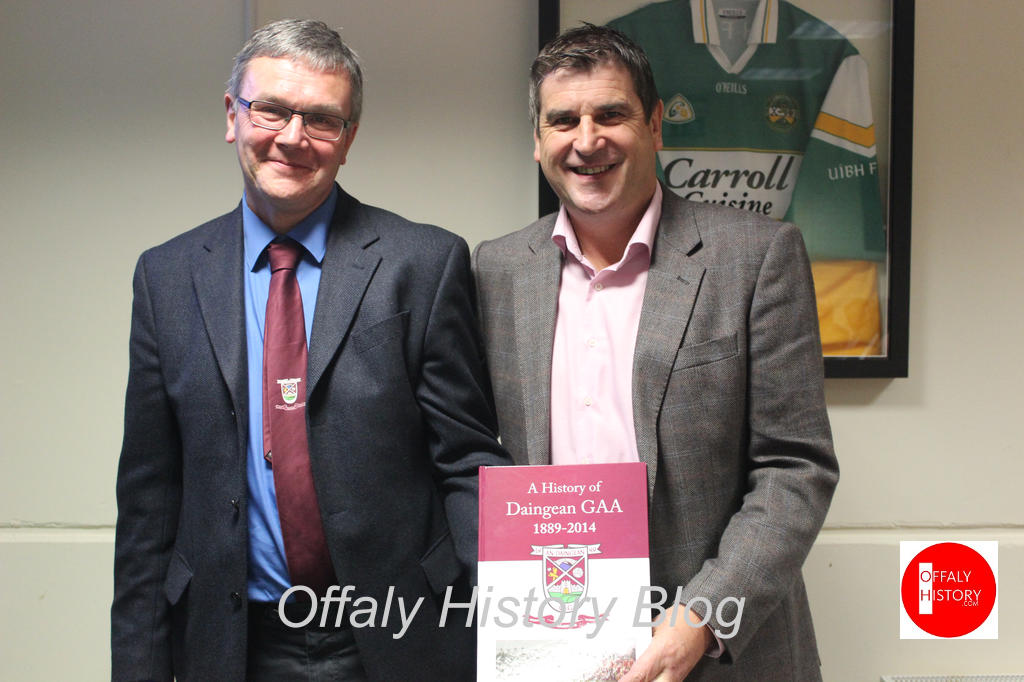
The pics for this article were supplied by Offaly History and not the author. Three of the five were from the launch of Sean McEvoy’s Daingean GAA history of 2017 in tribute to his ongoing work.

Supported by the Department of Culture Communications and Sport as part of the Commemorations Series for 2025.
 offalyhistoryblog