
In early 1914, a controversy erupted over public access to Durrow Abbey that illuminates broader tensions regarding cultural heritage, religious identity, and national monuments in pre-independence Ireland. The dispute began when the Local Government Board ordered the closure of Durrow’s graveyard, citing “insanitary conditions.” This administrative decision catalyzed a remarkable public debate that revealed deep fissures in how Ireland’s sacred spaces were controlled, preserved, and accessed.
On Monday, 24 March. at 7 30 p.m. (please note the earlier time) Angus Mitchell will speak at Offaly History Centre, Tullamore. All are welcome. The public lecture is titled:
Sacred Space and Public Access: The Durrow Abbey Controversy of 1914
The 1914 controversy over public access to Durrow Abbey serves as a compelling lens through which to examine broader questions of cultural heritage, national identity, and preservation rights in pre-independence Ireland. When historian Alice Stopford Green published her indignant letter about restricted access to this ancient monastic site, she ignited a significant public debate that transcended local boundaries. The ensuing discourse, played out in Ireland’s leading newspapers, revealed deep tensions about proprietorial rights, Protestant privilege, and the role of local authorities in monument preservation. This controversy emerged at a crucial moment when sacred spaces were being reimagined as vital coordinates in Ireland’s cultural landscape. The debate highlighted a fundamental disparity in how ancient monuments were protected under British law in Ireland compared to Britain itself, raising questions about cultural sovereignty that would resonate well beyond independence. Though the immediate controversy lasted only weeks, its implications for heritage management and public access endured well past 1922. That Durrow Abbey remains largely inaccessible to the public in 2025 invites reflection on the persistent challenges of balancing preservation, private property rights, and public cultural access. This lecture examines how historical controversies about sacred spaces shaped, and continue to shape, dialogues about cultural identity and heritage management in Ireland.

The controversy gained national attention through historian Alice Stopford Green’s intervention. Her letter to multiple newspapers in February 1914 recounted a visit to Durrow she had made eighteen months earlier with the Belfast antiquarian Francis Joseph Bigger. Their experience of encountering locked gates, prohibitive signage, and general inaccessibility formed the basis of a pointed critique about proprietorial control of sacred spaces. The fact that the monastery lay within the grounds of the Otway Toler family – descendants of the infamous “hanging judge” Lord Norbury – added historical resonance to questions of ownership and entitlement.

Alice Stopford Green c. 1908
The historiographical significance of this controversy lies in how it intersected with multiple strands of cultural and political discourse in pre-revolutionary Ireland. Stopford Green, already established as an anti-colonial nationalist historian challenging traditional British interpretations of Irish history, positioned the Durrow dispute within a broader critique of Protestant ascendancy and imperial control. Her argument that a “Catholic public body” would better manage such sites deliberately provoked debate about denominational rights and responsibilities toward national monuments.

Access to Durrow Abbey was difficult in 1914 and is no easier today.
The press response was particularly revealing. The Freeman’s Journal endorsed Stopford Green’s position, advocating for local authority control of ancient monuments. The Irish Times, conversely, dismissed her intervention as “ill-conditioned,” exemplifying how the controversy mapped onto existing political and cultural divisions. The most nuanced analysis came from The Irish Independent, which contextualized the dispute within contemporary European debates about monument preservation, citing similar controversies in France and Hungary.
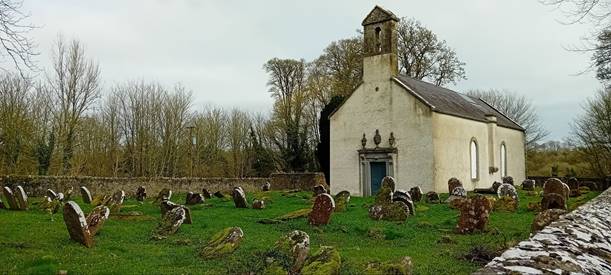
Durrow Church and Graveyard post the works of 2003-12
Particularly significant was the intervention of R.J. Kelly K.C., a council member of the Royal Society of Antiquaries. His observation that the Ancient Monuments Consolidation and Amendment Act (1913) had not been extended to Ireland highlighted a crucial legal disparity in heritage protection between Britain and Ireland. This legislative inequality became emblematic of broader cultural and political subordination.
The controversy’s timing, on the eve of the First World War and amid growing nationalist sentiment, invested it with additional significance. Durrow’s association with St. Columcille made it particularly potent as a symbol of indigenous Irish Christianity and cultural autonomy. The site’s inaccessibility could thus be read as symptomatic of colonial dispossession, while demands for public access represented assertions of cultural repatriation.
Methodologically, this historical episode offers rich material for analyzing how local disputes could acquire national significance through strategic deployment in broader political and cultural debates. The variety of contemporary sources – from newspaper editorials to private correspondence – allows for reconstruction of how different constituencies understood and deployed the controversy for their own ends.
The dispute’s resolution, or lack thereof, is equally instructive. Despite the public outcry, meaningful change in access arrangements proved elusive. This pattern of controversy without substantial reform would characterize many similar disputes about Irish cultural heritage sites in the revolutionary period and beyond.

Holy Well at Durrow
Moreover, the Durrow controversy exemplifies how sacred spaces became contested sites in the construction of Irish cultural identity. Stopford Green’s parallel campaign against Lord Aberdeen’s attempt to adopt ‘Tara’ in his title demonstrates how ancient religious sites were being reconceptualized as coordinates in a sacred geography of Irish nationalism.
The contemporary resonance of this historical controversy is striking. That Durrow Abbey remains largely inaccessible to the public in 2025 suggests the enduring complexity of balancing private property rights with public cultural access. The arguments articulated in 1914 about preservation, accessibility, and cultural heritage continue to inform debates about monument management in twenty-first century Ireland.
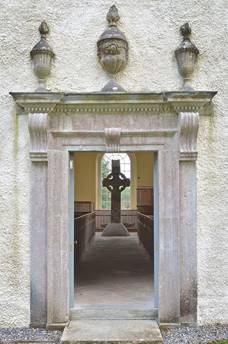
The Cross of Durrow is now protected inside the church.
This historical case study thus offers valuable insights into how controversies over sacred spaces shaped, and continue to shape, discussions about cultural identity and heritage management in Ireland. It reminds us that questions of who controls, preserves, and accesses historical monuments remain as pertinent today as they were over a century ago.
The Durrow controversy also merits examination within the broader context of Alice Stopford Green’s intellectual project. Her engagement with this local dispute aligned with her larger historiographical mission to recover and reframe Ireland’s medieval past as foundational to modern Irish identity. As a prolific author of a historiography promoting Irish nationality and a founder of the School of Irish Learning, Stopford Green brought considerable scholarly authority to the debate. Her intervention transformed what might have remained a provincial dispute into a platform for examining broader questions about cultural sovereignty and historical interpretation.
The controversy’s archival footprint reveals fascinating intersections between public discourse and private correspondence. Letters between Stopford Green and R.I. Best at the National Library of Ireland demonstrate how the scholarly community engaged with these questions behind the scenes, while newspaper coverage shows how the debate was framed for public consumption.
Furthermore, the Durrow dispute illuminates the complex relationship between Protestant intellectuals and Irish cultural nationalism. Stopford Green’s position as a Protestant championing Catholic access to historically significant sites challenges simplistic sectarian narratives. Her collaboration with the Belfast solicitor Francis Joseph Bigger, another Protestant antiquarian deeply engaged with Irish cultural revival, suggests how shared scholarly and preservationist interests could transcend religious divisions.
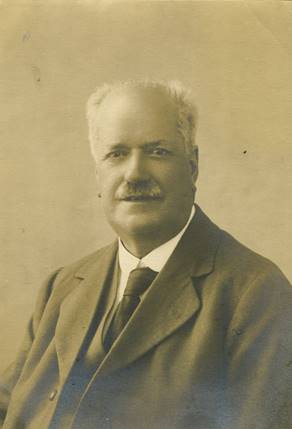
F.J. Bigger
The Durrow Abbey dispute represents more than a mere historical curiosity; it exemplifies how local controversies can illuminate broader patterns of cultural contestation and national identity formation. In revisiting this episode, we gain deeper understanding of both the historical dynamics of cultural heritage disputes and their continuing relevance to contemporary debates about preservation and access to sacred spaces in Ireland.
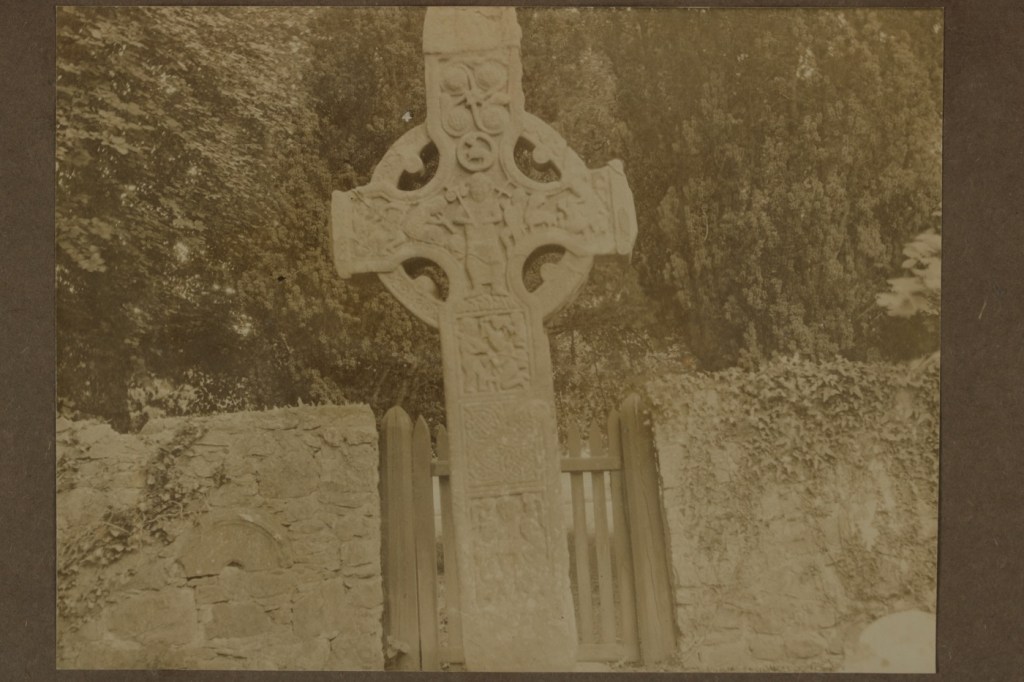
Angus Mitchell is a public historian and lives in Ireland. His work focuses on the disremembered Protestant intellectuals of the War of Independence, most notably Alice Stopford Green, Roger Casement and Francis Joseph Bigger. He undertook research for this lecture thanks to a grant from the Royal Irish Academy Decade of Centenaries Bursary 2023/24. Part of his work on the 1914 Durrow Abbey controversy is published in Ríocht na Midhe xxxv1, 2025.
Our thanks to Angus Mitchell for his blog article and for his lecture on Monday 24 March.
 offalyhistoryblog