
Richard Rothwell holds a place as Ireland’s foremost portrait painter of the 19th century but there has been much confusion about his identity owing to W.E. Strickland’s biography of him in ‘A Dictionary of Irish Painters’ (1913), which had him born in Athlone, a son of James Rothwell, and a descendent of the Rothwells of Co Meath, none of which was correct. This was repeated by other art historian and in a 1961 family history by his descendant Desmond Rothwell of Montreal, where Desmond wrote that Richard’s grandfather was Thomas Rothwell of Lisdaly, Co. Offaly, and that his father, James Rothwell, married Elizabeth Holmes and had seven children. He states that James fled Ireland in 1798, perhaps to America, after he allowed forces to rest overnight in his barns during the 1798 rebellion. This tradition, however, is not compatible another tradition recorded by Desmond of Richard supposedly being born in Athlone in 1800.
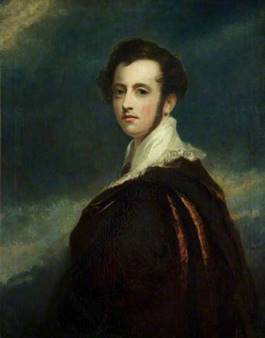
DNA testing combined with the use of primary sources have shown that these accounts are mistaken. Richard is believed to have been born on 20 November 1801 and on his census returns of 1841 and 1861 he indicates that he was born in Dublin, although this may have been written for convenience, as he may well have been born at the family home in Offaly. An extensive search of the Athlone parish registers show that no Rothwells were baptised in any of its churches and furthermore, the 1847 marriage certificate of Richard’s sister, Sarah Watson Rothwell, names her father, therefore his father, as William Rothwell, not James, whilst the Y-DNA of his family shows that they are a branch of the Rothwells of South East Ireland. The genetic link to the Rothwells of Rockfield, Co. Meath is more than couple of centuries further back. It can be said with certainty therefore, that Richard’s father was William Rothwell of Co. Offaly, who is described in some records as ‘gentleman,’ who became a publican at Ferbane, Co. Offaly. In 1823 William acquired 19 acres from Thomas Horn of Ballicknahee, paying £272 10s with a perpetual renewal of lease and payment of a proportionate amount of rent annually on the land, which was part of a larger 61 acre parcel. (Deed memorial 779.97.527432). William Rothwell of Ballicknahee and James Rothwell of Lisdaly were likely to have been brothers as Isaac Bagley, William Rothwell’s son-in-law, appears to have occupied the 196 acre townland of Lisdaly after James Rothwell. Isaac married Eliza Rothwell a daughter of William Rothwell and Elizabeth Holmes of Ferbane and Ballicknahee.
The Rothwell’s of Co. Offaly may well descend from a Thomas ‘Radwell,’ who in 1680 is named as a member of the Mountmellick, Co. Laois, Quakers. The Quakers held their first meeting in Ireland at Mountmellick in 1659, and the first official Quaker Meeting House was built there in 1709. As the DNA confirms a close link to the Rothwells of Co. Wexford, Thomas may well have been a brother to a number of contemporary Rothwells, some of whom appear as members of the Quaker community in north-east Co. Wexford in the late 1600s.
Although Richard the artist’s mother is confirmed as Elizabeth Rothwell née Holmes, only three siblings, a brother and two sisters, have been identified for Richard, rather than the seven usually stated. These are Francis Rothwell of Ballicknahee, Co. Offaly, who died in 1893; Sarah Watson Rothwell who married Thomas Dickson and who died in Dublin in 1901; and Eliza Rothwell who died in 1899, the wife of Isaac Bagley. James Rothwell of Lisdaly, near Cloghen, Co. Offaly, was almost certainly an uncle of Richard’s, as is likely the Richard Rothwell who died in 1830 at Wellington Barrack, Tullamore. Richard’s daughter Marguerita Rosalie (Margo) Rothwell (1856-1916) also was a notable Irish artist but her contribution has been largely overlooked as is that of her sister, Frances who married Richard Patterson. A biography of Richard Rothwell was researched by Ruth Devine and is to be found under his entry in the ‘Dictionary of Irish Biography,’ (2009, revised 2022). Richard’s brother, Francis Rothwell of Ballicknahee, Clara, Co. Offaly, who died on 17 October 1893, married Hannah Linney, the eldest daughter of Charles Linney, Gent. of Baylin, Westmeath. Hannah’s marriage portion was £100, and Francis’ father, William, gifted them 19 acres on the condition that if they had no issue, the property was to go to William’s eldest son (Richard Rothwell the artist) contingent on him paying £50 to his sister Sarah. William’s wife Elizabeth, ‘otherwise Holmes,’ was to receive £10 a year. (Deed memorial 847.230.567250). Francis appears in the 1876 list of landowners, as owning 30 acres at Clara, Offaly. One of his sons, Francis Charles Rothwell, settled at Clunes, Victoria, Australia where he died on 17 June 1891. Another son, Thomas Rothwell, continued farming at Ballicknahee and died there on 18 February 1920.
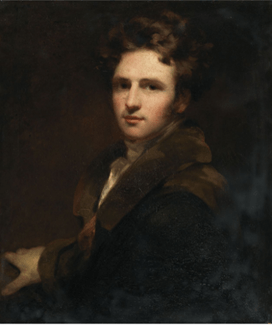
Richard Rothwell self-portrait.
(National Gallery of Ireland, Public domain, via Wikimedia Commons).
In 1814, Richard Rothwell joined the Dublin Society School of Art in Hawkins Street, where he won a silver medal for his studies in 1820 and in 1824 he was elected to associate membership of the Royal Hibernian Academy. Leaving for London in 1829, Richard became sought after as a portrait painter and painted portraits of the Duchess of Kent, mother of the future Queen Victoria, and the young Princess Victoria herself.
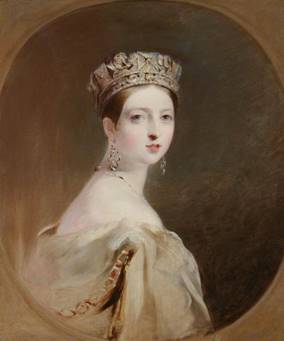
Princess Victoria by Richard Rothwell. Courtesy National Trust Images.
Deciding to go to Rome in 1831 to study the Old Masters, the Duchess gave Richard letters of introduction to several Italian courts. Richard lived in Italy for three years, returning to London in 1834, he found that his well-intentioned study tour proved somewhat of a mistake as he found that other painters had become fashionable in his absence, and the Duchess was offended because he had not used her letters of introduction. Nevertheless, he was not short of work.
In 1842, Richard married Rosa Marshall, daughter of surgeon, Andrew Marshall, and the couple lived at 31 Devonshire Street, Portland Place, London until they decided to settle at Rose Cottage, Willbrook, Rathfarnham, Dublin, in 1848. The couple met with tragedy when their eldest son William died aged seven in 1850, and with the subsequent death of their eldest daughter, Isabella aged nine in 1852 Richard appears to have suffered serious depression. The couple left Rose Cottage following Isabella’s death and he resigned from the RHA in 1854, although he was elected an Honorary Member. Leaving for America in 1854, Richard’s letters reveal a yearning to completely change his life and live as a farmer but this never happened. At the end of 1855, he took his family to Rome where they lived for a year and a half before he decided to settle in Leamington, Warwickshire. In 1862, he moved the family to Belfast whilst he spent time in Paris, Brussels and Rome. His wife Rosa set up a school.
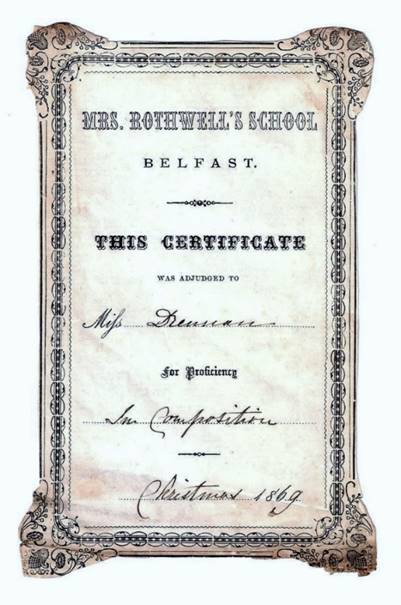
(Collection of Byrne-Rothwell).
Richard is perhaps best known for his two portraits of his friend Mary Wollstonecraft Shelley (1797-1851), one of which was shown at the Royal Academy in 1840. She was the widow of radical poet Percy Bysshe Shelley and author of ‘Frankenstein.’
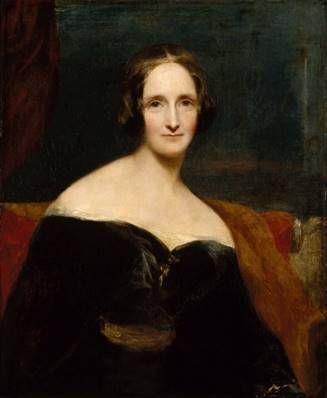
Mary Shelley “child of love and light.” (Wikimedia Commons, PD-Art tag).
Richard is also known for his portrait of United Irishman, Francis McCracken (1762-1842), who, coming under suspicion, fled from Belfast to America in 1798, although he returned to Ireland in 1800. Francis was the brother of Henry Joy McCracken (1767-1798), a founder of the United Irishmen in Belfast, who was executed.
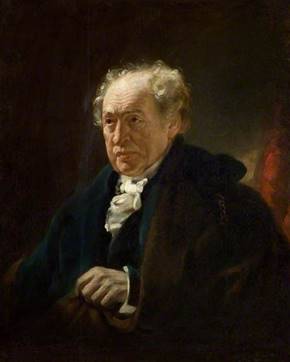
Francis McCracken by Richard Rothwell c. 1835. (Courtesy Ulster Museum Art Collection).
Little is known of Richard’s life in his last few years on the Continent. Contracting a fever, he died on 8 September 1868 in Rome although some newspapers reported his death as being in Paris. He was buried in Rome on 12 September in the same cemetery as poets John Keats and Percy Bysshe Shelley.
Richard’s daughter, Margarette (Margo) Rothwell (d. 1916), followed in her father’s footsteps to some degree. Living the latter part of her life on Claremont Avenue, Belfast, she is best known for her portrait of Isabella Tod who founded the North of Ireland Women’s Suffrage Society, the first campaign movement established in Ireland for the right of women to vote.
It seems that two of Ireland’s most talented portrait artists had deep roots in Co. Offaly.
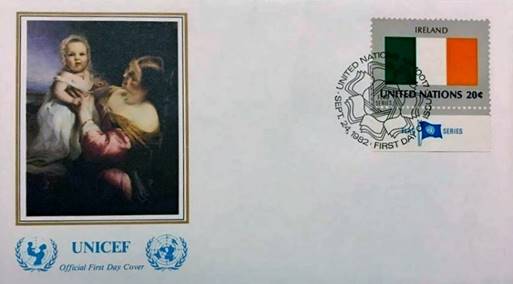
UNICEF first day cover of 1982 depicting ‘The Mother’s Pastime,’ Richard’s portrait of his wife Rosa and their first child Isabella. Sometimes known as ‘Madonna and Child.’ (Collection of Byrne-Rothwell).
This series is supported by Offaly County Council’s Creative Ireland community grant programme 2025-2027.
 offalyhistoryblog