
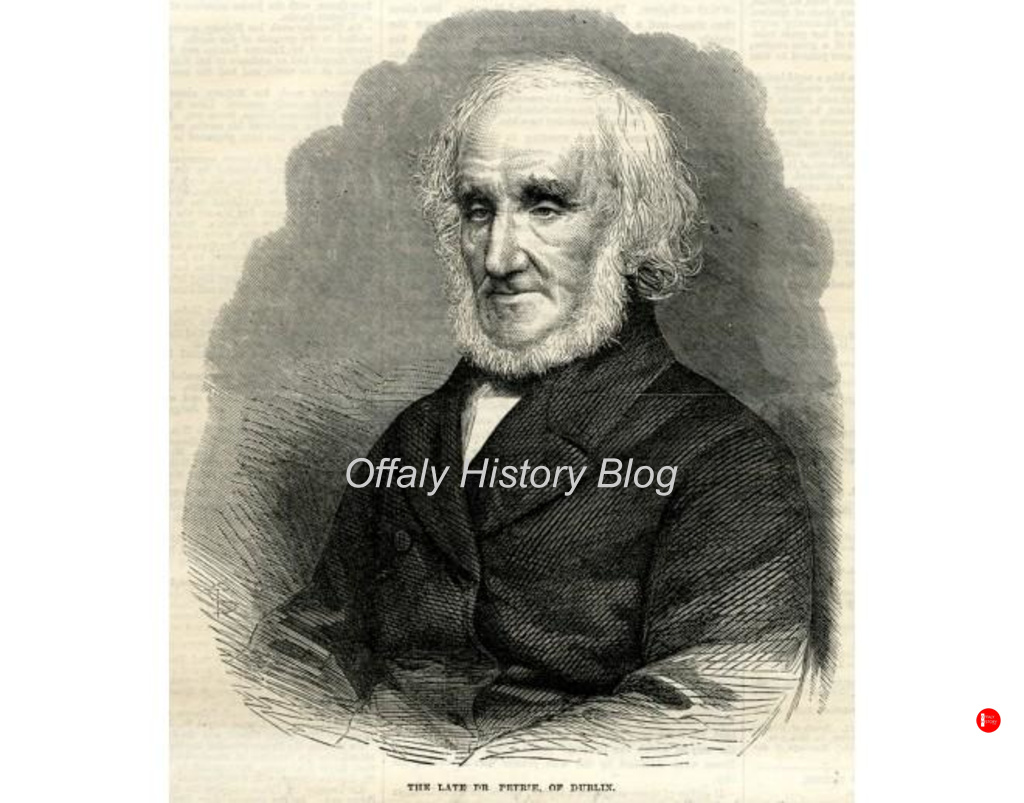
George Petrie was born in Dublin in 1790 and has a strong King’s/ County Offaly connection through his work at Clonmacnoise, Birr, Banagher, Clonony, Lemanaghan and Rahan. He may have been the most significant topographical artist so far as Offaly is concerned. He was certainly the greatest exponent of the heritage of Clonmacnoise first visiting the site in 1818–22. Dates differ as the visits to Clonmacnoise as was noted in the most attractive publication by Peter Murray and published by the Crawford Gallery in 2004.[1] The other great work on Petrie is that of William Stokes, The life and labours in art and archaeology of George Petrie (Longmans, London, 1868). Also important is Crookshank and Knight of Glin, Irish painters, 1600–1940 (Yale, 2002).
The Dictionary of Irish Biography (DIB) entry by David Cooper records that Petrie, was an artist, antiquary and collector of Irish traditional music, and was born on 1 January 1790 in Dame Street, Dublin, the only child of James Petrie, portrait painter, of Dublin, and Elizabeth Petrie (née Simpson) of Edinburgh, Scotland. James Petrie (d. 1819) was born in Dublin of Scottish parents and studied at the drawing school of the Dublin Society. Afterwards he practised as a miniature painter and a dealer in jewellery, coins, and antique objects at 83 Dame Street. The collecting instinct would stand Irish heritage in good stead with James Petrie’s son George performing an outstanding archival and museum service.
George Petrie’s, DIB entry notes:
[Petrie] was educated at Samuel Whyte‘s school in Grafton Street and at the drawing school of the Dublin Society, where he learnt his craft as an artist, winning a silver medal for figurative drawing when he was thirteen. During his teens he developed an interest in archaeology, and sketches and detailed descriptions of artefacts are to be found in a journal dating from 1808. Petrie began his career as a landscape painter, working in both watercolours and pen-and-ink, and was noted for the excellence of his draughtsmanship. In 1816 he exhibited paintings of Glendalough and Glenmalure at the Royal Academy, and in 1818 visited Clonmacnoise, copying more than 300 inscriptions from monuments. He contributed numerous illustrations to guidebooks, including Thomas Cromwell, Excursions through Ireland (1819), and George Wright (qv), An historical guide to ancient and modern Dublin (1821) and Ireland illustrated (1829).
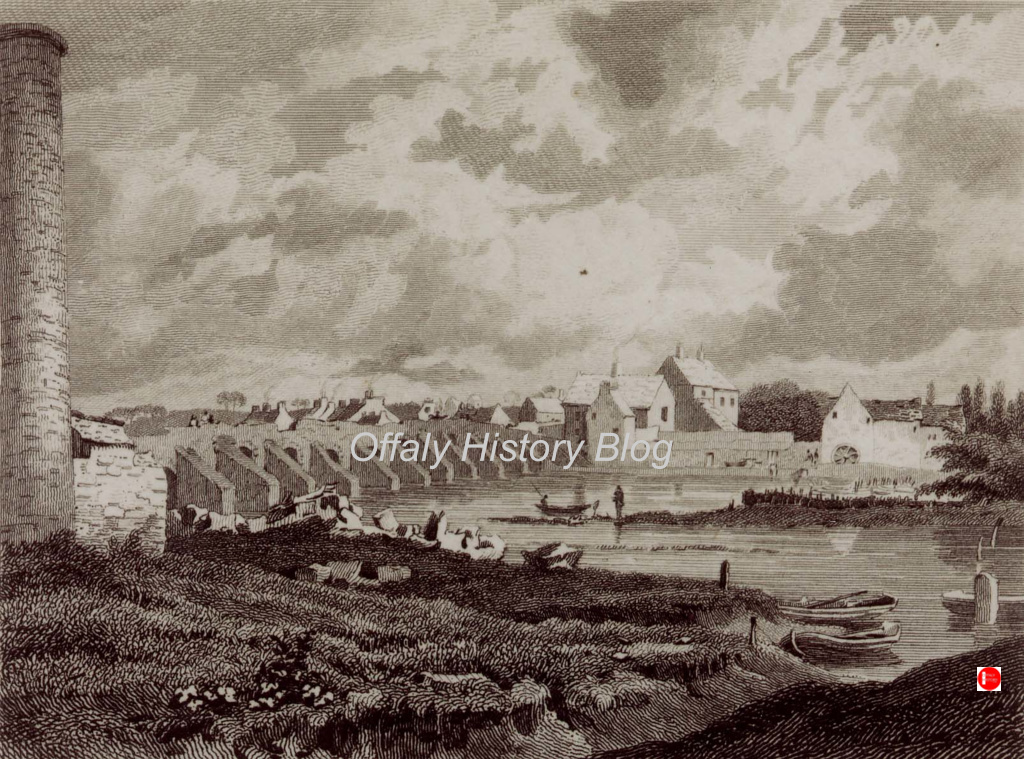
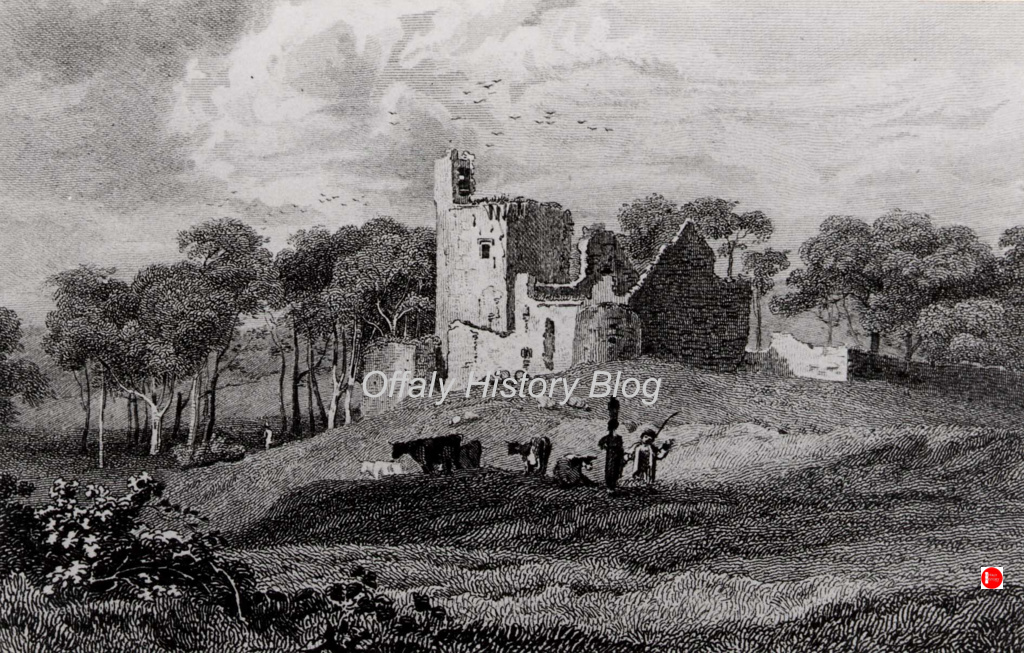
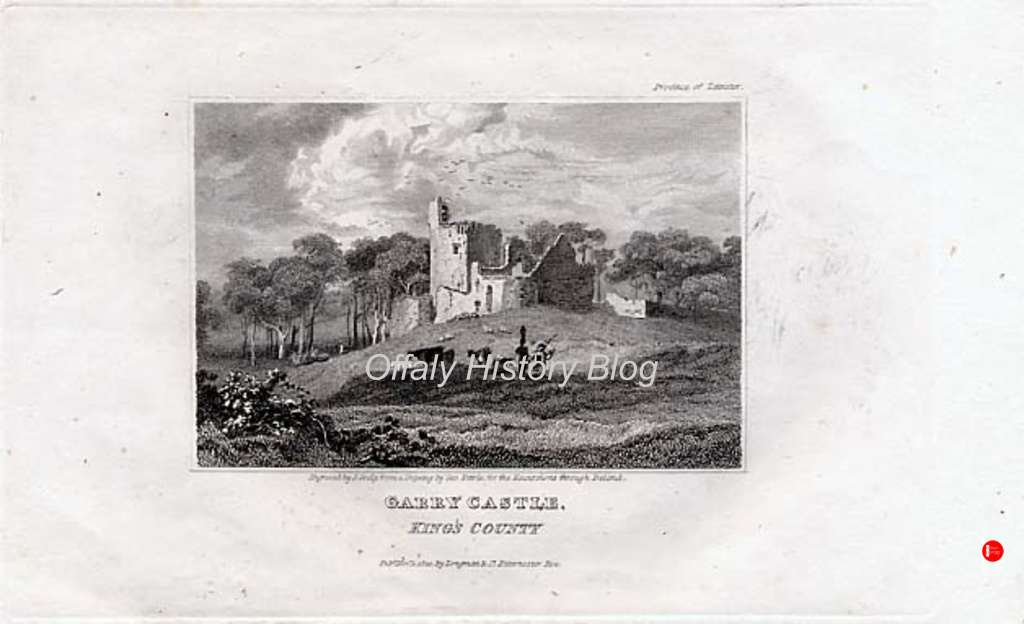
These were books of engraved views, all in monochrome and were popular in the 1820s, 1830s and 1840s. Of the 119 views in Cromwell’s Ireland (1820–21) Petrie prepared about two-thirds. These included The bridge at Banagher, Clonony Castle, Garrycastle and Clonmacnoise. For Brewer’s Beauties of Ireland (1826, two vols) Petrie’s included Birr Castle and Clonmacnoise. . . .
Petrie began to collect ancient documents for evidence that would help him to understand the inscriptions he had collected from monuments at sites such as Clonmacnoise, and these antiquarian activities eventually led to his election to the Royal Irish Academy (RIA) in 1828. . . Between 1832 and 1833 he coedited the popular periodical Dublin Penny Journal with the Reverend Caesar Otway (qv). . . Petrie contributed more than fifty articles, ranging from a discussion of the origin of phrenology to a study of ancient Irish trumpets. . .
Petrie was appointed to the topographical department of the new Ordnance Survey in 1833, and by 1835 was responsible for overseeing the orthography of place names and the cataloguing and description of historic artefacts, work that brought him into close working contact with the scholars Eugene O’Curry (qv) and John O’Donovan (qv). . .
Petrie had maintained his career as a painter and illustrator, and one of his finest watercolours, ‘The last circuit of the pilgrims at Clonmacnois’, was completed around 1838. He continued to work on The ecclesiastical architecture of Ireland, anterior to the Anglo-Norman invasion, comprising an essay on the origin and uses of the round towers of Ireland, finally publishing it in 1845.
Petrie died about 17 January 1866, and was buried in Mount Jerome cemetery on 22 January, 1866.
Petrie’s work on Christian inscriptions in Irish, edited by Margaret Stokes (qv), was published after his death (2 vols, 1872, 1878).
Alongside John O’Donovan and Eugene O’Curry the name of George Petrie (1790–1866) will forever be remembered as one of Ireland’s greatest scholars of the first half of the nineteenth century. It was a time when tremendous work was done by for Irish archaeology and history. Petrie was a major figure in the historical research section of the Ordnance Survey. Jeanne Sheehy in her The Rediscovery of Ireland’s Past 1830–1930 states that he was the founder of systematic and scientific archaeology in Ireland. Herity and Eogan in their Ireland in Prehistory were not so generous to him. Petrie’s famous essay on the Round Towers was published in 1845 and his Christian Inscriptions in 1872-8.
Petrie began his career as a painter and was the only child of James Petrie, a miniature painter. It was as a result of his visit to Clonmacnoise that his interest extended from art to antiquities. It is said that while at Clonmacnoise in 1818-22 he made over 300 drawings of the monuments there. In fact it may have been 1822 while on an extended visit. Many of these drawings were reproduced in Margaret Stokes (ed.) Christian Inscriptions in the Irish Language (Dublin 1872-8).
The Petrie drawings are the best known of Clonmacnoise today. It was he who provided the illustrations for Thomas Cromwell’s Excursions through Ireland (1820) and Brewer’s Beauties of Ireland of 1826. The Cromwell Excursions include views of Garry Castle (near Banagher), Clonony Castle, Banagher bridge, the castle at Clonmacnoise and McCarthy’s church and tower at Clonmacnoise. His drawing of Birr Castle used by Brewer in 1826 is outstanding and a beautiful representation.
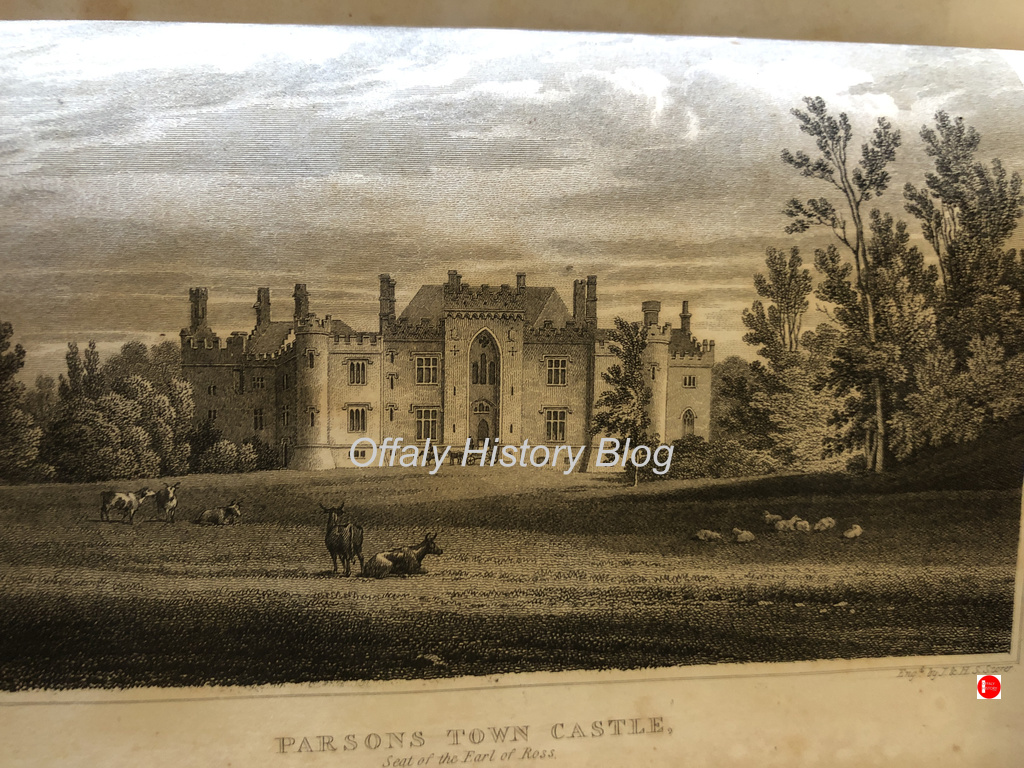
Birr Castle, two-storey over basement c. 1820 from Brewer’s Beauties etc 2 vols 1826
The RIA drawings collections notes of its Petrie holding that:
As an artist, he concentrated on landscape painting. He mainly used watercolours, but he also produced sketches in pencil, indian ink and sepia wash. .. He exhibited artworks annually at the Royal Hibernian Academy until the early 1850s. The National Gallery of Ireland holds a collection of his watercolours and antiquarian drawings bequeathed by Margaret McNair Stokes, Hon. MRIA (1832–1900). [She will be featured in an article in this series.]
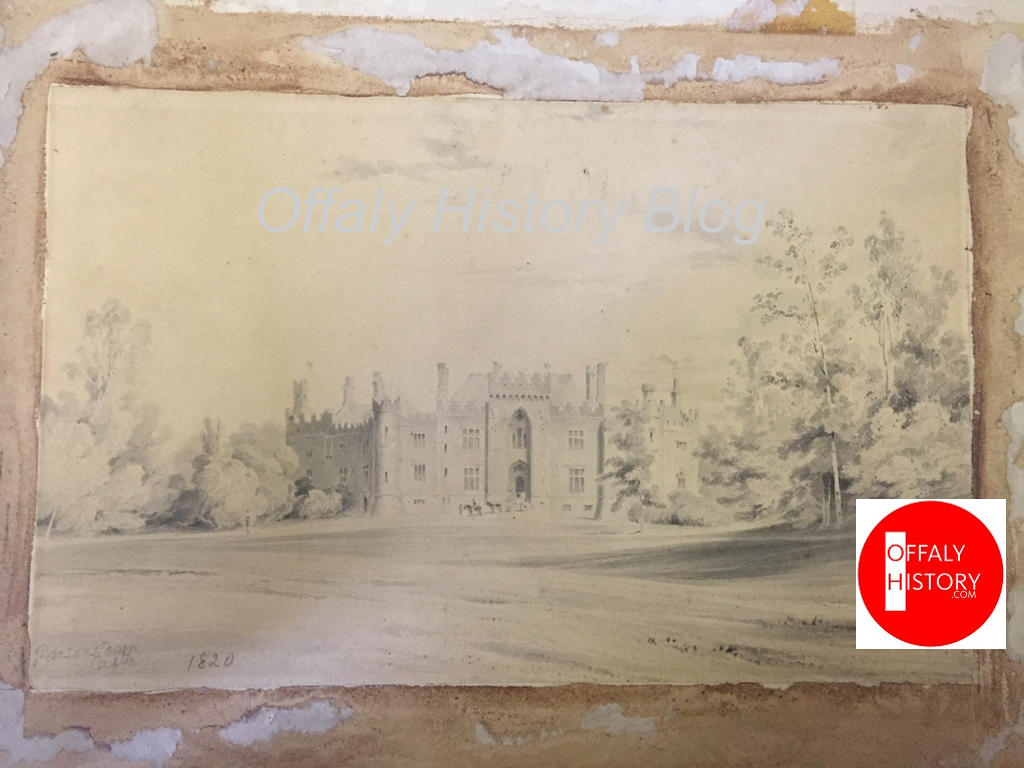
The Royal Irish Academy holds a set of Petrie’s watercolours depicting Dublin buildings and streetscapes (RIA 12 Q 14–27). This series of ‘Views of Dublin’ was created by George Petrie in 1821. They include the City Hall, Christ Church cathedral, St Patrick’s cathedral, Dublin Castle chapel and record tower, Parliament House on College Green, Theatre Royal, Carlisle Bridge and the Custom House, Sackville Street, the Pro-Cathedral, the Rotunda and Lying-in Hospital, King’s Inns, and the Four Courts. These watercolours formed the basis of a ‘Views of Dublin’ exhibition in the Academy Library in 2016. . .
The Academy Library also holds Petrie’s manuscript ‘Journal of a Tour to Longford and Sligo’ that contains neat pencil sketches, copies of inscriptions and notes on travel (RIA MS 23 L 44). The work is unsigned, but has been identified as that of George Petrie, and is dated 1837. A small number of sketches preserved among the Ordnance Survey drawings and memoirs held by the Academy are also attributed to Petrie.
Petrie was elected to the Council of the Royal Irish Academy in 1830 and thereafter devoted much of his time and money to building up an Academy library and museum of Irish antiquities. He organised the purchase of treasures such as the cross of Cong and the autograph manuscript of the second half of the Annals of the Four Masters (RIA MS 23 P 6–7), amongst many other Academy acquisitions. The establishment of a new library and museum exhibition space at 19 Dawson Street in the early 1850s was the culmination of decades of work by Petrie and his fellow Academy members. It provided tangible evidence of a collaborative commitment to the preservation of the Irish historical record and Irish antiquities. The museum artefacts were transferred to the National Museum of Ireland after it opened in 1890 while the Academy retained its manuscript treasures and research library. Irish language manuscripts acquired in the years of Petrie’s active involvement with the Academy remain as a core part of the library collections. His portrait, painted in oils by J. Slattery, hangs in the Academy library.
From the 1830s, Petrie became very involved in the publication of the Academy’s Transactions and Proceedings, contributing numerous articles himself as well as editing material by other authors. He was concerned with the visual aspect and readability of the Academy’s publications in addition to the academic content, and introduced a new typeface (still known as the Petrie A type) for use in printing Irish language material. The best known use of this Gaelic fount was in John O’Donovan’s edition of the Annals of the Kingdom of Ireland by the Four Masters, first published between 1848 and 1851,[ by Gill] but it was also used in printing Irish language text in the Ordnance Survey of County Londonderry, vol. 1 (1837), in the Academy’s Transactions from 1839, and in the publications of the Irish Archaeological Society. [these can be seen in the Offaly History Centre Library].
Petrie also designed a new device for the seal of the Royal Irish Academy. The pattern of shamrocks, incorporating the Academy’s heraldic shield and motto, enclosed within a circle, was used as the Academy’s logo in all of its publications from 1839 down to the early twenty-first century.
Petrie was also concerned to reach a wider audience and he initiated and contributed to the popular weekly Dublin Penny Journal, in 1832–1833. The magazine continued until 1836 but Petrie was no longer involved after it was sold to a new owner in 1833. Clearly believing in the value of writing material of cultural significance for a wide audience, Petrie established a similar magazine entitled the Irish Penny Journal in 1842, but it ceased publication after a year. These were non-political, non-religious, cultural magazines, featuring a variety of illustrated articles on Irish history, topography, archaeology and mythology.
Between 1833 and 1842 George Petrie was employed by the Ordnance Survey of Ireland where he oversaw the topographical department. He coordinated a team of researchers that included linguists such as John O’Donovan and Eugene O’Curry and artists such as William Wakeman and George Victor Du Noyer, who inspired one another to document and record many overlapping aspects of Ireland’s archaeology, topography and history.
Further Reading list provided by RIA entry [most of the books are available to view in Offaly History Centre].
The story of Irish museums, 1790–2000: culture, identity and education, Marie Bourke (Cork, 2011)
‘Petrie, George’ Dictionary of Irish Biography(opens in a new tab)
Dublin Penny Journal(link is external)(opens in a new tab)
Aloys Fleischmann, ‘Petrie’s contribution to Irish music’, Proceedings of the Royal Irish Academy, 72C (1972), pp. 195–218. (Available on jstor.org(link is external)(opens in a new tab)).
David Greene, ‘George Petrie and the collecting of Irish manuscripts’, Proceedings of the Royal Irish Academy, 72C (1972), pp. 158–163. (Available on jstor.org(link is external)(opens in a new tab)).
Irish type design: a history of printing types in the Irish character, Dermot McGuinne (Dublin, 2010).
George Petrie (1790–1866): the rediscovery of Ireland’s past edited by Peter Murray, (Cork, 2004).
Joseph Raftery, ‘George Petrie, 1789–1866: a re-assessment’, Proceedings of the Royal Irish Academy, 72C (1972), pp. 153–157. (Available on jstor.org(link is external)(opens in a new tab)).
A dictionary of Irish artists, Walter G. Strickland (Dublin & London, 1913).
Elizabeth Tilley, ‘The Royal Irish Academy and antiquarianism’, in The Irish book in English, 1800–1891. Oxford History of the Irish Book, 4 edited by James H. Murphy (Oxford, 2011), pp. 463–476.
Paul Walsh, ‘George Petrie: his life and work’ in Pathfinders to the past: the antiquarian road to Irish historical writing, 1640–1960 edited by Próinseas Ní Chathain (Dublin, 2012), pp. 44–71.
More on Clonmacnoise in a second article in this series to follow soon
[1] Peter Murray, George Petrie (1790–1866): the rediscovery of Ireland’s past (Gandon Press for Crawford Gallery, Cork, 2004).


This series is supported by Offaly County Council’s Creative Ireland community grant programme 2025-2027.
 offalyhistoryblog