
John O’Donovan was in Birr in early 1838 and having obtained a copy of The Picture (1826) by Thomas Lalor Cooke thought better of him as a scholar, but one subject to some foolish ideas after the school of Charles Vallancey. O’Donovan identified Cooke as ‘B’ in the Penny Journal articles he wrote and one of these was on the monastery of Seir Kieran at Clareen. It is interesting to compare the article in the 1834 issue of the DublinPenny Journal with that in the 1875 publication. Also of interest is to take into account the manuscript annotations to the Picture of 1826, now in Birr Castle Archives. And if that was not enough Cooke has letters and other MS sources in the RIA, NLI and the National Archives. In his letters of 1850 to the Cork antiquarian, John Windle (now in RIA) he tells Windle that he was the author under the pseudonym ‘B’ of articles in the Penny Journal and under his own initials of articles in the Dublin Evening Post. Despite the published work of George Petrie on the Round Towers (1833 and 1845) Cooke continued to put forward the Vallancey-style notion that the origin of the round towers lay in early times and were temples of fire.
Read more: Thomas Lalor Cooke the Mr ‘B’ of Birr with his Dublin Penny Journal article of 1834 on Seir Kieran. No. 16 in the 2025 Offaly History Anniversaries Series. Blog No 715, 28th may 2025The 1875 Cooke is widely available in libraries and online while below is the 1834 article by our TLC friend ‘Mr B’ on Seir Kieran. It is that of an accomplished antiquarian and like the Picture, the contemporary references in Cooke’s works are almost of great interest than the ponderous research. The ‘indecent figure’ perhaps drawn by Cooke himself, is now in the National Museum.
THE DUBLIN PENNY JOURNAL
CONDUCTED BY P. DIXON HARDY, M.R.I.A.
Vol. III. OCTOBER 11, 1834 No. 119.
SEIR-KYRAN’S CHURCH AND PARISH, KING’S COUNTY.

The place now popularly called St. Kyran’s, but properly Seir-Kyran, was anciently denominated Sarger. Seir-Kyran is probably from Seir, a heel, meaning Kyran’s heel; this parish in shape very much resembling a shoe, with the heel greatly prominent. Its other name, Sarger, is in all likelihood from the Irish, Saigeoir, a sawyer, owing to the wooden buildings of which the town was originally composed. Be the derivation of the name as it may, the ancient church is situate in the centre of the parish of the same denomination, about four miles from Birr, in the barony of Ballybritt, and King’s County. It is in the ancient district of Ely O’Carroll, which (notwithstanding what Harris says, ‘Ware’s Bishops of Ossory at Kieran,’) was in ancient Munster, which it is well known extended over part of the modern King’s County. Thus Macgeoghagan, Hist. d’Irlande Tom. 1, fo. 213, describes Ely O’Carroll as “terretoire autrefois de la province de Mumonie,” and Colgan AA. SS., says, “In australi plaga et regione mumonie in plebe quae vocatur Hele.”
At present there is little remaining to indicate the former greatness of this place – a few mouldering walls, built with Pudding-stone, and a stunted stone-roofed tower, partly covered with ivy, about fifteen feet in diameter externally, and twenty feet high, being the only remnants of antiquity appearing above the level of the soil. The vestiges of numerous deep ditches and high ramparts, which nearly surround the place, and encompass about ten Irish plantation acres, indicate that it was formerly of importance, and the crumbling ruin of a sod fort, about seventy feet square, is a convincing proof that the occupants in the distant ages had an eye to personal security as well as to the worship of the Deity. These ramparts are in some places double, and seem to have been of that description which Cambrensis alluded to when writing, “Civitates fossatis et muris optime cinnerant.”
St. Kyran, who is said to have been born at Cape Clear, * (Lanigan, Eccl. His. 29) or, as Harris† (Ware, Bishops) has it, at Clear Island, in the ancient district of Corcamluighe, in Munster, in the fifth century, was the founder of this house for regular canons of St. Augustine. His father’s name was Lugneus, a noble of Ossory, and his mother Liadian, of Corcainluidghe, or Carberry, in South Munster. It is said ‡ (Colg. AA.SS) that he met St. Patrick in Italy, who desired him to proceed before him to Ireland, and at a fountain called Fuaran, about the centre of the kingdom, to build a monastery where St. Patrick would afterwards visit him. I shall not now stop to enquire whether such a conversation ever took place, but content myself with merely observing, that the ruin I describe in this article, is actually adjoining the small stream called Fuaran,* (a spring)which purls away on the east side of it; and there is also a little to the south of the church, a holy well, neatly faced with stone embankments of a quadrilateral form, and shaded with thorns well hung with torn scraps of calico dedicated to the tutelary saint.
There is yet to be seen in the middle of the church-yard of Seir-Kyran, a very ancient freestone slab, having a cross and a few Irish letters visible upon it. From the letters legible, (only a few being so,) I am induced to suppose it the tomb of Caomb† (Gentle – mild) Oran, or gentle Oran, who, as he was abbot of Aghaboe, and died in 1066, was probably Bishop of Ossory, and having removed from Saiger, in 1052, at the transfer of the see, his corpse was, in all like-lihood, interred in the latter place.
By far the most curious thing at Seir-Kyran’s is the round tower, and to which I have never seen a similar one. It is only about twenty feet high, with a conical stone roof, and was evidently erected subsequent to the fabric that once stood beside it, and against the south-east angle of which it was built. It contains a great many loopholes around it. There are three or four inches square on the outside, but are levelled off so as to adjoin each other on the inside. Some of the holes are not on a level with the others. I suppose this tower to have been used for keeping up a consecrated fire in it.- These religious fires were by no means so rare as some suppose. This is not a convenient place for entering upon a dry and lengthened treatise respecting them. The general class of readers of the Dublin Penny Journal would probably spurn such food. Suffice it, therefore, to remark, that the Druids kept fires ignited as emblems of the sun or life. In Toland’s History we find that “on a certain evening all the people of the country, out of religious persuasion instilled into them by the Druids, extinguished their fires entirely: that every master of a family was obliged to take a portion of the consecrated fire home, and to kindie the fire anew in his house, which, for the ensuing year was to be lucky and prosperous. He was to pay, however-.” Macgeoghagan, Tom. 1, p. 81, writes there was an annual Druidical fire lighted at Ilachta‡ (Ilachta appears to be situate about Brusna, in Sir Robert Vaugondy’s map of Ireland 1757in the barony of Clonlisk, and the King’s County.) The same historian says, that this was an institution of the monarch Tuathal-Teachmar, and that the place it was held in had been cut off Munster by the same king. He adds that it was forbidden to supply fires with fuel on November eve until they were first renewed from that holy fire – we are informed by early writers that this practice was continued after the introduction of Christianity. We are told that St. Patrick had his consecrated fire, and St. Brigid had at Kildare her perpetual fire. Ware informs us that Henry de Loundres, Archbishop of Dublin, put out St. Brigids’s fire, because the custom was not used elsewhere. It is strange how so learned and laborious a writer as Sir James Ware could have fallen into so great a mistake. In a paper of Mr. Cooke’s, of Birr, giving an account of the Barnaari-Cuilawn (a curious ancient fire-cover in that gentlemen’s possession,) published in the transactions of the Royal Irish Academy, as read before that learned body the 7th of January, 1822, he shows that relic to have been the cover of a perpetual fire, instituted in the parish of Glankeen, county of Tipperary, by St. Cuilawn, brother to Cormac M’Cullenan, who was king and bishop of Cashel upwards of nine hundred years ago. In like manner St. Kyran had his consecrated fire at Saiger, in imitation of the Druidical one at Ilachta, which was but a short distance from his monastery. Colgan relates, ‖ (DeVita S. Kierani, c. 35.p 462.) (“St. Kyran, the Bishop, resolved that the fire consecrated at Easter should not be extinguished in his monastery for the whole year.”- The same authority informs us that “a boy named Chichideus, of Cluain, who belonged to the monastery of Clonmacnoise, having spent some days with St. Kyran at the monastery of Saiger, extinguished the fire, and was killed by wolves as judgement from heaven: which when his master, St. Kyran, the younger, Abbot of Clonmacnoise, learned, he went to Saiger, to St. Kyran. senior, and was received with great honour, but that there was not then any fire in the monastery, because the fires all through the place used daily to be kindled from the consecrated fire.” This story, divested of what relates to the wolves, plainly shows that there was formerly a sacred fire kept up here; and it is most likely the tower I have described was used as a fire house. Such is at least my opinion, which I offer for the correction of those more learned in these matters.
There is a beautiful demesne called Oakley in this parish. It belongs to George Stoney, Esq., who has expended large sums of money adorning with all the diversities of water and landscape his mansion here, and in doing that which, in a public point of view, is still more creditable, namely, giving employment to the labouring classes. In a fort in this demesne was found, a few years ago, the haft of a pen-knife, of brass, having upon it, in Roman characters, “Success to the king of Prussia – I say for ever, huzza.” It was probably brought here by some of the Germans in the year 1798. It is now in the collection of Mr. Cooke, of Parsonstown.
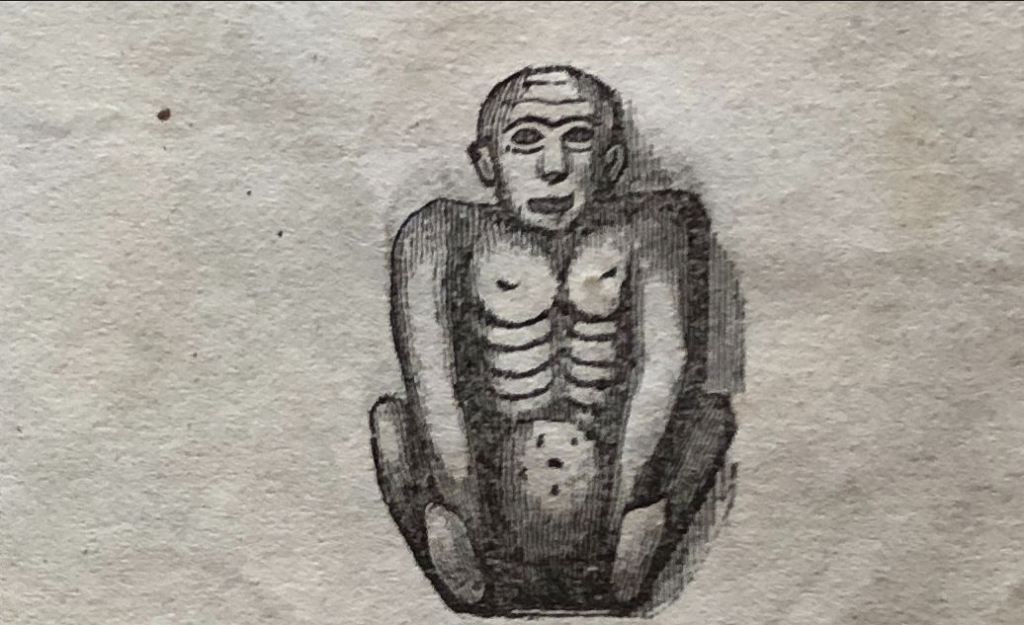
The Roman Catholic chapel in this parish is a tolerable edifice, and the present parish church is not only a plain, but damp and uncomfortable old building. The only thing remarkable about it is its having, projecting from western gable end, an ancient freestone bust of St. Kyran, which probably, ornamented the more ancient fabric. The eastern gable is ornamented with an old freestone window-frame, at some distance from which there also projects from the wall a grotesque figure, in figure, to a small porcelain Greek idol, in possession of the writer of this account. The above engraving is a representation of it

B
*J.Lanig. Eccl. His. 29. † Ware’s Bishops, ‡ Colg. AA. SS.
* Fuaran, a spring. † Gentle – mild, ‡Ilachta appears to be situate about Brusna, in Sir Robert Vaugondy’s map of Ireland 1757. Antiq. c, 1-7 & 6
‖ DeVita S. Kierani, c. 35.p 462
You will find more material in Archaeology.ie and the printed Offaly Archaeological Inventory of County Offaly. Search here for Churchland and not Seir Kieran.
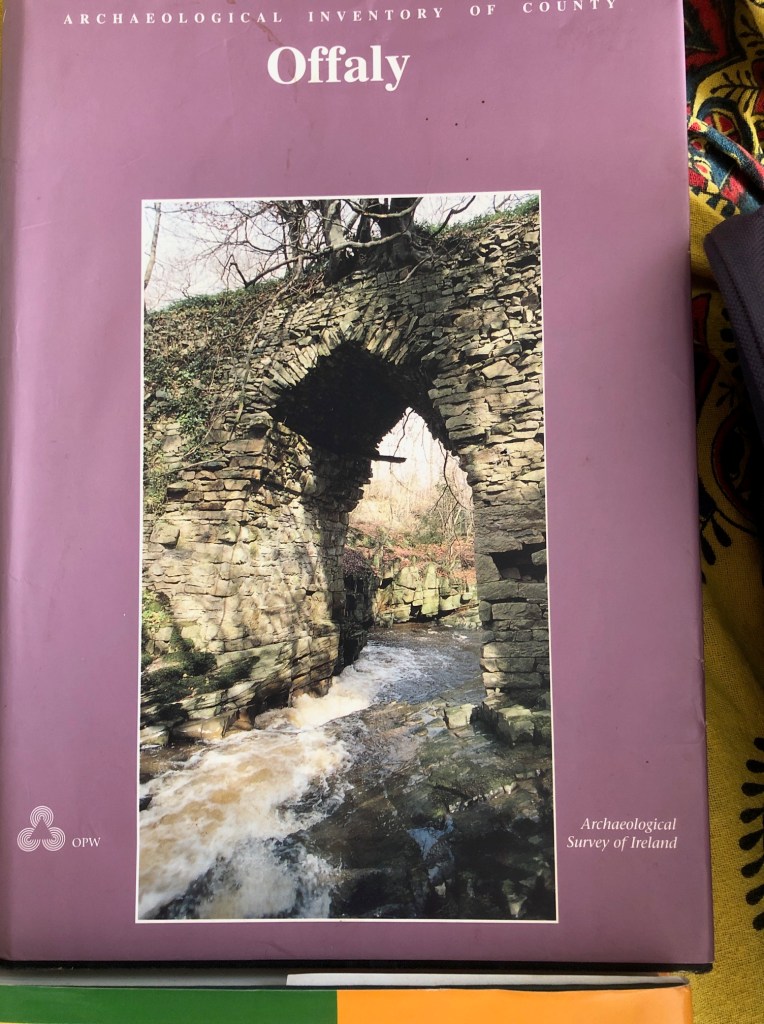
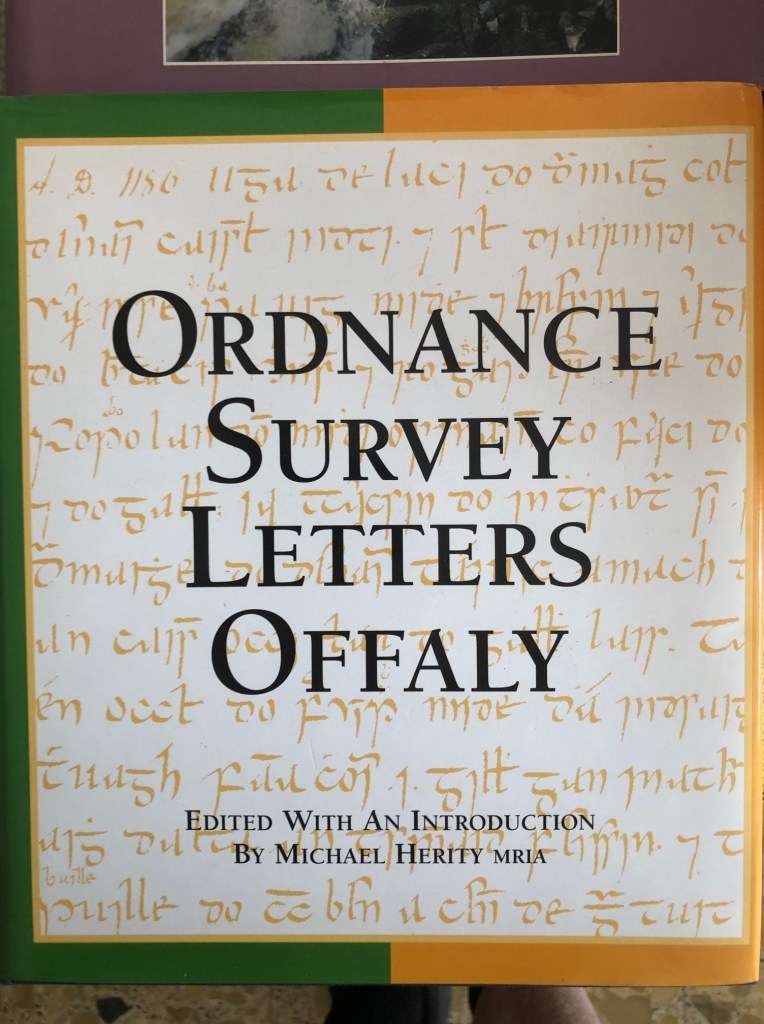
For O’Donovan see the printed volume of letters or go to RIA online. Both books are available from Offaly History http://www.offalyhistory.com, For other books on Seir Kieran see the Offaly History library catalogue at http://www.offalyhistory.com
OF039-003008- : Building : CHURCHLAND from archaeology.ie and with lots more on Seir Kieran.
Description: National Monument No. 497, consisting of a poorly preserved church (OF039-003005-), base of round tower (OF039-003003-), low motte (OF039-003009-), possible souterrain (OF039-003026-) and building (OF039-003008-) all of which is contained within the impressive remains of a bivallate ecclesiastical enclosure (OF039-003001-). Present remains consists of a large square-shaped graveyard with poorly preserved church (OF039-003005-) with gun turret at SE angle, base of round tower (OF039-003003-) at NW angle, base of high cross (OF039-003002-), cross-slabs, architectural fragments, 19th-century C of I church and medieval earthworks of a deserted medieval settlement enclosing graveyard from S through W to N and low motte (OF039-003—-) to SW, all of which is contained within the impressive remains of a bivallate ecclesiastical enclosure (OF039-003001-). Founded by St. Kieran the elder in the fifth century (ITA Survey 1943). Grass covered wall footings of a long rectangular building (approx. ext. dims. 19m N-S x 9m E-W) orientated on a N-S axis and located outside E wall of graveyard. Compiled by: Caimin O’Brien. Date of upload: 23 May 2011
Six-Inch First edition:
Six-Inch Latest edition: Indicated
ITM Coordinates: 613910 , 702212
Latitude and Longitude: 53.070347 , -7.792437
Published as part of the County Offaly 2025 Commemorative Programme with the support of Department of Tourism, Culture, Arts, Gaeltacht, Sport and Media

 offalyhistoryblog