
Beaujolois Elenora Catherine, the only daughter of the second earl of Charleville (1801–51) and his wife Harriet Charlotte Beaujolois Bury née Campbell (1803–48) was born on 4 December 1824 and survived almost as long in years as her later cousin, Col. Howard Bury. In case anyone would think that the name Beaujolois is in recollection of some Bacchanalian festive evening we should know that the unusual name was (as De Beer writes) due to her having as her godfather, Louis Charles d’Orleans, Comte de Beaujolais, brother of Louis Phillipe.[1] There is much about this connection in the Charleville Papers in Nottingham University. Beaujolois married Captain Hastings Dent in 1853 and died in 1903. Dent died in 1864. Lady Beaujolais had been married for only eleven years and was a widow for almost forty.
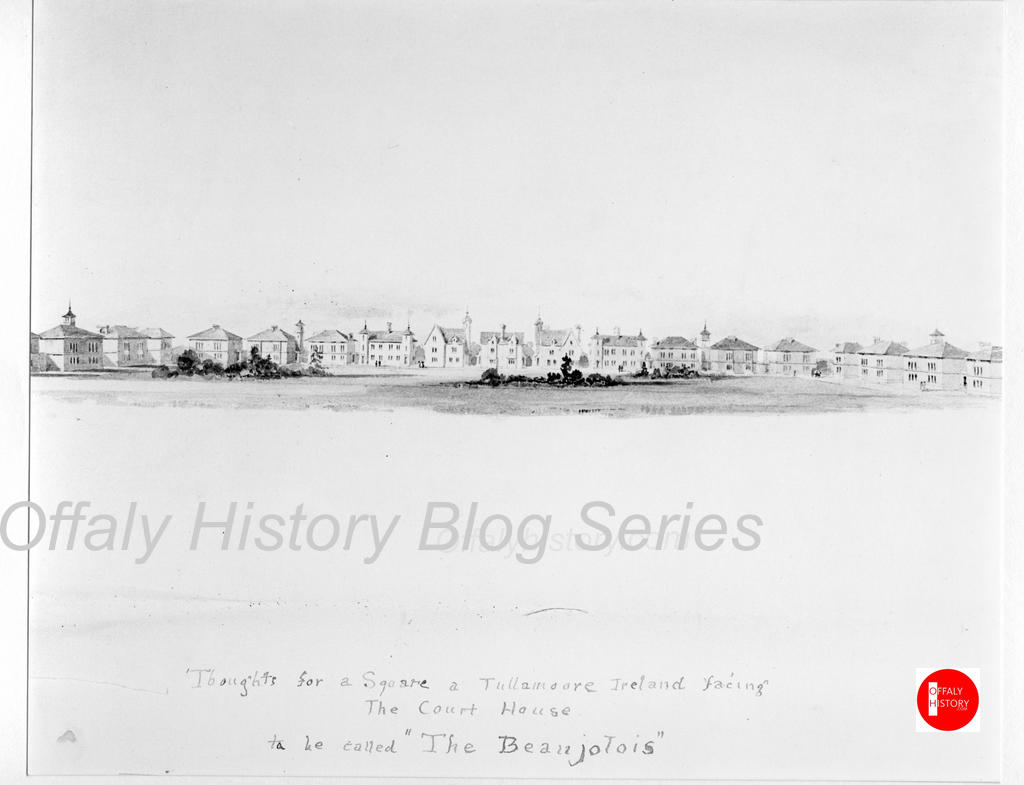
A few of the five known engravings by Beaujolais Bury are also in Offaly Archives. It is not known if Beaujolais executed any other drawings save the stairwell off the entrance hall to the castle and possibly a fanciful drawing of a housing scheme opposite the courthouse. This may have been by an architect or other person as likely was that of the Willis printing shop in Charleville Square. Copies of both these pictures are in the Irish Architectural Archives.
The young artist was unfortunate that the family money ran out soon after she was presented at court in 1843 and before she could meet a partner with funding for the style she had once been used to. Her husband of 1853 was a retired army officer and a widower. ‘Young Beau’ outlived poor Mr Dent by 40 years.[2]
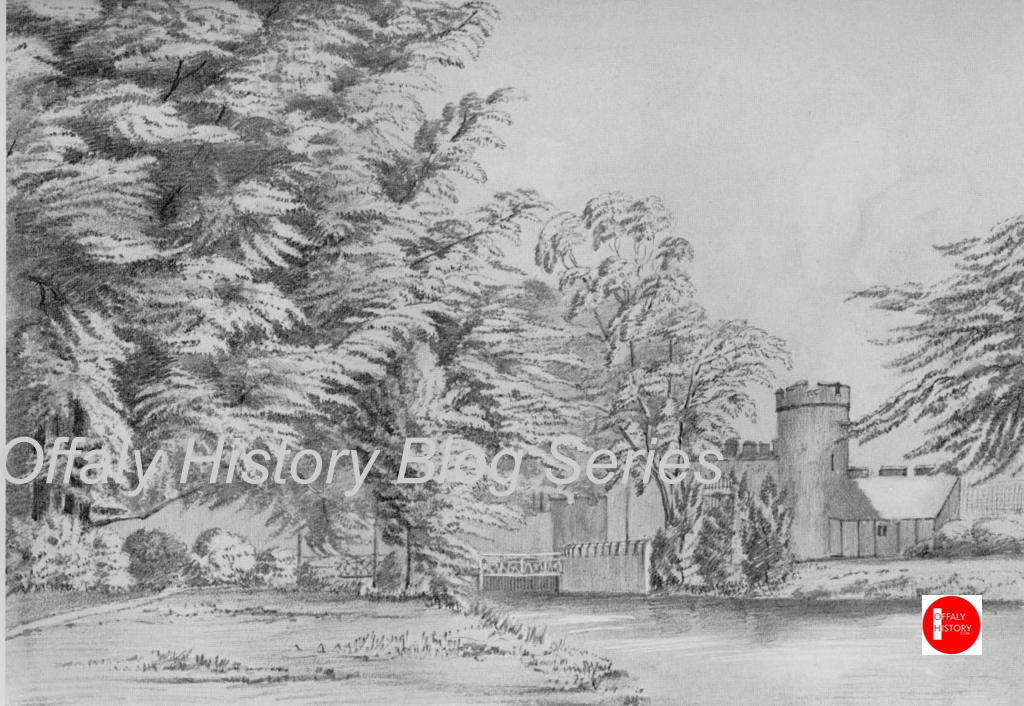
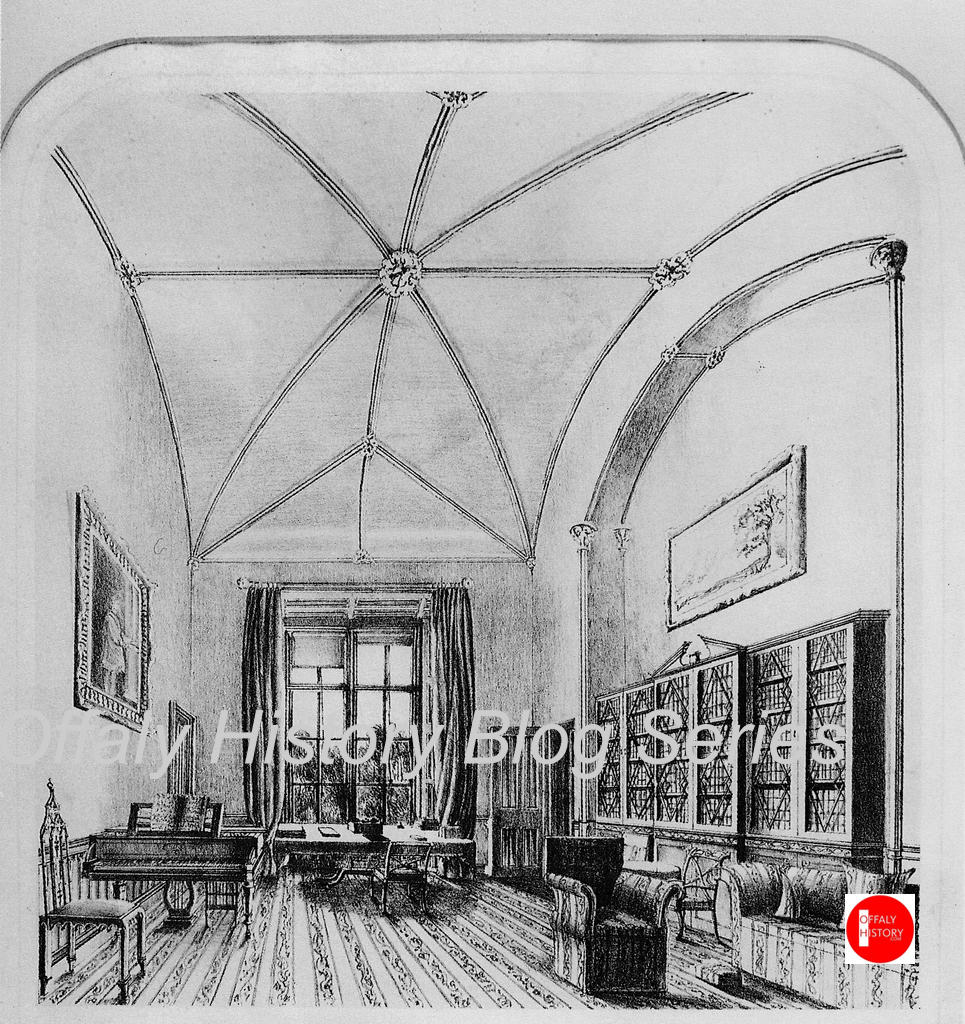
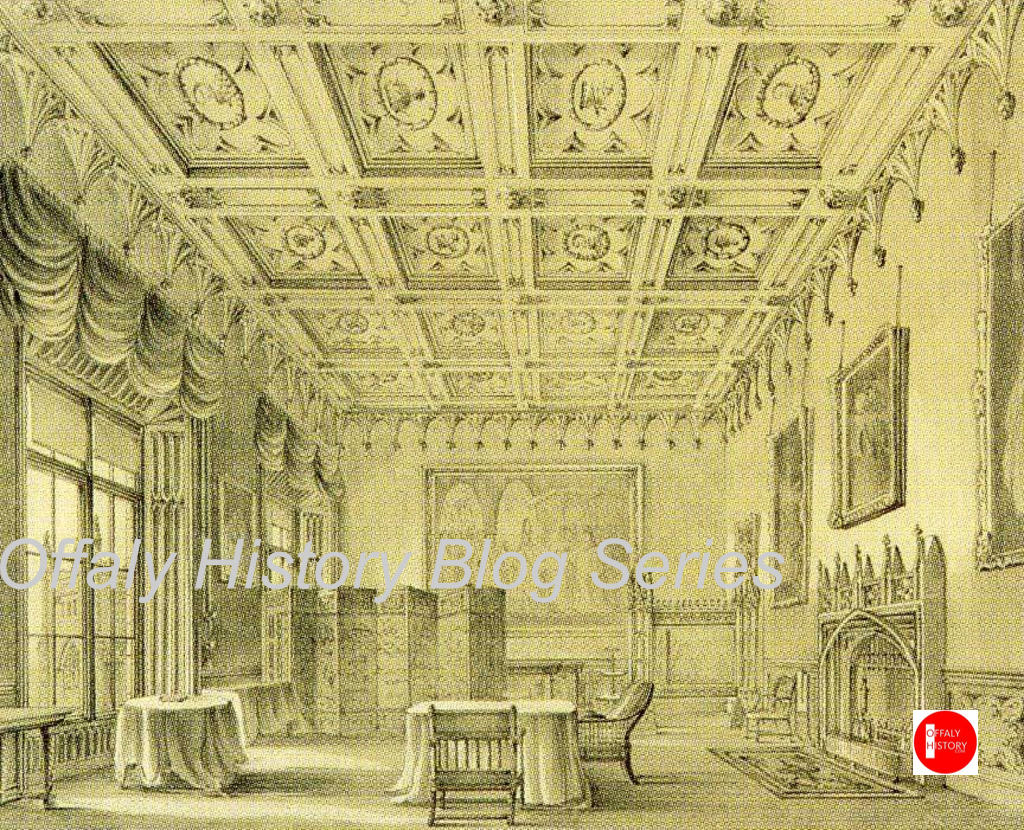
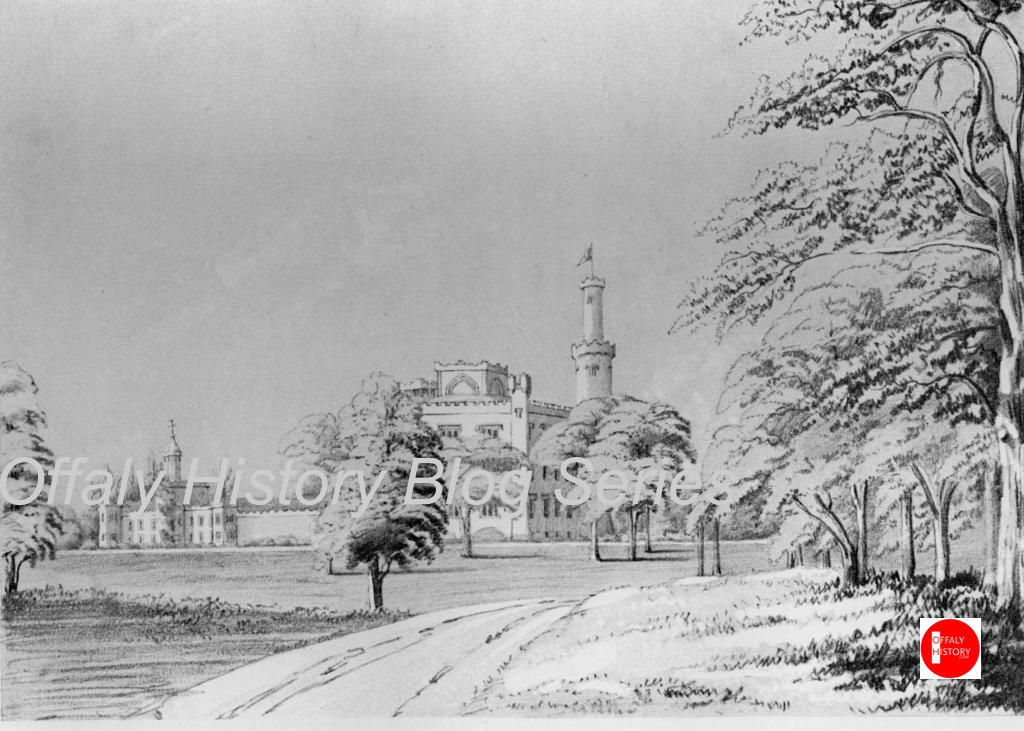
Beaujolois Bury is remembered today as the accomplished artist who sketched at least four views of Charleville Forest/Castle in 1843 and subsequently printed as lithographs and reproduced in the Knight of Glin’s collection of topographical drawings, Painting Ireland. The interior views are especially interesting to see the salon, music room, dining room and the great stairwell. One of the chairs from the Walpole home at Strawberry Hill was acquired by the second earl in the 1842 sale of Walpole’s creation and can be seen in Beaujolois’s drawing of the music room at Charleville. The room is now larger by the removal of a wall than it was in 1843. The chairs were sold at the Charleville Castle contents sale in 1948 and, if you were about, of course you would have bought them. Have described the drawings as pedantic but yet valuable as pictures of Victorian interiors.[3]
In 1843–4 the Charleville family departed their Charleville home to live ‘cheaply’ in Berlin and the house was shut up until 1851. Of the two surviving daughters of the third earl (died 1859) it was Emily who inherited in 1875 and lived on, mostly abroad, from her widowhood ten years later until her death in 1931. She had closed the house in 1912 and her son Lt. Colonel C. K. Howard Bury (who had inherited Belvedere, Mullingar in the same year) auctioned the contents in 1948. The castle was leased in 1971 to Michael McMullen (died 1 Jan. 2025) and his occupancy is well documented in the local press and the Law Reports. His coming to Tullamore was fascinating too in that he first saw the castle in an advert made in Tullamore for one of the big English banks. The recently deceased Ann Williams of Dew Park, Tullamore provided the black horses to take the funeral coach from the castle to St Catherine’s at Hop Hill for that bank advertisement.
Lady Beaujolois Bury’s prayer book (in mint condition) was donated to the Offaly History Centre by a friend who loved Tullamore and was connected with the town for 150 years. Like some family bibles it contains on two of the blank pages scraps of the family lineage of her ladyship and her siblings, the third and fifth earls of Charleville. The information recorded agrees with what is provided in Burke’s Irish Family Records (1976 edition), but like every family there is more to it than the bland recital of names and dates. Lady Beaujolois Bury (1824-1903) was the talented daughter of the second countess of Charleville (1803-48) and granddaughter of Lady Charlotte Susan Maria Campbell (1775–1861). Her Bury in-laws, the first earl and countess, were the builders of the great castle, known as Charleville Forest, and which was commenced in 1800 and completed in 1812. According to Girouard it is ‘perhaps the finest Gothic Revival Castle in Ireland’.[4]
Charles Williams Bury (1764-1835) was a landowner of considerable wealth, derived partly from the Bury estates in Co. Limerick (where the family had settled in 1666) and partly from property in King’s County, inherited through his father’s mother, Jane Moore, the only sister and heiress of Charles Moore (1712-64), earl of Charleville and Baron Moore of Tullamore.
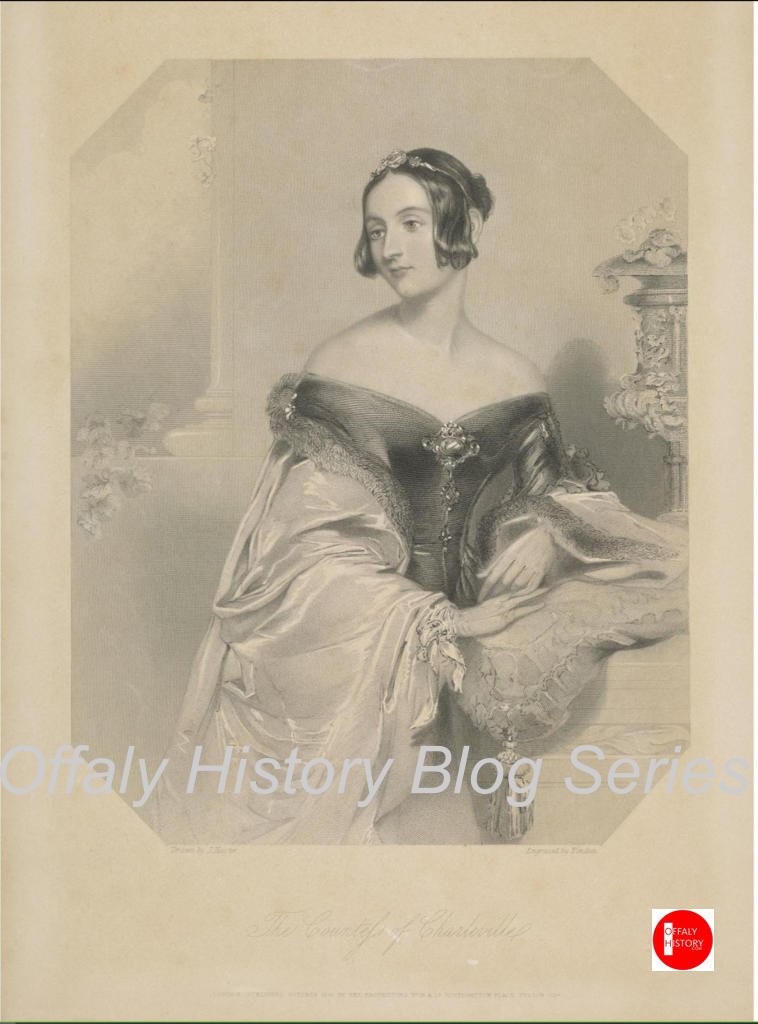
Lord Tullamore (or Tullamoore as he preferred), the only son of Charles William Bury (1764-1835), first earl of Charleville (second creation) was born in 1801 and married handsomely but not financially well while on the Grand Tour of the cultural capitals of Europe in 1821. He was almost 20 and his wife just 18 years old. As the illustrated entries from their daughter’s prayer book tell us Lord Tullamore married on 26 February 1821 at Florence. His wife was Harriet Charlotte Beaujolois, the third daughter of Col. John Campbell of Shawfield in Scotland and her mother was Lady Charlotte Susan Maria Campbell. The latter was the daughter of Elizabeth Gunning and John, the fifth duke of Argyll, and was born in London in 1775, and died in 1861. Harriet was born in 1803 of Lady Charlotte’s first marriage. Lady Charlotte, despite her famed good looks, made a modest marriage with Colonel John Campbell and by whom she had nine children. He died in 1808 and she married again in 1818 (despite the reservations of friends including Sir Walter Scott) her son’s tutor, the Revd John Bury (no connection with Tullamore), by whom she had two daughters. John Bury, later rector of Lichfield, died in 1832 and Lady Charlotte in 1861. She is best remembered now for her Diary Illustrative of the life and times of George IV (1838). Earlier money-making efforts included Flirtation (1827) and The History of a Flirt (1840).[5] Such titles might be expected to make more money today than they did for their impecunious, if titled, author. Curiously, Beaujolois’s mother-in-law, Lady Catherine Maria Charleville, had herself caused some scandal with the publication in 1796 of a translation of Volatire’s La Pucelle which was attributed to her by some, although published anonymously.[6] Others have suggested that the co-author was a bishop![7]
At the age of fourteen (and four years before her marriage to Lord Tullamore) Harriet Charlotte Beaujolois Campbell completed a manuscript account of her trip to Florence which was published as A journey to Florence in 1817 (edited by G.R. de Beer, London, 1951). An illustration of Lady Tullamore, who became the second countess of Charleville in 1835, is provided as a frontispiece to the printed 1817 Journal. It is hardly surprising that the young Lord Tullamore was captivated by this blue-stocking beauty. Some pictures survive of him too from the 1830s, when money was still flowing and prospects were good. One, a miniature, was offered for sale in 2015 (see illustration).
Lord Charleville appears to have been quickly reconciled to the marriage and wrote to his agent, Frances Berry:
You have heard before this, I make no doubt, of a very important event to us, that is Tullamore’s marriage. It took place 26th February last, and was solemnised in the ambassador’s chapel. As you may reasonably suppose, I was little inclined that he should marry so young; but I am more reconciled to it now, as I like the young lady, who appears to me both amiable and sensible. In consequence of his marriage, I allow him at present £1,600 a year, which I intend you should pay him out of Charleville estate at least till my return, when perhaps I may be able to settle it otherwise. I mean that you should lodge £800 half-yearly on Tullamore’s account, with Lord Newcomen, from whence he will draw it, your first payment being previously to the 1st July next, and to continue half-yearly. You probably have more than sufficient in your hands at this time of year. At all events, let him not be disappointed as to its being lodged in time.[8]
The first child of this romantic marriage, Charles William Bury, was born at Geneva on 8 March 1822 and succeeded as third earl of Charleville in 1851.The marriage did not go well with Lord Tullamore’s father, the first earl of Charleville (17764–1835) because the young bride brought charm and good looks but no money. Lord Charleville was conservative and not, it seems, very bright. In 1798 he married, within six months of her husband’s death, Catherine Maria Tisdall. He and Catherine Tisdall were the co-executors of her late husband’s estate and she had two smart young children of the first marriage John T.T. Tisdall and Louisa Tisdall. Joining them, from 1801 was the only child of their marriage and heir to the Charleville estates, known in his young days as Lumpy Tullamoore. He must have been an insecure child with two elder stepchildren and seems to have been constantly trying to prove himself, but at considerable expense to the property and his family. His birth was a fraught time for the young mother with Charleville having to hire one of the new boats on the canal in early 1801 to take the expectant mother to Dublin in haste.
The building of Charleville Castle was of itself almost a folly and cost the first earl a very considerable amount of money. His son’s extravagances led to the second earl bankrupting himself in 1844. His lovely wife died in poor circumstances in Naples in 1848 and the second earl, sad and mad, died in 1851. It was a difficult time for the family and for Tullamore. So much promise unfulfilled and so much need in Tullamore town and on the 20,000-acre estate in the 1840s during the Famine years. Were it not for the wise management of the resident agent, Francis Berry, things would have been worse.
Coming back to Beaujolois’s crisp clean prayer book the entries for her siblings (see illustration) were:
1 Charles William George, born at Geneva on 8 March 1822, succeeded as third earl in 1851 and died in 1859. His young wife predeceased him by two years leaving four children. Their deaths caused great sadness in Tullamore. They had married only in 1850, had three or four children and found themselves in 1859 in the care of Uncle Alfred and his wife. Alfred was only 30 years old and childless. Two years later one of the children in his care was killed in an accident on the stairs at Charleville. The so-called ghost of the castle, young Harriet Bury now needs some rest from ghost tourism. Her little coffin is still preserved with that of her young parents.
2 Henry, the next child, was born in 1823 and died in 1829. He can be recalled today in the name Henry Street (now O’Carroll Street) Tullamore.
3 John James was born in 1827, married in 1852 and died in 1864.
4 Alfred, was born in 1829, married in 1854 and died on 28 June 1875. On the death of the young fourth earl in 1874 Alfred succeeded as fifth earl, but died the following year. Burke (1976) states that the property passed to his sister Lady Emily, but she was a daughter of the third earl not the second and was reared by Alfred and his wife after the death of her parents in 1857 and 1859. Her sister, Katherine, married Edmund Bacon Hutton, in 1873 within a few weeks of her brother coming of age. It was a time of celebration and was well reported. Their wedding provides what is thought to be the earliest surviving wedding photograph in County Offaly. Military officers passing through Tullamore, as in Jane Austen’s novels, were a singular opportunity and both Katherine and her sister Emily both married handsome young officers, possibly passing through Tullamore on the way to the barracks in Athlone.
5 Beaujolois or Young Beau as she was called was born in 1824. Lady Emily Bury (d. 1931) was not unlike her. Young Beau had three children following on the marriage to Captain Hastings Dent in 1853.
Children:
Hastings Charles Dent 1855-1909
Beaujolois Anne Jane Louisa Dent 1856-1927
Alfred Robert Tighe Dent 1861-1922
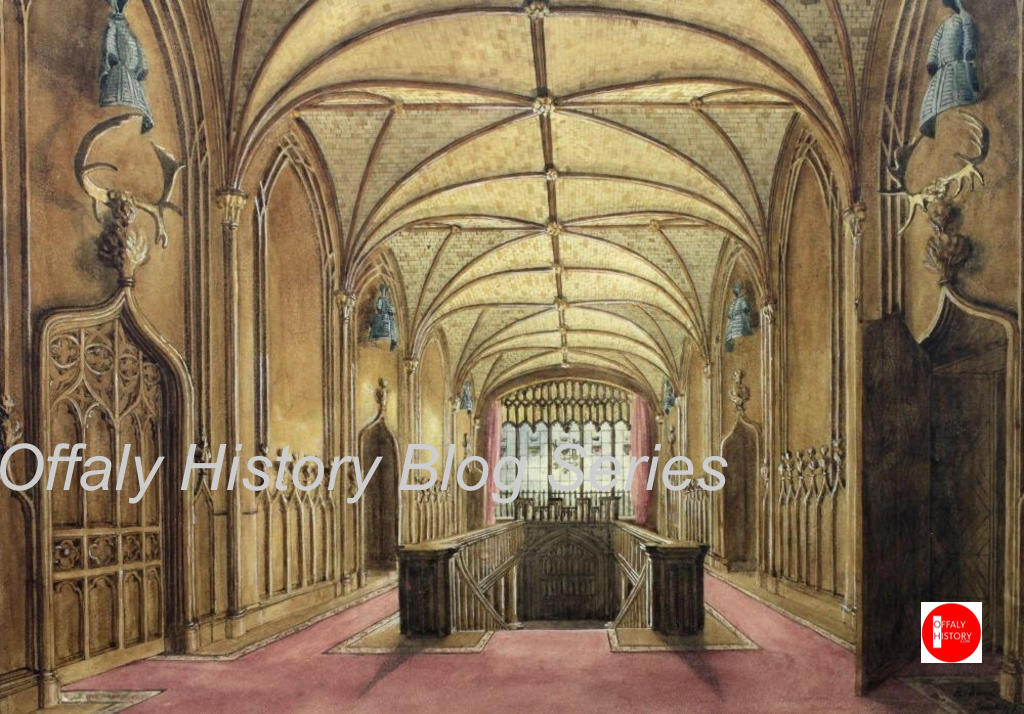
Kevin V. Mulligan, in a handsome volume on Portrait miniatures & the Irish Country House: the Edmund Corrigan Collection (IGS, Dublin, 2024), has featured the drawing below of the Upper Hall and Main Stairs with the large window with its heraldic glass (sadly destroyed in silly vandalism in the 1960s) and said to have been completed in 1860 by Beaujolois Bury (now Mrs Dent) ( a copy was sold in recent years at Mealy’s and another featured in the Glin Castle collection. (10) Charleville at this time (1859-73) was in the care of her brother Alfred who succeeded his nephew at fifth earl in 1875. Alfred also had charge of the children of the third earl who died in 1859 until 1873 when the fourth earl came of age and his sister Katherine married Edmund Bacon Hutton.
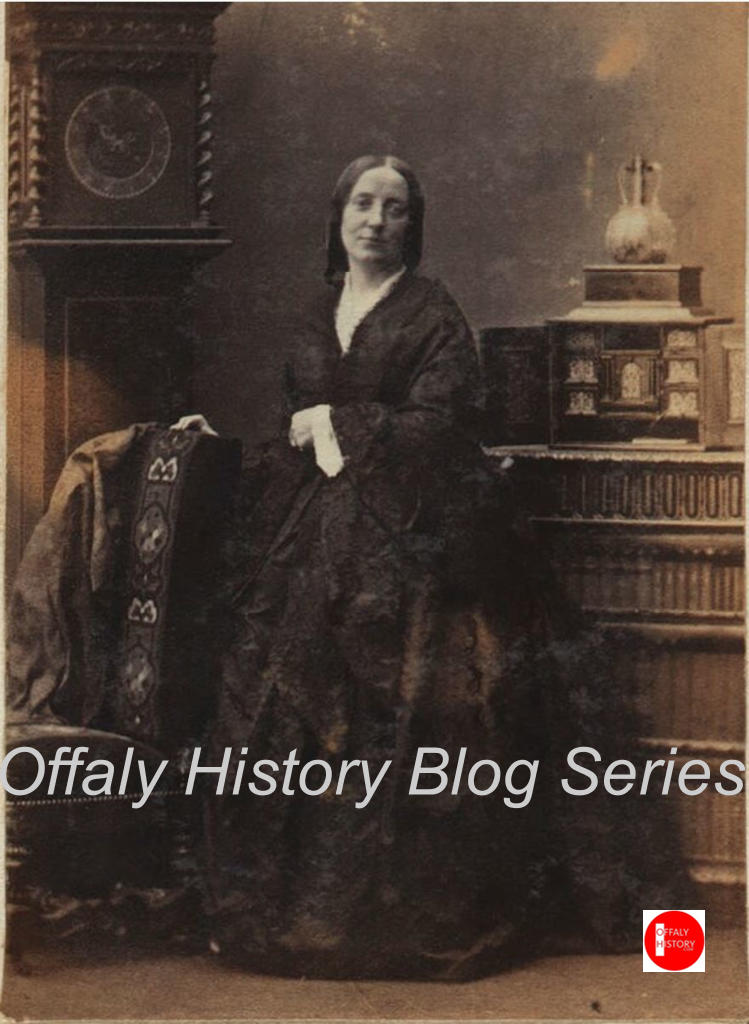
The siblings of the second and third earls were visited by the miasma that troubled almost all of the Bury family down to the extinction of the earldom in 1875 and the death of Lady Emily Bury’s husband, Captain Howard, in 1885 and their daughter Marjorie in 1907. Only Col. Charles Kenneth Howard Bury was destined for a long and hardly life. Of Everest climbing fame he was born in 1883 and died in 1963 at Belvedere, Mullingar, the home he inherited in 1912 from his kinsman, Charles Brinsley Marlay. Marlay’s grandmother was Catherine Maria, first countess of Charleville by her first marriage (d. 1851). His mother, Louisa Tisdall, married a Lt. Col. Marlay in 1828 and, yes, she was a widow after just two years and lived on until 1882. Her son Charles Brinley Marlay was immensely rich, died a bachelor, and left estate valued at over £500,000 in 1912. Lt Col. Bury was also a bachelor and was aged 80 and had a long and colourful life between his travels and his war service. He had the comfort in the last 25 years of his life of his friend Rex Beaumont. Today the golfers in Tullamore and Mullingar can pay tribute to Colonel Bury for the finest club grounds in the country that he made available out of the Belvedere and Charleville estates.
So living in a great Gothic castle may not have been so wonderful after all and was certainly not so for the five earls and their progeny over the 100 years of the castle’s fitful occupancy from 1812 to 1912. Shortage of money, to live as they were accustomed, combined with poor health were the twin problems. The early death of Lady Emily’s husband, Captain Howard, only a few years after their marriage brought closure on what otherwise might have been a long and happy stay for his family and successors. The old church at Lynally, now a private residence, was erected in 1887 to his memory.
In should be mentioned that the Gothic-style castle, known as Charleville Forest, was written up by Mark Girouard for Country Life in 1962. Just over fifty-three years later another article appeared (October 2016) in the same prestigious publication and this time by Dr Judith Hill, recently awarded a doctorate for her work on the Gothic in Ireland (soon to be published).
Charleville Demesne is a great boon to Tullamore and the castle could be great too, but it will need great capital to come to anything like Ballyfin in terms of repair and décor. In the meantime much thanks are due to the Hutton Bury family and to Bonnie Vance and her family for keeping safe and intact a tremendous heritage potential for Ireland and the midlands. People take these things for granted but it should not be so.
Beaujolois’s prayer book (now in Offaly Archives) will have to be well thumbed to intercede for the millions of euro needed to achieve all that could and should be done. In the meantime we are grateful for what we have. Charleville Demesne is part of the great oak forests of Offaly and there has been a mansion house on the lands since 1641. The formal grant of the lands goes back to 1622 when Tullamore was just a castle and perhaps ten cottages.
[1] G.R. de Beer, A journey to Florence in 1817 (London, 1951), pp 14, 138-10.
[2] Marlay Papers, Nottingham University, and see Warwick Bond, The Marlay letters (London, 1937); Nenagh Guardian, 17 June 1843.
[3] Anne Crookshank and the Knight of Glin (Desmond Fitzgerald), The Watercolours of Ireland: Works on Paper in Pencil, Pastel and Paint, c.1600-1914 (Barrie & Jenkins, London, 1994); p. 203.
[4] Mark Girouard, ‘Charlevillle Forest’ in Country Life, 27 Sept. 1962.
[5] See ODNB, vol.9 for an entry on Charlotte Susan Maria Bury, pp 58-9
[6] The book is rare but was offered on Abe website at €2,000 in 2017.
[7] The poem appeared anonymously, but according to some Lord Charleville was almost certainly the translator, though John Wilson Croker hinted at the time that he had had help from ‘lawn sleeves and gauze petticoats’, that is, from Charlotte Maria Tisdall, whom he married in 1798, and Richard Marlay, the worldly and witty Bishop of Waterford. See Mark Girouard, ‘Charlevillle Forest’ in Country Life, 27 Sept. 1962.
[8] Calendar of the Howard Bury Papers, B/15 (unpublished), ref., B.15, in a letter from Charleville to Francis Berry.
(9) William Laffan (ed.), Topographical views from Glin Castle (Churchill Press, Tralee, 2006), pp 174-6.
(10) Kevin V. Mulligan, Portrait miniatures & the Irish Country House: the Edmund Corrigan Collection (IGS, Dublin, 2024), pp 95-7.
This series is supported by Offaly County Council’s Creative Ireland community grant programme 2025-2027.


 offalyhistoryblog