
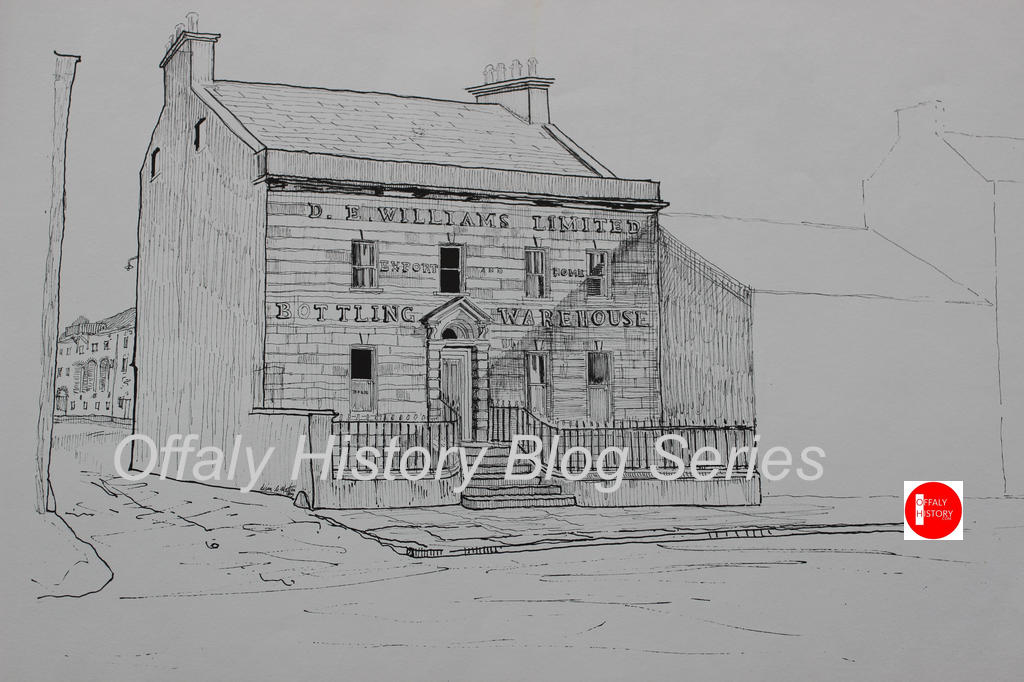
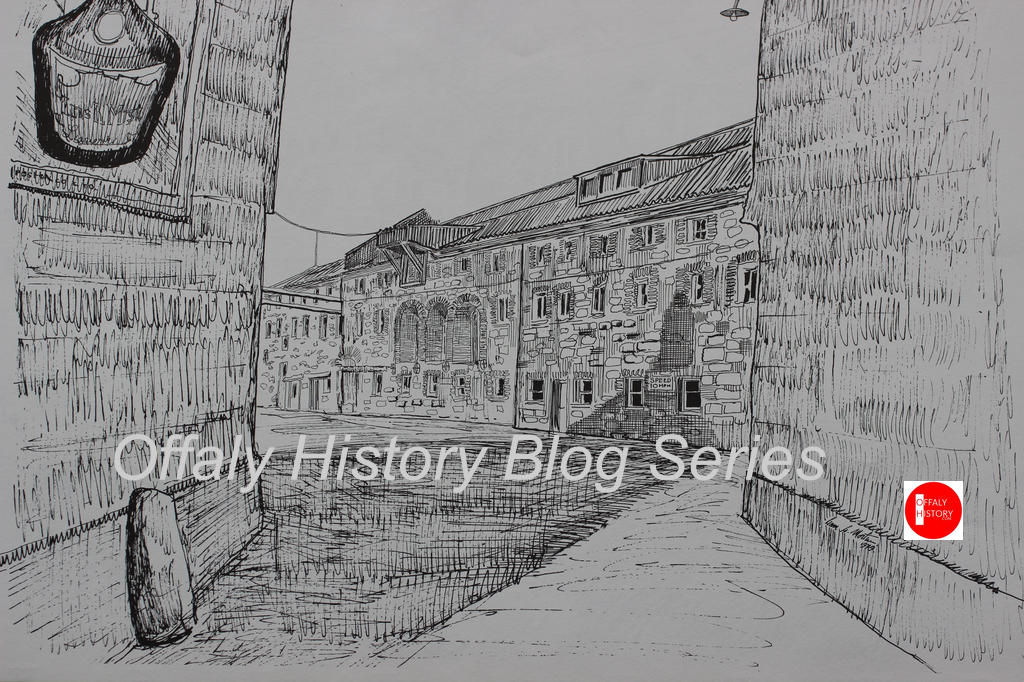
Liam C. Martin was born in Kilbeggan in 1934 so he must have known all about the Locke’s distillery in that town and the associated distilling history of the Williams family in Tullamore. In about 1980 he was commissioned by the Williams Group and the late Edmund Williams to record the Williams buildings in Tullamore for posterity. The drawings were printed in an issue of about 25 copies and presented in a specially printed folder. There are some of the drawings in Offaly Archives and complete sets in private collections. It was the act of a far seeng man to have the legacy recorded and Liam C. Martin was a great choice.
There is a good entry for Liam C. Martin in the printed and online Dictionary of Irish Biography. His most significant legacy is ‘having captured on paper innumerable views and structures before the bulldozers wreaked havoc’.[1] The DIB contributor notes that:
Martin, Liam Christopher (1934–98), artist and illustrator, was born 25 February 1934 in Kilbeggan, Co. Westmeath, the son of Ambrose Victor Martin of Kilbeggan, a commercial traveller, and his wife Margaret (née Harding). When he was aged one his family moved to Rathfarnham, Co. Dublin, where his father ran a greengrocery business. Martin began to draw at the age of five, and his parents nurtured his talent by hiring Harry Kernoff (qv) to give him private lessons when he was ten. His artistic interests may also have been encouraged by the fact that his mother had photographed much of her native Kilbeggan. Kernoff’s own ground-breaking work as an ‘artistic chronicler’ of Dublin’s urban environment clearly left its mark on Martin’s work, which focused mainly, but not exclusively, on the capital’s landmarks and quaint neighbourhoods, but also its increasing neglect, decay and destruction.

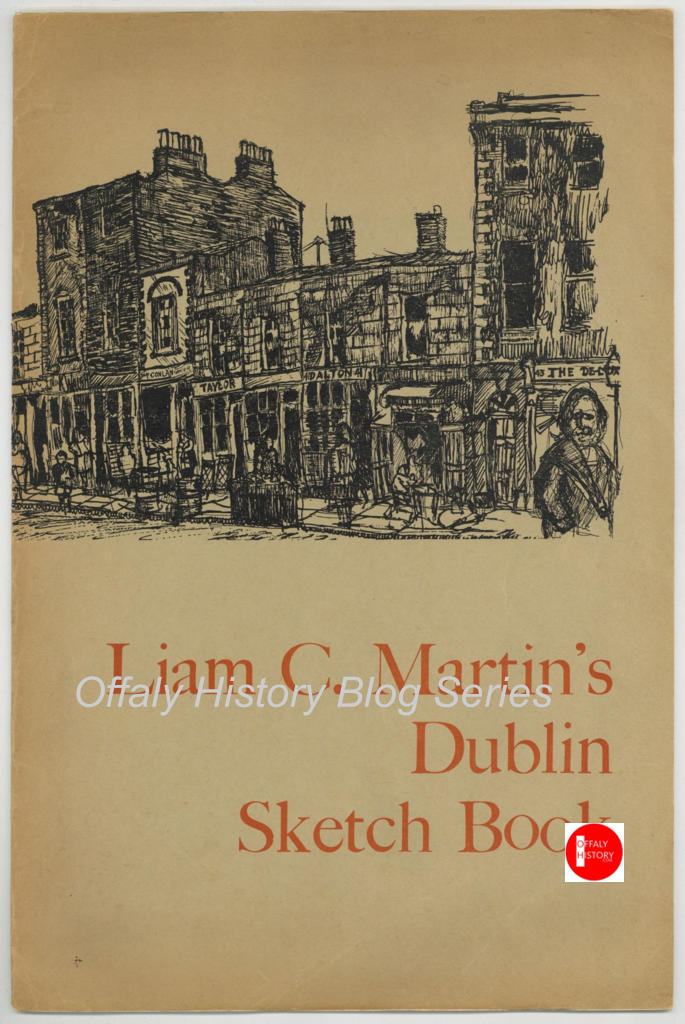
Martin is most famous as an urban artist and for his distinctive pen-and-ink drawings of Dublin’s streetscapes, shopfronts and vanishing architectural landmarks, a genre he pioneered in the 1960s and which became highly popular through weekly sketches and regular features in the press. From 1960 to 1964, ‘Liam Martin’s Ireland’ was a regular feature in the Irish Times, but his sketches also enhanced various columns in the paper (e.g., ‘Irish schools’ (15–16 April 1964)), and his personalised impressions of hotels or department stores gave a lift to the otherwise dry ‘Business and finance’ section. He first published Liam C. Martin’s Dublin sketch book in 1962 in association with the Irish Georgian Society, and more compilations followed, including themed volumes on churches and on medical and legal Dublin.
In 1977 he was voted the Westmeath Association man of the year. He had settled in Tallaght, Co. Dublin, with his wife Violet (née Dillon; d. 2009), with whom he published Medieval Dublin: an illustrated guide to the town within the walls (2000?). Liam C. Martin died in Dublin after a short illness on 28 May 1998.


Martin’s Legal Dublin is now sought after and includes drawings of places providing fond memories for older practitioners of law.

The Williams collection of thirteen drawings is unique and has captured buildings and scenes now gone including the first house built for Daniel E. Williams near to the old mill where he started work in the 1860s; the stationery steam engine (still in situ); the shop and head office in Patrick Street; the bonded warehouse; the old distillery.

Sources as outlined in the DIB entry include:
NIVAL [National Irish Visual Arts Library], NCAD, file IE/NIVAL AR/1316; NCAD student registers; Liam C. Martin, Liam C. Martin’s Dublin sketch book (1962); Brian O’Higgins, The soldier’s story of Easter week … with sketches of the leaders by Liam C. Martin (1966); Ir. Times, 28 May 1998; Stan McCormack, Kilbeggan 2000: millennium book of photographs (1999); information from Máire Kennedy (Dublin City Library) and from Gearóid O’Brien (Westmeath County Libraries). To which can be added:


This series is supported by Offaly County Council’s Creative Ireland community grant programme 2025-2027.


[1] Online and in vol. XI of DIB, pp 623–4 by Sylvie Klienman.
 offalyhistoryblog