
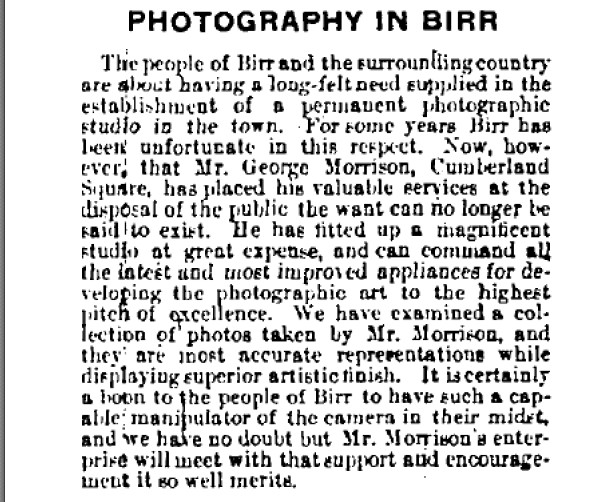
One of Offaly’s pioneering photographers living in Birr in the late nineteenth century was George Morrison, son of Edward, both were jewellers in the town in Duke now Emmet Square. George Morrison was a trained photographer who had opened a studio in his Birr jewellery shop in 1894. He was grandfather to the now acclaimed documentary artist George Morrison of Mise Éire (1959) fame who has just died at the age of 102. It can be said that George Morrison inherited a tradition commenced in the family by his grandfather, but following in the footsteps of many others including Mary, third countess of Rosse.
Another Birr neighbour of the Morrison family was Archie Wright, of nearby Cumberland House, Birr had also trained in photography and would assist his father in producing photographs weekly for the local King’s County Chronicle newspaper from 1885. At the time an innovation in the provincial press. The Chronicle was one of the first provincial papers to use the block process and Wright had been sent to London to study the process.
Edward Morrison, the jeweller, was succeeded by his son George who was also a jeweller, and in addition was a trained photographer who had opened a studio in his Birr jewellery shop in 1894.[1] The younger Morrison had a distinguished career in photography. He was also a founder member of the Birr Wilmer Tennis Club in 1886 and retained membership up to his death. He continued to manage the jewellery shop (retaining his father’s name over the shop) up to a year before his death in 1919 and also found time for his urban council duties. His early work featured in the Chronicle and in postcards sold in Birr.
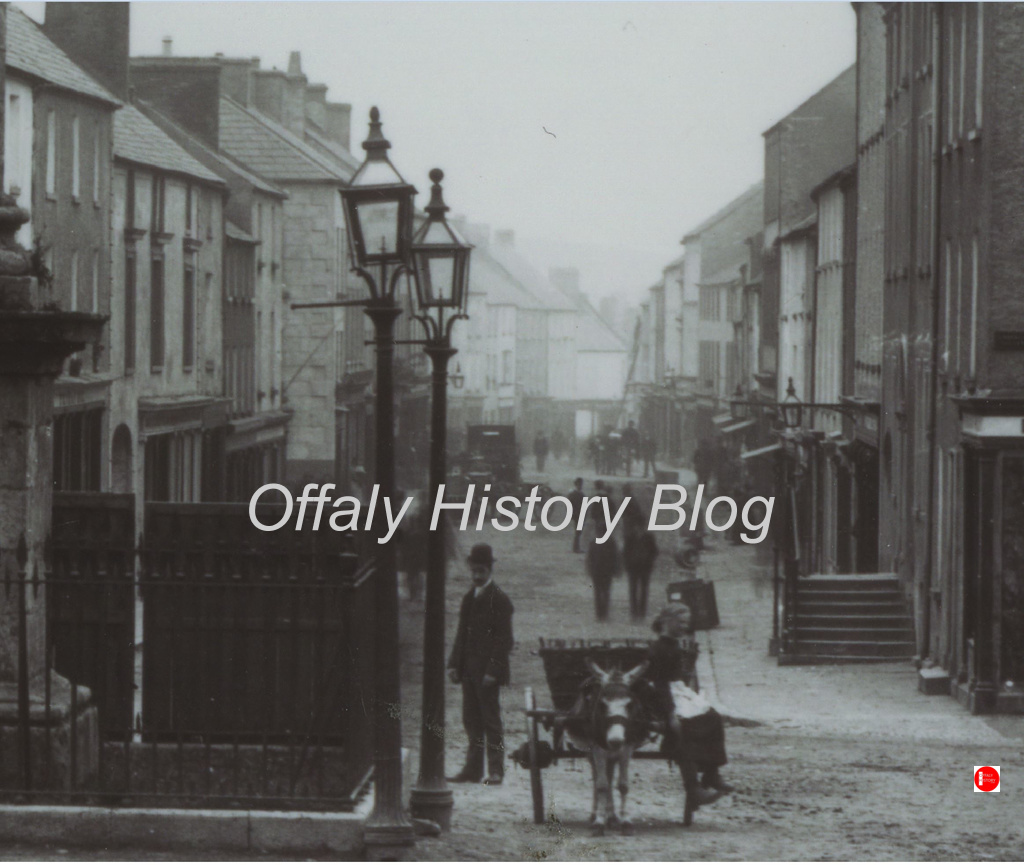
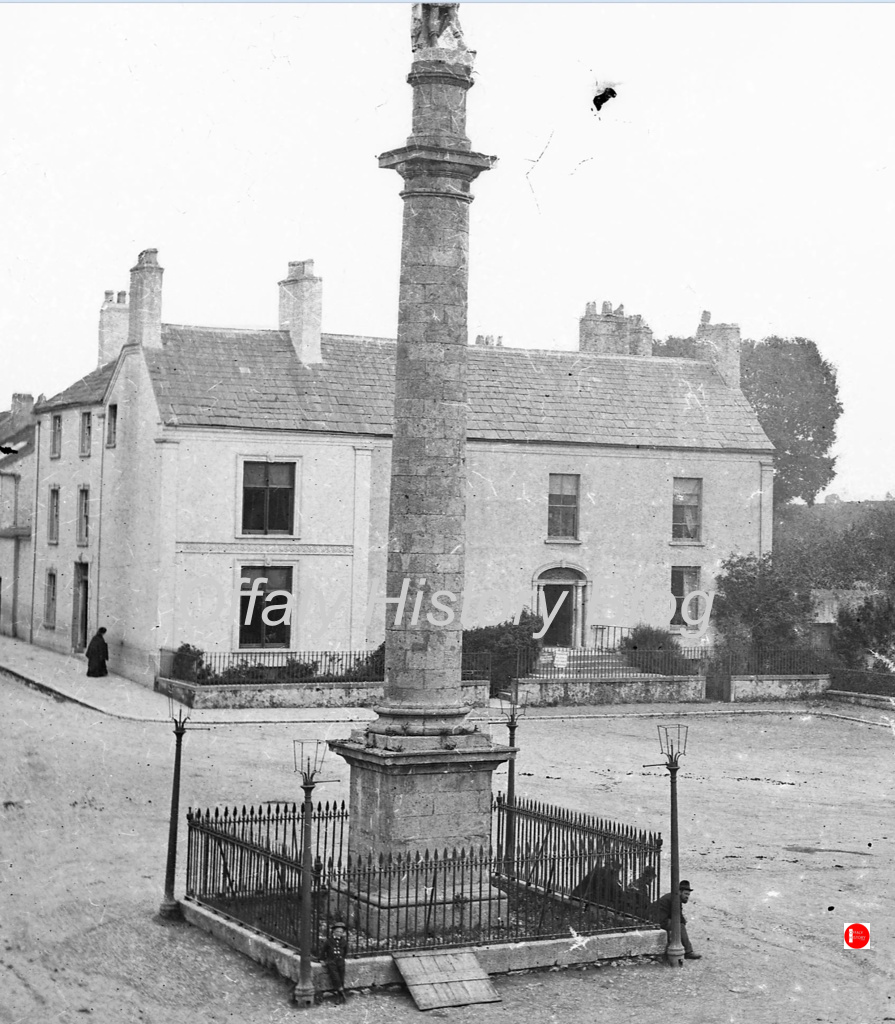
It may be mentioned that Morrison along with Michael Carroll secured pictures of the taking down of the ‘Duke’ in Emmet Square in 1915. His 1901 photographs of the Bronte heirlooms at Hill House Banagher were published in a London weekly in that year. His client for this assignment was the avid Bronte collector, the journalist and literary critic, Clement Shorter.
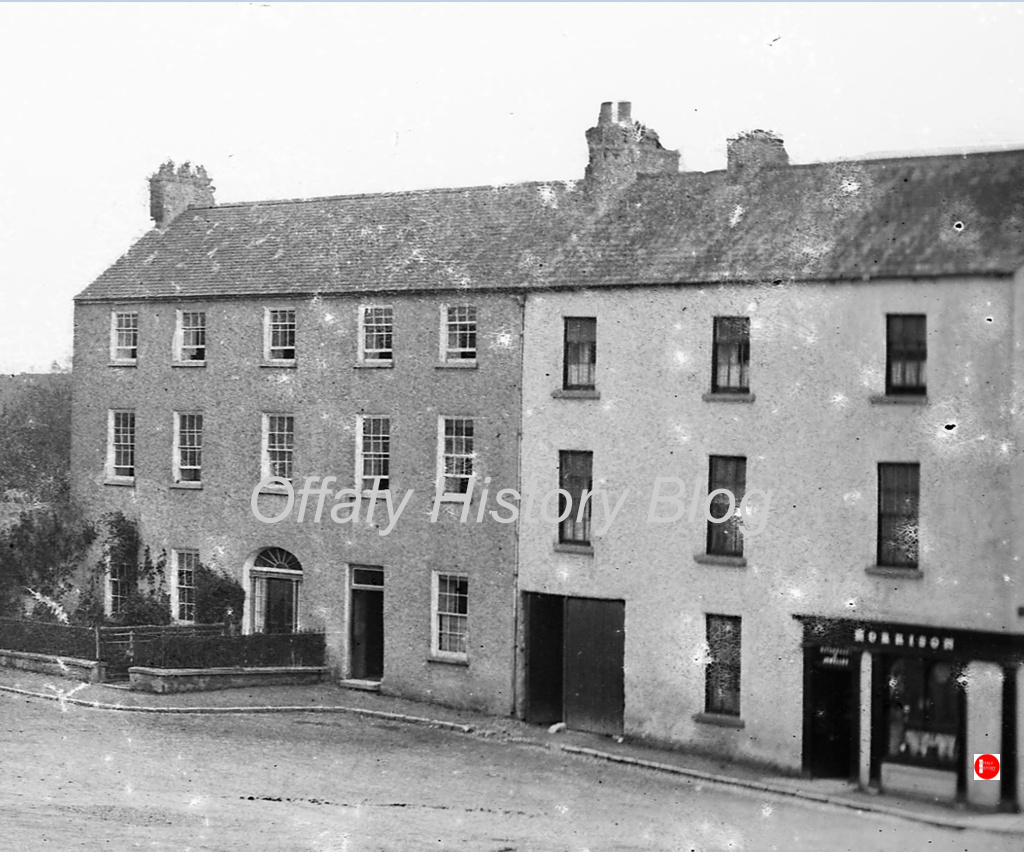
The Morrison family were part of the merchant community of Birr in the eighteenth and nineteenth centuries. Where the Quaker community had dominated towns like Mountmellick, Tullamore Edenderry, Moate and to a lesser extent Birr from the 1700s this had given way after 1800 to a growing Methodist influence. We need look no further than Duke/Cumberland/Emmet Square, Birr for evidence of this with at least four of the sixteen houses in the square owned by Methodists. One family were booksellers and printers (Sheilds) and two others were jewellers – Lynne (Lynn) Riddler (Ridler), and later Morrison. Church Street, Tullamore would provide a similar venue of such Methodists enterprise.
References in the trade directories to Morrisons of Birr
1854, King’s County Directory, p. xv, Edward Morrison, established 1854, advertisement.
1870, Slater, Edward Morrison, clock and watch maker
1881, Slater, Edward Morrison, clock and watch maker
1890, King’s County Directory, 345, Davies Dentistry at Morrison’s every alternate Wednesday
1894, Slater, Edward Morrison, clock and watch maker
1931 McDonald, Edward Morrison, jeweller.
The Morrison family of 5 Emmet Square were not prominent in the Birr Methodist Society until after the mid-1850s. The Ridler jewellery store was acquired, some say, about 1854 and by the 1860s Edward Morrison was a local Methodist leader and maintained that position up to his death in 1895. The new parish hall and vestry beside the Methodist chapel in Birr were named in his honour. About seven years earlier a manse had been acquired at Oxmantown Mall confirming how strong Methodism was in the 1850s to the 1900s.
George Morrison’s only son, called Edward after his grandfather, married in 1921 Florence Downey of Arcadia, Tramore. His mother, Katherine Hannah Morrison (née Clarke) now lived in Dublin where she died in 1944. Edward Morrison worked as a neurological anaesthetist and his wife was an actress. He was of the third and last generation who had lived in Birr.
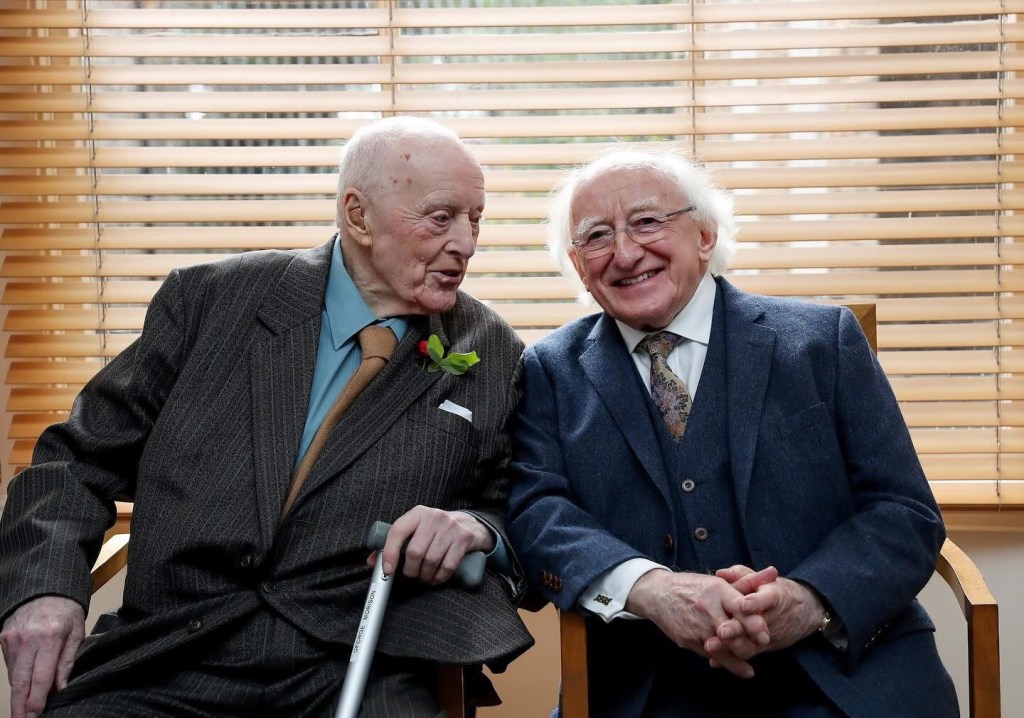
Their son George Morrison (after his grandfather, above left, and who died in August 2025) was born in Tramore in November 1922, studied medicine for a while, but dropped out to follow in the footsteps of his Birr-based grandfather and work in films as opposed to still pictures. George Morrison related in an interview at aged 90 in 2012 that it was his grandmother (living in Dublin by then) who took him to see a film work by Kinnitty associated Rex Ingram in 1928 which enchanted him. His father was not so sure that film making was suitable work for a gentleman. In that interview GM did not allude to his Birr history.[2]
Morrison’s best-known work is Mise Éire (1959). He was elected to Aosdána in 2005 and awarded the title Saoi in 2017. His first wife was the late Theodora Fitzgibbon (1916–91). They married in 1960 and settled in Dalkey. Some of her best-known works on cookery were illustrated by her second husband George from his knowledge of photo archives in Ireland and Britain. He used one of Leap Castle by his grandfather, a picture first published about 1897, in their A taste of Ireland in food and pictures. Theodora Fitzgibbon died in 1991 and his second wife Janet in 2019.
George Morrison was an astute illustrator and that long before the current craze for colouring old black and white pictures. As a film archivist he would hardly have approved. That said his grandfather George would almost certainly have sold coloured postcards in his shop in Birr’s Cumberland Square 125 years ago. As a jewellery artist and commercial photographer he would have been pleased to see the success achieved by his grandson.
[1] King’s County Chronicle, 23 June 1894.
[2] Irish Examiner 2012 online
This series is supported by Offaly County Council’s Creative Ireland community grant programme 2025-2027.


 offalyhistoryblog