
There are a number of references in the Annals to Viking bases been set up on the Shannon, particularly in the larger lakes of Lough Derg and Lough Ree. There were two distinct periods of Viking activity on Lough Ree starting In the ninth century when the Vikings had a fleet on the lough. The Annals of Ulster for 845AD say ‘There was an encampment of the foreigners i.e. under Tuirgéis on Loch Rí, and they plundered Connacht and Mide, and burned Cluain Moccu Nóis (Clonmacnoise) with its oratories, and Cluain Ferta Brénainn (Clonfert), and Tír dá Glas (Terryglass) and Lothra (Lorrha) and other monasteries’. Later another base was built between Dromineer and Castlelough in the lands of the O’Sextons. It was from the Shannon that the majority of raids into County Offaly were carried out. A very early and unusual entry in the Annals of Ulster for 749 says ‘ships with their crews were seen in the air above Cluain Moccu Nóis’.
The following year Tuirgéis was captured by Maelsechlainn and drowned by him in Lough Owel outside Mullingar. The Annals of Ulster for 922AD say ‘The fleet of Limerick, that is of Ailche’s son went on Loch Rí, plundered Clonmacnoise and all the islands on Loch Rí and took great booty in gold, silver and much treasure’. In 924AD the entry reads ‘Kolli son of Bárðr ‘Lord of Luimnech’ raids Lough Ree’.
Catherine Swift gives us a date of 845AD for setting up the Lough Ree camp. The Viking leader at that time was Olafr Ceancaireach (Olaf the scabby-head) of Limerick who landed in Lough Ree in 936 AD having moved his ships overland following a raiding expedition on Lough Erne. The Annals of Ulster for 837 state that Inis Celtra was plundered by the heathens. Later in 937AD he came into conflict on Lough Ree with Olafr Gothfrithsson a Dublin based Viking king and was taken prisoner and brought to Dublin. The Annals of Inisfallen for 930 records that ‘a naval encampment by the foreigners of Luimnech at Loch Bethrach in Osraige and Lough Derg’.
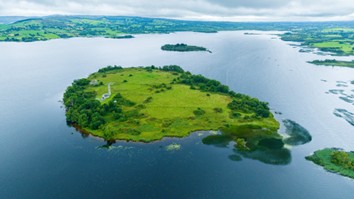
Holy Island/Inis Cealta, Wiki Commons.
The islands on the Shannon suffered a lot. Inis Cealtra (King’s Island, Co Clare) was an open target as recorded in the Annals of the Four Masters for 836AD ‘The churches of Laichtene (Unknown), Inis Cealtra and Cill Finnche (Unknown), were burned by the foreigners. The Annals of Inisfallen in 922AD tell us ‘Tomrair son of Elgi, a Jarl of the foreigners, of Luimnech and he proceded and plundered Inis Cealtra and Muicinis and burned Cluain Moccu Nóis’. An entry for 937 states ‘Inis Celtra was plundered by the heathens’.
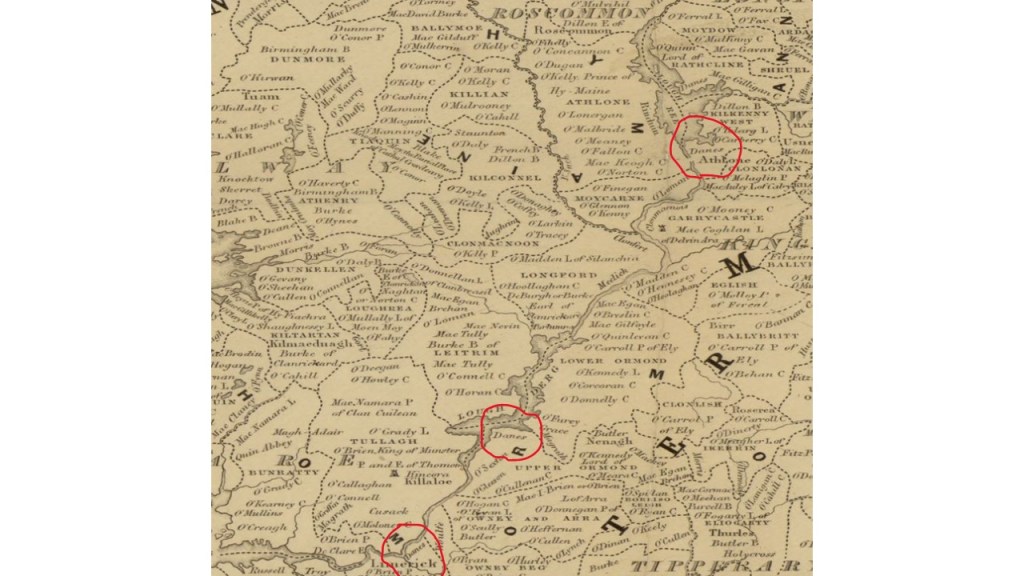
Map of three areas marked Danes on the Shannon. Tipperarian Antiquarian, February 2020.
Professor Elizabeth Fitzpatrick lists 33 Offaly monasteries for this period in her paper The Early Church in Offaly. However, only five or six Offaly monasteries are mentioned in the Annals that suffered from Viking raids. The Annal entries provide us with details of the raids with specific dates.
One might assume that all of the attacks on Offaly monasteries would have come via the Shannon. However, details of the raids suggest that Vikings may have arrived from Dublin or as far away as Annagassan, Co Louth. Did these raiders travel overland or sailed around the coast and then up the Shannon. Or did the monks recording these events make mistakes as to their origin.
Obviously Clonmacnoise was the main target and was raided in 837, 841, 842, 845, 922, 936, 942, 946, and 953 AD, not all by Vikings. One wonders what state the monastery was in when raided so continuously. The 936 raid was supposedly by the Vikings from Dublin, while the 953 raid had Munstermen accompanying the Vikings.
Kinnitty was raided in 850 as recorded in Cogadh Gaedel re Gallaibh ‘Cell Dara (Kildare), also, and Cluain Eidhneach (Clonenagh, Co. Laois), and Cenn Etigh (Kinnity), and Cell Ached were plundered by them that is by the fleet of Ath Cliath’ along with Saighir (Seir Ciarán) in 839, 841 or 842 – the dates here are disputed. The Annals of Ulster mention the following raids for 842 ‘Biror (Birr) and Saiger (Seirkieran) were plundered by heathens from Duiblinn’.
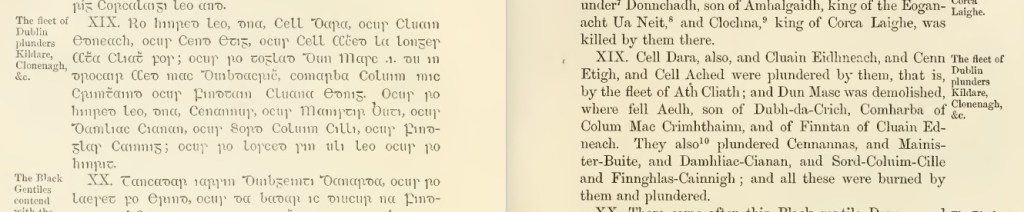
The entry about the Viking raid on Kinnitty from Cogadh Gaedel re Gallaibh translated by James Henthorn Todd, 1867.
A different cross-country raid was made on Clonmacnoise in the same year ‘Cluain Moccu Nóis was plundered by heathers from Linn Duahaill’ (Annagassan, Co. Louth). Killeigh was raided in 840 according to the Annals of the Four Masters ‘the plundering of Cluain Eidhneach (Clonenagh, Co. Laois) and the destruction of Cluain Iraird (Clonard, Co. Meath) and Cill Achaidh Droma Fota (Killeigh, Co Offaly) by the foreigners’.
A later entry in that Annal for 937 has the Munstermen joining the Vikings on a raid ‘the men of Munster, under Ceallachaan, King of Munster, who had the foreigners along with him, plundered the churches of Cluain Eidhneach (Clonenagh, Co. Laois) and Cill Achaidh and the territory of Meath, as far as Cluain Iraird (Clonard, Co. Meath)’.
What is interesting from the above list is the number of churches that appear to have been ignored entirely by the Vikings, such as at Gallen, Durrow, Lemanaghan, Tisaran, Rahan, Knockbarron, Tihilly or Lynally etc.
Outside of Scandinavia the greatest number of Viking artefacts discovered have come from the excavations at Wood Quay in Dublin and at Jorvik (York) in England.
The Wood Quay discoveries were immense and give us an understanding of the wealth and skills of the Dublin Vikings. Outside of Dublin the number of Viking sites excavated have been limited. Most of the discoveries have been accidental, and include grave goods, weapons, amber, amulets, female ornaments, jewellery, gold and particularly silver.
Weapons.
The most significant Viking discovery in County Offaly was in Ballinderry Bog on the border between Offaly and Westmeath. Interest was raised when a man digging a drain in the bog found a Viking sword in 1928. The iron blade had the makers name on it; Ulfberht made this blade in modern day Germany; almost 150 of his blades have been found between Russia and Ireland. A magnificent crannog was later discovered in the bog which led to an excavation by a team from Harvard University led by H. O’Neill Hencken in 1932. This high status sword find led to one of the most important Viking related discoveries in Ireland, outside of Wood Quay.
The Ballinderry crannog is within 17 km of the Shannon and close to the river Brosna. Ballinderry was under the control of Clann Cholmain of the Northern Ui Neill at that time. The occupants of the crannog probably traded with the Limerick Vikings initially. Later the amount of Viking material found suggests that the Vikings may have been living there or had inter-married with the family. Their main dwelling was a house built to the layout of the Dublin Viking houses.
650 artefacts were recovered. Many are decorated, showing strong Irish -Viking influence in art and manufacture. Hiberno-Scandinavian artefacts were used by the Norse settlers on which Celtic (Irish) designs were created by locals trained in the design and/or production of these objects.
| Ballinderry Viking Artefacts | Ballinderry Hiberno-Scandinavian Artefacts |
| Wooden long bow | Wooden game board |
| Two iron spearheads | Wooden motif pieces |
| Iron sword | Silver kite brooch |
| Iron axehead | Copper-alloy ringed pins |
| Two glass linen-smoothers | Copper-allow hanging lamp |
| Iron strike-a-light | Copper-allow strap end |
| Wooden zoomorphic figures |
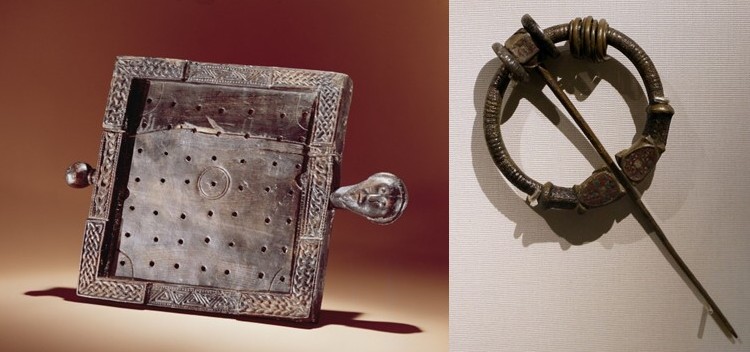
Ballinderry Viking board game and Ballinderry Brooch, Google Commons
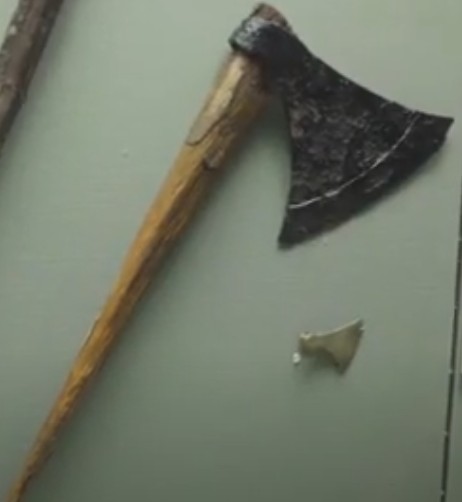
A Viking battle axe was found at Athlone in 1986.
Viking battle Axe from Athlone, NMI
A Viking sword was found at Banagher by their local sub-aqua club in 2012. The sword hilt is decorated with silver niello and copper alloy and is dated to the 11th century.
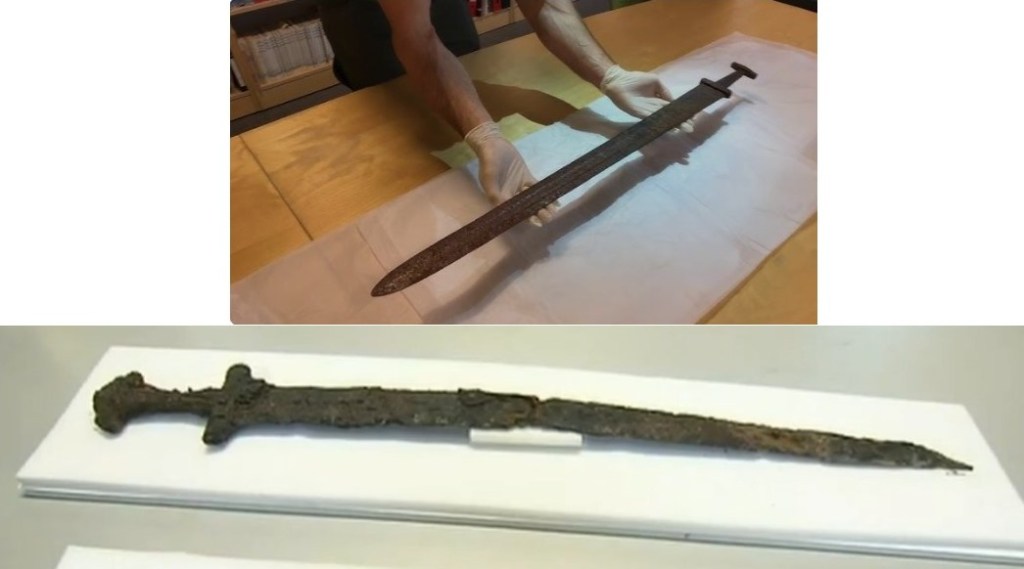
Banagher Viking sword, NMI.
Silver.
During the ninth and tenth centuries large quantities of Viking silver came into circulation in Ireland. Dublin was the obvious focus as barter continued as the way goods were traded in areas under the control of the Irish Kings. Silver circulated in the form of coins, ornaments, ingots, hack-silver and personal artefacts.
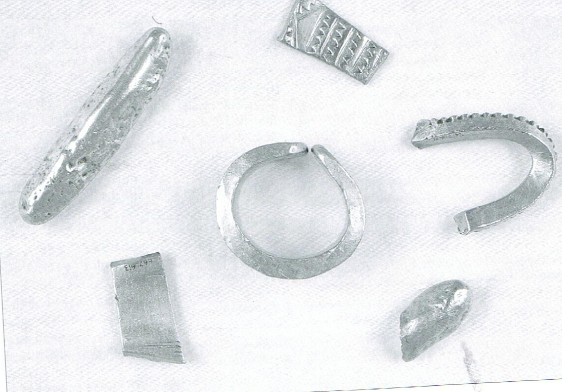
Hack silver. Cathy Swift, MIC, Limerick.
There was no silver mined in Ireland so it came from abroad, particularly from Afghanistan via the Volga River. Kufic silver coins arrived from the Arabic countries that traded with the Vikings. Analysing the silver is difficult due to impurities being added and some silver was melted down multiple times and recast.
One of the surprising discoveries of what the Vikings left behind were the large number of silver hoards, mainly of coin. Of the over 130 silver hoards found six were found in Co. Offaly, mostly at religious sites. This implies trade between Vikings and monasteries – a complete reversal of our understanding from when the first Viking arrived!
The Clonmacnoise hoard was discovered during renovations to St. Ciaran’s National School. It consisted of 30 Hiberno-Norse coins, dating from 1075-1090AD. The find consists of 27 silver coins along with an ornament made up from twisted gold wire and also a single copper ingot. Obviously Clonmacnoise was a monastic city that traded regularly with the Vikings and others, unlike what was happening a few hundred years previously!
The Durrow find was also at the ecclesiastical site and consisted of 10 Anglo-Saxon coins and 1 Viking coin from York. All are dated to around 940AD. The coins were found in 1850AD and are now in the National Museum, Dublin.
The Geashill find consisted of 5 Anglo-Saxon coins from York and date to around 920AD. The coins were presented to the British Museum by Lord Digby in 1862.
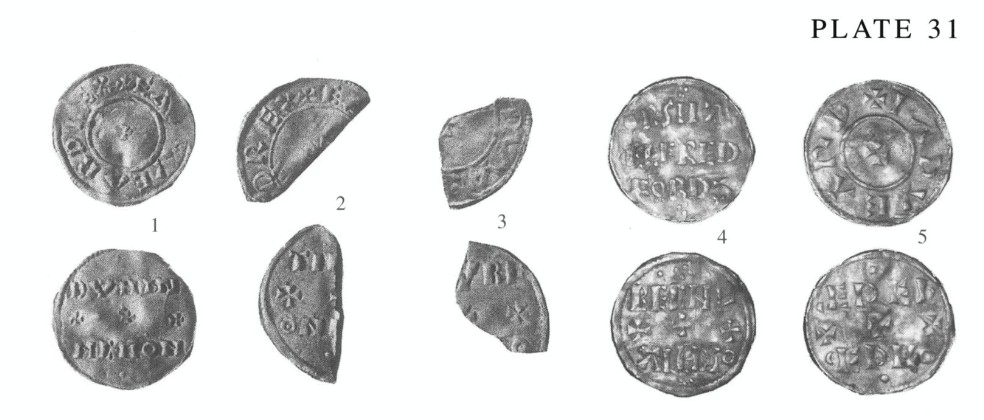
Geashill Viking silver coins, The Numismatic Chronicle, Vol 163, 2003
Rahan produced 2 finds at the ecclesiastical site. These are described as of Anglo-Saxon origin. The early find was in 1820 and was described as ‘an extensive hoard’. No trace of these coins survive. The second hoard was discovered in 1828 and was described as ‘a considerable number’ of coins, some hacksilver and 1 ingot. The ingot is in the National Museum in Dublin.
Based on the discovery of two major Viking hoards on Hare Island in Lough Ree in 1802 we can safely assume that the island was among those occupied by the Vikings during one or both of their major periods of occupation on the lake. The finds included gold arm rings and silver anklets, unfortunately all were melted down but drawings of the items have survived. This may well have been one of the largest Viking gold hoards uncovered in Europe.
Surprisingly, one of the remnants of this period of coin based trade in the Viking world is the survival of the Norse loan word penninger in the Gaelic language as pingin and in English as penny.
Sources:
The majority of the quotes above are from the UCC CELT website at https://celt.ucc.ie/publishd.html
Lucas, A.T. 1967, The Plundering and Burning of Churches in Ireland, 7th to 16th century. In Etienne Rynne (ed), Essays in commemoration of Monsignor Michael Moloney. Limerick. [Available at Offaly History Centre][
Krogsrud, L. M. 2012, Checklist of Viking-Age silver hoards from Ireland, JRSAI, Vol 142. [available at Offaly History Centre
Many thanks to John Dolan for his two articles of which this is part 2.
 offalyhistoryblog