
The story of people hitting a ball with a stick is a story which is told everywhere, from Iceland to Ethiopia to the Far East and across to the Aztecs. Look at lacrosse played by the American Indians, the stick and ball games played by the Mongols, the Berber stick and ball game played on the sands of the desert. The Irish game of hurling is a modern variant of a theme which is written through history, across millennia.
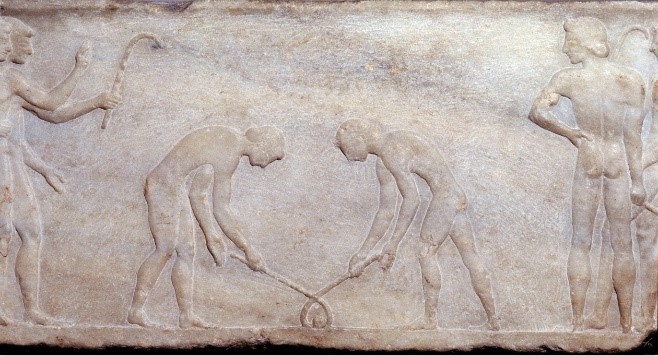
Players with two sticks and ball. Greek National Museum, Athens.
There are plenty of books that cover the history of hurling in Ireland. The public library system has most of them. Along with a general history of hurling that are also many histories that are specific to individual counties, particularly parishes and clubs.
However, the earlier accounts of hurling go back to the pre-Christian myths and folklore of this island. Later, the scriptoria of the early church spent their first hundreds of years copying the religious material needed for church services and activities – particularly gospels and psalters (book of psalms). It appears that each priest had his own personal psalter that he carried around with him in a satchel. One such psalter and satchel was the unique Faddan More Psalter found in a bog in 2006. All such manuscripts were written in Latin at this time.
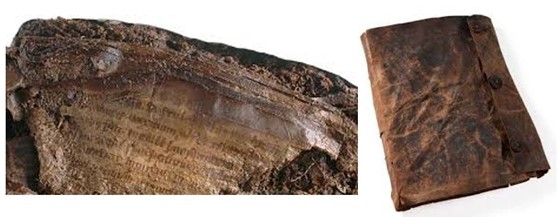
Fadden More Psalter with Satchel, NMI, Dublin.
The earliest manuscripts in the Irish language are from about 600 AD. A possibly late-sixth century Latin psalter text known as the Cathach of St Columba’ contains early glosses in Old Irish, and early Irish itself was increasingly used during the 8ᵗʰ and 9ᵗʰ centuries. Unfortunately, very large numbers of the earliest manuscripts were lost to Viking and Irish plundering of monasteries between the 8ᵗʰ and 10ᵗʰ century.
Writing in Irish the monks adopted the Roman script and alphabet, although some of the letters were modified in later years. There was no standard Irish dictionary, grammar, use of hyphenation or punctuation at this time, even though Irish monks were experts in teaching Latin grammar and mathematics. Early written Irish was based on local and regional phonetics of the spoken language, creating problems for scholars up to the current time.
Writing in Irish developed through three phases:
- Old Irish 700 – 950AD
- Middle Irish 950 – 1200AD
- Early Modern Irish 1200 – 1600AD
From the early 11th century onwards, we have a significant change where the monasteries started to produce non-church related manuscripts. We have monks, writing in Irish, recording stories that had never previously been written down but that had been passed down verbally through previous generations. It is from these stories that we get our first accounts of hurling. Over the next 300 years there was a huge output of this material, much of it copied many times.
This indigenous output was the written verbal folklore that had existed for hundreds of years and which continued to be handed down verbally by the poets and seanchaí until recently. The most significant material from the output were the Hero Tales, Early Irish Law, Poetry, Genealogies, myths, historical narratives, all covering a diverse range of literary genres.
Hurling in the manuscripts.
Hurling is mentioned many times in the ancient manuscripts. For our purposes we will deal with two of the most important ones. The earliest mention is tied in with the first of two battles at Moytura in the west of Ireland. We find this account in Ireland’s Origin Story called Cath Mag Tuired, the battle is supposed to have occurred in 1,272BC.
Cath Mag Tuired is one of the significant episodes that we find in Lebor Gabála Érenn (Book of Invasions), translated by JH Todd and published in London, 1867. Origin Stories (sometimes called Creation Myths) are usually backstories, usually based on mythology and represent a county, city or tribe in the best light possible. The Lebor is housed in the Royal Irish Academy in Dublin.
The Lebor recalls the invasion of Ireland by five different groups who attempted to take over the island, all five invasions failed. Sounds familiar? The fourth group who arrive were called the Tuatha de Danann who were supposed to have fled Greece. Here they found the previous invasion group the Fir Bolg who were not happy with the arrival of the Tuatha de Danann, leading to the two Battles of Moytura.
The first battle was near Cong in Mayo, the second near Lough Arrow in Sligo. They involved the Tuatha de Danann firstly against the Fir Bolg, the second battle was against the Fomorians.
The Fir Bolg offered to split the country into two, Leith Cuinn for the north of the country and Leith Moga for the south of the country. Understandably, the offer was rejected. Negotiations were carried out by the druids on both sides.
The account concludes ‘The druids went back to the Tuatha Dé and told their story from beginning to end, how the Fir Bolg would not share the land with them, and refused them favour or friendship. The news filled the Tuathé De with consternation’.
‘Thereupon Ruad with twenty-seven of the sons of courageous Mil sped westwards to the end of Mag Nia to offer a hurling contest to the Tuatha Dé. An equal number came out to meet them. The match began. They dealt many a blow on legs and arms, till their bones were broken and bruised, and fell outstretched on the turf, and the match ended. The Cairn of the Match is the name of the cairn where they met, and Glen Came Aillem the place where they are buried.’ Local folklore records that this cairn contains the remains of twenty nine youths killed in the hurling match.
Táin Bó Cuailgne.
Although the earliest account of hurling in Ireland is that from Lebor Gabála Érenn, the most famous account has to be found in the Táin Bo Cuailgne, a legendary tale from early Irish literature. It is regarded as the most famous tale in Irish mythology about our mythical heroes and is the central story of the Ulster Cycle.
It also introduces us to the boy-hero Setanta who then became the Ulster hero Cú Chulainn (literally Hound of Culan), describing his exploits during his short life. All of the accounts agree that his mother was called Deichtine. However, there is no agreement as to who his father was. Thomas Kinsella’s translation says that his father was Conchobor and later in the tale Cú Chulainn tells the king ‘I am Setanta, son of Sualdam and your sister Deichtine’. The Book of Leinster version puts Crunniuc as his father with Macha as his mother. He was fostered out to a noble family in the normal fashion of the time.
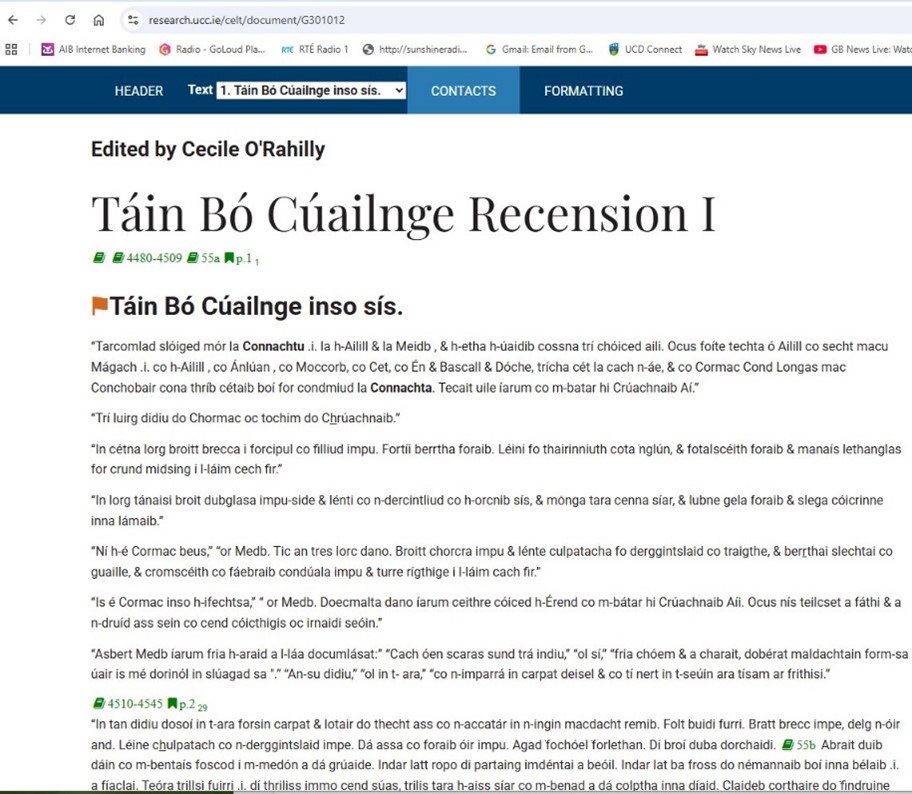
Táin Bó Cuailgne, from CELT on the UCC website.
There are also many lesser Táinte. Some of these are known only by name, but most of them are extant, but fragmentary, and have been translated into English. Among these are the following:
- Táin Bó Flidaise – “The Cattle Raid of Flidais”
- Táin Bó Aingen – “The Cattle Raid of Aingen”, also known as Echtra Nerae
- Táin Bó Dartada – “The Cattle Raid of Dartaid”
- Táin Bó Ere
- Táin Bó Fraích – “The Cattle Raid of Fráech” (see also Fráech)
- Táin Bó Munad
- Táin Bó Regamna – “The Cattle Raid of Regamain”
- Táin Bó Ros
- Táin Bó Ruanadh
- Táin Bó Sailin
There are two main copies of Táin Bó Cuailgne. Unusually, both of these copies are retained in Ireland. The story in the older version (Recension 1) is dated to around 1st century AD. It is written in Old and Middle Irish and can be found in two Books, Lebor na hUidre (Book of Dun Cow) and The Yellow Book of Lecan. The word Book here should really be described as a Folder as all of these Books contain additional Early and Middle Medieval manuscripts. This Táin is badly damaged and is held in the Royal Irish Academy, Dawson St., Dublin.
The second copy of the Táin (Recension 2) is much later, better written and is the most complete version. It also contains additional sections not found in the RIA copy. This copy is in The Book of Leinster and is held at TCD, Dublin and is the copy that has been translated regularly. The Book of Leinster contains five more mythological manuscripts and one Christian one.
The cattle raid was triggered by a dispute between a disgruntled husband and wife over the value of their wedding gifts to one another. This section of the Táin is called the Pillow Talk; this led to their army leaving Cruachan in Connacht and heading to the Cooley mountains in Co. Louth, led by Queen Meave who was accompanied by her husband King Ailill. Cattle raiding was endemic in Medieval Ireland.
The stories of Cú Chulainn’s childhood are told in a flashback sequence in Táin Bó Cúailnge. The main section of the tale that deals with his hurling is contained in a section called Cú Chulainn’s Boyhood Deeds. As a boy Cú Chulainn grew up wanting to join the king’s army, initially by joining the soldier academy. We read early on that Cú Chulainn demanded from his mother that he be allowed to go and train with King Conchobor’s trainee soldiers.
The Book of Leinster says: “He proceeded to the plains of Emain Macha where the youths were gathered. There were one hundred and fifty youths with Follúin mac Conchúir exercising in the field of Eamhain. The young boy went among them in the playing field and putting the ball between his two feet without raising it above his knee nor dropping it below his ankle, he thrust it before him keeping it between both legs such that no one succeeded in catching or hitting it. He took it with him to the edge of the goal”.
Again, ‘Another time he was playing ball in the playing field east of Emain. He stood alone against the three times fifty boys. He could always beat them in every game of this kind.’
Another story from Recession 1 on the UCC CELT website says ‘Then they threw all their balls at him and he caught them, every single ball, against his breast. Then they threw their thrice fifty hurling-clubs at him. He warded them off so that they did not touch him, and he took a load of them on his back. Whereupon Cú Chulainn rose to his feet, and, striking off his opponent’s head with his hurley, he began to drive the head like a ball before him across the plain’.
Setanta was invited by his uncle Conor to a feast at Culann’s house, Culann was a renowned craftsman or smith. “I’m busy playing hurling”, said Setanta. “Go on ahead. I’ll follow your chariot tracks and catch up with you later.”
When the men arrived at Culann’s house, Culann asked if anyone else was coming, as he wanted to let his guard dog loose. Forgetting about Setanta, Conor said that no one else was expected. The dog was let loose.
Setanta finally arrived, batting the sliotar into the air with his hurley, throwing the hurley after it, and catching them both before they fell to the ground. The dog attacked him. The men heard the commotion, but they couldn’t get out of the house in time to save Setanta. The Táin continues ‘now when the hound came towards the boy, he cast aside his ball and his hurley, and he tackled the dog with both hands, that is, he put one hand on the apple of the hound’s throat and the other at the back of his head, and dashed him against the pillar-stone that was beside him so that all the hound’s limbs sprang apart. According to another version, however, he threw his ball into the hound’s mouth and it drove his entrails out through him.’
Conor and the rest of the men were relieved that Setanta was safe, but Culann complained about the loss of his guard dog. “It took me a year to raise and train that dog. Now I’ll have no guard dog to protect my house until I can train another one.”
“Don’t worry,” said Setanta. “I’ll be your guard dog until you can replace the one I killed. I’ll be the Hound of Culann [Cú Chulainn].” And that is how Cúchulainn got his name.
Quotations from Táin Bó Cuailgne by Cecile O’Rahilly.
Brehon Laws and Hurling.
The earliest references to the sport in Brehon Law date from the fifth century, although put to writing much later. The Seanchas Mór outlines specific legal protections for hurling. The laws detailed compensation, penalties, and punishments for injuries sustained during hurling matches. This indicates that the sport had rules and that injuries were taken seriously, with legal consequences for those causing harm. Provisions were also made for cases of deliberate injury, or even death, as a result of hurling.
Many reasons were given for having these laws: the roughness of the games, the fighting that followed them, the destruction of woods and ditches, the danger of the caman becoming a weapon and the danger from large assemblies. Throughout the countryside, hurling thrived as a wild and often violent sport with few set rules.
Another legal document, not included in Seanchas Mor, is the Mellbreatha. Mellbreatha is fragmentary, deals with sports-judgments and was translated by Daniel Binchy. It deals with accidental injuries, the liabilities they incur and displays a Christian influence. It gives the names of twenty five sports, some quite obscure but includes hurling.
Laws against Hurling.
The 1366 Statutes of Kilkenny proscribed the descendants of the Normanswho had become so assimilated to Gaelic society that they ‘had become more Irish than the Irish themselves’, the first time this phrase came into use. The Statutes forbade hurling due to excessive violence.
One story in the Kilkenny Observer for 8 December 2022 describes the torture that Norman soldier Geoffrey FitzThomas underwent when he was brought to court for playing hurling. His jailors demanded to know who the Irish players were and where they lived. When he refused to deliver up their names he was given 40 lashes as punishment.
1383 – 1389 there was a synod organised by John Colton, Archbishop of Armagh, who forbade the game of galbardy, a type of hurling according to some historians.
1527 The Statutes of Galway prohibit hurling and handball.
1555. Act of Parliament forbids festivals and activity on the Sabbath, including all sports. Confirmed also by a decree of Elizabeth 1st.
in 1579 a decree by Elizabeth 1st declared that ‘all heathenish playes and interludes should be banished upon the Sabbath days’.
By 1603 another decree from Cork Corporation stated ‘To desist from hurling on the streets’.
 offalyhistoryblog