
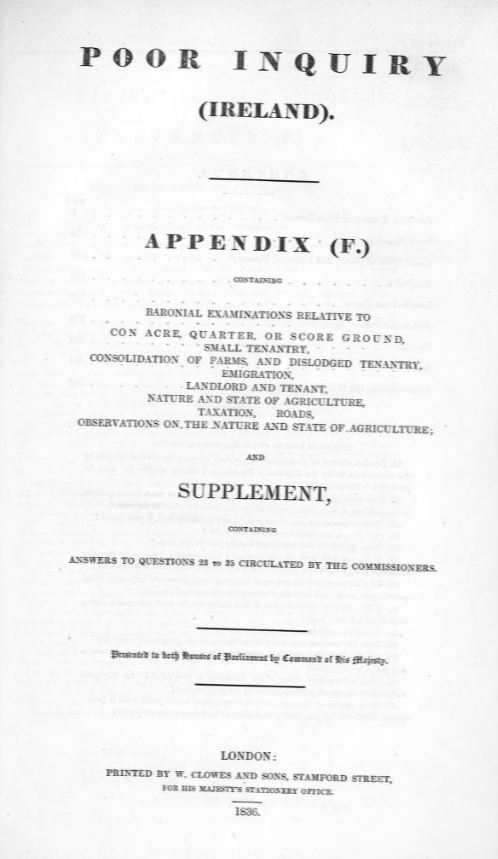
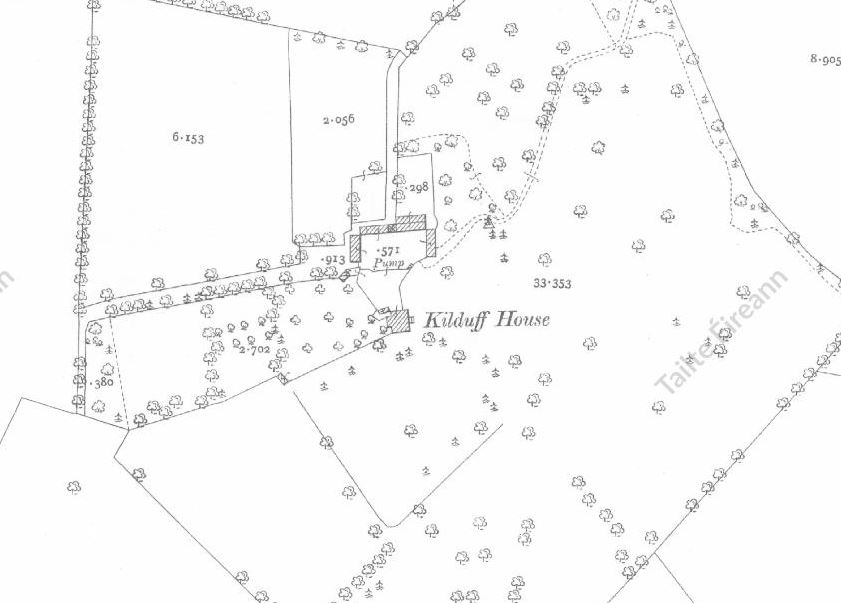
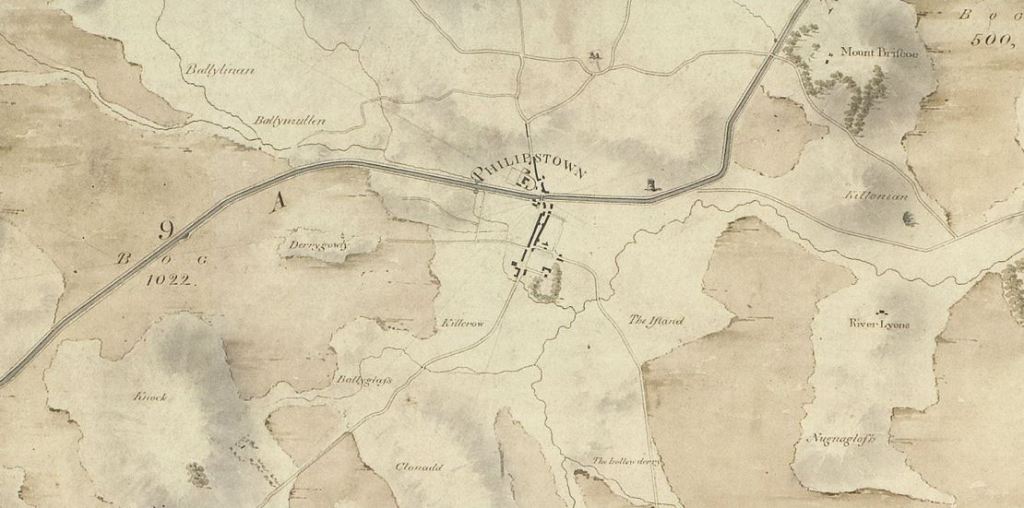
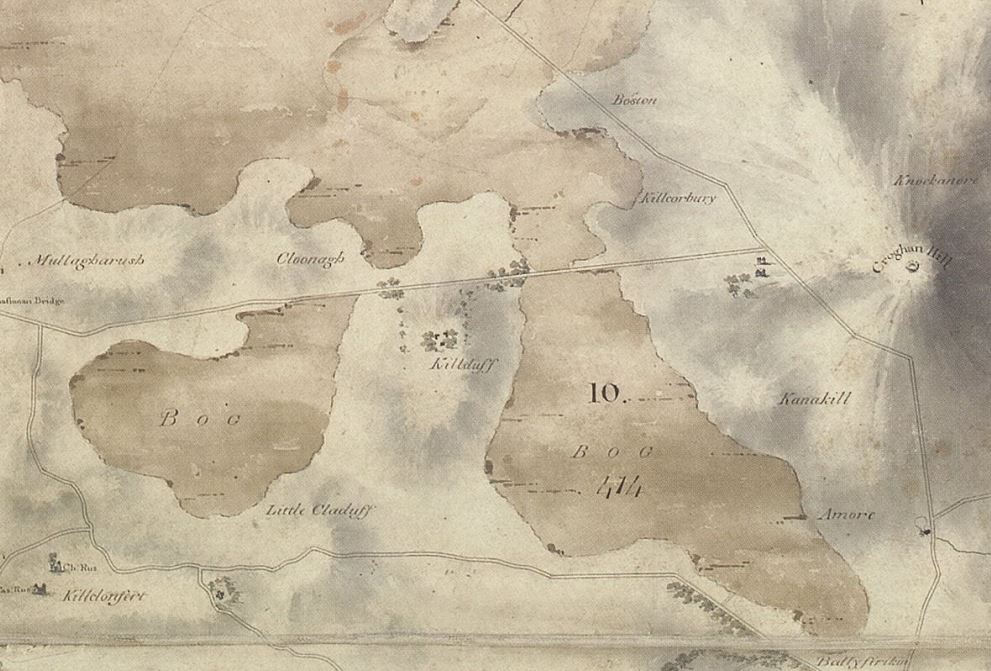
This is part two of a three-part blog on the 1835 Poor Law Inquiry into the baronies of Philipstown Upper and Lower. The respondents to the questionnaires for Philipstown were Rev P. Rigney and Roger North. Roger North was a landowner in King’s County. He inherited the Kilduff estate upon the death of his father, Roger North, in 1830. He was involved in estate management, including raising rents, which made him unpopular with local farmers and other landlords.[i] Roger North was shot dead in September 1850.
Transcripts of the Poor Law Reports – Continued
Amount of Rent, and Mode of Paying.
‘The rent of the small holdings in this barony is paid entirely in money, though occasionally days are given to the landlord for making or drawing turf, &c. For these small holdings the competition is so great, that, as Mr. Odlum says, “they would give the last farthing to get possession.” “Ay, and would bid as much as would not leave them better food than ‘lumpers,’ and not enough even of them.”— (Mr. Walsh.)—In case of a farm of five or ten acres being vacant in the district, Mr. Odlum said that “40, ay 50, would be looking for it; and men not able to stock half an acre. Most probably lives might be lost about the taking of it. He gave as the reason of this anxiety, “that they were sure of a home.” “When land is out of lease in this neighbourhood the large proprietors send out a valuator; but in case of a middle-man having land to set, he generally lets to the highest bidder.”—(Mr. Odlum)—A hanging gale of half a year’s rent is usually allowed, nor is it called in upon any occasions; but Mr. Walsh states that “there is no remission of rent in a bad year ; and though almost all the country is in arrear, there is nothing like striking off this arrear ; and a greater injury could not be done to any man than to keep a debt hanging over him which he can never pay.” And Mr. Odlum adds, “If a good year comes, all the profit is swallowed in arrears, so that the people are dispirited, and it is impossible for capital to accumulate.” In bad seasons remission of rent is not usual; but it was mentioned that, the tenantry in every part of the barony were in arrear, and that the small tenants have nothing left but lumpers [poor potatoes] and buttermilk. Mr. Odlum was of opinion that, if tithes or any imposts affecting the land were withdrawn, the landlord would be bettered by it, inasmuch as he would thus be enabled to collect more of the arrear, although, as Mr. Walsh says, he demands too much already.[ii]
Cause of the Peasantry bidding Rents above their Means of Paying.
Mr. O’Connor says, “A man bids for land because he has no alternative: the land must be had if possible, and you’ll find men giving a premium to get into a farm where another had just been broken. It arises from some notion that, may be, prices would rise, or some Means of Paying, reduction be made in the rent; at all events, a man will have a home for some time.” Under these instigations a sum is often offered for land which the bidder knows well to be out of his power to pay; and he is obliged to give up everything but what is barely sufficient to sustain life.
Effects of the System in the Creation of Crime.
Many of the crimes committed in the neighbourhood are connected with the taking of land; Mr. Odlum states that “there is a feeling among the people that no man has a right to come in on the land of another.” He adds that “he considers destitution to be the cause of this feeling, and a soreness arising out of what they conceive unjust dealing on the part of the landlords: thus, for instance, when a man is put out, and his successor gets the land at a lower rate than it was set for before, the tenant who has been ejected thinks that he Should have got a trial at the lowered rent.” It was stated that in many cases the ejected tenant suffers extremely, and that there is a very general feeling in favour of those dispossessed; but Mr. Kennedy observes that, in general, when a crime is committed, it is some person connected with the dispossessed family who perpetrates it. He mentioned the following case as having occurred a few years since: “A farmer hired a soldier to shoot a man who took his farm; the soldier did so, and afterwards turned king’s evidence, and the farmer was hanged.” Mr. Odlum states that there has not been any combination here against rents; and Mr. Porter added, “It is not that they will not pay, but they cannot.” To outrages committed about the taking of land the sanction of the agricultural classes is very generally given; and Mr. Kennedy says, “There is every opposition given to a newcomer, and few would be willing to take land from which a man has been ejected upon which Mr. Odlum observed, “I don’t know that: so great is the anxiety to obtain land that men are willing to run all risks.”[iii]
Effect of the System on the Accumulation and Introduction of Capital.
This custom of making their own regulations, and uniting to redress their Effect of the wrongs, was .considered very mischievous in its consequences. Mr. Odlum remarked, “There cannot be a worse custom; but latterly the country is quiet, and the feeling not so strong.”
Mr. Porter did not conceive that the fear of disturbances prevented any persons from investing capital in farms in the neighbourhood. He mentioned a case of a large farm ~ held lately by an individual, who was ejected from it, and a farmer from the county Kildare came down an took it. Neither was it known that any persons withdrew their capital through fear of violence. With regard to capital among small tenants, Mr. Odlum says that when a small farmer has any little money, he always bids the higher for land; in fact he bids taken by the last farthing, and leaves himself without as much as would stock a rood of land. He likewise stated that, in the case of under-letters, a sum of money is often given in hand, but not in the case of the great proprietors; so that the tenant frequently wants the capital necessary to Purchase stock and implements. With regard to the accumulation of capital among the small tenantry, or the possibility of the farmer’s making money now, Mr. Walsh states that there is not one shilling in the farmer’s hands now for every pound formerly, even 10 years ago: and Mr. O’Connor corroborates this opinion by saying “that the farmers are all losing; it is in the landlords’ power to put them out on the road in every part of the country.” The observation of Mr. Odlum, as to the possession of capital by the tenantry, was, “The landlords have taken it all with them.”[iv]
Effect in preventing the Application of Capital to the Land.
With regard to the concealment, of money among the tenantry, lest they may be called on for more rent, Mr. Odlum observes, “In truth there is no concealment of money, for there is no money to conceal. The nominal rents which have been kept up have done incalculable injury. A heavy arrear hurts industry; it is a chain round the farmer’s neck that prevents him from using his hand.” It was everywhere apparent through the barony that the want of sufficient capital caused the cultivation to be kept in the rudest state; and it was stated that the land was exhausted by efforts to make large rents without adequate capital to cultivate the land.
Effect on Population.
It was the general impression that many persons marry from the conviction that their condition cannot be made worse, and that those who are a little above the wants of a labourer or a cottier are more cautious about marriage.
Remedy.
It was not conceived possible that the condition of the small tenantry could be improved while they continued to bid as they do at present for small holdings; and yet Mr. Odlum says that, even if a subsistence by permanent employment at 5s. per week were secured to them, they would still bid, for land.
The statements made as to the small tenantry of this barony agreed in this — that the small farmers were in a very bad condition at present, most of them being in arrear, and their farms becoming more and more exhausted every year.[v]
Emigration.
Emigration has been very considerable from this -barony within the last five years, and chiefly from the class of single labourers, who have gone, as Mr. O’Connor says, “to better themselves.” Still emigration has not been sufficient to reduce the competition for labour and for small holdings, or to raise wages and reduce rents. The nearest seaport is Dublin, 40 miles distant. It was stated that very many would go to America who have hitherto forborne, if the passage-money were paid, especially young people of both sexes.[vi]
Tenure.
The principal portion of this district is held direct from the head landlord: there is some, but not much, held under the Court of Chancery. The chief proprietors in this district are looked on as tolerable landlords.
The principal proprietors are all absentees, residing entirely out of the country. “We never see anything about them ’except when the dead body of one of them comes.” — (Mr. O’Connor.) The tenants complain greatly of the absence of the proprietors, and think they would receive encouragement if the landlords resided at home among them.
The lands in the neighbourhood were all considered to be let high, and there was not much difference in different districts, or under different landlords. Security for the regular payment of rent is required upon lands set under the Court of Chancery, but in litigated property no suffering to the tenantry has occurred in consequence of different persons claiming rent. The agents of properties in this neighbourhood were stated to be paid by the proprietors for whom they acted, and not by the tenantry; and when landlords receive their own rents they do not charge agents’ fees. Receipts are usually given to the tenants, who are not required to pay for the stamps.[vii]
Leases.
There is a good deal of the land of the barony under lease, but it was stated not so much as formerly; that it is not as usual now to grant leases, and that the duration of leases is shortened; that the present leases are made for one life and 21 years, but that the former were usually for three lives and 31 years. It was considered that the long leases were better in every way; that the farmers were found richer under long leases; and that the lands were more improved, and the farm-buildings better kept than under short leases.
It is very unusual to set land to tenants in common in this district, and such a practice is considered injurious to an industrious man, as each tenant is liable for the rent of the entire.
The usual covenant, and indeed the only one mentioned as inserted in the late leases, is not to underlet. There are no clauses whatsoever with regard to modes of farming, or to using a particular quantity of straw as manure, or as to improvements in cultivation, &c. &c. It was stated to be a common practice towards the end of a lease to exhaust the land, lest, if the land were in a very improved condition, a higher rent, may be demanded for it. Mr. Porter, a very respectable farmer, mentioned that he himself had a farm, the lease of which was near expiration, and that he was deterred from improving it for fear of an increased rent in consequence of his improvement. It was judged that such a system must injure production in subsequent years, and all persons agreed that it would be most desirable that the landlord should be compelled to take all improvements made by the tenant at a fair valuation, and the tenant be liable to pay damages for wilful neglect of his land. It did not appear that any leases, or covenants in them, prevented the extension of tillage in this barony.[viii]
Middle-men.
In this neighbourhood there are very few middle-men. The great proprietors are mostly the landlords of the occupying tenants. The right of disposing of the occupation by the tenant is allowed, and Mr. Ridgway observed that the price of the tenant-right was greatly diminished, owing to the want of money.
The disposition to let lands to middle-men was stated to be decreasing, as that which forms their profit would be either rent to the landlord or profit to the tenant.[ix]
From here parts three and four will continue with the final transcripts of the poor law inquiry, to be available soon.
[i] Fr John Moorhead, SMA, The shooting of roger north (on Monday, 23rd September 1850), p. 1. See also Michael Byrne (ed.) Towards a history of Kilclonfert (Tullamore, 1984).
[ii] Royal commission for inquiring into the condition of the poorer classes in Ireland, first report, appendix F (HC, 1836), p. 49.
[iii] Ibid.
[iv] Ibid., pp 49–50.
[v] Ibid., p. 50.
[vi] Ibid., p. 135.
[vii] Ibid., p. 159.
[viii] Ibid., pp 159–60.
[ix] Ibid., p. 160.
 offalyhistoryblog