
A few years back I met up with some members of the Offaly diaspora in the Gresham Hotel, Dublin, for coffee, and we had a reflective chat about the Faithful County. My fellow aficionados were Laura Price and the late Dr. Michael J.S. Egan. Dr. Egan, a truly wonderful Offaly man, raised the idea of marking the termans at Clonmacnoise.
While I had grown up in the area I had never heard the expression. He explained it was the point where funeral corteges paused on the way to the cemetery. I was well aware of the practice, for as a child in the area every funeral paused at what was called the `coffin bush`. I have enquired from local folk and found nobody had used the expression in this context.
I should like firstly to look at the word before dealing with the sites at Clonmacnoise.
I think we can safely say the word terman is an Anglicized version of the Irish word Tearmann. When you look an Irish-English dictionary we see it means, asylum, presbytery and sanctuary, e.g. to take refuge, tearmann a ghlacadh. I enquired from some Irish speakers if they had ever heard of it used in this context. Tim Dennehy, a very fine Irish speaker referred me to a hymn by Tomas Rus O`Suilleabhain called `A Rí an Domhnaigh` which has the lines `Faoi dhion do thearmann, tri riocht an Aifrinn,, suas go Parrthais Napfa` which translates `Under the roof of your sanctuary, through the holy rites of Mass lead me to the gates of Paradise.` As we shall see later this ties in with the idea of the laity handing the corpse over to the Monks for interment.
The late Bráthair Micheál Fionán O`Catháin an Irish language expert from Dingle County Kerry, was not able to put it much further. He did point out that in Dineen`s Irish dictionary the word was used to apply to Church of Ireland glebes in Antrim.
Moystown native Padraig Heavin was able to tell me the earliest use of the word was found in the State Papers of Henry VII, where it is said `from Irish tearmann, tearmonn lands of a church or monastery within which there is a right of sanctuary.` It is from classical Latin terminus, and in post-classical Latin it became territory. Of course going right back, The Roman God Terminus was the deity who protected boundary makers, who even had a festival in his honour called Terminalia.
In Brewer`s Dictionary of Irish Dictionary of Phrase and Fable we find: `Termon. A defined area around a church or monastery that provided legal protection or sanctuary. The word is a version of the Irish word tearmann, itself derived from the Latin terminus (a limit) survives in Irish placenames such as Termonfeckin, county Louth. (`Termon of St. Feichín`).`
So on balance Dr. Egan`s use of the word was on the money.
At Clonmacnoise there were two such stopping places, with indeed a possible third over the Shannon on the Connaught side.
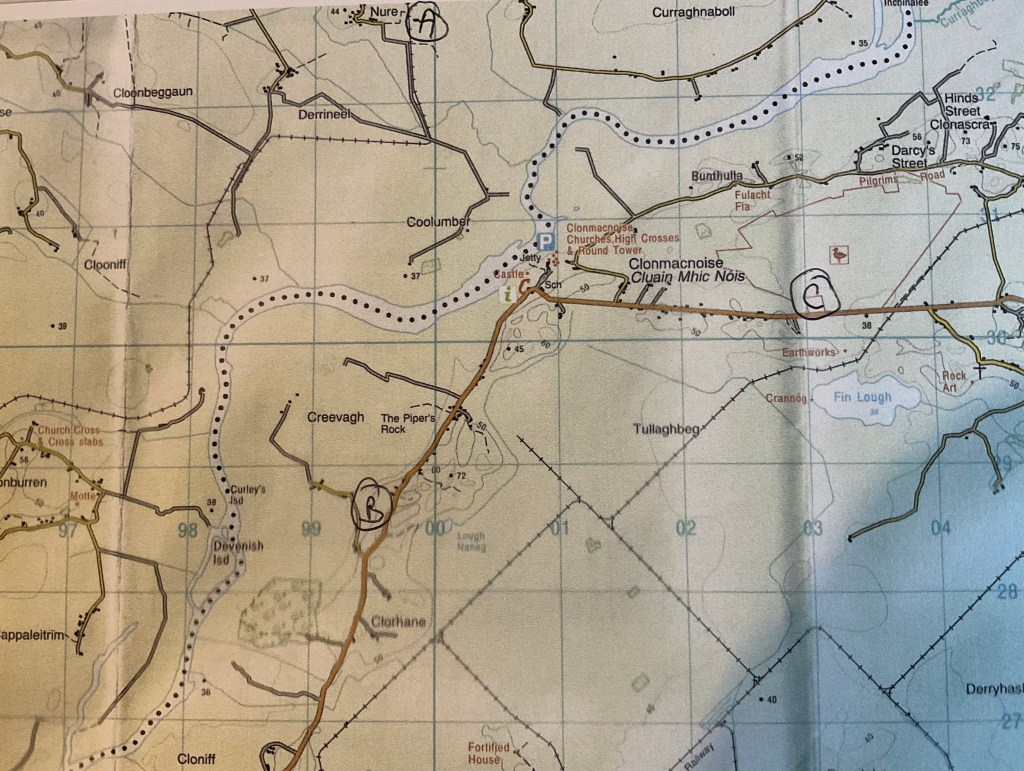
On the Shannonbridge-Clonmacnoise road the stopping place is located, about 50 metres north of the turn to Augincabe. (Marked `B` on the map.) It was a bush known as the `coffin bush`. I recall in my youth every funeral would pause there for about two minutes. The bush was removed for road-widening in the 1970`s. Gussie Claffey, tells me that the old folk there at the time were very unhappy about this. While the segment of road has clearly changed, the actual location was captured in the film the `Flight of the Doves`. The clip lasts less than ten seconds so one has to pay close attention see it.

The terman located on the Ballinahown-Clonmacnoise road is at Tullabeg Hill. (Marked C on the map.) It was marked by a stone where the cortege would pause. This would include funerals from Ballinhown and Clonfinlough. Tom Ryan from Doon confirmed to me that Ballinahown funerals still stop at Tullabeg Hill, which he says is called Bishop`s Hill by Ballinahown folk. Similar to the one on the Shannonbridge-Clonmacnoise road the stone was removed for road widening. Gus Claffey tells me this practice of stopping at Tullabeg Hill has become very infrequent.
Across the River Shannon in county Roscommon, there was something akin to the terman, at Nure in the parish Drum. (Marked A on the map.) It is called `Keen Na Marabh` and is located about 1,000 meters from the River Shannon up from Coolumber. Just west of Coolumber there is a place called Friar`s Lough. Local folk tell me that when funerals were going to Clonmacnoise they would stop here, rest, and folk would keen and cry the deceased, before continuing on to Clonmacnoise. There is no traditional belief here, that the Monks would meet the funeral at this point taking custody of the corpse for interment. This seems more like the traditional form of vocal lament, keening from the Irish and Scottish Gaelic term caoineadh meaning to cry or weep.
Why did funerals pause at these termans? There is much oral tradition locally to the effect that in olden times, they marked the spot where the monks took custody of the body for interment. There was a popular belief that this was not part of a religious ritual, rather it was a precaution to stop the spread of infection to the monastery and the school. There is a rationale to this when one considers there was little understanding of infections and viruses. It may have been dressed up as a religious ceremony. However, I have not been able to locate a similar practice elsewhere, which must cast serious doubt on this theory. It is very unlikely that the monks at Clonmacnoise did a solo run on this.
Gus Claffey tells me that the late Dan Edwards and a group of folklore enthusiasts did some exploration, investigating the significance of the bush and the stone. While they were unable to confirm the origin of the practice, they discovered that the distances between the coffin bush and the high altar in Clonmacnoise, and the top of Tullabeg Hill and the high altar in Clonmacnoise were exactly the same. There may be no significance in this, and it may be purely a coincidence.
While the origin of this custom is well lost in the mist of time, I feel, as the late Dr. Michael Egan did, it would be prudent if some permanent marker could be put in place to mark where they are/were, and of course to acknowledge that they had real meaning for our ancestors. I think an email to our Heritage Officer might be in the agenda.
 offalyhistoryblog