In December 1968 Thomas [Tommy] Dunne received the tribute of a soldier’s burial from surviving I.R.A comrades in Offaly and the army in Annaharvey graveyard, near Tullamore.
Thomas Dunne grew up in Ballinagar (between Daingean and Tullamore) along with his siblings Mary, Richard, Margaret and James in the late 1800s. Their father was Tommy and their mother was Anne Brien from nearby Clonmore. Tommy was in his time a leading member of the local Fenian movement and came to Ballinagar from Rathfeston during the time Trench was the land agent for Lord Digby. The family tradition was that Tommy was about 27 at the time and by all accounts was a fine strapping young man. A family of Dunne’s owned the farm at the time, they were relatives of Tommy’s, but because they were all females and because of the impossible situation of that time, they were about to throw up the farm. Trench had someone in mind for the farm but Tommy took it over. One day Trench arrived on the farm and spent a while staring and trying to unsettle the young Dunne. Then Trench spoke “I see you have come Dunne.” “Yes” was the firm reply. Trench then said “On account your family has been here for so long I will let you stay, but instead of the rent being 7 shillings and sixpence an acre it will now be 30 shillings an acre.” This left it nearly impossible to farm but he managed. This incident took place shortly after the infamous evictions on the Geashill estate, where it was reported that the evicted tenants of Geashill filled the streets of Tullamore. A lot of these tenants went on a ship called Erin go bragh to Australia which was charted by a Fr Dunne from Daingean who raised funds for this purpose. He was possibly a relation of the Ballinagar Dunnes.
War of Independence Memorial Tullamore, unveiled in 1953
Everywhere in the world today, the role and validity of public art, particularly statues of historical figures, is under scrutiny. At the same time it is the policy of our new Government to place an increased emphasis on urban quality-which presumes the installation of even more public art. This could be a recipe for conflict but much can be learnt from an examination of the history and experience of the provision of sculpture in County Offaly, and its errors and successes.
Manchester Martyrs Memorial Birr 1894
The Three Tests
I suggest that three criteria, all of which are of course totally subjective, apply to any reconsideration of the role of public art. The first is the continuing historical acceptability of the person or event which is commemorated. In Offaly, it is beyond doubt that the Manchester Martyrs Memorial in Birr or the War of Independence Memorial at the Courthouse in Tullamore would pass that test. The second is the intrinsic artistic quality of the work and ‘Saints and Scholars’ by Maurice Harron on the Tullamore bypass is generally agreed to be both striking and imaginative. Finally, there is the work’s contribution to a planned urban ensemble and in this respect both the Downshire Memorial in Edenderry and the Barnes-McCormack Memorial in Banagher which close vistas or reflect their settings, would qualify. It gets a lot trickier however when a work satisfies some of the criteria but not all.
Maurice Harron’s Saints and Scholars Tullamore 2009
For example, in our capital city the statue of Daniel O’Connell, the ‘Liberator’, marks the entrance to the fine boulevard which bears his name and having been designed and executed by the greatest Irish sculptor of his day John Henry Foley, it clearly fulfils all three criteria of artistic worth, civic design contribution and an historically enhanced reputation.
However, further along the same street the statue of Horatio Nelson failed the public acceptability test and along with its beautiful and blameless Doric pillar, was blown up in 1967.
Foley’s Third earl unveiled in 1876
Interestingly, Birr provides a precisely similar scenario. The image of the third Earl of Rosse in John’s Mall is also a fine example of Foley’s skill, and the reputation of ‘The Astronomer Earl’ has grown over the years. The statue, by virtue of its scale and location, is an integral part of a well-designed public space. Thus all three criteria are fulfilled.
In nearby Emmet Square stands the finest urban ensemble in Offaly and the only extant example in Ireland of the use of a central column as a focus for a public plaza. Whatever about the artistic merit of his statue which stood atop its elegant Doric pillar, the brutal reputation of the Duke of Cumberland was anathema to many and the discovery of a crack gave a valid excuse for its removal by Birr Town Council in 1915. Had Dublin Corporation adopted the same approach, the column upon which Nelson stood and which contributed to the scale and architectural character of O’Connell Street, might still be with us but as in Birr, we would probably still be debating a suitable replacement to cap it.
The Duke is gone but the column has survived – 1747
Pure Dynamite
The issue of whether existing public art is still relevant and making a contribution to its locality can sometimes be contentious, but the location and nature of new public art is always pure dynamite, as the persistent vandalism of the Luke Kelly statues in Dublin (whether for aesthetic reasons or not) demonstrates.
Ideally public art requires public consensus and the smaller communities of Offaly who have got together to commission and install works of high artistic quality to celebrate their own local heroes or legends have shown the way in this regard and their approach deserves study and emulation.
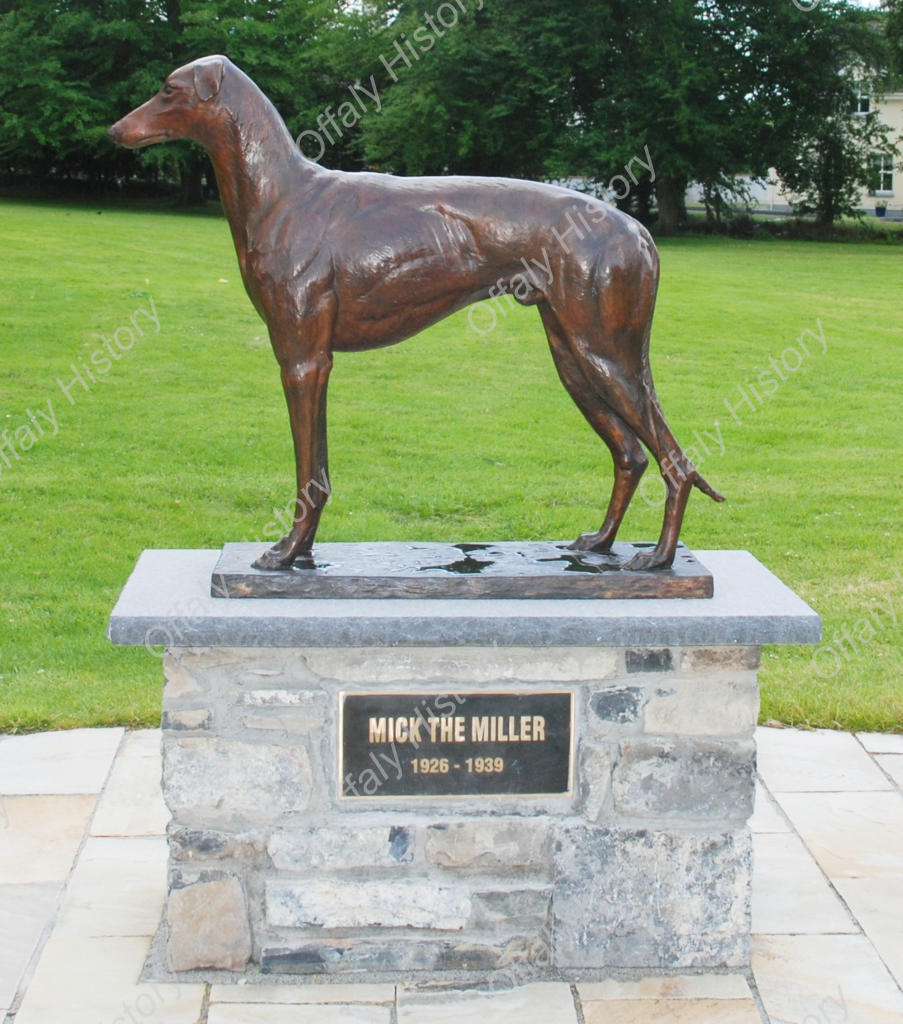
Killeigh commemorates its famous local greyhound ‘Mick the Miller’ with a beautiful bronze piece by Elizabeth O’Kane. Cadamstown remembers local boxer Dick McRedmond in a lovely stone bust by Dermot Scully. In Ballycumber the wonderful little ‘Pilgrim’ trudges wearily to Clonmacnoise along the Erry Way in a delightful work by local artists Gerry Dooley and Lorie Quinn.
It is acknowledged by everyone that in Offaly both semi-State and local authorities have been to the forefront in providing good public art. The ambitious installations provided by Bord na Mona in the Lough Boora Discovery Park make it one of the best sculpture parks in Europe and it is the calling card of Offaly Tourism. Through its operation of the Percent for Art scheme, Offaly County Council has provided many imaginative and successful works in every part of the county, most recently Holger Lonze’s ‘Cruinne’ in Geashill and the ‘Marker Stone’ on top of Croghan Hill by Ciaran Byrne.
A son of Banagher – Johnny McEvoy
The elephant in the room however, is that almost all of these are in rural, village or remote locations and therefore their theme and siting is relatively uncontentious. A proposal to install a major piece of sculpture in the centre of any of the principal towns of the county on the other hand would immediately raise the questions of where, who, why, by whom and at what cost and inevitably cause a row. Nonetheless, busy central public spaces, both existing and planned, should now be the first choice locations for new artwork and these issues must be faced and a reasonable public consensus sought.
Edenderry’s progressive landlord – the third marquis of Downshire – 1845
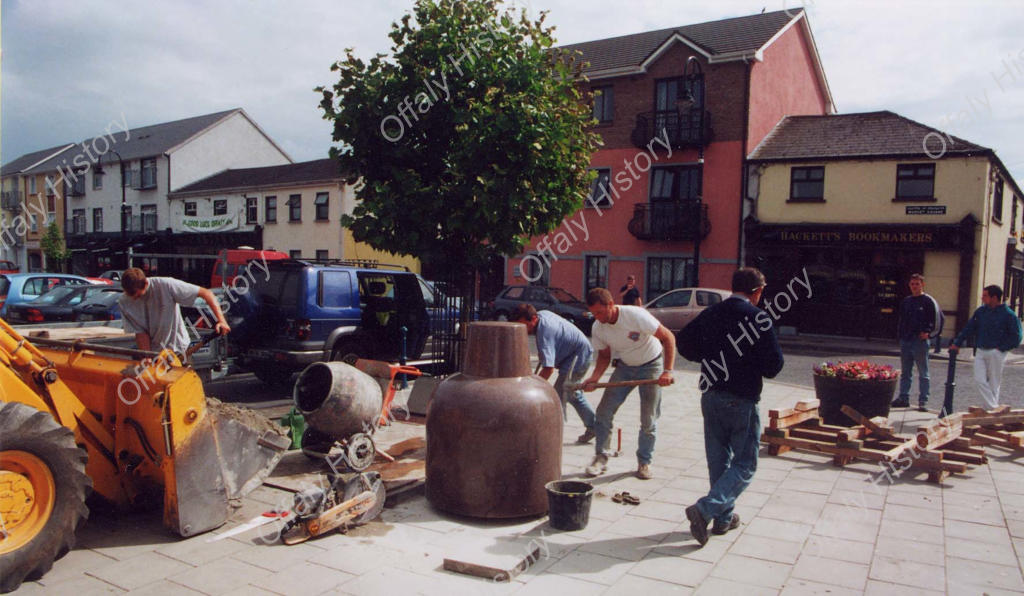
The county capital, Tullamore town centre has only three significant sculptural works, the two long established War Memorials and the 1999 ‘Pot Stills’ in Market Square by Eileen McDonagh. The recent Street Enhancement Scheme which might have provided the opportunity for the installation of a significant new work, instead inexplicably and without giving public notice, required the removal of the Memorial to the Dead of the Great War from O’Connor Square, despite its designation as a Protected Structure. Following an outcry and Ministerial intervention, it was saved but its generous planted setting vanished and it now stands looking a little lost and unhappily compromised by car parking. A more considered and consultative approach to our urban heritage is urgently required
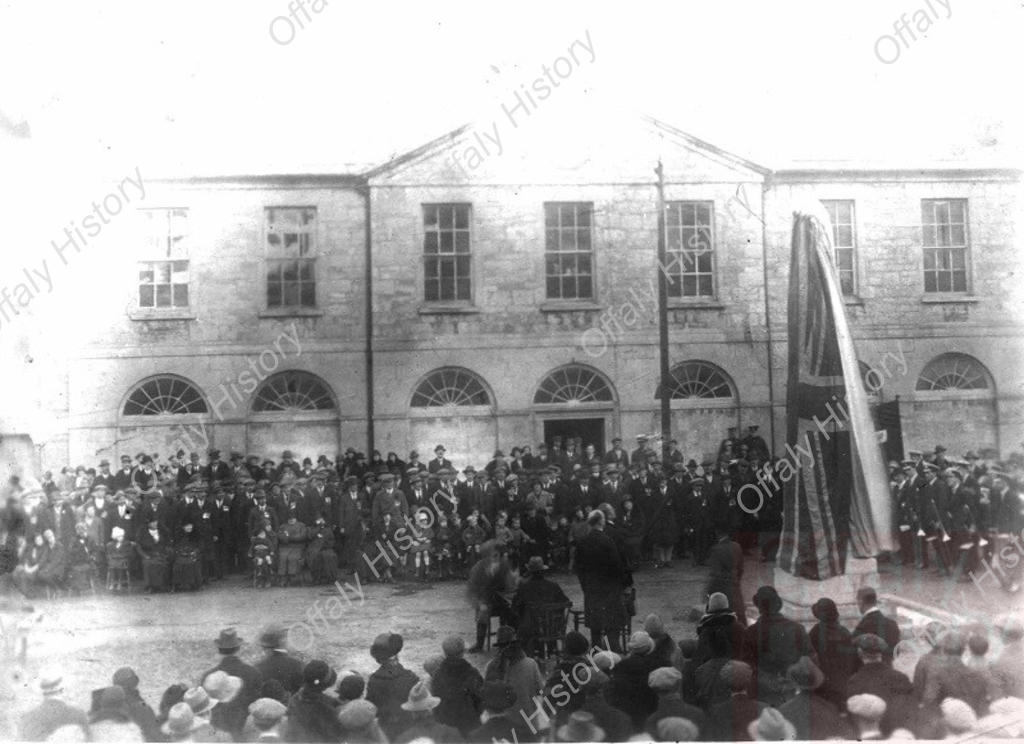
Pot Stills in Market Square 1999Unveiling the Great War memorial in Tullamore in 1926 Widows of those killed were seated
A Phoenix arises?
The installation of a fine new piece of sculpture to adorn the historic centre of Tullamore is long overdue and the imminence of a new town plan presents the opportunity for its delivery. Hopefully, unlike its predecessor, the new plan will include a coherent vision for the preservation and enhancement of the town’s architectural heritage.
It might also follow the lead of other local authorities and outline the role that urban art would play in making the centre more attractive and even suggest where new sculpture or installations might be placed. The Offaly County Council Public Art Working Group could then initiate a debate as to appropriate subjects. One relatively uncontentious idea that has been around for years and which would certainly stimulate the imagination of a talented artist, would be that of the Phoenix- the symbol of the town.
This is now the time to start the debate on how Tullamore can celebrate its history, remember those who made a contribution to it and furnish its historic centre with new and exciting public art.
The 12 June 2020 marks the 98thanniversary of the disbandment of the historic Southern Irish infantry regiments of the British Army at Windsor Castle. Disbandment was brought on by economic cuts to the British Army and in part due to the Anglo-Irish agreement. The Royal Irish Regiment, Connaught Rangers, Leinster Regiment, Royal Munster Fusiliers, Royal Dublin Fusiliers (and South Irish Horse) all surrendered their colours to King George V for safe keeping. The ceremony took place at 11:30am in St. George’s Hall in Windsor Castle. During the ceremony the King made a promise to safe guard these highly prized colours. The ceremony finished with a royal salute and God Save the King played.
The colour party detachments for each regiment consisted of the regiment’s commanding officer, then three officers and three non-commissioned officers (NCO) for the 1stand 2ndbattalion respectively. One of the NCOs on whom this honour fell was John Thomas Cannon of the Leinster Regiment’s 2nd Battalion. This is John’s story.
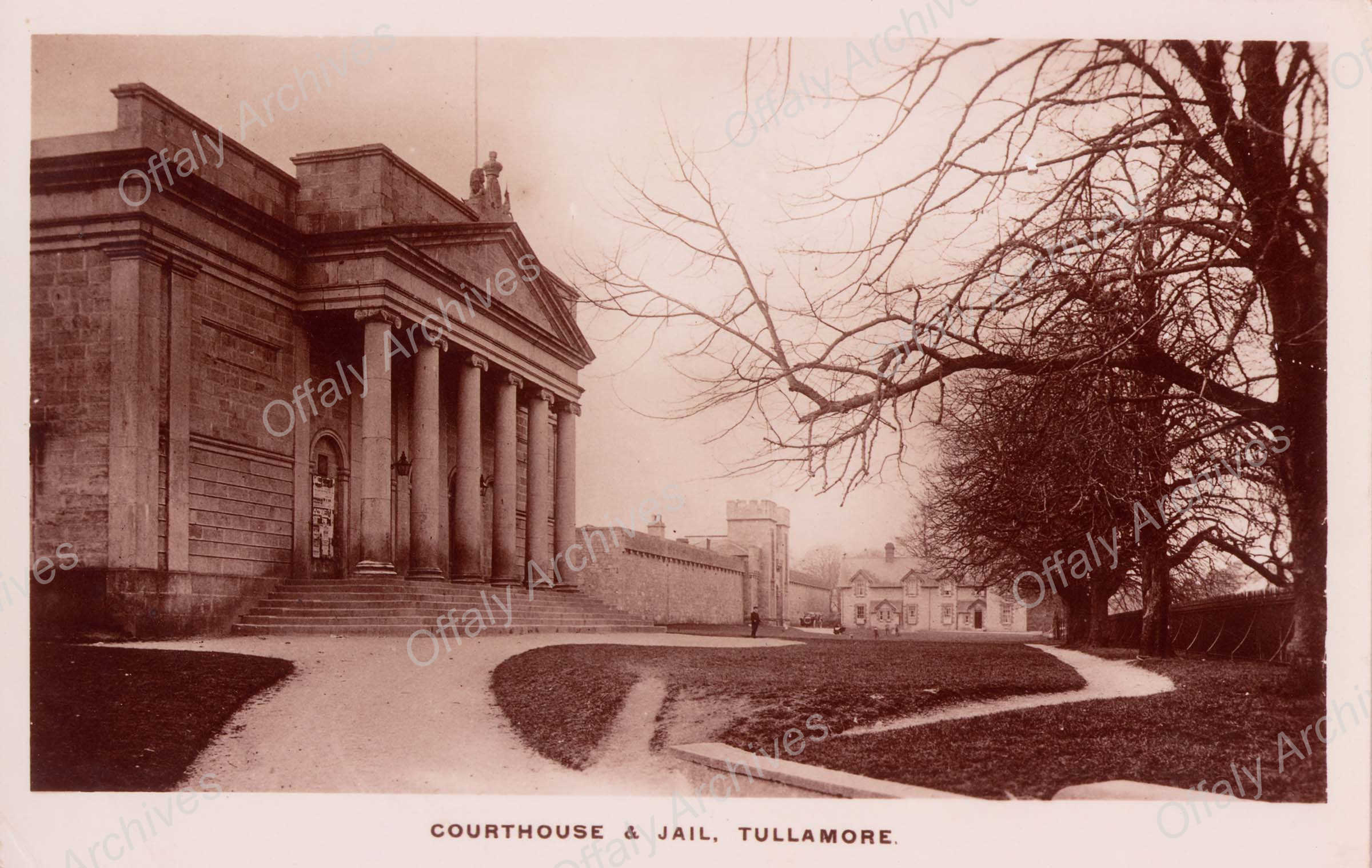
The seat of civil and judicial governance in Offaly about 1910 and the place of correction in the background with the houses of the ‘turnkeys’, Charleville Street, Tullamore.
The verdict of county secretary James P. Kingston on the county council elections of 2 June 1920 was that the election was not just remarkable and memorable but revolutionary. Kingston believed it was even more revolutionary than the 1899 elections that saw only three members of the old grand jury transfer to the new county council. In that election James Perry Goodbody was elected for Clara unopposed and William Adams defeated distiller and grand jury member Bernard Daly to secure the Tullamore seat. Goodbody was a leading Quaker businessman and Adams a large farmer and publican. Adams retired from the council in 1912 and was succeeded at the council by his son P.F. Adams who was married to Rosaleen Egan, a daughter of Henry Egan, chairman of the county council from 1899 to 1910. Goodbody served on the council as chair of the Finance and Proposals Committee from 1900 and was vice-chairman of the council from 1912. Both P.F. Adams and James P. Goodbody sought election to the new council of 1920 in the first post-war elections and both were defeated. Sinn Féin secured 19 of the 21 seats and acceptable Labour men two seats. For Secretary Kingston the election was also a turning point as he was forced out of office within a year, just as his predecessor Thomas Mitchell had been in 1899.
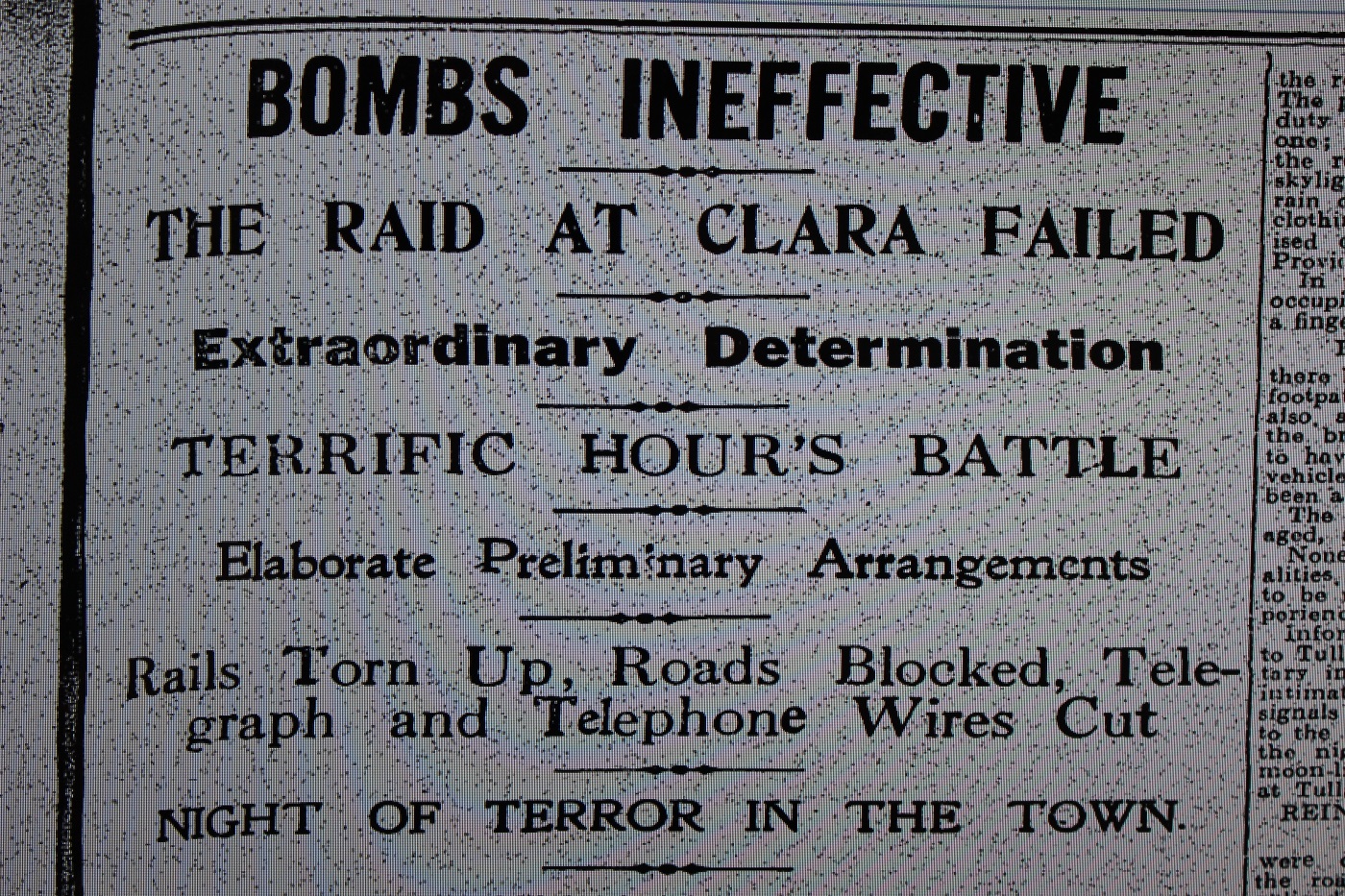
Reporting the outcome of the Clara barracks attack of 2 June 1920
‘While some counties have done much in the matter of publicizing their part in the fight for freedom, very little has been heard of the part played by Offaly in that great struggle, and yet it was within the borders of this historic county that some of the bravest and most daring deeds were done. It is not right, he said, that these should be allowed to pass into complete oblivion, and it is hoped the writing of this story of the Clara R.I.C. barrack attack will encourage others into penning the complete story of Offaly’s fight during that critical period of Irish history.’ These were the words of P. O’M. in 1960, basing his account on that published in the local press on 5 June 1920. (P O’M was brought to our attention as Paddy O’Meara who wrote a number of good articles on Clara history and was a local news correspondent.) The witness statement of Séan O’Neill, a manager in P.J. White’s Clara shop (Bureau of Military History) supports the press reports of the time. So to do the recollections of Harold Goodbody (forthcoming). IRA man and county councillor Sean Robbins of Clara was critical as was Fergus O’Bracken, writing to vindicate the role of his father, overall IRA commandant Peadar Bracken, in the episode.
The first week of June 1920 was a momentous week in Offaly with the major raid on Clara Barracks in the early morning of 2 June with upwards of 200 men. The outcome was a defeat in the short term with four men seriously injured, one of whom died in 1921. In the same week the first county council elections since the changed political landscape after 1916 were held and now with proportional representation. Clara’s Sean Robbins topped the poll. It was a victory and a defeat in the same week. The bomb and the ballot in different times. The Brigade Activity Reports reports, now published online from the Military Archives (forming part of the Military Service, 1916-23 Pensions Collection), provide a useful summary of activities in Offaly in the War of Independence, 1919–21. The reports from Offaly Brigade 1 were submitted by officers, Peadar Bracken of Tullamore and Seán Kelly (Gorteen Coy) of Mucklagh in 1940 to the Military Service Pensions Board. Particulars for the 4th Batt, Offaly No 1 Brigade were submitted by James Earle of J.K.L. St., Edenderry.
Offaly History is delighted to welcome a new contributor this week who has generously shared her mother’s memoirs of life in Clara in the 1930s.
My mother, Ethel Clarke neé Kerin, wrote memoirs in later life of the time before she moved to England after World War II. Clara figured a great deal in the stories that she told me about her childhood and she clearly held very fond memories of the town.
Her mother, Elizabeth Evans, came from nearby Geashill and was employed as a servant in the household of Joshua Clibborn Goodbody at Beechmount, Clara. Her sister, Mary Anne Evans, known as Poll also worked in Clara, employed as a housemaid/domestic servant at Charlestown. It was here where Poll met her future husband, Robert Stewart, who was employed as a coachman. (more…)
It was lately announced that Drayton Villa, Clara and some lands adjoining are to be acquired by Offaly County Council for public purposes. Offaly History asked Michael Goodbody to contribute this piece on the story of this important house. He is currently working on ‘One Hundred years of Clara History’ to be published later this year and from a preview we can say that it will represent an important contribution to the story of Clara from the 1840s to the 1940s. Thanks to Michael Goodbody for the article and the pictures. We have added the subheadings.
Drayton Villa (courtesy Stephen Williamson)
Drayton Villa, built by Lewis Frederick Goodbody in the mid-nineteenth century, is largely untouched by more recent additions and alterations, so that many of its original features are intact. The main block of three bays, with a basement underneath, dates from 1849. There can be no disputing this date for it is recorded by Lydia Goodbody – future sister-in-law of Lewis – in her diary entries for that year.
The Anvil editon of 1979 included the six pages on O’Malley’s torture as did the American edition, Army without banners (1937)
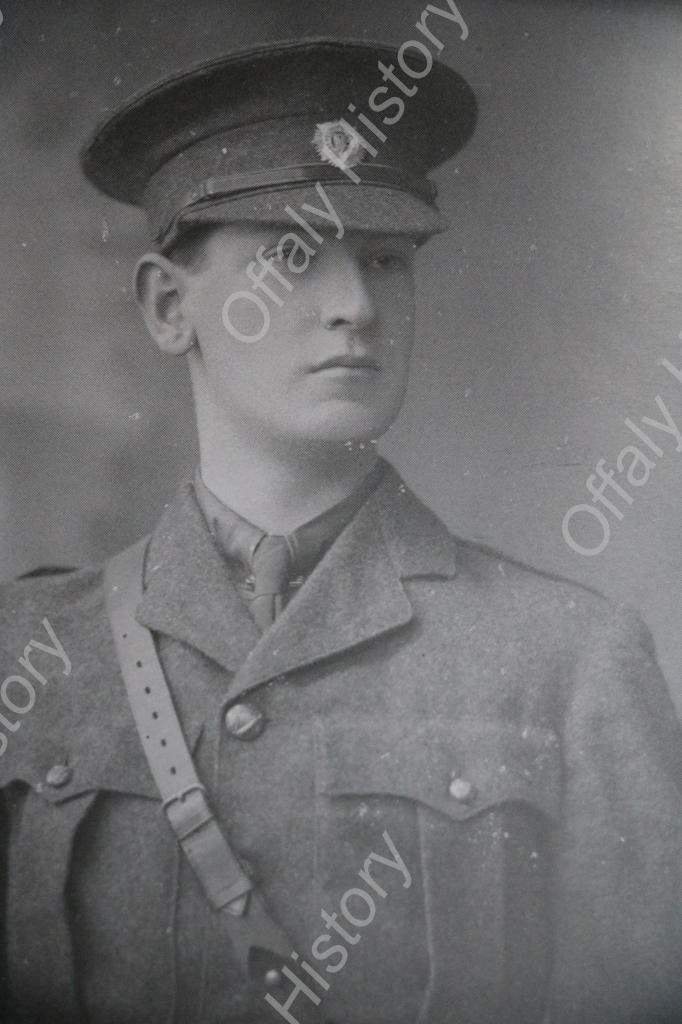
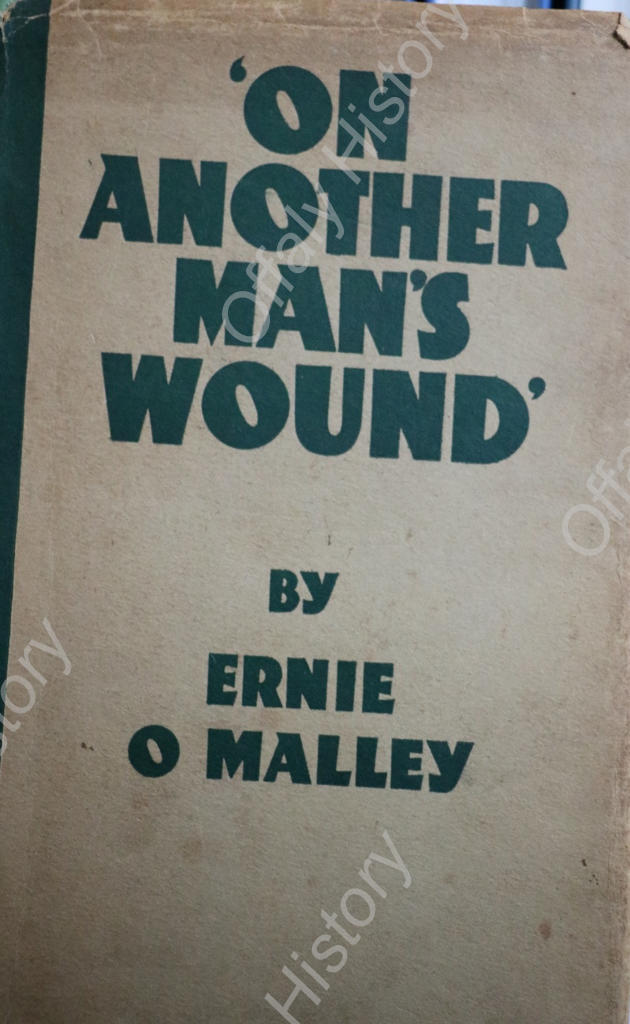
Ernie O’Malley was in Tullamore in April 1918 helping the Volunteers with the work of the North King’s County by-election (won by Sinn Féin without a contest because of overwhelming support in the aftermath of proposed imposition of conscription. This extract is from O’Malley’s famous account of the War of Independence years – On another man’s wound – first published in 1936. This extract from the Anvil edition of 1979 with the original pagination shown in square brackets. ‘On Another Man’s Wound, is primarily an account of that war, the only work of high literary quality to emerge directly from the violence. Upbringing had combined with temperament to make him half an alien in his own country. This gave him the detachment of a natural observer; the war forced him to live close to the people:’
Dick Mulcahy
[76] Mulcahy [Dick Mulcahy Assistant Chief of Staff] told me to report to the director of Organisation I found Micheal Collins in his office on Bachelor’s walk Dublin. He was pacing up and down. We shook hands. He jerked his head to a chair to indicate that I should sit; he took a chair which he tilted back against the wall. On shelves were green membership cards, heaps of The Irish Volunteer Handbook, and stacks of white copies of the organization scheme. Behind his desk was a large map of Ireland marked with broad red streaks radiating from Dublin. He was tall, his shoulders were broad; his energy showed through rapid movement. A curving bunch of hair fell on his forehead; he tossed it back with a vigorous head twist.
Michael Collins in 1917. O’Malley was no great fan of Collins
“I’m sending you to Offaly, there’s an election coming off [the by-election of April 1918]. I want you to organise a Brigade in that county. There are a few good chaps in Tullamore and they’re on the run. He had a strong singing Cork accent his brown eyes studied me fixedly. He pointed out companies on a map and mentioned officers’ names.
“It looks like conscription” he said. “That’ll make some slackers wake up.
He pointed out communication routes on the wall map. I was to improve and keep them tested by despatch riders. He gave me a bundle of organization schemes, instructions for the preparation of emergency rations, lists of equipment that could be made locally. “Read that and see what you think of it.” He handed me notes on the destruction of railways, bridges and engines with and without explosives.
[77] It was signed by Rory O’Connor, Director of Engineering. He crossed to the window whilst I read. “My bail is up, he said. “They’re looking for me now.” “They” meant the “G” men, who carried out political arrests in Dublin. Collins had been arrested by for a Volunteer recruiting speech; he had been released on bail. That was unusual. Volunteers were not allowed to accept bail. “Two nights ago “G” men brought off a raid; they found empty packing cases and a pile of cartridge wrappers in a store. Bruton said: This looks as if there were brains behind it; I bet it’s that fellow from Mountjoy Street” Collins laughed; it meant himself “Good luck now, Earnán” he said, as he shook hands. As I walked across O’Connell Bridge I wondered at the risks he ran, coming and going to and from his office, whilst detectives watched for him.
The first edition of 1936 produced in London and Dublin
Austin Stack of Kerry who had recently fought a jail war in Belfast was in Tullamore with Darrel Figgis. Stack had a quizzical turn in his deep brown eyes which he half shut when he told a long story. He was grave and quiet; he spoke slowly. Figgis was not popular; it was thought that he was too vain. Stories were told about his Christ like beard. His manner, his insistent focus of attention for his words, was of the porcupine quill effect of an artist amongst those who thought of nationality alone. He was egotistical; it could be seen in his face and mannerisms; his image was reflected in the half suppressed smiles of his listeners. He had come from another life; he would find it hard now, I felt. I had read his novels: Children of Earth was the best book I had read about the West of Ireland. He was pleasant when he talked to me of his books; but he had unfortunate habit of making enemies. Eamonn de Valera was due to arrive. There was intense excitement; work speeded up. Volunteers, Cumann na mBan, and Sinn Fein Clubs arranged a parade. I heard a new song: “Convict 95” his number when on penal servitude.
“Twas in Kilmainham prison yard our fifteen martyrs died
And cold and still in Arbour Hill they are lying side by side,
But we will yet pay back the debt for the spirit is still alive.
In men who stood thro’ fire and Blood and Convict 95.
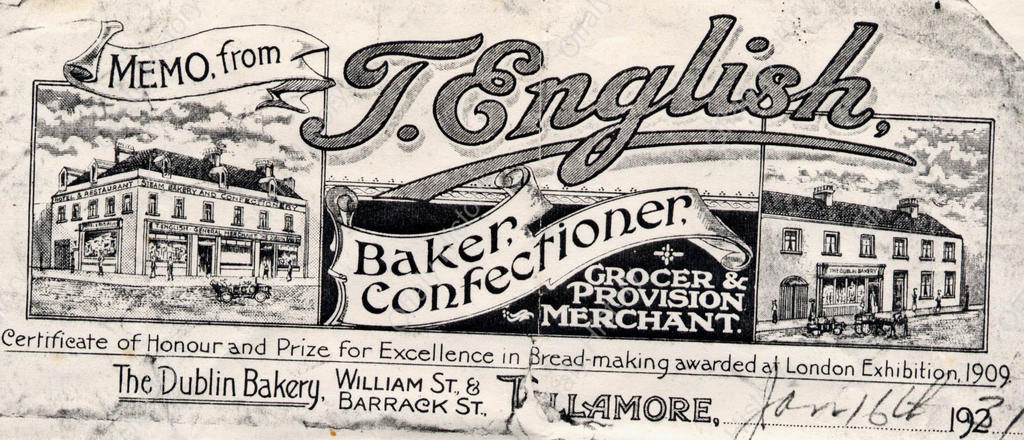
Enlgish’s Hotel and restuarant at the juntion of Columcille Street and Patrick Street. A view of post 1914.
Eoin Plunkett was with me in English’s Hotel when de Valera walked in. We made a machine spring to attention [78] and remained tense, glued with admiration till he spoke to us and asked us to sit down. He was tall and lean; his hair rifted on his forehead. His face was long and sallow. He wore rimless glasses. He had a very deep voice that welled up, a fairly immobile face save when he spoke, and then the muscles, to one who had watched them in repose, played tricks. On the platform there was a hard unemotional feel to his voice and he twisted his body in emphasis.
His gravity we noticed most; he was patient and kindly to the many demands for his signature. “Have you seen Dev?” I would be asked in the country. It was easy to take on heroic build of one had seen or talked to any of those whom the people admired.
An Irish Convention called by Lloyd George had been in session for nine months; Sinn Féin refused to send representatives. It met and talked. The Irish vote in Australia had helped to defeat conscription there; a second referendum would succeed, Premier Hughes said, if the English could in any way settle the Irish Question. Irish Americans fighting for small nationalities and to make the world safe for democracy made their government anxious to have some patch-up in Ireland. The first draft of a conscription Bill was passed in England the same say that Lloyd George announced the failure of the convention; an emasculated Home Rule Bill was to be given as a gift. In England conscription had been imposed by degrees; in Ireland all males between eighteen and fifty-one could be taken. As a nation Ireland was not deeply concerned with the world war. Proganda about territorial violation and outrages could be paralleled at home. The people had long watched politicians play their thimble trick at the Imperial circus: “Walk up gentlemen. See freedom is here. You cannot lose. You give your youth and you take your chance.” The wild Irish who always looked for fight, who were never happy unless smashing heads with ponderous shillelaghs now wanted to fight to prevent themselves from fighting. What an Irish bull; the dear, delightful Irish, so picturesque and such charming brogues; they were broths of people; they were entirely.
A meeting of political enemies was held in Dublin. [79] They issued a statement: “The passing of the Conscription Bill must be regarded as a declaration of war on the Irish people.” The Irish Parliamentary Party left the House of Commons as a protest. Labour carried out a day of general strike. A parish fund was organised to raise money. In Offaly committees and subcommittees worked on Transport and Food supply; statistics were compiled; offers of help came from strange places. I paraded battalions in Tullamore; we were skirmished and manoeuvred through towns and the country side followed by police. Officers were arrested and at once replaced. To save the officers I commanded the companies of a parade in turn. I was not interfered with. In small towns I drew my gun when police asked me my name.
In daytime I could now enter a town to practise quick mobilization. Shop boys, carpenters, shop owner’s clerks, fell into line quickly. They practised bayonet fighting with brush handles up and down streets; they sat on pathways or in halls to listen to my talks from the destructions of railway plant to street fighting.
Men relieved each other during the day to mould lead to buck shot; gun cartridges were collected and refilled. Jewellers and locksmiths made revolver springs; they repaired weapons. Telegraphic clerks held classes with buzzers and tappers or taught Morse to signallers; harness and boot makers worked at belts and equipment, smiths and carpenters made pikes and pike handles. Cumann na mBan sewed signalling flags and haversacks. They gathered medical supplies made splints and packed first field dressings.
Shops were raided for cartridges and detonators, quarries for explosives. Volunteers came to houses whose owners were hostile or had permits from the police; the police searched Volunteer and friendly houses for arms. One raiding party would often followed close on the other.
Railways would be destroyed when conscription came; through communication routes by road were worked out. There were many branch lines in Offaly and Westmeath. Some companies were always on duty. Day and night, despatch riders on bicycles tried to improve time speeds. All despatches had time sheets; the time was checked by [80] each company through which they passed. The time sheet from Dublin to Castle bar or to Tralee would be lengthy. Despatches were hidden in the collar or tie; sewn up in the coat, put in a part of the bicycles or in socks. The despatch might be a smelly remnant when it reached its last station.
I was told that warrants had been issued for my arrest. I changed my sleeping quarters frequently. In Clara I slept in the house of a publican [presumably P.J. White’s]. The owner came into my bedroom one night. He found two improvised hand grenades on the floor and a revolver beside my bed. He hurriedly made piles of empty porter barrels at points inside the back wall to help my escape.
Much more to be found here.
[Stopped at Philipstown/Daingean]
Three Royal Irish halted me in Philipstown. They carried revolvers in black holsters. “What’s your name?” the sergeant asked in a deep voice; the thumb of his right hand was stuck behind his broad flat belt.
My name is O’Malley, do you want more information? I half drew my gun from inside my coat. The police were irresolute. They had evidently intended to arrest me. I waited. The sergeant took out a note book; he wrote quickly with a pencil. They watches as I cycled away.
Daingean town in 1910-18
People remarked that officers had been afterwards arrested for drilling when I had been afterwards arrested for drilling when I had been in charge or for carrying out my orders. Some said I was a spy and that the police did not want to arrest me. A few women said I was leading the boys astray. I met mutterings in many forms.
In an island of the Bog of Allen which covers a large part of eastern Offaly I had a farmer friend. “We’ll give them what’s what in the bogs” he said “if it wasn’t for them bloody peelers less than a snipe id never get in here.” He had a white horse for me. “When fighting begins up you get and lead us all against the English” I liked the white horse. He was a fine mettlesome beast and he could “lep a house,” but he savoured of the range mark. I could see myself stuck up to my middle in bog water or crawling close to gorse and heather instead of leading a procession against the near post. I was in Athlone. I had met an Irish battalion sergeant- major from the castle barracks. He had been fifteen years [81] in the British army and had seen much fighting. A tall man, sturdy with independence; he was resilient in will trained muscle. He had a well handled, pointed moustache. He was willing with some soldiers to help us capture the magazine; they would fight, if nessacary, during the raid, and they would join us when conscription came. I received a despatch from Collins; I was to go to South Roscommon at once.
A short note on the 1918 by-election in North King’s County/Offaly, Michael Byrne (see Offaly Heritage 9 for the full article)
The sitting MP for North King’s County, E.J. Graham, died in a Dublin hospital on 26 March 1918, aged only 51, thereby creating the possibility of another contested war-time by-election in North King’s County/Offaly in April 1918. His death brought about the election of Dr Patrick McCartan, the Sinn Féin candidate, without a contest. McCartan had been defeated in the Armagh South by-election of February 1918, but was returned in North King’s County after the hint of a contested election. He was again returned unopposed for the entire county in December 1918 at the general election. He too was an imposed candidate continuing a tradition broken only in December 1914. His non-contested by-election came in the wake of the big demonstrations against conscription in Tullamore and everywhere else. What looked like compromise on the part of IPP leader Dillon was recognition that the win for the IPP in Armagh South would not be repeated. The Tribune had stated in its editorial of 6 April 1918 that Dr McCartan was a certainty and that the greatest enthusiasm existed for Sinn Féin. ‘The electors state that they are only anxious to give the party a better reverse than it got in 1914.’
Patrick McCartan
The Sinn Féin by-election campaign began at the end of March with meetings in every parish in the constituency after Sunday mass and speeches from visitors Dan McCarthy, Austin Stack, Stephen Mara, Joseph McGuinness and in Tullamore from Tribune editor, Seamus/James Pike, the draper Michael Berrill and P.J Bermingham. There was broad acceptance of the Midland Tribune view that McCartan would succeed and confusion in the IPP as to who might stand. All parts of the constituency were said to be solid for Sinn Féin save perhaps Tullamore ‘which is pretty evenly divided’. On Sunday 8 April De Valera spoke in Tullamore (the meeting was chaired by Bermingham.) on Ireland’s ‘fateful hour’ and the right of Ireland to self-determination. De Valera had first spoken in the town in the aftermath of his East Clare victory in July 1917. Meanwhile the vacancy in the IPP candidature was not and would not be filled. When deputations from both Nationalists camps in Tullamore (the IPP and Graham supporters) met John Dillon, the IPP leader who succeeded Redmond in March, it was to tell him that they would agree on one candidate. But the conscription crisis was about to overtake the matter of an IPP candidate and Dillon told the deputation that now was not the time for a local contest. Notwithstanding this prohibition it appears that John Dooly of Birr, the chairman of the county council, was selected. Dillon persisted and Dooly withdrew his candidature. McCartan was duly elected on 19 April 1918 with sixty nominations and no opposition. Lyons points out that the conscription crisis could not have come at a worse time. In the three by-elections fought since the beginning of 1918 – South Armagh, Waterford City and East Tyrone – the IPP had beaten off the challenge of Sinn Féin. As so often before the government had stepped in to revive Sinn Féin fortunes. That said the lack of a suitable candidate for North King’s County and a local press united against the IPP made the chance of winning the seat highly remote. McCartan went to take the seat again in the general election of December 1918 without a contest.
Offaly Archives’ local government collections cover an extensive range of local government organisations – from grand juries, infirmaries, rural district councils, town commissioners, poor law unions, county councils, committees of agriculture and urban district councils. The material from the collections was acquired since the 1950s and covers roughly two hundred years of history.
Recently, the local government collections, as well as a number of donated collections of private origin, have been relocated from Offaly County Library to purpose built archival facilities at Offaly Archives, Unit 1F, Axis Business Park, Clara Road, Tullamore. Offaly Archives is the joint archival repository of Offaly Historical and Archaeological Society (Offaly History) and Offaly County Library, and is administered by Offaly History.
During the summer of 2019, I worked on providing online catalogue descriptions for the local government collections in preparation for their move. Descriptions for the collections were created using Michael Murphy, Anne Coughlan and Gráinne Doran’s 2003 publication Grand Jury to Áras An Chontae, which provides breakdowns of Offaly Archives local government collections, as well as detailed information relating to the formation of Offaly’s local government structures, their various duties, lists of members and historical points of interest.








![A000b Courthouse, Philipstown [Daingean]](https://offalyhistoryblog.com/wp-content/uploads/2020/02/a000b-courthouse-philipstown-daingean.jpg?w=1024&h=483)

 offalyhistoryblog