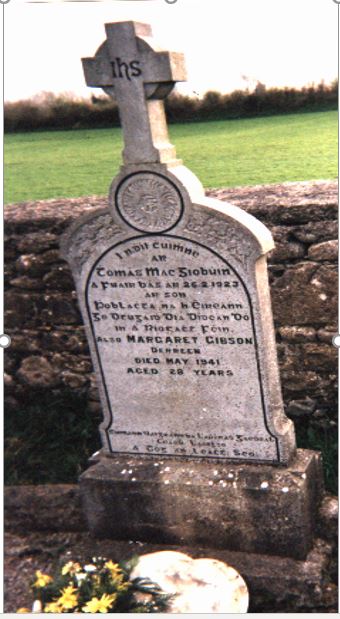
‘Well, Tommy, I am sentenced to death on this day 23rd February [1923] and tomorrow will face it. I feel quite happy thank God only I feel very lonesome when I think of you… I am praying for you as I know you will for me, and I hope they will be heard… from your old chum Tom, Goodbye ever, it’s a long way to Tipperary.’
Last letter from Thomas Gibson who was executed at Portlaoise during the Civil War.
Offaly Archives is pleased to announce the publication of the catalogue of the Papers of St Stanislaus College, Tullabeg, the result of a collaboration with the Irish Jesuit Archives, Leeson St, Dublin, where the papers are permanently housed. This blog outlines the history of the college at Tullabeg, the scope of what is contained in the archives and how to access the online catalogue.
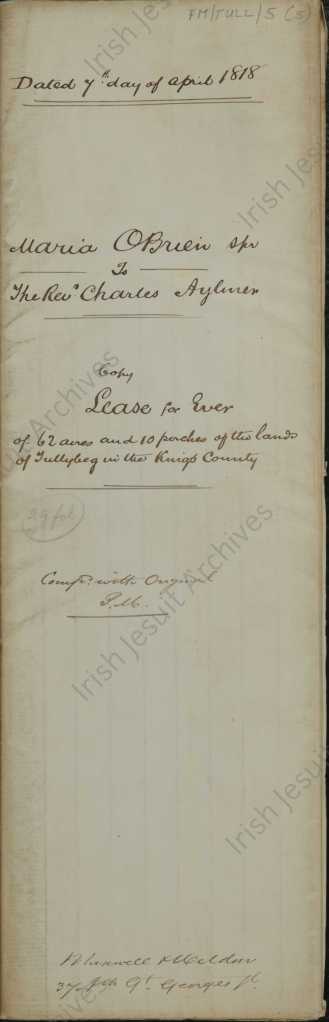
The Jesuit community at Tullabeg (St Stanislaus College), Offaly was established in 1818, four years after they were restored as an order. Tullabeg was initially intended to function as a novitiate (training centre for Irish Jesuits) and a suitable site was offered in 1815 by Ms Marie O’Brien (1765-1827), of Rahan Lodge. She had also helped the Presentation Sisters establish a convent nearby at Killina. When the Tullabeg building was complete, the idea of novitiate was abandoned and the new foundation served as a feeder school for Clongowes Wood College, Kildare. Tullabeg rarely counted more than forty pupils, all of them below early teens and the pace of life was unhurried. Drama, debates and sport (gravel football and cricket) were encouraged, and facilities followed. The appointment of Fr William Delany SJ (1835-1924) as rector, transformed the College educationally. Pupils were matriculated and examined successfully for BA degrees at the University of London, and later at the Jesuit-run University College, Dublin.
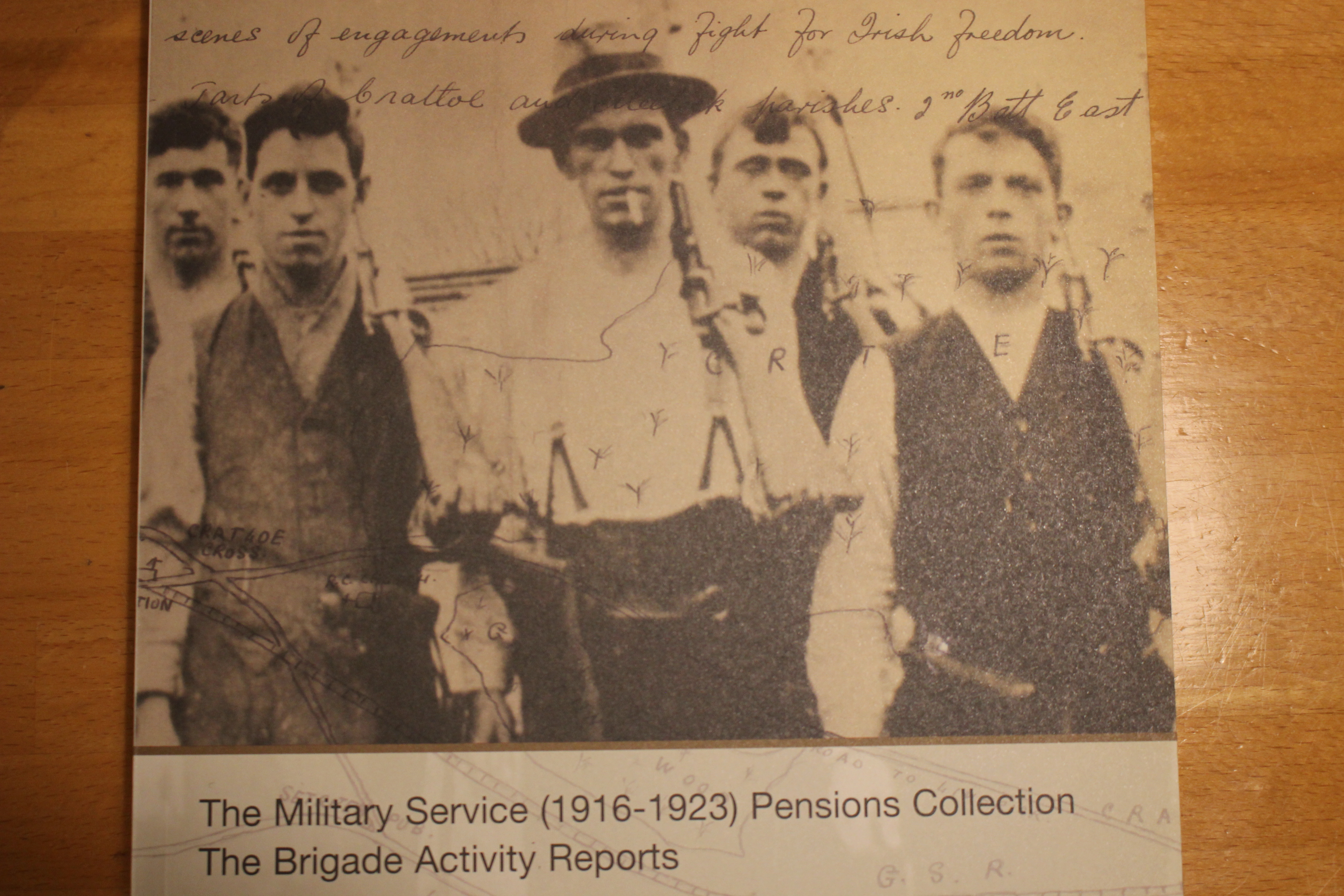
The Brigade Activity Reports (BAR) series of the Military Service (1916–1923) Pensions Collection, released by the Military Archive recently were compiled from 1935 onwards to assist in the verification of individual applications for pensions; nearly all of the reports include brief descriptions of particular operations undertaken or planned including some in Tullamore, the attacks on Clara barracks, Kinnitty, Raheen and more. A new publication, a Guide to the Brigade Activity Reports is available from the Military Archive and a copy can be downloaded there free of charge (hard copy in Offaly History Centre Library). The published guide contains useful essays together with listings of Brigade activity in Offaly, the diversionary attack at Geashill, the killing of Sgt Cronin and the death of Matthew Kane, IRA Volunteer. Last week we looked briefly at the killing of Sergeant Cronin and this week the aftermath. But first a mention of what else is contained in the BAR for Offaly.
Two memorial cards: :Terence McSwiney and Henry Cronin. One was killed in retaliation for the death of the other.
Most people will readily agree that good fortune in life is dependent on hard work and luck. Getting a break can make all the difference. Policeman Sergeant Henry Cronin was shot at Tullamore’s Henry Street (now O’Carroll St) on 31 October 1920 and died the following morning. Now those who shot him that night have been identified in the release of the latest batch of records from the Military Archive. It was a case of bad timing for Cronin as he had been sent to Tullamore only four years earlier in 1916 to replace Sgt Philip Ahern who was injured in the Tullamore Incident and was retired in September of that year.
In 1910, about six weeks before the first successful powered flight in Ireland by Harry Ferguson in Co Down, the King’s County Chronicle reported as follows, ‘Mr Michael Carroll, cycle mechanic, conducted experiments in aviation in the hills adjoining Birr reservoir. An apparatus constructed from calico and bamboo made one or two fitful attempts to ascend. The incredulous may laugh at his efforts but it should not be forgotten that every great invention has its beginning in failure.’ One week later it was noted that the Engineering and Scientific Association of Ireland [founded in Dublin in 1903] had been discussing aviation, ‘The opinion was expressed that flying through the air was not an accomplished fact, though eventually it would be, that flying was not of any practical use and that men now engaged in a series of experiments in aviation would not die in their beds.’
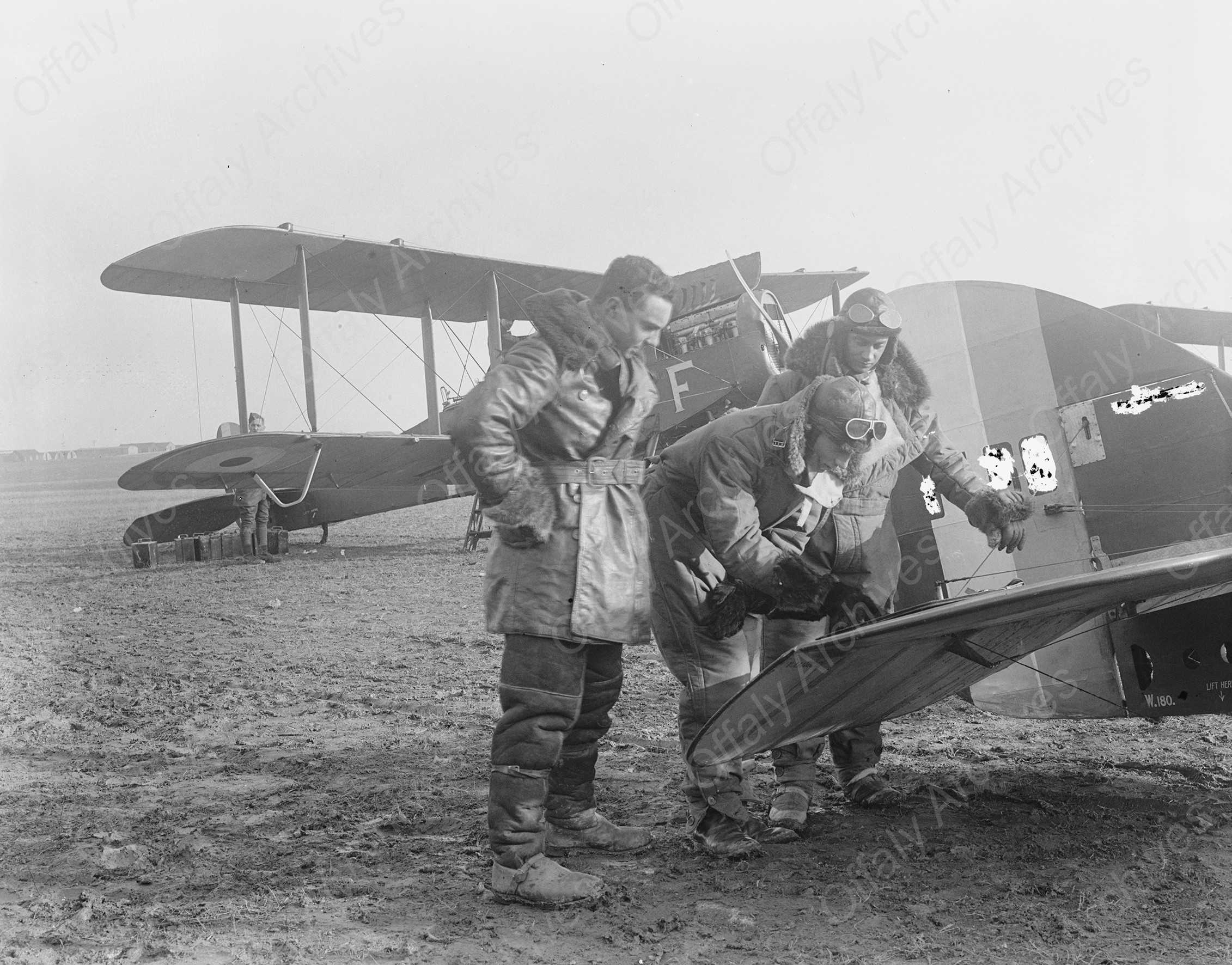
2. D.H.4 bomber, aircrew posing with map (IWM, Q12021)
Offaly had a small but significant part in the early years of military aviation. In September 1913 Offaly was an important base for some of the earliest uses of aircraft in the annual British Army manoeuvres; some of the Royal Flying Corps’ earliest crashes took place in Offaly during those operations. Approximately 85 men who served in the Allied flying services were born or from Offaly, but their impact was far greater than would be expected. Ferbane hosted an operational wartime base at ‘RAF Athlone’, and there was a landing ground at Birr during the 1918-1920 mobilisation period.
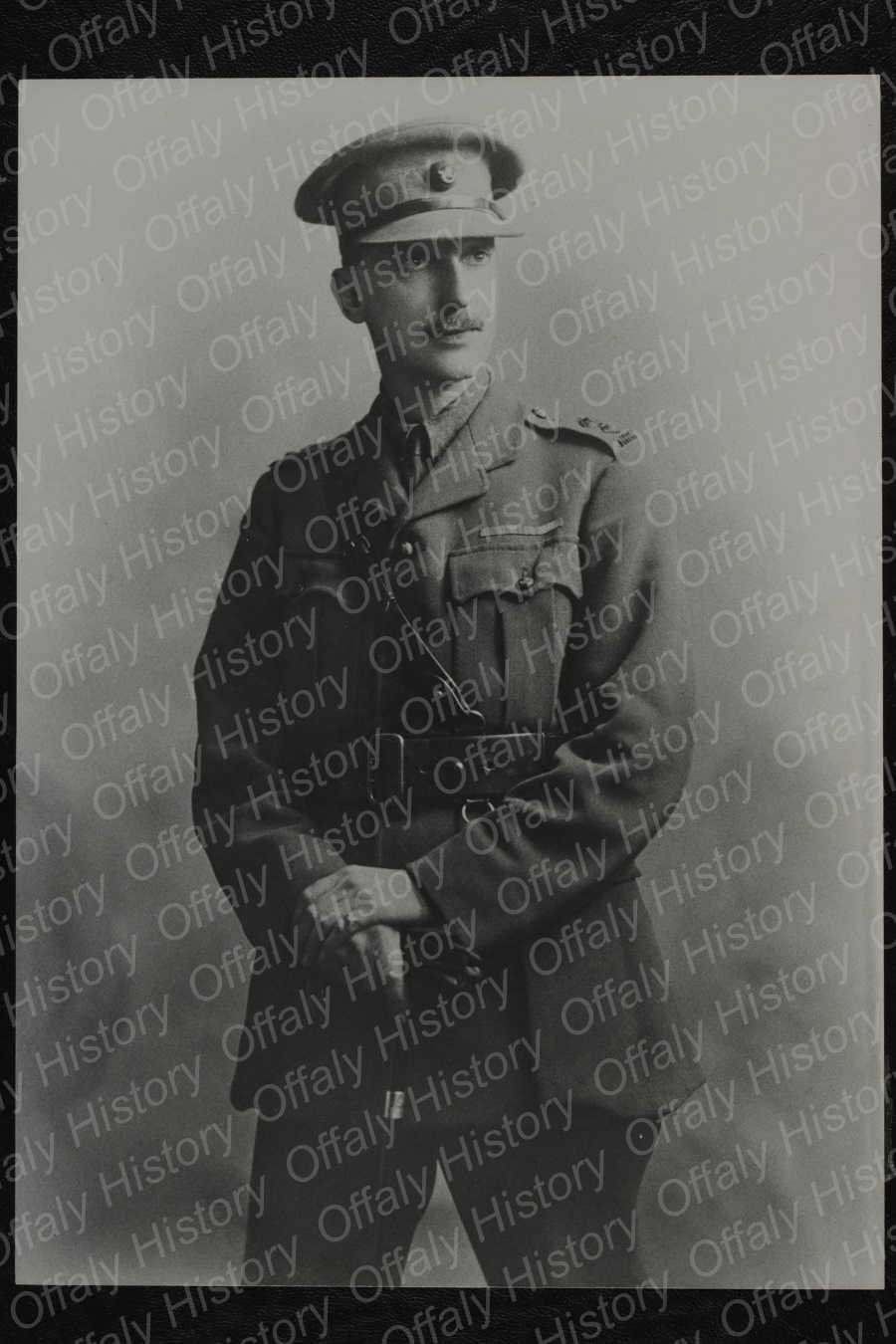
Charles Kenneth Howard Bury of the Royal Irish Rifles, probably c. 1914. Courtesy of David Hutton Bury.
At the beginning of the centenary commemorations for the War, at the Theatre of Memory Symposium at the Abbey Theatre in 2014, President Higgins spoke of the commemorative activities in terms of myth-making and ethical remembering. He remarked that ‘for years the First World War has stood as a blank space in memory for many Irish people – an unspoken gap in the official narratives of this state’. He suggested that ‘literary memoirs written during or after the War can be enabling sources for ethical remembering’ and advocated using the commemorative period to create ‘opportunities to recollect the excluded, to include in our narratives the forgotten voices and the lost stories of the past’. In the aftermath of the death in the last few years of all the veterans of the War, to find these stories and these voices we must go back to the archives and seek out the diaries, memoirs letters and photographs of those who served. The Library in Trinity has a fascinating collection of this kind of material, gifted and bequeathed over the decades and, to mark the centenary of the War, the Library decided to publish this material online.
Fit as fiddles and as hard as nails is the name given to the online project which allows free access not only to digitised images of over 1500 pages of WW1 letters and diaries from the Library’s special collections, but transcriptions of the texts are also provided. There are nine war-time authors involved – almost all officers – and altogether they produced three sets of letters, four diaries (including a very brief home-front diary by the single female author among them) and three memoirs (two of which are prisoner-of-war accounts). The authors served on both Western and Eastern fronts, and ranged in age from twenty years of age to thirty-three. Two of them won Military Crosses, and one of them received the DSO having been mentioned in despatches seven times. This was Charles Howard-Bury – the oldest of our authors; he was born in Charleville Castle, Co. Offaly in 1881 and was a career military man who went with the British army to India in 1904. He was present at the Battle of the Somme and was eventually taken prisoner in 1918.
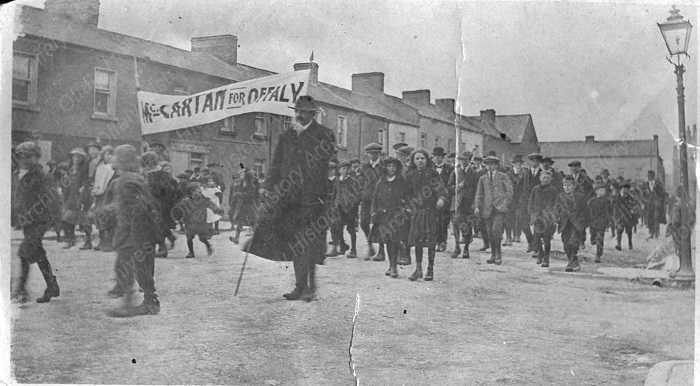
McCartan for offaly. This picture may be in 1921 or 1922 and not 1918. The feature poster is for the April 1918 by-election.
Congratulations to the people of Offaly in having secured as their member Ireland’s Ambassador to America. Their unanimous endorsement of his mission is particularly opportune. Dr McCartan will voice a united Ireland’s demand that the Irish people be given the right of self-determination and will tell the world that Irishmen will not fight as England’s slaves.
De Valera telegram to Dan MacCarthy, Dr Patrick McCartan’s election agent for the North King’s County by-election, April 1918. Irish Independent, 20 April 1918.
This week we publish a day earlier to mark the 100th anniversary of the General Election of 14 December 1918 – a watershed in the history of politics in Ireland. It should be noted that apart from the by-election of 1914 in North King’s County (Banagher-Tullamore-Edenderry district) no opportunity arose for the north King’s County parliamentary voters to go to the ballot box between 1885 and 1922. Notwithstanding all the excitement in 1918 for both the by-election in April and the general election in December Dr McCartan was unopposed. Women who had fought so much for the vote in the pre-war years did not get a chance to exercise the parliamentary franchise in north Offaly until 1922.
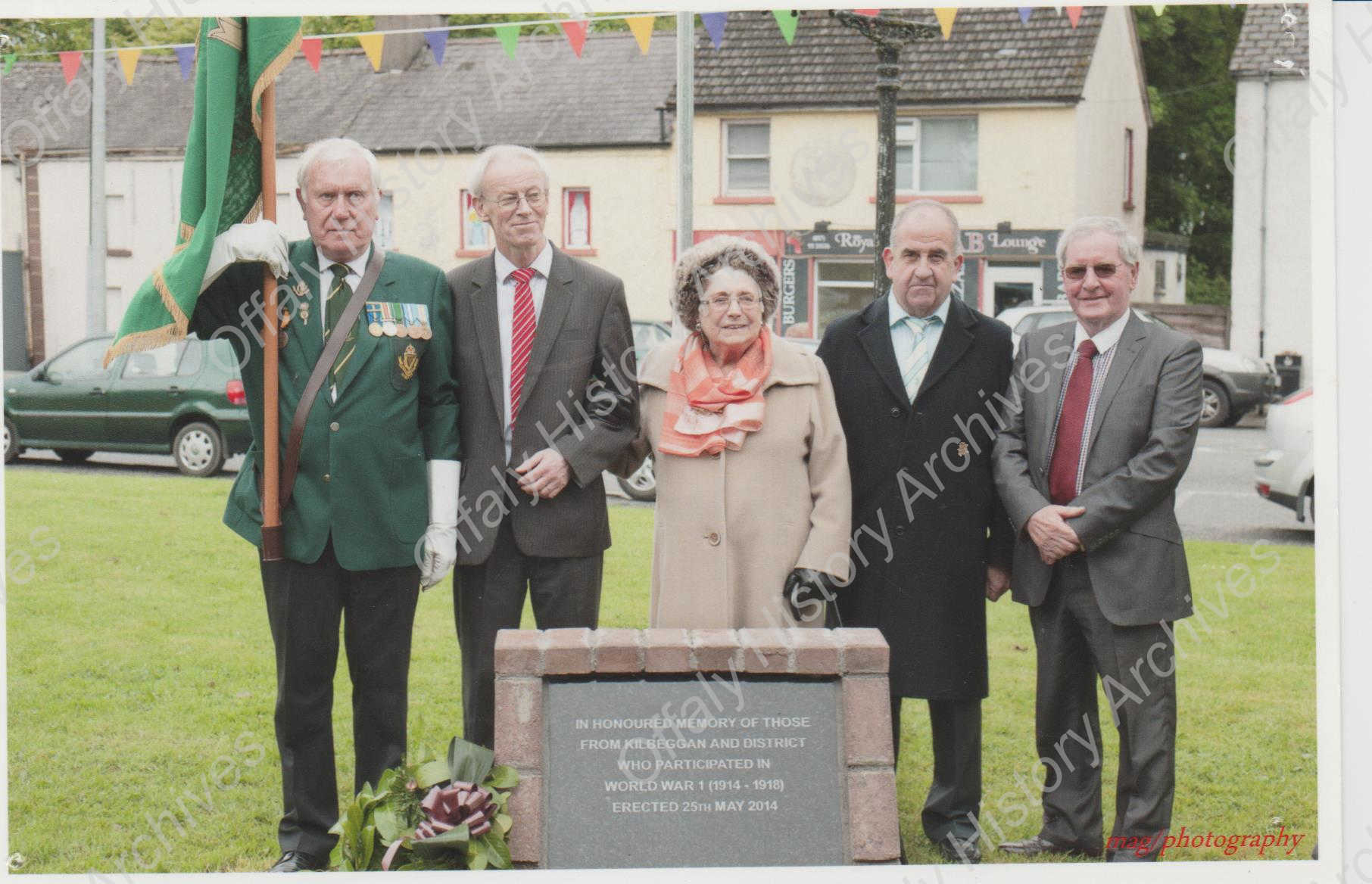
2. Kilbeggan War Memorial 1916, includes Stan McCormack and Kitty Flynn
The conversation about the 100th anniversary of World War 1 this last month is on-going, with reference to poppys and Easter lilies, as part of the story. It should be a lot simpler as it has always been about remembering the people who died or who were injured in World War 1 and during the 1916-21 period in Irish history, without exclusion. In Kilbeggan we have two small memorials on the Green remembering World War 1 and Ireland between 1916-21, almost beside each other, as it’s the same history, the same nation, and in many ways the same ideals.
The Parker Brothers of Clara and John Martin of Tullamore. One of the Parker boys was killed as was John Martin on 8 October 1918.
There was very little published work relating to Offaly in World War I until recent times. The 1983 essay by Vivienne Clarke was a first and rare examination of the period in Offaly, until Tom Burnell’s Offaly War Dead in 2010, and 2014’s Edenderry in the Great War by Catherine Watson. And so nearly every essay published in Offaly and the Great War which was launched to mark the centenary of the end of the Great War represents new and original historical research and findings, a very exciting prospect in the world of history publishing.The seventeen contributors have submitted essays that cover every aspect of the war and from almost all corners of the county.