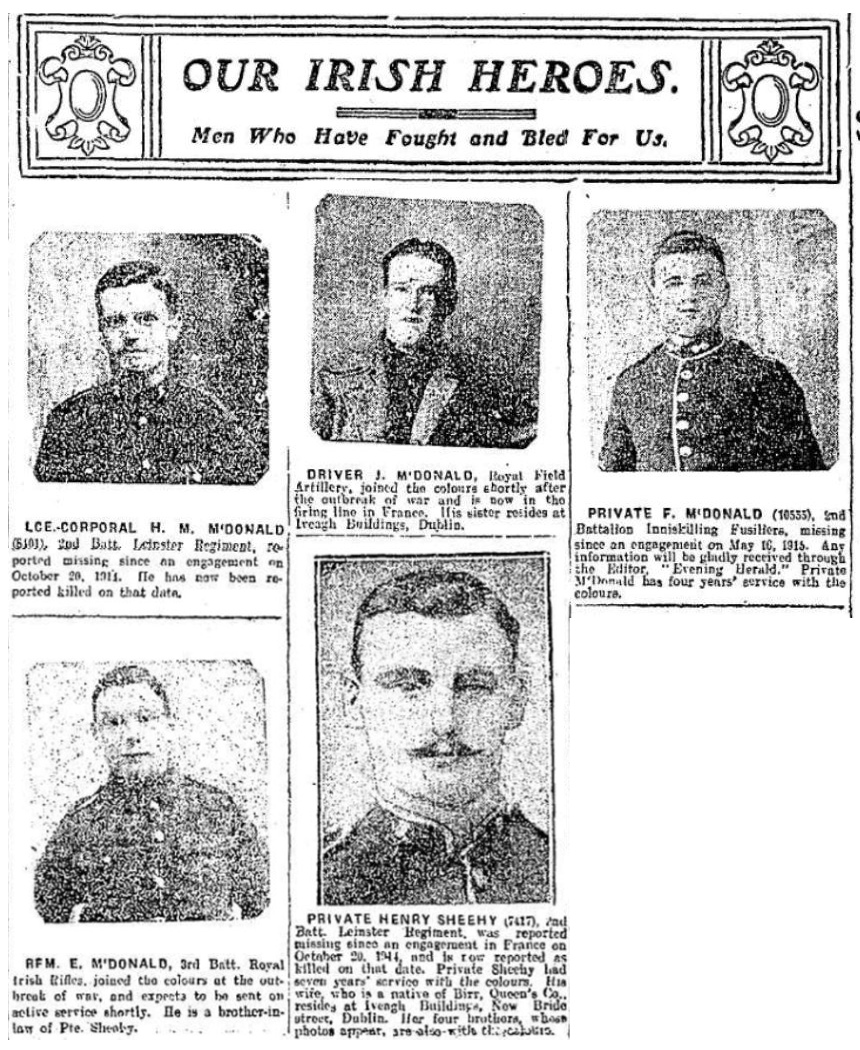
In July 2018 an interesting Great War campaign medal appeared on eBay, a single 1914–15 Star awarded to Private Frederick McDonald of the 2nd Battalion, Royal Inniskilling Fusiliers. The description provided by the seller stated that Frederick was born in Birr, and that he had been killed in action during the war.
Further research unravels a forgotten story, which gives insight into the life of Frederick and his family. It is a story not too dissimilar among the many working class Catholic families in Birr, because serving in the British Army was a source of steady employment and a means to support a family.
New discoveries of old views or photographs of Tullamore are always of interest. Street scenes of Tullamore are not known to survive any earlier than 1902 (views of the jail and Charleville Castle excepted). These 1902 views are from old postcards and show only the main streets. We have none of the lanes of the town until later, and then only a few.
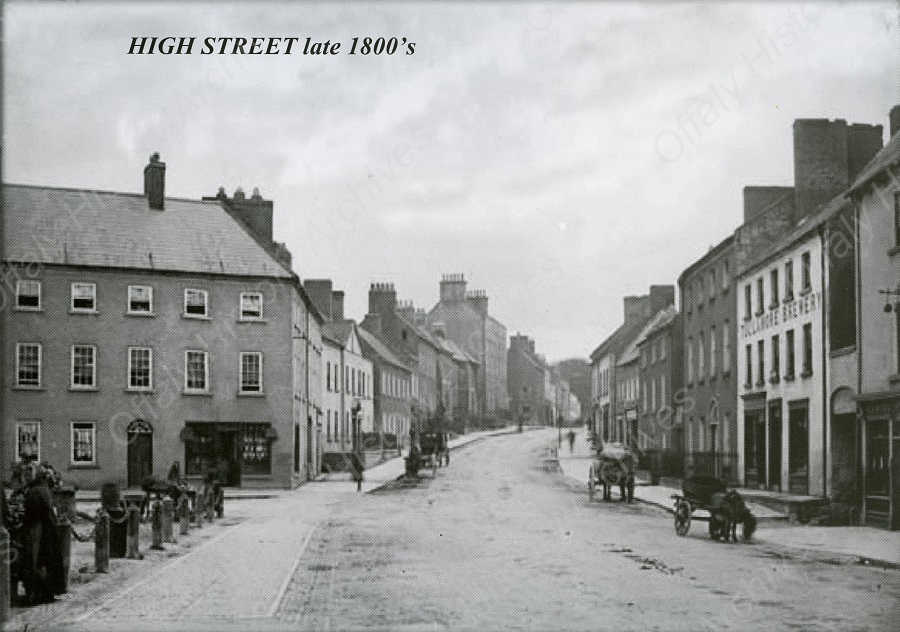
This photograph of O’Connor Square was taken about 1900, or a little earlier (and preserved courtesy of the National Library) shows the fine corner building erected by the distiller Joseph Flanagan in 1787 with its original glazing bar/windows and Georgian doorcases. This is the large building from the former Willie and Mary Dunne’s shop to the William Hill bookmaker’s office, beside Gray Cuniffe Insurance. Like the Adams-Tullamore House at the junction of O’Moore Street and Cormac Street it is a substantial three-storey house closing off the square on the southern side with some ten bays to O’Connor Square and six to High Street. The building was carefully planned as can be seen from this lovely old photograph, courtesy of the National Library of Ireland. This is the earliest surviving view of the building.
Also of interest are the bollards fronting the square, the shopfronts and the name Tullamore Brewery on what is now the Brewery Tap. Deverell’s brewery was in this location from about 1830 and was taken over by Patrick and Henry Egan about 1866. It continued to produce Egan’s Ale until the early 1920s. The ironwork in front of G.N Walshe and the fine doorcase on this house and what is now Sambodino’s and Kilroy’s showrooms (currently Mr Price) shows the changes on the town’s fine buildings since the 1900s.
Now with shopping moving out to the suburbs there is a case for more restoration of what were residential properties in the town based on the new realities of greatly reduced turnover in town centre shopping.
The road surface was not yet steamrolled – that would have to wait until after 1914–15.
It will be interesting to see how any pub and club in the former Woodchester building will retain the façade of the existing building (the former Dixon residence erected in 1752) and what lighting and advertising will be permitted by the planning authority.
Now the old post office has been painted and a carpark provided to the rear for 100 cars. This is forty more than in the square and should mean that the entire square saving the road to the Tanyard should be considered for presentation to the public as most other squares are in fine European towns.
What has gone in the picture includes the bollards, the house where Galvin’s Ladieswear was located (formerly Gill’s drapery and now Anthony Kearn’s Guy Clothing). The former McMullen three-storey house opposite Guy Clothing was demolished in the 1940s to make way for the Ritz Cinema. The cinema, in turn, was demolished in 1982 and part of the site acquired for the access to the Roselawn town houses.
Views of the Flanagan building in the early 1900s and again in the 1980s
Good buildings have survived including the offices of Conway & Kearney and much of the square. The lovely old 1740s building where the library is now located was demolished in 1936 to make way for the new Tullamore Vocational School. The 2011 façade to the old school (later library) appears to have worked well. The Bank of Ireland restored the facades of its buildings in 1979 as did the Northern Bank the former town hall, now Eddie Rocket’s. Finally, a few gas lamps can be seen in the picture. These may date back to 1860 when gas lighting was first introduced. It was the era before the telegraph and later telephone poles and, of course, the motor car.
The county council’s works for O’Connor Square are likely to commence soon. After many requests the war memorial will stay where it is. It was erected in 1926 on the site of the old town fountain of the 1890s and before that a solitary gas lamp stood there from the 1860s. It was the first public memorial erected in Tullamore and was centrally placed for obvious reasons.
Tullamore in the early 1960s with the original doorcase still to be seen at G. N. Walshe. Also Ritz Cinema and the original facade and exterior ironwork at what is now Sambodino etc. The Egan hardware can be seen beyond Conway & Kearney at what is now Anthony Kearn’s shop.
Picture: O’Connor Square and High Street about 1900 and changes thereafter.
As part of the events for the 50th Birr Vintage Week, a set of mock WW1 trenches were excavated in the training grounds of Birr Barracks. The excavation, which was the first of its kind in the Republic of Ireland, helped provide further information about the training structure put in place to train men for life in the trenches. This article gives a brief overview of the barracks itself and its long colourful history.(more…)
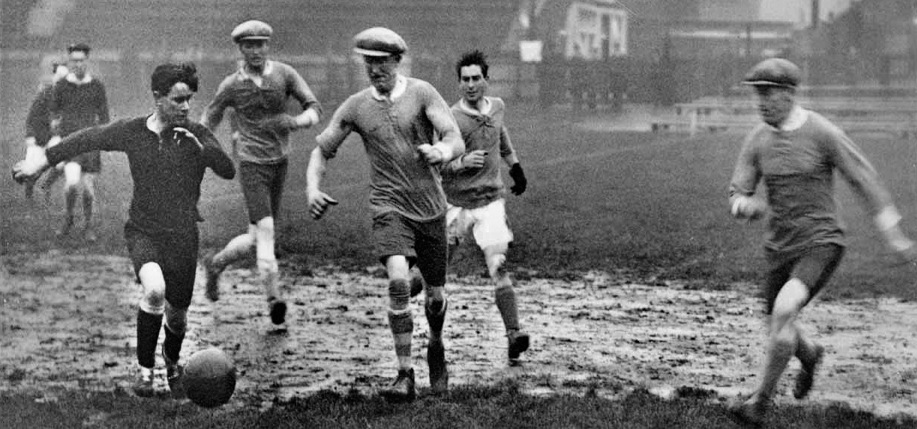
‘From Jones’s Road to the craggy hillsides of the Kingdom the day was fought and won in fields no bigger than backyards, in stony pastures and on rolling plains … wherever posts could be struck and spaces cleared, the descendants of Fionn and the Fianna routed the seal of servitude. In one never to be forgotten tournament we crossed our hurleys with the lion’s claw and emerged victorious’. Tommy Moore of the Dublin club, Faughs.
Some background reading for our outing on 8 July, Sunday, to Kilcormac and Ballyboy
Meet in grounds of Catholic church at 3 pm (ample parking) The historic sites of Kilcormac and Ballyboy to include the Catholic church, the parochial grounds, the Mercy Convent, Bord na Mona housing and on to Ballyboy, the village, church, cemetery and old hall concluding with refreshments in Dan and Molly’s celebrated historic pub at 5 p.m. Our thanks to Agnes Gorman, John Butterfield and the other history enthusiasts in the historic barony of Ballyboy. A few members of the committee will be at Offaly History Centre from 2 15 p.m. until 2.30 p.m. for members needing a lift. (more…)
Congratulations to the people of Offaly in having secured as their member Ireland’s Ambassador to America. Their unanimous endorsement of his mission is particularly opportune. Dr McCartan will voice a united Ireland’s demand that the Irish people be given the right of self-determination and will tell the world that Irishmen will not fight as England’s slaves. De Valera telegram to Dan MacCarthy, McCartan’s election agent for North King’s County by-election, April 1918. Irish Independent, 20 April 1918.
‘Up Offaly’ the Tullamore and King’s County Independent told its readers that ‘Offaly men can proclaim through their votes that they are no sons of a miserable English province’ but descendants of a royal race. They were not to be deceived by the ‘hireling band’ of paid politicians who would descend on the county for the by-election. ‘Poor Ned Graham’, it said, drove them out in 1914 aided only by a few priests and local nationalists. Tullamore and King’s County Independent, 30 Mar. 1918.
Anyone who has read the Ballycumber chapter of the recently published Flights of Fancy: Follies, Families and Demesnes in Offaly by Rachel McKenna, may have noticed a remarkable set of snapshots from a photograph album of the Homan Mulock family of Ballycumber and Bellair. The album is still in Ballycumber House, now owned by Connie Hanniffy and thanks to her generosity, its pages have been digitised revealing life in the big house in the early 1900s. The album is more of a scrapbook filled with illustrations, sketches, and notes alongside the many photographs relating to the leisure pursuits of the Homan Mulocks. Particular interest is shown in horses and equestrian events locally and in England, with photographs from the Pytchley, Grafton and Bicester Hunts; racing at Punchestown; the Moate horse show; and polo matches and gymkhanas at Ballycumber House in the early years of the twentieth century. (more…)
Whilst dressing I was startled by a loud yell of terror stricken male and female voices coming – apparently from hall, and ran out to see the cause. My husband was out ahead of me at his heels I passed through corridor of wing and onto the gallery running round two sides of hall. Two lamps on gallery, two more in hall below. On the gallery, leaning with ‘hands’ resting on its rail, I saw the ‘Thing’ – the Elemental and smelt it only too well.
Mildred Henrietta Gordon Dill was born on 13 March 1869 daughter of Dr Richard Augusta Caroline Dill, of Birchwood, Brighton, England. She was the youngest of six children, educated at Oxford and afterwards set her heart on a literary career and this would be difficult as her parents were Plymouth Brethren and higher education was not allowed for a woman. Before Mildred got engaged she ran off and joined the Salvation Army with the intention of tending to London’s poor. On 6 November 1889 at the age of twenty she married Jonathan Charles Darby, fifteen years her senior, and heir to Leap Castle and the Darby estates in King’s Co/Co. Offaly. Although young and small in stature Mrs Darby would prove to be no shrinking violet of a bride. (more…)
Dan Lawlor was born in 1907 and in this interview (extract – for the full interview follow the SoundCloud link) he talks about his early memories of growing up in the early 1900s, attending national school in Mount Bolus. Starting to work at the age of 14, where the wage was 3 shillings for a boy and 5 shillings for men and the working day was 8 or 9 hours at least. He also recalls growing up during very disturbed times, the 1916 rising, the Black and Tans and the First World War. Going around the rambling houses and the stories he heard about the Famine 1846 – 49, the big wind in 1903 knocking down all 13 acres of Colonel Biddulph trees, the big storm around 1803 (or was it 1839). The telling of ghost stories, attending wakes, clay pipes and match making where the father gave £100 and those who couldn’t afford it and gave nothing would say “she’s a good girl and will earn her keep”. His love of hurling in Killoughy, making their own hurleys and using a tin can if they couldn’t afford a leather ball. He also speaks about the 1920s not being great times, but the crops were good for anyone who minded them, farming all his life also all his family, the farm evictions and the Economic War. He also mentions about 80 years ago there was a brewery in Monasterevin called Cassidy’s and a monk in Clara who worked miracles with the mortar, they called him Cassidy’s Monk.(more…)
My grandfather Michael McDermott of Durrow, County Offaly was born in 1895 and died on 30 March 1976. My mother later stated that he was actually aged 81 years (not 79 as on the gravestone) when he died. What caught my particular attention was that his gravestone records him as ‘CO (sic) North Offaly Batt. IRA’. But he was not in fact the OC of the North Offaly Battalion as claimed. For the funeral, as is usual for old IRA men, the coffin was draped in the Irish tricolour, and the ‘Last Post’ was played, with a firing party over grave. My cousin still has one of the spent cartridges from the blanks. (more…)



 offalyhistoryblog