
Church Street is unusual in Tullamore in that it does not have a common width throughout and its lower half, closest to the town centre, is clearly earlier than the upper half from the Methodist church to the Pound Bridge over Tullamore River. While the building pattern is now post 1786 in date it did have at least two earlier buildings in the Protestant church built by Mrs Ellen Moore in 1726. She was the mother of the first Lord Tullamore who died in 1725. Charles the second Lord Tullamore succeeded while still a minor, having been born in 1712.[1] In an earlier article we reproduced maps from the 1770s depicting the church and noted that the building was shown on the on the 1730 Mountrath (Coote) estate map. The church stood in what was post 1820 the yard shown as The Shambles and was not aligned to the later street.[2]
(more…)Category: Living in Towns
-
The Bridge Centre in Tullamore: Town centre shopping over thirty years. A contribution to the Offaly History Anniversaries and Commemorations Series, By Michael Byrne. Blog No 748, 17th Sept 2025
The big developments of the 1990s were the Bridge Shopping Centre and the new Texas store both of which were completed in September 1995. The equivalent of perhaps 100 typical shops in terms of floor space was added to the Tullamore offering in one month. It was a turning point in the history of shopping in Tullamore and opened a brief period when Tullamore possibly dominated shopping in the midlands. These were the ‘good Tiger’ years for Ireland and for Tullamore with two hotels to follow in the same decade.
(more…)
-
Charleville School, Church Street, Tullamore. By Michael Byrne and Offaly History. No 7 in the new Offaly History series on Church Street, Tullamore: houses, businesses and families, over 300 years. Part of the 2025 Living in towns series prepared with the support of the Heritage Council. Blog No 745, 10th Sept 2025
There are few buildings of interest on the northern side other than the Charleville School. McNamara’s Foresters Hall of 1923-4 had a fine façade spoilt in the 1950s to make way for the Morris hardware store at ground level.
The former Charleville school is an attractive building in rough-cut limestone ashlar with Georgian glazing bars was built in 1811 and vacated as a school in 2006 when the new building was completed at Church Avenue. Erected by the earl of Charleville (1764–1835) for the education of the poor children of the parish of all religions, it was operated originally on the plan on Joseph Lancaster. Lancaster’s system was to have small classes with the elder pupils (monitors) doing much of the teaching of the younger. Louisa Tisdall, a daughter of the countess of Charleville by her first marriage, wrote a few interesting details about the school in 1824:
The school was built by Papa and is a handsome building. It was originally arranged by dear Mama on the Lancasterian plan, but in our absence it was remodelled and is now a mixture of the Bell system and Lancaster’s with other additions. Introducing the bible among the school books has given great offence to the Catholics, and the whole thing was nearly overturned: there are still however a tolerably good attendance of children in the boys’ school; the girls’ we hope to revive soon again – but subscriptions were withdrawn in our absence and as usual it will all fall again on Mama’s purse. The schoolmaster [Taylor] is clever but appears methodistical [that may have been true]… The Irish peasantry has great natural quickness and talent, and warmth of feeling very congenial to my own. Were they but educated, civilised, done justice to, would they not be a charming people.
(more…)
-
Memories of Church St. Tullamore in the 1960s and 70s: living in flatland. By Imelda Higgins. From the Offaly History series on Church Street, Tullamore: houses, businesses and families, over 300 years. No 6 in the 2025 Living in towns series prepared with the support of the Heritage Council. Blog No. 742, 29th August 2025
I left Tullamore years ago but I enjoy reading the Offaly History blogs and delighted with the articles on Church Street. A friend of mine died there a few years ago and it brought back many memories of my time sharing in a flat in Church St, Tullamore. I was there in the late 1960s and 70s and it had certainly changed when I saw it lately. I came to work in the hospital from a small farm near the Mayo Sligo border and found the midlands a bit strange at first. I came to love Tullamore. I lived in hospital accommodation at first but eventually a friend and I branched out into a flat. There were lots of flats in Church St in those days. Nobody called them apartments! We were down near Merrigan’s furniture store in the terrace below the Methodist church. There were two of us. We had one bedroom and a living room. Our kitchen was actually little more than the passage between the two rooms with a two-ring cooker and oven, a sink and a little press. Ikea eat your heart out! We shared a bathroom and toilet with the girls across the corridor and it was fine .We took turns to clean it and we never fought! We also took turns to answer the phone in the hall and answer the front door. We all certainly knew each other’s business! There were lots of people living in similar flats right along Church St and we knew each other well to see. You could set you watch by one lad who used to drive his car around from Church St to Harbour St every morning to collect his paper from Francie Gorry ! I think he was one of the teachers from near the Manor.
(more…)
-
The five Methodist Churches in Tullamore town, 1760–1889. In the Offaly History series on Church Street, Tullamore: houses, businesses and families, over 300 years. By Michael Byrne and Offaly History. No 5 in the 2025 Living in towns series prepared with the support of the Heritage Council. Blog No 741, 23rd August 2025
John Wesley, the founder with his brother Charles, of the religious movement, Methodism, visited Ireland on twenty-one separate occasions between 1747 and 1789 and has left eight volumes of journals (the Curnock edition) to tell the tale. The journals are mainly spiritual in character but nevertheless contain much that is useful about Irish life, the towns, estates and even the weather. The late T. W. Freeman, in his ‘John Wesley in Ireland’ used the Everyman edition The Journals of the Rev. John Wesley, A.M., edited by the Rev. F. W. Macdonald.[1]
Freeman noted that Wesley generally visited Ireland in the late spring and stayed for two or three months; making what was in those days, the perilous journey across the Irish Sea. Wesley was born in 1703 and died in 1791 and was the fifteenth child of Samuel Wesley. His ‘conversion’ is dated to this time and following the example of George Whitefield (1714 – 70), the originator of Methodism, he began his open-air preaching of which he did much across his ‘parish’ which was effectively England, Scotland, Wales and Ireland. The ODNB noted that his journal of missionary travel would serve as a guidebook to Britain and Ireland.[2] To the last he continued to travel and is said to have preached 40,000 sermons and travelled 250,000 miles.
(more…)
-
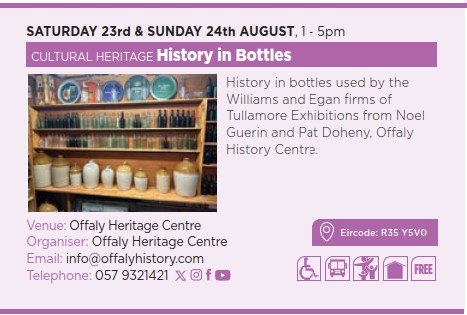
James Lyle Stirling Mineral and Medicinal Water Manufacturing, Importer of Wines and Brandies, Athy and Church St., Tullamore. By Noel Guerin. Part of the Offaly History series on Church Street, Tullamore: houses, businesses and families, over 300 years. No 4 in the 2025 Living in towns series prepared with the support of the Heritage Council. Blog No 740, 20th August 2025
James Lyle Stirling was born 16 May 1858 to Thomas Lyle and Anne Stirling of Tullamore. He was a business man who ran several businesses in Tullamore, between the years of 1880 and 1888, and is best remembered for his mineral water manufacturing company.
You can find out more about Stirlings by visiting the exhibition on Saturday and Sunday at Offaly History Centre.
His father, Thomas Lyle Stirling, was a brewer and merchant in Kings County, who ran most of his business in Church St., Tullamore. He was also an active Tullamore town Commissioner and sometime acted as an agent for Mary Anne Locke of Locke’s Distillery Kilbeggan. Thomas Lyle Stirling married Anne Jane, daughter of William and Catherine Commins of Cappincur, Tullamore, they had six children, all born in Tullamore except the youngest, Thomas who was born in Dublin. The children were Margaret (born 1857), James Lyle (1858), William (1860), Catherine (1862), Isabella Elizabeth (1863) and Thomas (1866).
(more…)
-
The first Protestant church in Tullamore town, Church Street, 1726–1815. In the new Offaly History series on Church Street, Tullamore: houses, businesses and families, over 300 years. By Michael Byrne and Offaly History. No 3 in the 2025 Living in towns series prepared with the support of the Heritage Council. Blog No 739, 16th August 2025
The young Arthur Fisher from Annagharvey was at the age of twelve in 1880 apprenticed to Archibald Warrren, the Church Street draper (where Salter’s shop was later located) and could recall many years later (c. 1949) coming into Tullamore that day with his mother to begin his five-year term. At the end of the fifth year he would receive £5 and in the meantime live over the shop with bed and board. The town he recalled was built on the river and Grand Canal. He went on to describe the entry to the town from the Geashill Road-Portarlington via Cloncollog.
(more…)
-
Church Street, Tullamore: houses, businesses and families, over 300 years. By Michael Byrne and Offaly History. No 1 in the 2025 Living in Towns Series on Church Street prepared with the support of the Heritage Council. Blog No 736, 2nd August 2025
The Church Street series of articles is supported by the Heritage Council. The series has as its object making people aware of the history and heritage of their own town and to see how, in this case, one Tullamore street has evolved over 300 years.
You can help with the study by sending us your memories, stories and pictures to me at info@offalyhistory.com. You can also call to Offaly History Centre, Bury Quay (beside the new Aldi), We can photocopy items or scan them as you wish.
(more…)
-
Another brisk walk this Saturday in Tullamore to visit Harbour Street and the Canal Quarter. Tullamore Tour Saturday 12 July, 11 a.m. to 12 30 p.m. to include Harbour Street, Deane Place, Market Square, Gas Works Lane, Canal Harbour, O’Carroll Street, Store Street, Benburb Street and Chapel Lane. Blog No 729, 9th July 2025
Walk around Tullamore’s canal quarter with Michael Byrne as guide. Find out where was Charles Street, Deane Place and Gas Works Lane. Where did Lord Tullamore live before the family moved to Charleville in 1740. When did the canal arrive. Was there a barracks there before that? Where was Pentland’s Distillery. Who was the Thomas in Thomas Street? Find out where the largest meeting in Tullamore was held and why. Take care and thanks to our yellow-jacketed stewards Shaun and Pat and to Helen and friends for assistance with the teas.
We meet at Offaly History Centre, Bury Quay (beside new Aldi and Tullamore Old Warehouse restaurant) for ease of parking from 10 30 a.m. All are welcome and the tour is free. Tea/Coffee/scones available from Offaly History Centre from 10. 30 a.m. Bathrooms available. We walk to Harbour Street through the new Aldi car park (over the former Williams oats store and Irish Mist warehouses and into Offally (sic) Street or Wheelwright Lane).
Harbour Street
Developed over the period from 1800 to 1825 it could be described as the opening to the canal quarter facilitating access to the new streets at Deane Place, Market Square, Chapel Street, Store Street, Gas Works Lane and O’Carroll Street. Surprisingly for such a great artery it was never an important trading street. The harbour takes up much of the eastern end of the street together with the great distillery of the 1820s – now the Granary apartments. The original name here was Charles Street and this can be seen carved in stone on the corner with O’Carroll Street.
(more…)
-
Brisk walking tours of Tullamore town on 5 July and 12 July 2025. By Michael Byrne and Offaly History. Some notes for the 90 minute tours. Please print off this piece or bring your phone. Blog No 727, 2nd July 2025
This year for the walking tours we move to Patrick Street and Church Street on Saturday 5 July, and to the ‘canal quarter’ on 12 July taking in Harbour Street, Store Street, St Brigid’s Place, the Harbour and O’Carroll Street. All are welcome. Admission is free. Wear high viz is helpful. The details are as follows:
5 July, Saturday morning from 11 to 12 30 p.m. Walking tour of Tullamore town: Patrick Street and Church Street with Michael Byrne. Explore the history of these old streets dating back to the 1700s, from the military barracks of 1716 to the church of 1726, county hospital of 1788, the Methodist chapels (4) and the families and shops over 250 years. Find out what is left of the old barracks; where was Swaddling Lane and Pike’s Lane, the linen factory. Who was the Henry in Henry Street – and so much more.
We can meet outside Offaly History Centre, Bury Quay (beside Old Bonded Warehouse restaurant) for ease of parking from 10 45 a.m. All are welcome and the tour is free. Teas/Coffee and bathrooms available from Offaly History Centre from 10. 30 a.m. A big welcome to Birr IGS members who are planning to join the tour.
12 July Saturday morning from 11 to 12 30 p.m.Walk around Harbour Street, Store Street, St Brigid’s Place, the Harbour and O’Carroll Street with Michael Byrne. We can meet outside Offaly History Centre for ease of parking from 10 45 a.m. All are welcome and the tour is free. Coffee and bathrooms available from Offaly History Centre from 10. 30 a.m. Tea and scones available.
(more…)
 offalyhistoryblog